




The Great Depression isn’t just a chapter in our history books—it’s a warning etched into the fabric of America. Often reduced to textbook explanations of stock market crashes and banking failures, the truth behind this economic catastrophe runs much deeper.
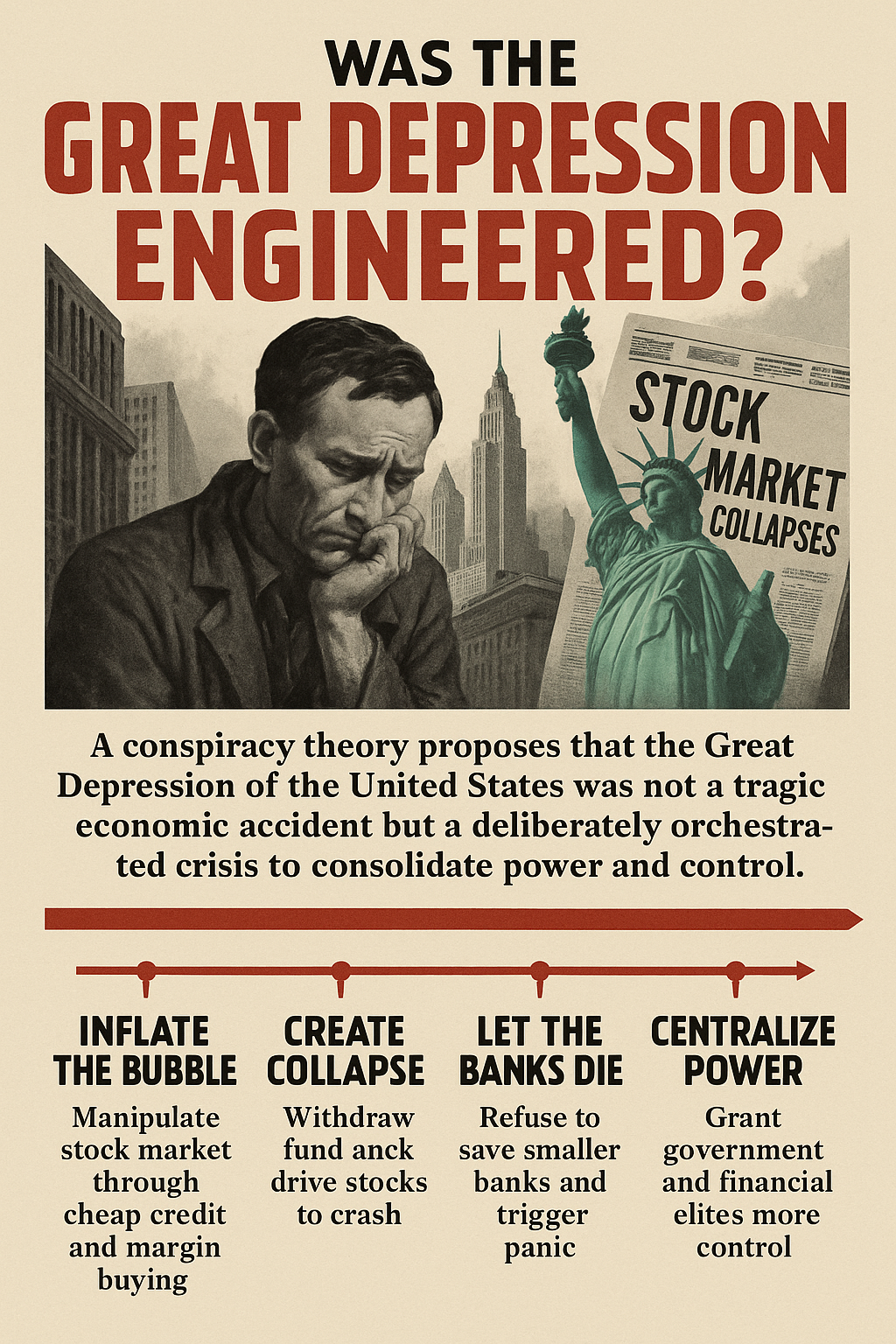
What if the Great Depression wasn’t simply a tragic accident, but a strategically engineered collapse?
October 1929 | The Day the American Dream Crashed
It started with a bang. On October 24, 1929—Black Thursday, panic hit Wall Street. Markets crashed again on Black Monday and Black Tuesday, with the Dow Jones dropping by over 25% in just two days. By November, the U.S. stock market had lost nearly $30 billion in value, an unfathomable sum at the time—about a third of America’s GDP.
But here’s where it gets strange | despite the crash, there was no immediate economic collapse. Stock prices briefly stabilized. The banks didn’t crumble overnight. So why did a market correction morph into the worst economic disaster in U.S. history?
The Myth of the Average Investor
Conventional wisdom says the Depression happened because everyday Americans gambled their savings in stocks. When the crash came, they lost it all, stopped spending, and triggered a downward spiral.
But that’s not supported by the facts.
In 1929, only about 3 million Americans—less than 2% of the population—owned securities. Most working-class families had never touched the stock market. So if regular citizens weren’t the culprits behind the bubble, who was?
The Real Architects of the Bubble | Corporations, Credit, and Corruption
The 1920s saw American banks operating in a virtually unregulated environment. Thanks to cheap borrowing from the Federal Reserve, they loaned money into speculative ventures at staggering levels.
Enter the big players.
- Standard Oil of New Jersey was issuing $69 million per day in market loans.
- Electric Bond and Share, a subsidiary of General Electric, was funneling over $100 million daily into the markets.
These weren’t isolated financial moves. They were massive, strategic, and deliberate injections of capital that inflated the market far beyond sustainable levels. And at the center of this was one man | Owen D. Young.
Who Was Owen D. Young—and What Was He Really Doing?
Owen D. Young is a name history often brushes past. A self-made lawyer turned corporate mogul, he ran General Electric and sat atop one of the most influential financial machines in the country.
But Young wasn’t just making light bulbs and radios—he was actively shaping the global financial landscape. In 1929, he introduced the Young Plan, an international agreement that restructured German war reparations and allowed U.S. banks to flood Germany with capital.
These weren’t corporate loans—they were public bonds sold to American citizens, many of whom would later be devastated when Germany defaulted and President Hoover suspended payments. Millions of Americans were wiped out, and it had nothing to do with the stock market.

It was international finance gone rogue—with Young pulling the strings.
December 1930 | The Bank Collapse That Set the Nation on Fire
One year after the crash, disaster struck. On December 11, 1930, the Bank of United States in New York suddenly shut down. Over 400,000 depositors—most of them working-class immigrants—lost access to their money. The name fooled the public; it wasn’t a government bank. It was private.
Within weeks, over 300 U.S. banks failed.
This, more than the stock market crash, ignited the true firestorm of the Great Depression. Credit dried up. Panic swept across the country. Businesses collapsed. Jobs vanished. And the dominoes kept falling.
Why did that bank fail? And why did regulators allow it to go down without intervention?
To this day, we don’t have clear answers. But the timing, scale, and chain reaction suggest something far more calculated than mismanagement.
Was the Great Depression Engineered?
Here’s the part most history classes skip.
The collapse of the U.S. economy didn’t just hurt the poor and working class. It wiped out the independent middle class—the small businesses, the local banks, the private investors—and consolidated power into the hands of a few.
While the public was suffering, the elite were buying assets for pennies on the dollar. The same corporations that helped inflate the bubble were there to scoop up industries, properties, and resources at fire-sale prices.
And while citizens begged for work, those who controlled capital tightened their grip on everything—from finance to media to government.
The Legacy of the Great Depression | A Warning for the Future
The Great Depression wasn’t just an economic disaster. It was a carefully orchestrated redistribution of wealth and power. And the same levers—central banking, corporate credit, political influence—still exist today.
What happened in 1929 could happen again. In many ways, it’s already happening.
Every economic crisis is an opportunity—for someone. The question is | for who?
Who Really Controls America?
Was the Great Depression engineered by a cabal of elites? That depends on your perspective.
The official narrative emphasizes incompetence, bad policy, and global chaos. But the alternative view, backed by patterns, profits, and timing, suggests something much more chilling:
A strategic collapse, disguised as a crisis. A deliberate transfer of wealth and power, masked as economic misfortune.
The Great Depression taught us one harsh truth | the American economy doesn’t always collapse on accident. Sometimes it’s nudged. Sometimes it’s designed. And sometimes, the fall is the plan.
Behind every chart and graph, behind every “too big to fail” bailout, are decisions made by people you’ll never vote for—people who move markets with a phone call and reshape nations without stepping into the light.
The next time headlines scream of crashes, debt ceilings, or “unforeseen events,” ask yourself | is this a crisis… or a strategy?
If you look at who lost—and who gained—the pieces begin to fall into place.
Maybe the real conspiracy is thinking it couldn’t happen again.