



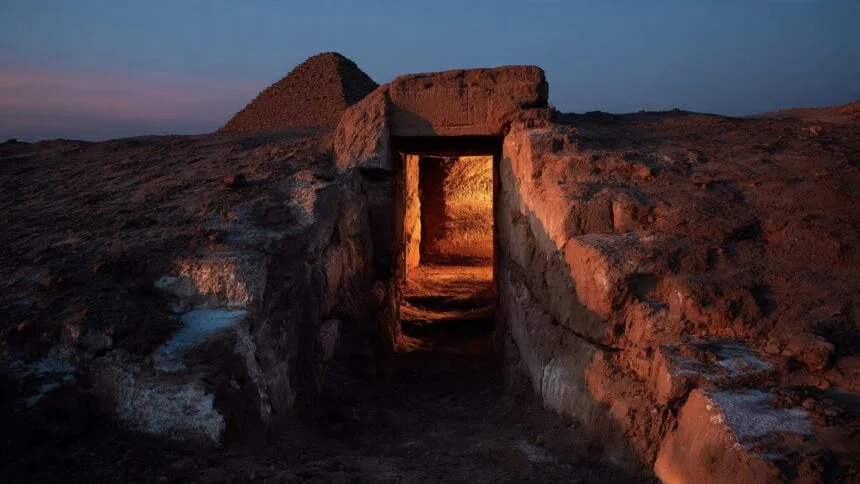
In January 2025, a French-Swiss archaeological team announced a remarkable discovery at Saqqara, Egypt: the 4,100-year-old tomb of a royal physician named Tetinebefou, also transliterated as Teti Neb Fu, who very likely treated a pharaoh personally.
The tomb was found by the Mission Archéologique Franco-Suisse de Saqqâra, led by Philippe Collombert, an Egyptologist and professor at the University of Geneva whose research focuses on Old Kingdom royal cemeteries. The team had been excavating the southern sector of Saqqara since 2022, working near the mastaba of the Vizier Ouni, in an area containing burial sites for senior Old Kingdom statesmen and royal officials.
A Modest Tomb That Turned Out to Be Anything But
The tomb initially resembled one of the many so-called “oven” or kiln-type mudbrick tombs common in the necropolis of Pepi I, structures that are typically plain and heavily looted, offering little of archaeological value. This one was different. As excavation proceeded, the team uncovered a beautifully preserved false door stela inscribed with the name Tetinebefou. Soon after, they found a limestone lintel above the burial chamber’s shaft, again carved with his name and an extensive list of titles.

The tomb had been extensively looted in antiquity, and no human remains were recovered. What survived instead were the walls themselves, richly decorated, with vivid, well-preserved paintings depicting containers, furniture, and hieroglyphic inscriptions describing the tomb’s occupant. Collombert has publicly stated that despite the missing burial goods, the intact painted walls alone made the discovery exceptional.
A Man of Extraordinary, Verified Titles
What makes Tetinebefou’s tomb remarkable is confirmed in the inscriptions themselves: an unusually specific and rare combination of medical titles for a single individual in the Old Kingdom record. He is identified as Chief Palace Physician, direct evidence he treated Egypt’s ruling family personally. As Collombert has stated on the record, he was certainly the main physician at the royal court, meaning he would have treated the pharaoh himself.
He also carried the title “conjurer of the goddess Serket,” or Serqet, the Egyptian deity Egyptologists associate with protection against scorpion and snake venom, a title indicating he specialized in treating poisonous bites, a serious medical concern in ancient Egypt. Separately, his inscriptions identify him as “director of medicinal plants,” a title known, according to Collombert, from only one other inscription in the entire published Egyptian archaeological record, and “chief dentist,” a title so rare that Roger Forshaw, an honorary lecturer at the University of Manchester’s KNH Centre for Biomedical Egyptology who was not involved in the excavation, has noted that written evidence for ancient Egyptian dental specialists is exceedingly scarce.
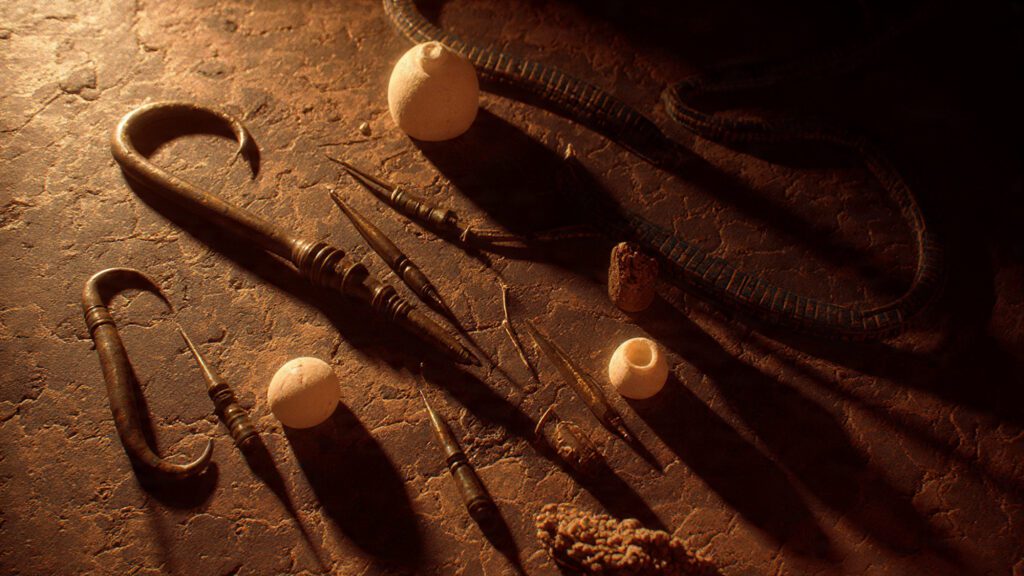
Historians place Tetinebefou’s likely service during the reign of Pepi II, a Sixth Dynasty pharaoh whom Egyptologists date to roughly 2246 to 2152 BCE, one of the longest reigns in recorded ancient history, since Pepi II reportedly came to the throne as a child. Collombert has publicly noted that this discovery offers new insight into court culture and daily life during that specific reign.
What the Titles Suggest About Ancient Egyptian Medicine
Paleopathologist Edgard Camarós, of Spain’s University of Santiago de Compostela, has publicly described ancient Egyptian medicine of this era as among the most advanced that existed anywhere in the ancient world. This is not a fringe assessment. Extensively studied Egyptian medical practice included treatments for fractures, diagnostic methods, and, according to some earlier archaeological findings referenced in coverage of this discovery, procedures as sophisticated as brain tumor removal.
Ancient sources independently confirm this picture of specialization. The fifth-century BCE Greek historian Herodotus, writing centuries after Tetinebefou’s era but describing a longstanding Egyptian medical tradition, recorded that Egyptian physicians were highly specialized, noting the country was full of physicians treating different parts of the body, some the eyes, others the teeth, others the abdomen, and others less visible ailments. Tetinebefou’s own combination of titles, physician, dentist, plant specialist, and venom specialist, fits precisely within this independently attested pattern of specialization, corroborating evidence from a completely separate ancient source written well over a thousand years after Tetinebefou lived.
No Curse, No Cosmic Origin
No report from the Mission Archéologique Franco-Suisse de Saqqâra, the Egyptian Ministry of Tourism and Antiquities, or any established archaeological or news outlet covering this discovery describes any curse, any unexplained illness among excavation workers, any reported dreams, or any synchronicities connected to the tomb’s opening. These elements do not appear in any source and should be treated as invented narrative embellishment layered onto a genuine archaeological find.
Similarly, no Egyptologist involved in this excavation has proposed that Tetinebefou’s medical knowledge originated from anything other than the well-documented, centuries-deep tradition of ancient Egyptian empirical medicine, itself grounded in practical observation, herbal knowledge, and an integrated religious framework in which healing and ritual coexisted, a genuinely fascinating and well-studied historical reality that needs no speculative cosmic explanation to be remarkable.

Why the Discovery Matters
The significance of Tetinebefou’s tomb lies precisely in what it confirms about ancient Egyptian medicine without needing any embellishment. It provides physical, inscriptional evidence, from the Old Kingdom itself, of an individual holding an extraordinarily rare combination of specialized medical titles, evidence that historians can cross-reference against later texts like the Ebers Papyrus, a medical text compiled roughly 1,500 years after Tetinebefou’s era, containing hundreds of remedies and treatments, and against independent literary sources like Herodotus describing the broader Egyptian medical tradition centuries later still.
Ongoing work by Collombert’s team continues to study the tomb’s paintings and inscriptions in detail, part of the mission’s broader multi-year excavation project examining the Saqqara necropolis around Pepi II’s court officials. Egyptologists studying this discovery emphasize it as fresh evidence for how integrated medical specialization, religious practice, and court status were in Old Kingdom Egypt, a historically significant find that stands entirely on its own merits.
Comparable Discoveries at Saqqara
This ongoing pattern of discovery is worth appreciating on its own terms before returning to Tetinebefou specifically. Saqqara, located roughly 25 miles southwest of Cairo, has functioned as a burial ground for Egyptian kings, officials, and religious figures across multiple dynasties, and is often described by Egyptologists as an open-air museum precisely because significant discoveries continue emerging from its sands on an ongoing basis. The Franco-Swiss mission’s work sits alongside other recent excavation projects across the site, part of a broader, sustained archaeological effort that has substantially expanded historians’ understanding of Old Kingdom administrative and court life in recent years. Discoveries of well-preserved tombs belonging to specific, named officials, like Tetinebefou’s, are genuinely valuable precisely because so much of what survives from this era comes from royal monuments alone, leaving the lives of the specialists and administrators who actually kept the royal court functioning comparatively underdocumented.
Egyptian Pharmacological Knowledge, in Context
This deep tradition of practical plant-based medicine is exactly what a “director of medicinal plants” would have overseen. Egyptian medical texts from later periods, including the Ebers Papyrus and the Edwin Smith Papyrus, a separate ancient Egyptian medical text focused specifically on surgical trauma and wound treatment, document extensive herbal and mineral remedies, some of which modern pharmacological researchers have found contain active compounds consistent with their recorded therapeutic use. Honey, for instance, extensively used in ancient Egyptian wound treatment according to surviving texts, is now scientifically confirmed to possess antibacterial properties, and modern wound-care gels drawing on this historical precedent remain in ongoing clinical use today. This demonstrated continuity between ancient Egyptian practical medical knowledge and effective modern treatment is precisely why historians of medicine consider discoveries like Tetinebefou’s tomb valuable evidence, not because they hint at anything mysterious, but because they document an empirically developed body of practical medical knowledge, refined and specialized enough to require a formally titled “director” role within Pepi II’s own royal court.
How This Discovery Was Actually Announced
The straightforward way this discovery actually reached the public is worth noting, since it reflects standard, credible archaeological practice rather than anything sensationalized. The Egyptian Ministry of Tourism and Antiquities confirmed the find on January 6, 2025, and the excavation team itself published a detailed account through their own mission’s translated blog post, the standard, transparent channel through which archaeological missions typically share preliminary findings with both the academic community and the wider public. Science journalists at established outlets, including Live Science, subsequently corresponded directly with Collombert by email to confirm and expand on these on-record details, a standard journalistic verification process. This transparent, multi-source trail, official ministry confirmation, a research team’s own published account, and independent journalistic corroboration, is precisely the kind of documentation that distinguishes a genuine archaeological discovery from an embellished retelling of one.

What We Still Don’t Know
Being honest and direct about the gaps that remain in this story matters too, since they’re part of what makes it an ongoing area of active study rather than a fully closed case. No portrait or statue of Tetinebefou survives, and because the tomb was looted in antiquity, no human remains were found to confirm further biographical details through skeletal analysis. Historians cannot yet confirm with certainty exactly which pharaoh or pharaohs Tetinebefou served beyond the strong circumstantial case for Pepi II, based on the tomb’s location and dating. And the actual physical remedies, plants, and preparations Tetinebefou would have used remain, for now, known only through inscribed depictions rather than any surviving physical sample, a genuine avenue for potential future research rather than a settled fact.
What’s confirmed is enough on its own: a specific, named individual, holding an extraordinary and rare combination of medical titles, working at the highest level of Old Kingdom royal court medicine over 4,100 years ago, his tomb rediscovered by careful, patient archaeological work in 2025, more than four thousand years after he was buried. That story needs no curse and no cosmic mystery attached to it to remain one of the more significant Egyptological discoveries of the decade, precisely because it is entirely, thoroughly true.