



Seventy-three seconds into Discovery’s ascent on September 29, 1988, five astronauts crossed a line that existed nowhere on their flight plan but everywhere in the memory of NASA. Seventy-three seconds was how long Challenger had flown before it broke apart over Kennedy Space Center, killing all seven people aboard. Discovery’s crew kept climbing. They were the first all-veteran shuttle crew since Apollo 11, and their flight, STS-26, marked the return of the Space Shuttle after thirty-two months in which NASA’s entire shuttle fleet remained grounded. There was no shuttle launch in 1987, secret or public. No astronaut named Andy Woods appears in NASA’s astronaut records, and no credible spaceflight record places a technician named Glenn Morrison aboard a hidden shuttle mission.
The deeper the story is compared with what NASA actually did during those thirty-two months, the less room it has left to exist.
The Thirty-Two Months When Nothing Flew
Challenger was lost on January 28, 1986, ten days after Columbia’s STS-61C mission had landed safely, seventy-three seconds after liftoff, after the failure of a solid rocket booster field joint allowed hot gases to escape and initiate the catastrophic breakup of the vehicle. The Rogers Commission that followed did not produce a quiet internal explanation. It produced a public investigation into both the hardware failure and the organizational decisions that had allowed NASA to launch under conditions its engineers had warned about. The agency’s response consumed the better part of two years and ultimately produced more than 200 changes to the Shuttle system, from redesigned solid rocket boosters to new crew escape provisions and launch-and-entry pressure suits.
The recovery was therefore not a matter of replacing one defective component and quietly returning to business. Engineers redesigned the solid rocket booster field joints, subjected the new hardware to full-scale testing, modified Discovery itself, and rebuilt the procedures surrounding launch, crew survival, and mission operations. NASA was preparing for the most scrutinized return to flight in the program’s history. There were no shuttle launches in 1987 because there was no return-to-flight mission yet. The fleet remained grounded while the agency worked through the consequences of Challenger.
NASA announced the STS-26 crew in January 1987: Commander Frederick “Rick” Hauck, Pilot Richard “Dick” Covey, and Mission Specialists John “Mike” Lounge, David Hilmers, and George “Pinky” Nelson. Every one of them had already flown in space, making the crew the first entirely composed of space veterans since Apollo 11. They trained through the long return-to-flight process while engineers rebuilt and recertified the system beneath them. When Discovery finally rolled to Pad 39B on July 4, 1988, the mission was not slipping through a forgotten corner of NASA. It was the object of extraordinary institutional attention.
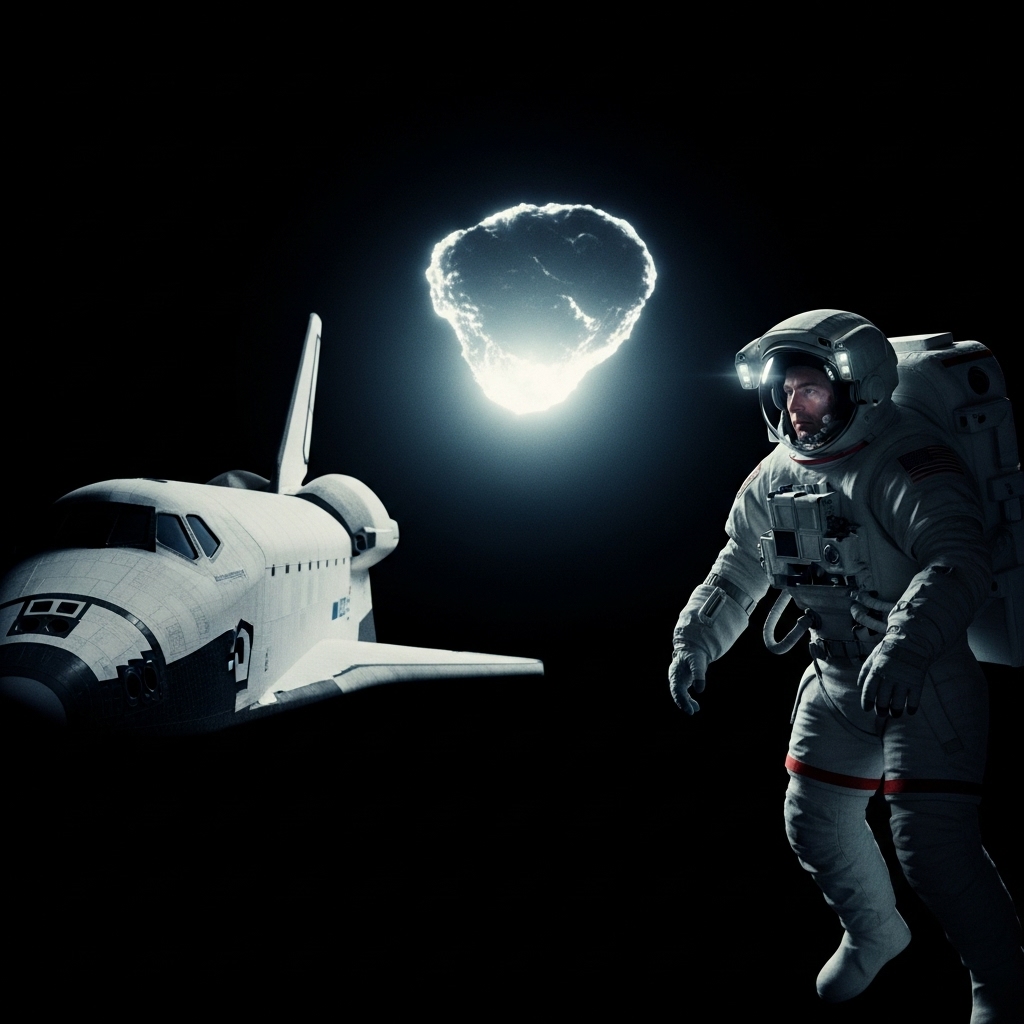
On September 29, Discovery launched. Four days later, on October 3, the five astronauts landed safely at Edwards Air Force Base. Their primary payload, TDRS-3, was deployed successfully, and the redesigned boosters performed as intended. NASA’s own historical record describes the flight plainly: STS-26 was the return to flight after Challenger, a conservative mission designed to demonstrate that the Shuttle could safely fly again.
The Alleged Mission Has a More Basic Problem
Even if the 1987 timeline could somehow be made to work, the story runs into a more elementary problem: the Space Shuttle was not designed as a one-person spacecraft. Every actual shuttle mission carried a crew, and the program’s operational history records 135 missions between 1981 and 2011. STS-26 itself carried five astronauts, as did the shuttle missions that followed it in the late 1980s. The orbiter’s flight operations, emergency procedures, payload work, rendezvous procedures, and checklists were built around a crew rather than a lone pilot disappearing into orbit.
That distinction matters because a supposed secret shuttle flight is sometimes treated as though the only missing evidence would be a launch announcement. It wouldn’t. A crewed Shuttle mission generated an entire chain of physical and administrative events: the vehicle had to be prepared and stacked, the crew had to train, hardware had to be tested, payloads had to be integrated, controllers had to rehearse the flight, tracking networks had to follow the vehicle, and the orbiter ultimately had to return. STS-26 left precisely that kind of trail because every Shuttle mission did. NASA’s surviving records include technical reports, crew photographs, launch-preparation footage, mission logs, press material, and post-flight histories.
The Two Names at the Center of the Story
This is where the story should become easier to verify, not harder. NASA has preserved the names of its astronauts across decades of missions, and the agency’s historical records cross-reference those names against individual flights, training histories, crew photographs, oral histories, and mission documentation. The five men who actually flew STS-26 are not obscure: Hauck, Covey, Lounge, Hilmers, and Nelson appear throughout NASA’s documentation of the return-to-flight mission.
Against that unusually dense record, the alleged astronaut “Andy Woods” has no corresponding place in the documented shuttle astronaut corps, while the supposed technician “Glenn Morrison” does not emerge as a verifiable participant in the mission from the established records cited for the period. That does not prove that no person with either name ever worked somewhere in aerospace. It establishes something narrower and much more useful: the names cannot be substantiated as members of a hidden 1987 Shuttle mission through the documentary record that actually exists.

The alleged source does not repair the problem. A reference to a supposedly “scrubbed podcast interview” is not evidence unless the interview can be identified, dated, archived, or independently corroborated. If the original recording cannot be located and the people supposedly interviewed cannot be independently placed inside the events being described, the claim remains a story about an unavailable source. The absence of a link is not itself proof of fabrication. But when the missing source is carrying essentially the entire weight of the allegation, the burden cannot be reversed and the reader asked to prove that an untraceable interview never existed.
A Hidden Shuttle Would Have Had to Leave a Very Large Footprint
The strongest objection to the story is therefore not that NASA says it didn’t happen. It is that the physical and documentary architecture of the Shuttle program makes a mission of this scale extraordinarily difficult to erase. A secret crewed launch would require a vehicle, a launch campaign, a flight crew, ground personnel, mission controllers, tracking infrastructure, hardware processing, and a destination or landing sequence. It would have to exist not merely in one database but across many independent records generated by people whose jobs were to make the mission happen.
And STS-26 provides the perfect control case. NASA’s records show exactly what a real return-to-flight mission looked like: the crew announcement, the training, the redesigned hardware, the rollout to Pad 39B, the launch, the deployment of TDRS-3, the 64 orbits, the landing at Edwards, and the post-flight recovery and inspection. The mission is documented at multiple levels because the Shuttle was not an isolated spacecraft disappearing into a vacuum. It was the visible endpoint of an enormous industrial system.
What NASA Actually Did After Challenger
The real history is more revealing than the hidden one because the real history already explains the missing years. NASA spent the aftermath of Challenger redesigning the booster system, changing crew equipment, revising safety procedures, restructuring aspects of Shuttle management, testing the new hardware, and training an all-veteran crew for the day the fleet would fly again. Discovery’s launch on September 29, 1988 was not simply another mission. It was the public demonstration that an entire national spaceflight program had survived its worst failure and rebuilt itself.
The agency’s real tragedies also left unmistakable records. Challenger’s seven crew members are documented in the Rogers Commission investigation and the NASA historical archive. Columbia’s seven crew members are documented in an equally extensive public investigation sixteen years later. The Shuttle program eventually accumulated 135 missions, 852 people who flew on its orbiters, thousands of technical documents, mission photographs, flight logs, oral histories, and decades of aerospace scholarship.
The Story Collapses Under Its Own Timeline
There is something almost elegant about the contradiction. The story asks the reader to believe that NASA secretly launched a shuttle in the very period when the agency was under extraordinary scrutiny for having just lost one, while simultaneously concealing an astronaut who does not appear in the astronaut corps, a technician who cannot be placed in the mission’s records, a spacecraft that supposedly flew without the normal crew structure, and an entire flight that left no independently recoverable documentary trail. Then, only months later, NASA publicly launched Discovery with five named veteran astronauts on the most closely watched return-to-flight mission in the program’s history.
The real record is not merely incompatible with the legend. It is more interesting. Thirty-two months passed between Challenger and Discovery. Engineers spent those months trying to understand how a machine built to carry humans into space had failed, and then rebuilding it so that the next crew could climb through the same first seventy-three seconds that had become synonymous with disaster. Discovery made it through. The five astronauts came home. And the historical record tells us exactly who they were.
That is the part the lost-astronaut story cannot improve upon. It doesn’t need another secret flight hidden between Challenger and Discovery. The documented gap already contains one of the most consequential periods in the history of human spaceflight: a national program grounded for thirty-two months, rebuilt under public scrutiny, and finally sent back into the sky with five experienced astronauts aboard. The real story has names, dates, hardware, photographs, telemetry, mission logs, and a launch witnessed by the world. The invented one has two names and a missing recording. Only one of those histories has to ask you to believe it happened.
The claim that a shuttle flew in 1987 has no documented mission, no crew, and no hardware behind it.