



Deep in the restless waters of the Pacific Ocean, just off the rugged coast of British Columbia, a terrifying phenomenon is emerging. Scientists have detected the formation of a colossal wave—towering as high as a 10-story building—rising from the depths. They are calling it a “rogue wave,” or more ominously, a “killer wave.” And what’s most alarming is that no one knows exactly when it will strike, or where it might vanish without a trace.
This isn’t science fiction. It’s a chilling reality unfolding beneath the waves, and oceanographers across the globe are watching with growing dread.
What Is Happening Beneath the Surface of the Pacific Ocean?
Recent data from deep-sea monitoring buoys near Vancouver Island has revealed a series of abnormal readings—strange underwater current shifts and sudden energy surges that defy ordinary weather patterns. Based on these signs, scientists now believe that a wave measuring up to 33 meters, or over 100 feet, could be forming. That’s ten times the size of an average wave in the region and large enough to destroy anything in its path—from cargo ships to coastal settlements.
This wave is unlike anything we’ve encountered in modern times. It doesn’t come with the thunderous warning of an earthquake or storm. It appears out of nowhere, a wall of water erupting from calm seas, indifferent to human life or warning systems.
Can the Killer Wave Reach Shore?
Despite their unpredictable nature, rogue waves have been known to reach shorelines, and when they do, the results are often catastrophic. These waves can strike without any sign on the horizon, leaving no time for ships to steer away or for coastal communities to prepare. Oil platforms, massive tankers, and even entire ports have found themselves vulnerable in the face of such sudden and devastating surges.
The possibility of a 33-meter wave reaching the shores of Canada or even the United States or Japan is no longer far-fetched. And that is why the global scientific community is on high alert.
From Ancient Art to Modern Reality | The Legacy of the Great Wave
Katsushika Hokusai’s famous Japanese woodblock print, The Great Wave off Kanagawa, has long been celebrated as a timeless piece of art—an elegant symbol of nature’s power and beauty. For centuries, it was viewed as metaphor, as mythology. But today, that elegant curve of water appears eerily prophetic.

The image of a massive wave bearing down on small boats has become more than a cultural icon; it has become a haunting reflection of real-world events. What once seemed like artistic license is now being viewed as a warning from history.
What Exactly Is a Killer Wave?
Unlike tsunamis, which are triggered by seismic activity and can often be detected well in advance, rogue waves arise spontaneously. These massive walls of water form seemingly without cause or warning, often in calm conditions and in areas that are not known for turbulent seas. Oceanographers still struggle to explain their exact cause, though it’s believed that overlapping wave systems and energy surges within deep ocean currents may be to blame.
What makes rogue waves so deadly is not just their size, but their suddenness. They offer no visual cues, no rumble of distant thunder. They rise without a whisper, and by the time they are seen, it is far too late to react.
A History of Disbelief | The First Rogue Wave Reports
Long before modern instruments confirmed their existence, rogue waves were considered little more than nautical legends. In the 19th century, a French navigator reported seeing a 33-meter wave in the Indian Ocean. His claims were dismissed as exaggeration or outright fantasy—tales of the sea, not science.
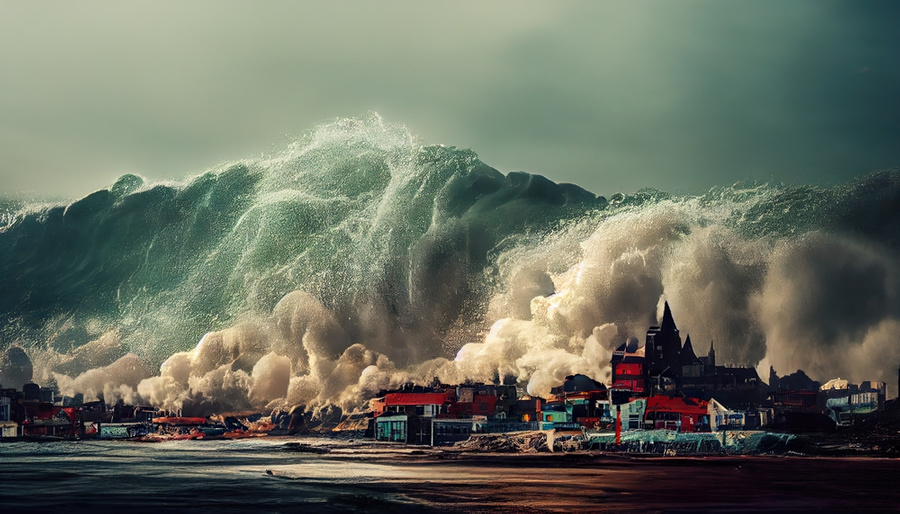
That skepticism persisted until December 1995, when the Draupner oil platform in the North Sea recorded the first verifiable rogue wave. Standing 26 meters high, the wave struck without any storm conditions, with sensors and video capturing every terrifying second. That single event forced the scientific world to reevaluate everything it thought it knew about the ocean.
November 2020 | A New Rogue Appears
The next major event occurred off Vancouver Island in November 2020, when a SmartBuoy recorded a wave measuring 17.6 meters. The surrounding sea, at the time, was relatively calm, with other waves barely reaching 6 meters. This stark contrast made it one of the most extreme rogue wave events ever documented. The scientific community was stunned—not just by its size, but by the complete lack of warning or cause.
Now, just a few years later, the signs are pointing to something even bigger.
Why the New 33-Meter Wave Has Scientists Alarmed
Today, the buzz among oceanographers is centered around a developing hydrodynamic anomaly off the coast of Canada. If early models prove accurate, a wave more than 33 meters tall could soon form in the region. If it does, it will dwarf the infamous Draupner wave and pose an unprecedented threat to maritime safety and coastal stability.
This wave, dubbed by some as the “New Draupner,” is being closely monitored, but the reality is grim | there may not be enough time to react. Ships at sea are ill-equipped to avoid such a sudden disaster. Platforms in open water could be obliterated. And if the wave moves toward land, entire towns could be at risk.
The Stealthy Nature of a Rogue Wave
What makes these killer waves so terrifying is their unpredictability. Unlike tsunamis, which can be anticipated following seismic activity, rogue waves strike without precedent. They’re not linked to any storm systems. They can’t be tracked by radar. They offer no visual sign from the horizon. And by the time they’re detected, impact is often seconds away.
This lack of warning makes them one of the most insidious threats to modern maritime life.
Is Climate Change the Catalyst?
A growing body of research suggests that global warming may be intensifying the formation of rogue waves. Rising sea temperatures are altering the structure and behavior of underwater currents, creating more volatile and energy-dense ocean conditions. As powerful storms increasingly interact with these turbulent systems, sudden bursts of energy may produce rogue waves more frequently and at greater heights.
In this light, climate change isn’t just a contributing factor—it may be the primary trigger for an era of unprecedented maritime threats.
The Future of Ocean Safety | Can We Prepare?
Governments and research institutions across North America and Asia are now deploying advanced sensors, satellite monitoring, and AI-based prediction systems to better track rogue wave activity. Coastal areas in Canada, the United States, and Japan are being outfitted with early detection networks in an effort to improve response times.
But even with improved technology, the reality is sobering. Ships in open water will still struggle to react quickly enough. Oil platforms may be left defenseless. And for coastal communities, the danger lies in the path the wave chooses.
The Ocean Demands Our Respect
For generations, we viewed the ocean as a source of life, beauty, and tranquility. But that perspective is changing. The sea is not a passive force—it is alive, volatile, and increasingly unpredictable.
Rogue waves are no longer legends. They are not myths or artistic metaphors. They are real, and they are growing in both frequency and magnitude.
As scientists continue to scan the horizon for signs of the Pacific’s looming giant, one unsettling truth remains | when it comes to the power of water, history teaches us that it never asks permission.
It simply takes.