


In 2022 and 2023, some contactees issued warnings about a significant increase in alien activity near the Sun. At the time, these claims were largely dismissed. However, the events of 2024, marked by unprecedented solar unrest, have prompted a re-evaluation of these predictions. The latter half of 2024 witnessed frequent and powerful solar flares, disrupting terrestrial vehicle operation and causing health issues, particularly for the estimated one in seven individuals on Earth who are meteosensitive.
Official data indicates that our planet endured over six months of continuous exposure to solar waves, with magnetic storms arising in quick succession. This surge in solar activity has left scientists searching for answers, and some are even considering the possibility of extraterrestrial involvement.
Introduction:
In 2022 and 2023, some contactees issued warnings about a significant increase in alien activity near the Sun. At the time, these claims were largely dismissed. However, the events of 2024, marked by unprecedented solar unrest, have prompted a re-evaluation of these predictions. The latter half of 2024 witnessed frequent and powerful solar flares, disrupting terrestrial vehicle operation and causing health issues, particularly for the estimated one in seven individuals on Earth who are meteosensitive. Official data indicates that our planet endured over six months of continuous exposure to solar waves, with magnetic storms arising in quick succession. This surge in solar activity has left scientists searching for answers, and some are even considering the possibility of extraterrestrial involvement.
Increased Solar Activity and Its Effects
The Sun, a subject of intense scientific scrutiny, continues to puzzle astronomers. While they propose various hypotheses, the intricate processes within our star remain only partially understood. The warnings of contactees were largely ignored by the scientific community. However, observations from the Solar and Heliospheric Observatory (SOHO) spacecraft reveal considerable activity in the vicinity of the Sun. SOHO, a joint project of ESA and NASA, provides continuous data and images of the Sun, allowing scientists to monitor solar activity and predict coronal mass ejections (CMEs) that could affect Earth.

Analyzing images from SOHO and other solar observatories, it’s possible to distinguish between natural and artificial objects. Objects moving at a constant speed and trajectory are likely natural, either drawn to or expelled from the Sun. However, objects that change direction and speed near the Sun, a celestial body with immense gravitational forces, suggest controlled movement. This implies a technology far superior to our own.
The Extraterrestrial Hypothesis
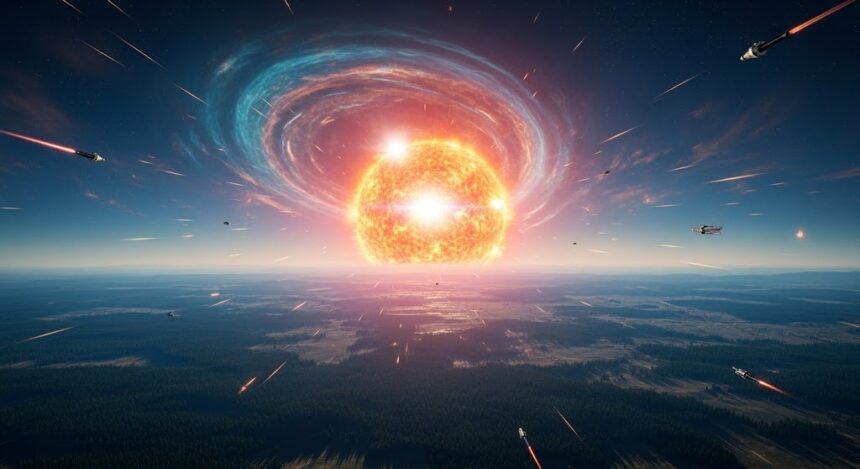
This has led some researchers to suggest that our solar system is being visited by “extraterrestrials” with the Sun, rather than Earth, as their primary point of interest. Ufologists claim a recent surge in the number of these spacecraft, some reportedly thousands of kilometers in size, near the Sun. The purpose of their activity remains unknown, but some speculate it might be influencing the Sun’s behavior.
The Scientific Perspective
The scientific community offers a different perspective. They highlight the dramatic increase in magnetic storms. In 2024, days affected by magnetic storms accounted for approximately 50% of the year. This figure has risen to 80% in 2025. While acknowledging the limitations of our current understanding, scientists attribute this heightened solar activity to natural processes within the Sun, specifically the current solar cycle.
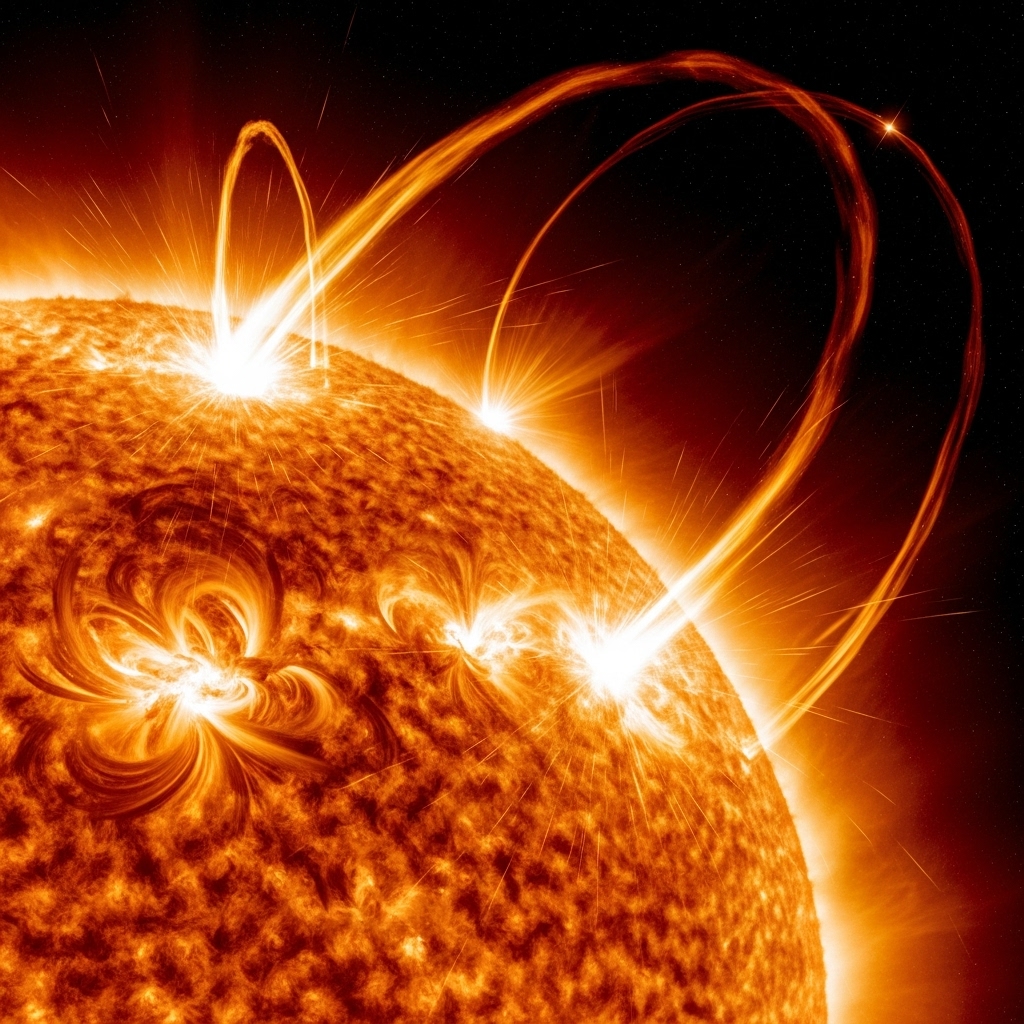
The sun is currently experiencing Solar Cycle 25, with peak sunspot activity expected in 2025. Solar flares, powerful bursts of electromagnetic radiation, and coronal mass ejections (CMEs), large expulsions of plasma and magnetic field from the Sun’s corona, are becoming more frequent. These events can cause radio blackouts and geomagnetic storms, impacting satellites, power grids, and even human health.
Can We Influence the Stars?
The possibility of other civilizations possessing technologies capable of influencing stars is intriguing. While we lack such capabilities, the rapid pace of human development suggests that such technologies might not be entirely beyond the realm of possibility.
A Call for Open-Mindedness
Whether the increased solar activity is a natural phenomenon or linked to extraterrestrial activity remains an open question. As we continue to study the Sun and its effects on our planet, it is crucial to maintain an open mind and consider all possibilities, including those that challenge conventional scientific understanding. Perhaps, as some contactees suggest, we should pay closer attention to alternative perspectives.