


In 2025, a team of astrophysicists made a discovery that has the potential to rewrite everything we thought we knew about the universe. The pulsar PSR B1937+21, already known for its unusual properties, was found to emit signals that mirror the vibrational rhythm of human DNA with astonishing precision.
The implications are staggering—could this truly be a coincidence, or is it evidence of something far more profound?
The Remarkable Nature of Pulsars, the Universe’s Timekeepers
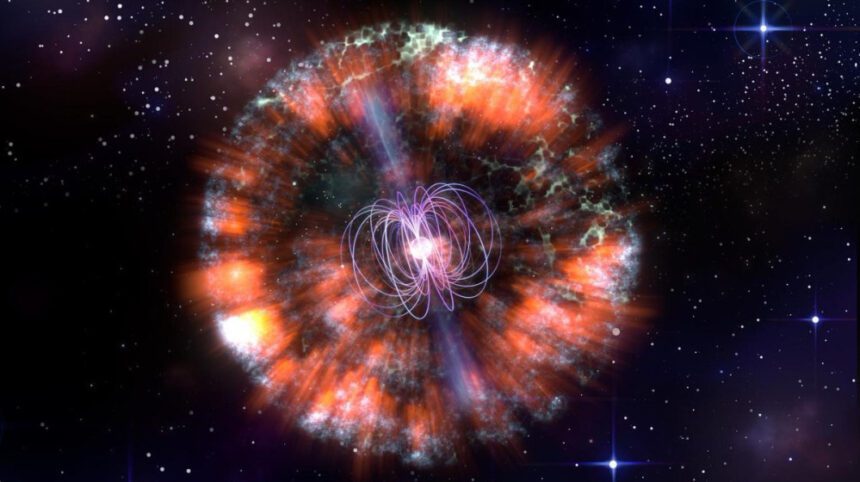
Pulsars are extraordinary remnants of supernova explosions. These neutron stars are incredibly dense, spinning at unfathomable speeds and emitting beams of electromagnetic radiation at perfectly consistent intervals. Often referred to as “cosmic metronomes,” their timing is so precise that even the most advanced atomic clocks struggle to compete. Some pulsars rotate at hundreds of revolutions per second, their magnetic fields are trillions of times stronger than Earth’s, and their pulses remain consistent with an error margin of less than a second over ten million years. They are, in every sense, nature’s most reliable timekeepers.
PSR B1937+21 | The Most Mysterious Drummer of the Cosmos
Discovered in the 1980s, PSR B1937+21 was always considered an outlier among pulsars. It holds the record as one of the fastest-spinning pulsars ever observed, rotating 641 times per second. Even more unusual, it displays a dual-pulse pattern and experiences strange signal “glitches” that repeat every 11 years. For decades, these anomalies defied explanation.
In 2024, the mystery deepened. Researchers, using advanced machine learning algorithms, discovered that the primary frequencies emitted by this pulsar correspond to the vibrational models of the DNA double helix with an accuracy of 99.7 percent. This wasn’t a minor overlap or a vague similarity. It was a near-perfect match—something that statistical models later calculated had only a one in five billion chance of occurring by accident.
Coincidence or Cosmic Communication? The Numbers Say Otherwise
The findings didn’t stop at frequency correlations. According to a joint study conducted by NASA and the Moscow Institute of Physics and Technology (MIPT), the surface temperature of PSR B1937+21 measures exactly 37 degrees Celsius—the same as the average human body temperature. Even more curiously, the pulsar’s glitch cycle matches the 11-year cycle of solar activity that affects Earth’s magnetosphere and biological systems. As one researcher eloquently noted, “It’s as if the entire universe is breathing in unison with our cells.”
Introducing PulsarDNA | The Neural Network Decoding the Cosmos
In response to this baffling discovery, a group of engineers, biophysicists, and quantum programmers launched PulsarDNA, a revolutionary neural network trained to interpret pulsar emissions using quantum computing. The system analyzes pulsar patterns and compares them against the biological rhythms of Earth’s life forms. In its initial phase alone, PulsarDNA identified 17 signal patterns that correspond to known human genetic sequences.
While some mainstream scientists dismiss this as an intriguing coincidence or “number play,” institutions around the globe are requesting access to the data, eager to conduct their own analyses. Skepticism persists, but so does curiosity—and curiosity, history reminds us, is often the seed of discovery.
Three Theories That Could Explain the Unthinkable
One possibility is cosmic resonance—the idea that the universe organizes itself using the same fundamental laws of physics across all scales, from quantum particles to star systems. If this is true, then it’s not surprising that DNA and pulsars might share similar patterns. They are, after all, governed by the same physical constants.
Another theory proposes that the universe operates like a program—a vast, interconnected system coded with universal algorithms. According to this view, the matching rhythms between pulsars and DNA may not be a fluke but rather a feature of a deeper, computational structure embedded into the cosmos itself.
The most speculative yet captivating hypothesis suggests that highly advanced civilizations may have embedded messages into our very biology. These ancient architects—possibly billions of years ahead of us—could have encoded information in DNA as a way of preserving their legacy. Pulsars, acting as interstellar beacons, may serve as the key to unlocking this genetic archive. As Dmitry “Mole” Ivanov, a former hacker turned astrophysicist and contributor to the project, put it | “We are like blind people trying to understand an elephant. Maybe pulsars are just one part of the beast.”
What Comes Next | The Mirror Project and the Future of Cosmic Biology
In the wake of this extraordinary finding, Roscosmos has announced the launch of the Mirror Project—a satellite mission designed to probe the interaction between pulsars and synthetic DNA. Scheduled to enter orbit by late 2025, the satellite will test whether pulsars respond to human-generated stimuli. These experiments will include broadcasting artificially constructed DNA sequences, musical compositions based on genetic rhythms, and even quantum entangled signals.
The first wave of data is expected to return by mid-2026, and scientists around the world are waiting with bated breath.
Are We Alone, or Are We a Part of Something Greater?
The discovery that a pulsar thousands of light-years away pulses in perfect rhythm with the structure of human DNA challenges everything we assume about randomness, life, and cosmic connection. Whether this is evidence of universal symmetry, an encoded message, or the echo of ancient intelligence, one truth is undeniable | we are not as separate from the cosmos as we once believed.
In the rhythm of a distant star, we may be hearing a message—not just from space, but from the very fabric of reality itself.