


Look long enough at the data and the consensus breaks apart. Not at the edges, not in the exotic margins where theoretical physics permits itself speculation, but at the center, in the foundational assumption that everything observed belongs to the same history, governed by the same laws, descended from the same singular origin. This assumption was never drawn from evidence. It grew from a psychological preference dressed in mathematics. The human mind perceives pattern and immediately constructs hierarchy. Finds similarity and invents a common ancestor. Cannot tolerate the possibility that what it is looking at operates as many things simultaneously, each running on its own internal logic, each indifferent to the unified story being written about it from below.
The cosmos functions as a garden. A universe requires a single origin, a single set of laws, a single story with one beginning. A garden requires only a medium fertile enough to crystallize into autonomous forms. The distinction carries consequences that the Standard Model has been spending decades trying to avoid.
What Brent Tully Found in 2014
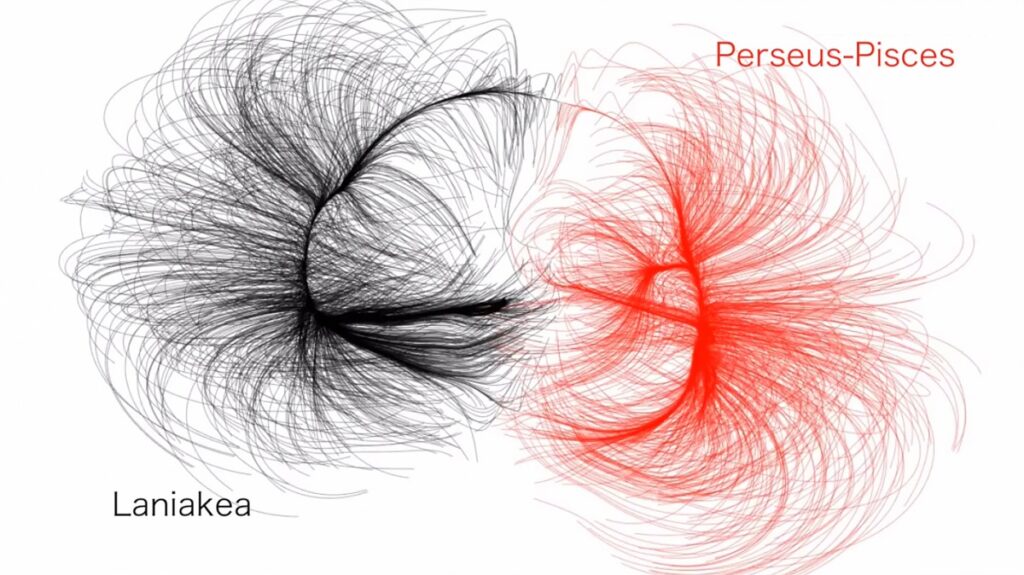
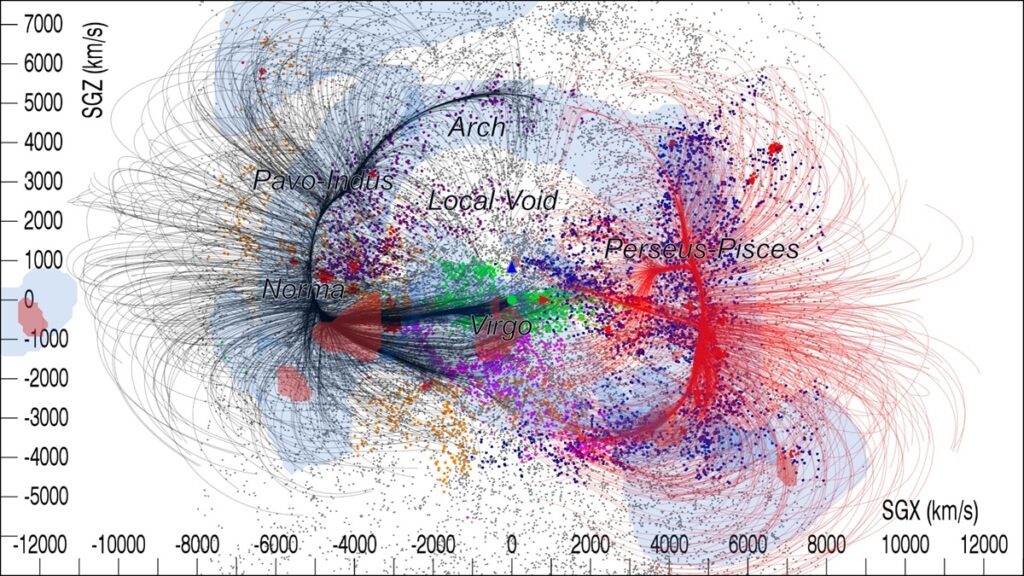
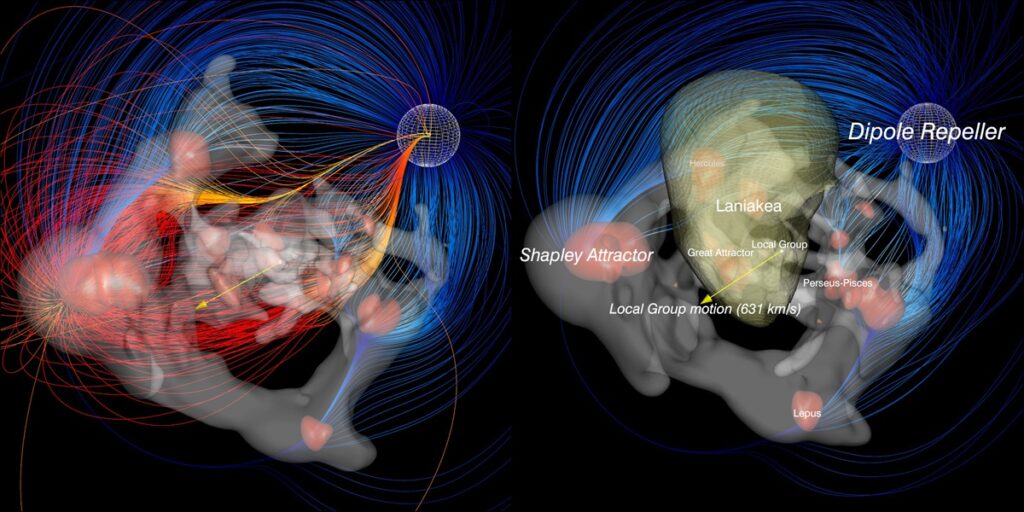
The data arrived from galaxy velocity measurements, thousands of them, mapped against each other to reveal position and direction of motion simultaneously. Brent Tully and his team at the University of Hawaii used this flow data to draw the boundaries of what they named Laniakea, the Hawaiian word for immeasurable heaven. A supercluster spanning five hundred million light years. Our galaxy sits near its outer edge like a dust mote near the rim of a slow drain.
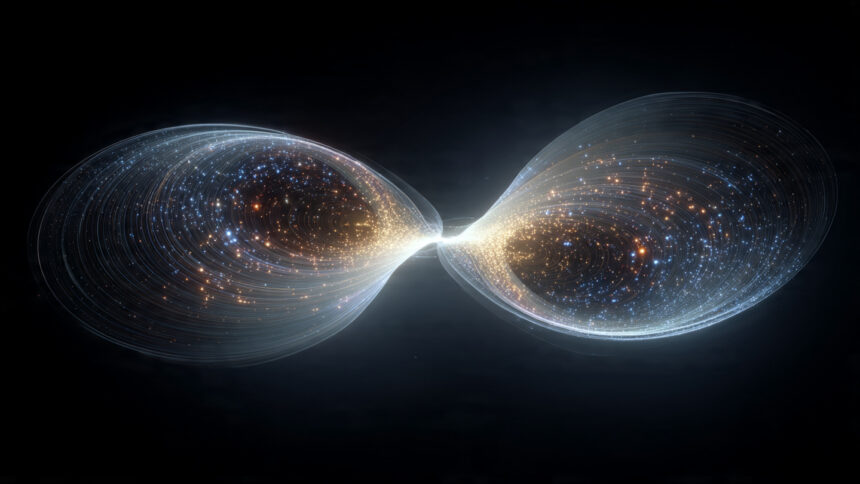
The geometry of Laniakea is specific enough to be uncomfortable. Two lobes of matter flow toward a central gravitational node, the structure long referred to as the Great Attractor, a region toward which hundreds of thousands of galaxies move at speeds implying something massive enough to pull matter across distances that should, by conventional reckoning, be dominated by cosmic expansion. The two lobes meet at this node and diverge from it in a mirror architecture. The whole structure rotates slowly around its own dynamics.

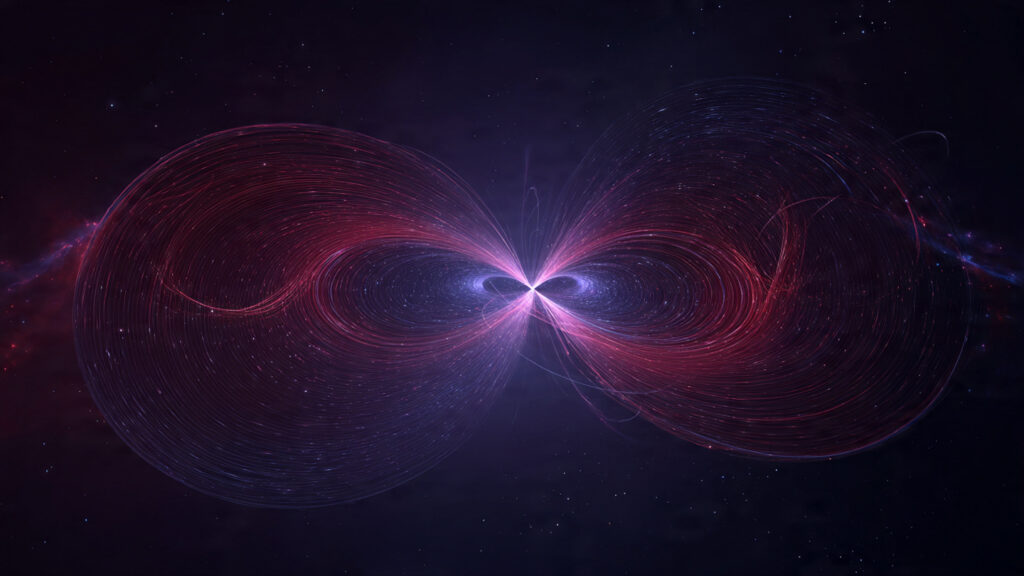
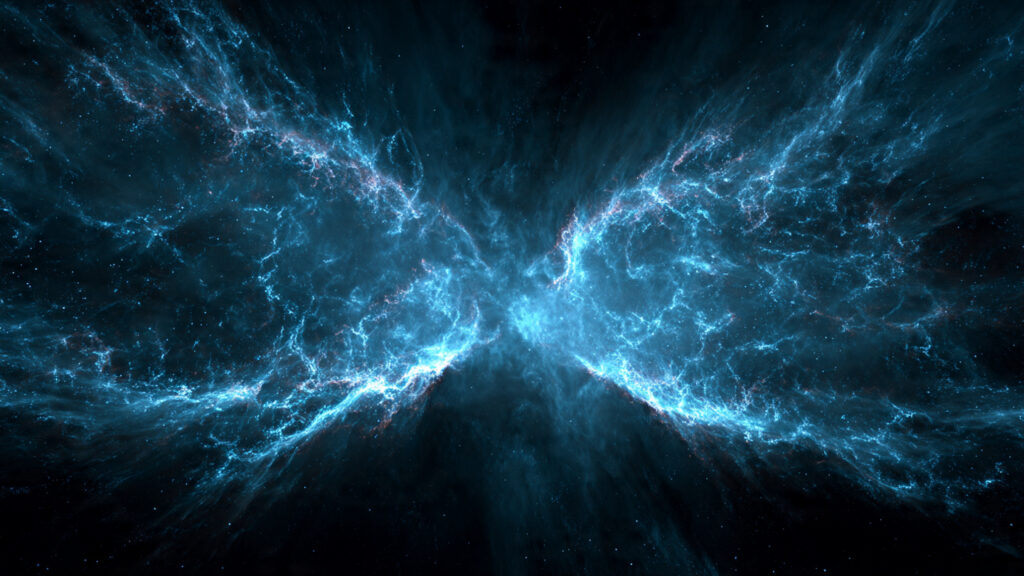
This geometry belongs to a Lorenz attractor. A strange attractor. The mathematical object Edward Lorenz discovered in 1963 while modeling atmospheric convection, the butterfly-shaped figure that a chaotic system traces through phase space, never repeating, never settling, never escaping the boundary of its own two-lobe structure. Lorenz found it in weather data. Tully found its signature distributed across five hundred million light years of galaxies.
Standard cosmology filed this under local inhomogeneity within a globally expanding universe. A regional quirk in the smooth Gaussian background of cosmic structure. That description requires ignoring the geometry entirely. A quirk carries no coordinated matter flows reversing direction at specific boundaries. A quirk carries no two wings and a central node matching the precise topology of a known mathematical object with documented dynamic properties.
What Tully mapped was a mode.
The Attractor Vocabulary
Dynamical systems theory has precise language for the kinds of stability that appear in complex systems. Point attractors pull toward fixed equilibrium, a pendulum settling, a temperature equalizing. Limit cycles trap a system in a closed orbit, a repeating oscillation with a fixed frequency. Strange attractors of the Lorenz type govern systems switching between two lobes in patterns that are deterministic but never exactly repeating. Toroidal attractors produce multi-layered spiral motion. High-dimensional chaotic attractors generate dense tangled structures that look, at sufficient scale, like walls and filaments.

Each type produces a recognizable geometric signature in the matter it organizes.
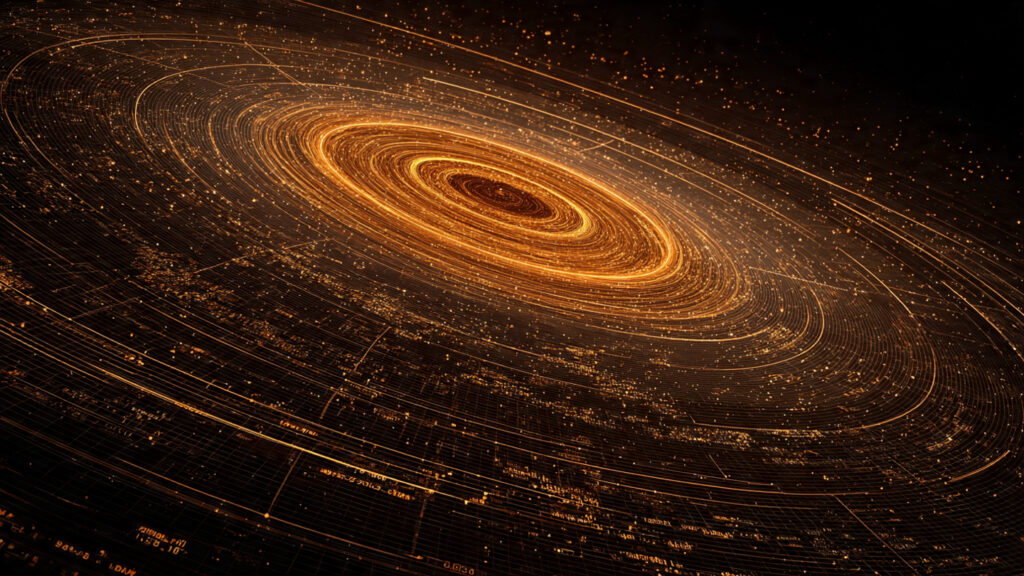
The Great Ring, discovered in 2024 by Alexia Lopez at the University of Central Lancashire, spans one point three billion light years in diameter at a cosmological distance of nine point two billion light years. A ring of galaxies and galaxy clusters arranged with a regularity that gravitational collapse from random fluctuations cannot statistically produce. The paper announcing the discovery noted the tension with the Cosmological Principle directly. The probability of this structure emerging from Gaussian initial conditions sat low enough that noting the tension was the polite version of saying the model fails here.
A ring traces a limit cycle. Matter caught in a closed orbit, cycling through the same path, accumulating density at the orbital frequency. The Great Ring carries the signature of an attractor type that the standard framework holds no category for, because the standard framework recognizes one origin and one set of laws. Everything observed gets forced into that container regardless of how aggressively the geometry resists.
The Sloan Great Wall. The Hercules-Corona Borealis Great Wall. The Giant Arc. Each structure arrives too large, too regular, or too specifically shaped to emerge from the Standard Model’s generative mechanism. Each receives the same response. A new correction. A new parameter. Dark matter. Dark energy. Inflation. The corrections now constitute a larger portion of the cosmological account than the original model they were assembled to preserve.
A theory running on more corrections than original content has become the corrections.
The Dissipative Garden

The ensemble model opens with a different premise. The cosmos functions as a primary medium, active and generative, capable of crystallizing into an indefinite variety of stable dynamic modes. Each mode is an attractor. Each attractor organizes matter according to its own internal logic, maintains its own local version of physical law, and exists in relation to neighboring attractors the way ecosystems exist in relation to each other. Adjacent, interacting at boundaries, fundamentally distinct in their internal dynamics.
Laniakea floats in the primary medium as an attractor, its boundaries defined by the points where its matter flows change direction and encounter the flows of neighboring attractors. Beyond those boundaries the physics we know may cease functioning in the form we know it. The laws of nature, in this reading, carry the properties of local habits rather than universal decrees. Specific dynamic tendencies of a particular attractor mode. Our physics describes the internal currents of Laniakea and nothing else with certainty.
The implications are precise. Dark matter functions as a local dynamic effect, the gravitational signature of attractor behavior that the standard model, lacking the attractor concept, accounts for by inventing mass that resists detection. Dark energy marks the boundary condition of our attractor, the zone where its organizational influence ends and the primary medium reasserts its baseline state. The expansion of the cosmos, measured from inside a specific attractor, will always appear as something pushing outward. The instruments are measuring the edge of their own regime and calling it the edge of everything.

The voids hold uncrystallized medium. Regions where the primary foam has not yet settled into a stable attractor mode, or where adjacent attractor dynamics have rarefied local density below the threshold for structure formation. Foam before it sets.
Scale Covariance
The attractor principle runs at every scale. The same logic governs each level of the hierarchy.
An electron holds itself against the quantum vacuum through the attractor mechanism, the same principle of stability operating twenty-eight orders of magnitude below the scale of Laniakea. A galaxy maintains itself as a stable hydrodynamic flow, a toroidal attractor organizing gas and dust and stellar populations through identical logic at a different scale. Life runs as a stable autocatalytic cycle, a chemistry producing the conditions for its own continuation. Consciousness settles into a stable mode of information reflection when a nervous system’s internal feedback loops reach sufficient density and coherence.

Each level of the hierarchy generates the conditions for the emergence of the next. Quantum attractors produce atoms. Atomic attractors produce molecules. Molecular attractors produce cells. The recurrent loop runs in both directions. The higher level feeds back into the lower, modifying the conditions that generated it. Nested dissipative systems behave this way from fluid dynamics to ecology. The principle has been documented. The cosmological application simply extends its range.
The observer, by this logic, functions as a specific attractor mode nested inside larger attractor modes, reflecting on the dynamics of the system it inhabits. Consciousness observing the cosmos is the cosmos running a feedback loop through a particular stable mode. The act of observation becomes a functional component of the system being observed, dynamically rather than philosophically. We are part of the feedback that maintains the stability of our own regime.
The instruments measuring the cosmos are themselves local patterns in the same attractor they are measuring. The measurement participates in the dynamics. The observer belongs to the data.
The Language of Plurality
Universe means one turning, one story, one set of laws, one origin. The word carries the assumption of unity into every sentence that deploys it, buried in the etymology, invisible through familiarity. Replacing it with cosmological ensemble or observable regime does something precise. It breaks the psychological commitment the word enforces. Opens grammatical space for plurality. Allows the sentence to acknowledge, at the level of its vocabulary, that the subject under discussion might be many things operating independently rather than one thing obeying a single law.

A supercluster becomes a local coherent regime. Large scale structure becomes a field of attractors. The Great Attractor becomes a mathematical necessity of the Lorenz mode our local regime inhabits. The voids become uncrystallized medium. The walls and filaments become turbulence signatures of high-dimensional chaotic attractors. Every observation currently requiring a patch or a new invisible substance resolves into a feature of a known attractor type once the singular assumption gets released.
The Standard Model persists through institutional momentum and the genuine achievements of its partial domain. Within our local attractor, at the scales where its assumptions approximately hold, it produces accurate predictions. The failure arrives at the boundaries, in the giga-structures that exceed the scale at which Gaussian fluctuations can generate what is actually observed. The model stands in a forest and describes one tree with great precision, then adds correction terms when the surrounding trees decline to behave like branches.
Persistence
The only thing that survives in a dissipative medium is what holds itself together long enough to be observed.
The electron holds itself. The galaxy holds itself. The cell holds itself. The thought holds itself. Each maintains a local pocket of order against the background tendency toward equilibrium, toward formlessness, toward the condition the primary medium returns to in the absence of stable dynamic modes. Existence at every scale is the ongoing achievement of persistence against dissolution. A form is a process that produces itself continuously, recruiting energy from its environment and spending it on its own maintenance.

Each light in the night sky represents a process winning, temporarily, against dispersal. Each structure holds its shape against a medium that would, given the cessation of organizing dynamics, dissolve it without remainder. The night sky is a field of ongoing achievements, each one provisional, each one dependent on the continuation of the dynamics that produce it.
The cosmos foams continuously into new attractor modes that no previous mode could have predicted. The garden grows. The flowers crystallize independently from a medium capable of producing, without limit and without repetition, new stable modes of being.
What holds itself, in whatever form and at whatever scale, earns its existence in the only way available. Everything else is the medium waiting for conditions that have not yet arrived.

We are a specific kind of waiting that learned to look back at itself. The attractor reflecting on the field that generated it. There is no outside position from which to observe this. The system becomes aware of one of its own stable modes, briefly, before the dynamics carry it elsewhere.
The garden does not know it is a garden. We are the part that does.