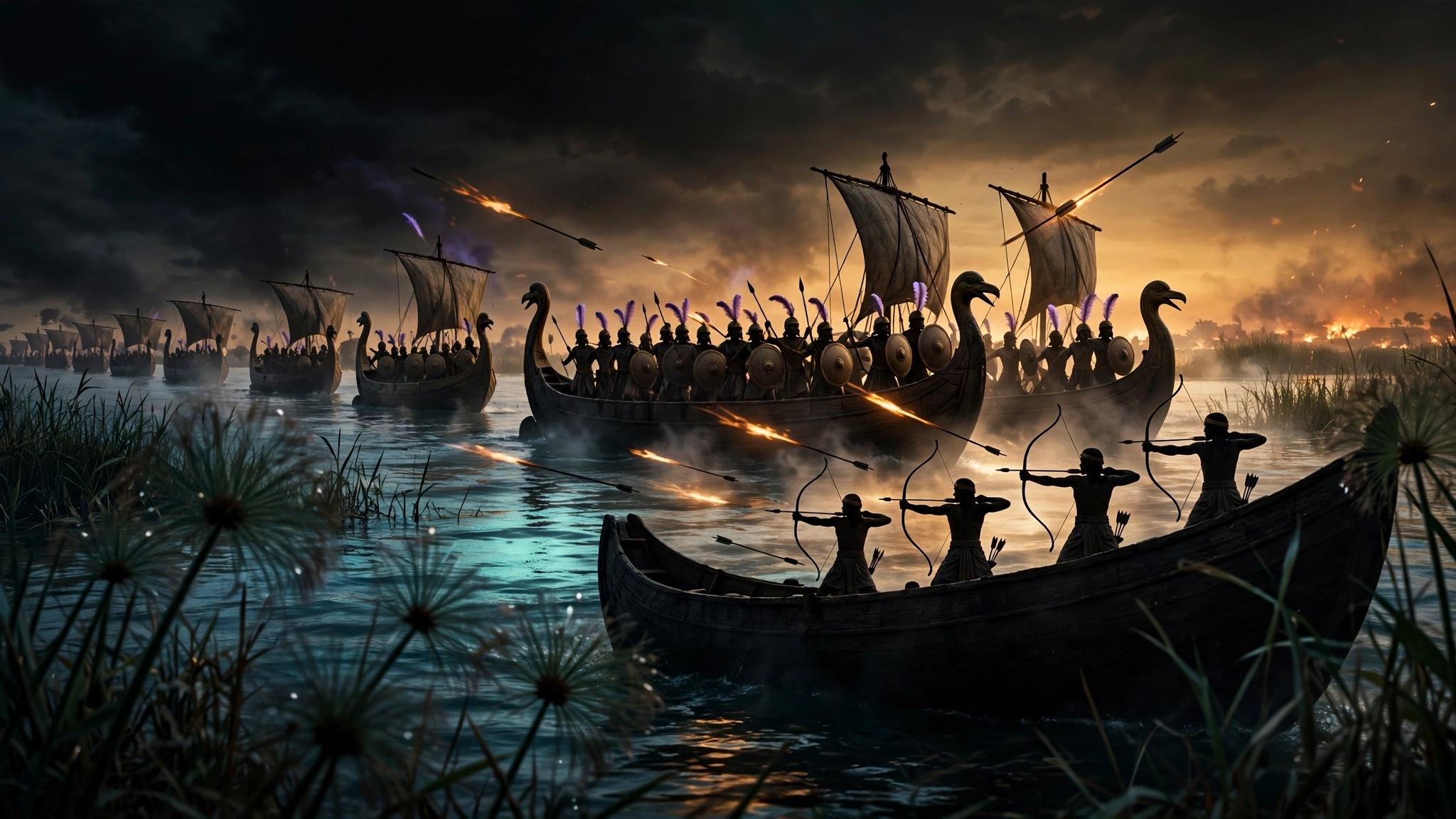
On the walls of a temple at Medinet Habu, on the west bank of the Nile across from Luxor, a sea battle has been raging for more than three thousand years. Egyptian archers stand in their ships and loose arrows into a tangle of enemy vessels. The enemy boats have prows carved like the heads of birds. The men in them wear helmets crowned with horns or with a ring of upright feathers, and they are falling, drowning, being hauled from the water and bound. Nearby, carved in hieroglyphs, the pharaoh Ramesses III explains what happened in the eighth year of his reign, around 1177 BCE.
The foreign countries, the inscription says, made a conspiracy in their islands. All at once the lands were removed and scattered in the fray. No land could stand before their arms, from Hatti and Carchemish to Arzawa and Alashiya. Then the Sea Peoples, as history now calls them, came for Egypt, and Egypt destroyed them at the mouths of the Nile.
Within a generation of that battle, the great powers of the Late Bronze Age had fallen. The Hittite empire was gone. The palaces of Mycenaean Greece had burned. Ugarit, the richest port of the Syrian coast, was a ruin, and its writing would not be read again for more than three thousand years. The raiders on the temple wall have been blamed for that catastrophe ever since. Modern historians gave them that name, one the Egyptians never used, and nobody has yet been able to say for certain where they came from.
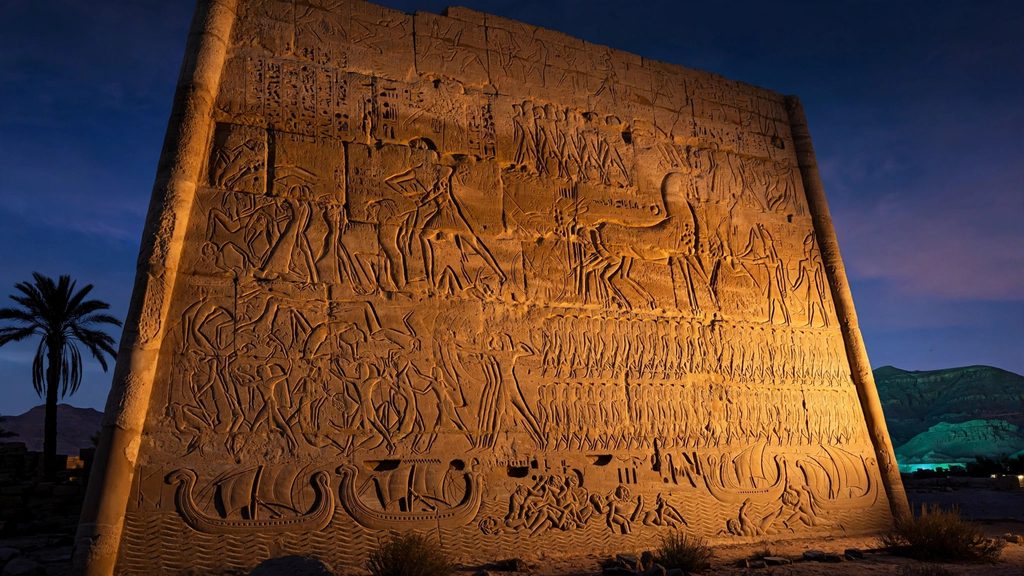
The Wall at Medinet Habu
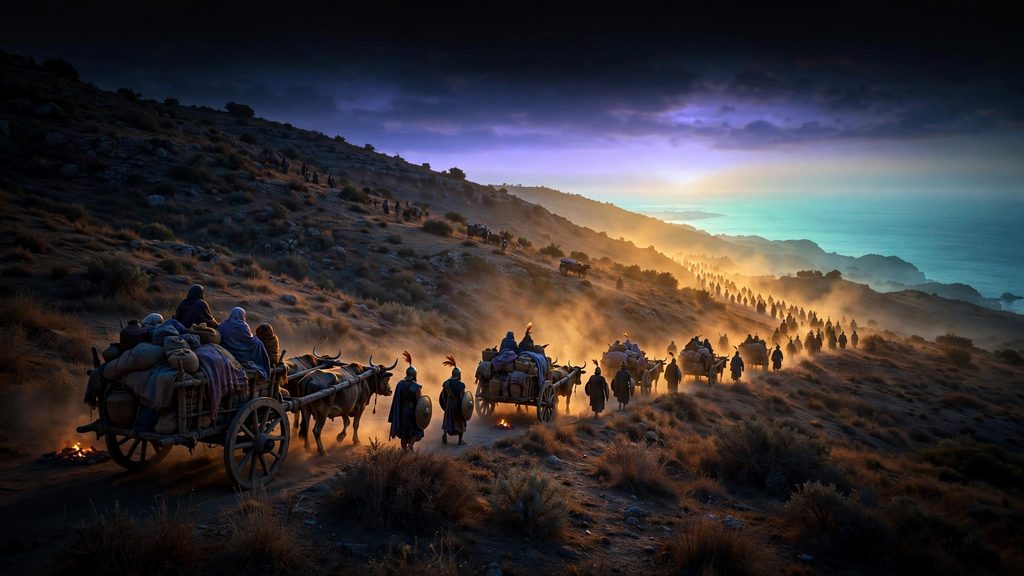
Ramesses III built Medinet Habu as his mortuary temple, and he covered its outer walls with his wars. The great sea battle is one of the largest scenes, but it is not alone. On another wall the land army of the invaders is shown in retreat, and among the warriors are ox carts crowded with women and children. This was not only a raid. Whole communities were on the move, with their families and their belongings, looking for somewhere to live.
The inscription names the peoples who came in Year 8. The Peleset, the Tjeker, the Shekelesh, the Denyen and the Weshesh. Ramesses says he lured their fleet into the river mouths and trapped it there, with archers on the shore and warships closing behind. Later, in a long papyrus written after his death, the Papyrus Harris, his scribes added that he had settled the defeated in strongholds and fed them from Egypt’s stores.
Egyptian kings were not modest. Their inscriptions were written to glorify the pharaoh, and the list of fallen kingdoms in the Year 8 text is partly a boast. Carchemish, one of the places named, came through the crisis with its royal line intact. Yet the carvings at Medinet Habu are the clearest picture anyone has of the people who were moving across the eastern Mediterranean as its old order failed.
Names Before the Storm
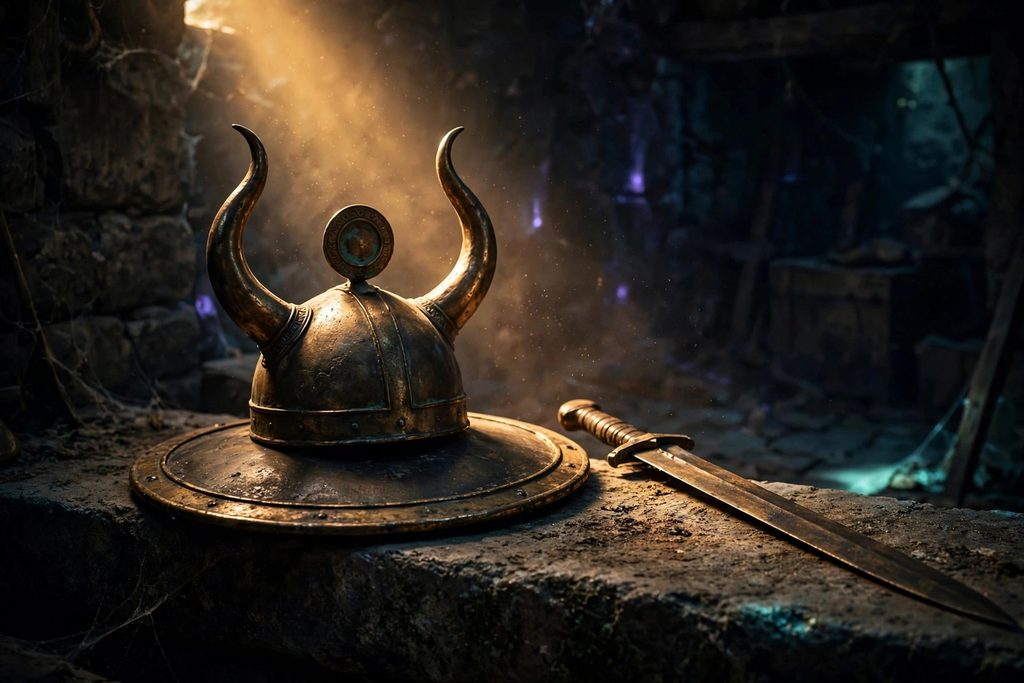
The raiders of Year 8 were not unknown in Egypt. Some of their names had been heard for generations. In the fourteenth century BCE, letters found at Amarna mention the Lukka, the Sherden and the Denyen. Early in the reign of Ramesses II, Sherden warriors attacked the coast of the Nile Delta, and a stele from Tanis records that they came in their warships from the midst of the sea. Ramesses defeated them, and before long Sherden fighters were serving in his own bodyguard at the Battle of Kadesh, recognisable by their horned helmets and round shields.
Around 1208 BCE, in the fifth year of the pharaoh Merneptah, a new alliance struck from the west. A Libyan chief named Meryey marched on Egypt with allies the Egyptians called northerners coming from all lands, the Ekwesh, the Teresh, the Lukka, the Sherden and the Shekelesh. Merneptah’s great inscription at Karnak claims more than six thousand enemies killed and nine thousand captured. In the same years he sent grain to the Hittite king, to keep the land of Hatti alive.
So the Sea Peoples were never one nation with one homeland. They were a shifting company of names, some of them mercenaries, some of them pirates, some of them settlers, appearing in Egyptian records over more than a century. The term itself was coined in the nineteenth century. The French Egyptologist Emmanuel de Rougé used it in 1855, and Gaston Maspero turned it into a grand theory of migrating nations that has shaped the story ever since.
SherdenHorned helmets
Raiders, then royal bodyguards. Some link them to Sardinia.
ShekeleshLived on ships
Named in the letters of Ugarit. Sicily has been suggested.
LukkaPirates of the coast
Linked to Lycia in south-western Anatolia.
EkweshWith the Libyans
Some see the Achaeans, the Greeks of Homer.
TereshWith the Libyans
Linked by some to the Tyrrhenians of later Greek writers.
PelesetFeathered headdress
Widely identified with the Philistines of Ashkelon and Gaza.
TjekerSettled at Dor
Later found on the coast of Canaan. Origin unknown.
DenyenSlain in their isles
Tentatively linked to the Danaoi, another name for Greeks.
WesheshOf the sea
The least known of all. Almost nothing survives about them.
The Last Letters of Ugarit
The most haunting witness to the end of the Bronze Age is not carved on a temple. It is a handful of clay tablets from Ugarit, a wealthy trading city on the coast of what is now Syria. Its last king, Ammurapi, wrote to the king of Alashiya, the island of Cyprus, in words that still carry the smell of smoke. My father, behold, the enemy’s ships came here, he wrote. My cities were burned, and they did evil things in my country. Does not my father know that all my troops and chariots are in the land of Hatti, and all my ships are in the land of Lukka?
Other letters from the same archives tell of a people of Shikala, probably the Shekelesh, who lived on ships. One letter reports seven enemy ships doing great damage along the coast. Another, written after the attack, says that the city was sacked, and that the food on the threshing floors was burnt and the vineyards destroyed.
For decades one of these tablets was said to have been found inside a kiln, where it had been put to bake when the city fell, so that the king’s last plea was never sent. It was too good a story to be true. Later study showed that the so-called kiln was no kiln at all. Ugarit itself was destroyed between about 1192 and 1190 BCE. Its archives, written in a cuneiform alphabet of thirty signs, lay buried until a farmer’s plough struck a tomb in 1928.
A World on Fire
From the Aegean to the Levant, the archaeological record of these decades is scarred with burning. At Pylos in south-western Greece, the palace of a Mycenaean king was destroyed by fire around 1180 BCE. The fire baked the clay tablets of its archive, and some of them record men sent to guard the coast, watchers waiting for something to come from the sea. Mycenae and Tiryns were damaged. The Hittite capital, Hattusa, was burned or abandoned. On Cyprus and along the Syrian coast, town after town shows signs of destruction.
The picture is not as simple as it once seemed. In 2023 the archaeologist Jesse Millek published a study of the destructions blamed on the Sea Peoples, and argued that a great many of them were misdated, weakly supported or never happened at all. Some places burned in war, some in accidents or earthquakes, and some were simply emptied and left. The fall was spread over decades, not a single season of fire.
- 1300s BCE
The Amarna letters mention the Lukka, the Sherden and the Denyen.
- c. 1278 BCE
Sherden raiders strike the Delta under Ramesses II and later serve in his guard.
- c. 1208 BCE
Merneptah defeats Libyans and five northern peoples. He also ships grain to the Hittites.
- 1198 to 1196
Juniper rings at Gordion record a severe three-year drought.
- c. 1192 to 1190
Ugarit is destroyed after its king writes of enemy ships and burned cities.
- c. 1180 BCE
The palace of Pylos burns. Its tablets mention watchers on the coast.
- c. 1177 BCE
Year 8 of Ramesses III. The great sea and land battles of Medinet Habu.
- Early Iron Age
The Philistines settle Ashkelon, Ashdod and Gaza. Newcomers appear in the DNA.
- 1855 and 1881
De Rougé and Maspero coin and spread the name Sea Peoples.
- 2017
A Luwian text about a Trojan prince who took Ashkelon is announced. It proves to be a likely forgery.
Drought, Hunger and Collapse
If the Sea Peoples were only raiders, it is hard to see how they could have brought down empires that had stood for centuries. Many scholars now think they were as much a symptom of the crisis as its cause. In 2023 a team led by Sturt Manning published a study in Nature based on the tree rings of junipers preserved at Gordion in central Turkey. The rings showed a severe drought lasting about three years, from around 1198 to 1196 BCE, right at the moment the Hittite empire fell apart.
Hunger runs through the written record too. Merneptah sent grain to the Hittites. A letter from the Hittite court to Ugarit demands a ship of grain at once, calling it a matter of life or death. When harvests failed across a world bound together by trade, the system that moved copper, tin, grain and luxuries between kingdoms began to break. Kings lost the means to feed and pay their people, and people took to the roads and the sea.
The historian Eric Cline told this story in his book 1177 B.C., The Year Civilization Collapsed, first published in 2014. He described a perfect storm of drought, earthquakes, rebellion, the breakdown of trade and the movement of peoples, each making the others worse, until the whole interlinked world of the Late Bronze Age went down together. In that picture the Sea Peoples were not the storm. They were among the people it swept along.
The Philistines of Ashkelon
One of the names on the wall at Medinet Habu has a famous future. Most scholars identify the Peleset with the Philistines, who settled on the southern coast of Canaan in cities such as Ashkelon, Ashdod and Gaza, and who became the great enemies of the Israelites in the Hebrew Bible. Their early pottery imitates Aegean styles, and they brought cooking habits and customs that look foreign to the region.
In 2019 a team led by Michal Feldman of the Max Planck Institute published the first ancient DNA from the Philistines, recovered from ten people buried at Ashkelon across the Bronze and Iron Ages. The people of the early Iron Age carried a European-related ancestry that the Bronze Age inhabitants lacked, most likely brought by newcomers from the west around the time the Sea Peoples appear in the records. Within about two centuries that signal had faded into the local population. The newcomers had married into the land, while their neighbours went on calling them Philistines.
The Stone That Never Was
In October 2017 the geoarchaeologist Eberhard Zangger and the linguist Fred Woudhuizen announced an astonishing find. From the papers of the British archaeologist James Mellaart, who had died in 2012, they had recovered a copy of a long inscription in Luwian, the language of western Anatolia. It told of a prince of Troy named Muksus who led a fleet across the sea and conquered Ashkelon. Here at last, it seemed, was the voice of the Sea Peoples themselves.
The original stone, the story went, had been copied in 1878 at the village of Beyköy and later broken up to build a mosque. Nobody but Mellaart had ever seen the copy. In 2018 a visit to his old study in London revealed what has been described as a forger’s workshop. Zangger and Woudhuizen dropped their claim for a set of related tablets, though they went on defending the inscription. Most scholars now treat the Trojan prince who conquered Ashkelon as the work of a modern hand.

Raiders From the Edge of the Map
There is an older story about invaders from the sea who came against Egypt and Athens and were destroyed. Plato told it in the fourth century BCE, saying it came from priests at Sais in the Nile Delta, and he called the invaders Atlantis. More than one modern writer has wondered whether a memory of the Sea Peoples lies somewhere beneath that tale, and in 1992 Zangger himself argued that Plato’s Atlantis was a distorted memory of Troy.
The Sea Peoples hold the imagination because they stand at the edge of the known world in every sense. They come out of the west in ships, wearing helmets no one else wore, with their wives and children in carts behind them, and they arrive just as an entire age is ending. They leave almost no words of their own. Everything we know about them was written by the people they attacked, and one of the few voices that seemed to be theirs turned out to be a forgery. Three thousand years later they are still what the Egyptians made them, faces on a wall, falling from their ships.
The Verdict | Unresolved
The Sea Peoples are no legend. Egyptian kings recorded them by name for more than a century, from the Sherden of Ramesses II to the great invasion of Ramesses III around 1177 BCE, and the last letters of Ugarit describe enemy ships and burning cities. One of their groups, the Peleset, very likely became the Philistines of Ashkelon, where ancient DNA shows newcomers of European-related ancestry arriving at the start of the Iron Age.
Where the open questions begin is with their homelands and their guilt. Proposed links between the Sherden and Sardinia, the Shekelesh and Sicily, or the Denyen and the Greek Danaoi are still argued over, and the one text that seemed to speak for them has been exposed as a likely forgery. Drought, hunger and the breakdown of trade now carry much of the blame for the end of the Bronze Age, and many of the destructions once pinned on raiders may have had other causes. Until their own homes and their own words are found, the Sea Peoples stay Unresolved, as much refugees of the storm as its bringers.
- Claim tested
- Seafaring invaders from unknown homelands brought down the civilisations of the Late Bronze Age around 1200 BCE.
- Oldest record
- Rung 1 · Written at the time
Egyptian inscriptions of Ramesses II, Merneptah and Ramesses III, and the letters of Ugarit, written as the crisis unfolded. - The record supports
- Repeated attacks on Egypt by named groups, the destruction of Ugarit by enemies from the sea, the burning of palaces such as Pylos, a severe drought around 1198 to 1196 BCE, and newcomers of European-related ancestry at Philistine Ashkelon.
- It does not support
- A single homeland, a single invasion that ended the Bronze Age, or any text written by the Sea Peoples themselves.
- Explanations weighed
- Migrating invaders, refugees driven by drought and famine, mercenaries turned raiders, and a systems collapse in which the movements were one cause among many.
- What would change it
- Excavation of a homeland that matches one of the named peoples, or a text in their own words from a source that can be traced.
Other lost worlds and vanished kingdoms wait in these files. A silver kingdom at the far end of the Mediterranean, one that writers have long tied to Atlantis, rises in Tartessos, and Plato’s drowned island itself in Atlantis. The pharaohs who fought the raiders take their places in the timeline of the pharaohs, and Egypt’s voyages south to a land of incense in the Land of Punt. The pattern of droughts and falling empires across the ages is traced in the great solar lows and the fall of empires, and the rest of the Nile’s riddles in the Egypt case files. Medinet Habu has its own marker on the Atlas of Mysteries, our Verdict Index sets this ruling among the rest, and the Archive Standard explains what each rating means.
Quick Answers About the Sea Peoples
Who were the Sea Peoples?
A loose group of seafaring raiders, mercenaries and migrants named in Egyptian records of the thirteenth and twelfth centuries BCE, among them the Sherden, Shekelesh, Lukka, Peleset, Tjeker, Denyen, Weshesh, Ekwesh and Teresh. The name Sea Peoples was coined by nineteenth-century scholars.
When did the Sea Peoples attack Egypt?
Sherden raiders struck early in the reign of Ramesses II, a coalition joined Libyan invaders around 1208 BCE under Merneptah, and the largest attack came in the eighth year of Ramesses III, around 1177 BCE, recorded at Medinet Habu.
Did the Sea Peoples cause the Bronze Age collapse?
They played a part, but most historians now see them as one strand of a wider crisis that included severe drought, famine, earthquakes, rebellion and the breakdown of trade. Many were probably refugees of that crisis as much as its cause.
Where did the Sea Peoples come from?
No one knows for certain. Scholars have suggested the Aegean, western Anatolia, Cyprus, Sardinia and Sicily for different groups. The Peleset are widely identified with the Philistines, whose ancient DNA shows newcomers of European-related ancestry.
Were the Philistines one of the Sea Peoples?
Most scholars think so. The Peleset of the Egyptian records are identified with the Philistines, who settled on the coast of Canaan in the early Iron Age, and a 2019 ancient DNA study at Ashkelon found newcomers arriving at that time.
Is there a Sea Peoples inscription from Troy?
A Luwian inscription announced in 2017, said to describe a Trojan prince who conquered Ashkelon, came only from the papers of James Mellaart, whose study was later found to hold forged material. Most scholars regard it as a likely forgery.