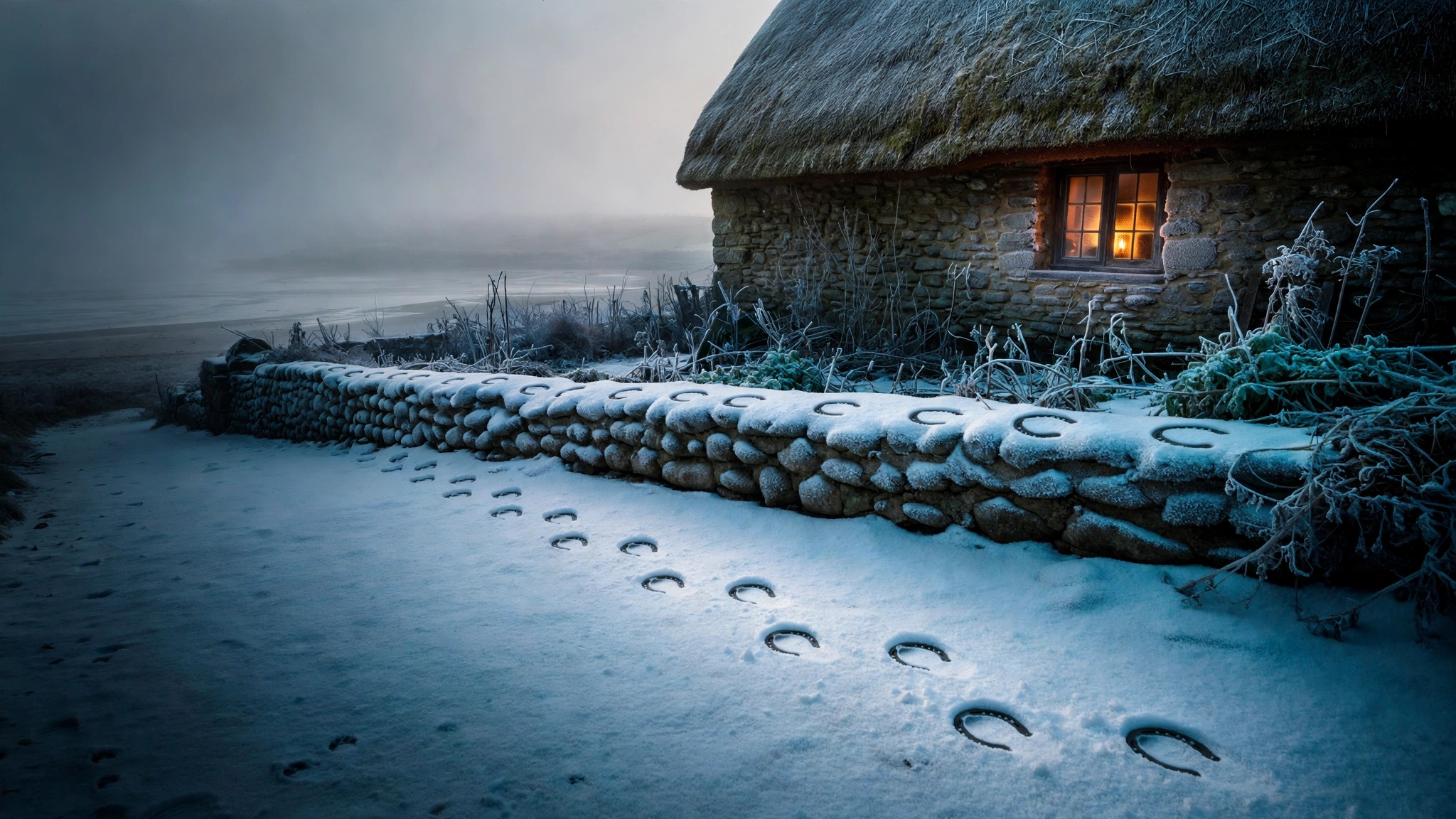
On the evening of Thursday 8 February 1855, snow fell across south Devon. It fell on the red cliffs at Dawlish, on the quays of Topsham and on the long grey water of the Exe estuary. Later that night it turned to rain, the wind swung round to the east, and before dawn everything froze hard.
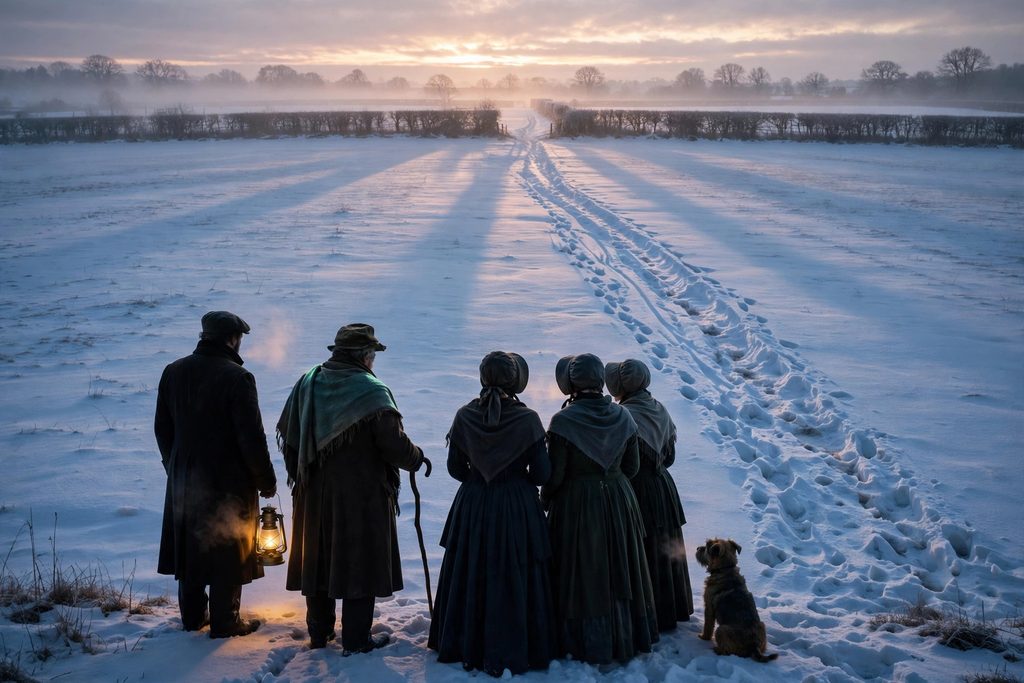
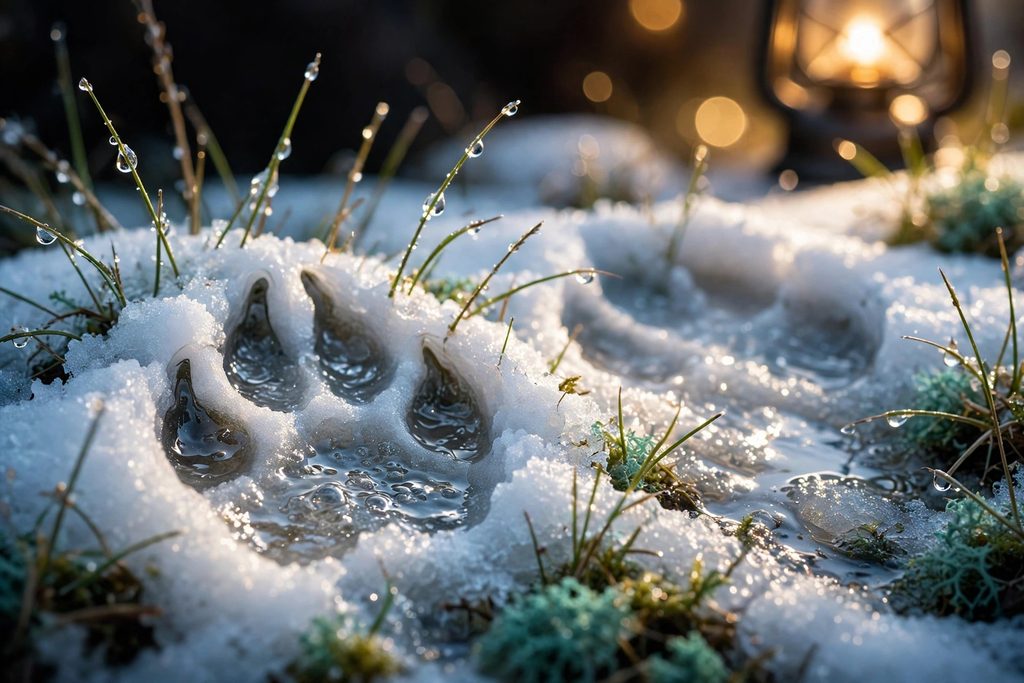
On Friday morning, people in towns on both sides of the estuary opened their doors and found marks in the snow. They were small and shaped like a horseshoe, and they ran one in front of the other, in a single line, as if something had walked on one leg. They crossed gardens and fields. Some were said to climb walls and walk over rooftops. By the end of the month the story was in The Times and the Illustrated London News, the trail had grown to more than a hundred miles, and parishioners were afraid to go out after dark. They had a name for whoever had passed through Devon in the night. They called it the Devil.
- The Source Ladder | How a Night Became a Hundred Miles
- Snow on the Exe
- What The Times Printed
- The Young Man Who Counted a Hundred Miles
- Both Banks of the Exe
- The Vicar of Clyst St George
- Eight Suspects, One Snowfall
- Tracks Before and After
- Why the Trail Grew
- The Verdict | Debunked
- Quick Answers About the Devil’s Footprints
The Devil’s Footprints are one of the most famous puzzles in British folklore, and almost everything the internet says about them comes from one letter written by a young man three weeks after the snow. The papers of that winter tell a stranger and more human story.
The Source Ladder | How a Night Became a Hundred Miles
Snow on the Exe
Devon is not a county that expects much snow, and the fall of 8 February was heavy enough to be remembered. By the next morning the snow had a crust of ice, the kind of surface that keeps every mark made on it and then, as the sun comes up and the frost lets go, softens it, spreads it and changes its shape.
The first newspaper report that survives is in the Western Luminary of Exeter on 13 February. It describes prints “exactly, in shape, like a donkey’s hoof” and says that “many parties have traced the prints for miles, but as yet, without any solution to the mystery.” There is no single path in that report, no distance and no impossible feats. There is simply a great many marks in a great many places, and a great many people out in the cold following them.
What The Times Printed
On Friday 16 February the story reached London. The Times reported that “considerable sensation has been evoked in the towns of Topsham, Lympstone, Exmouth, Teignmouth, and Dawlish” by footprints “of a most strange and mysterious description.” The prints, it said, were about one and a half to two and a half inches across and usually about eight inches apart, and “the impression of the foot closely resembled that of a donkey’s shoe.”
The report named the fear plainly. “The superstitious go so far as to believe that they are the marks of Satan himself.” It ended without an answer. “At present it remains a mystery.”
Five towns, two banks of a wide estuary and a second river, the Teign, between Dawlish and Teignmouth. Even this first London report describes something too scattered for one walker. Nobody in The Times claims to have followed one line of prints from one town to the next.

The Young Man Who Counted a Hundred Miles
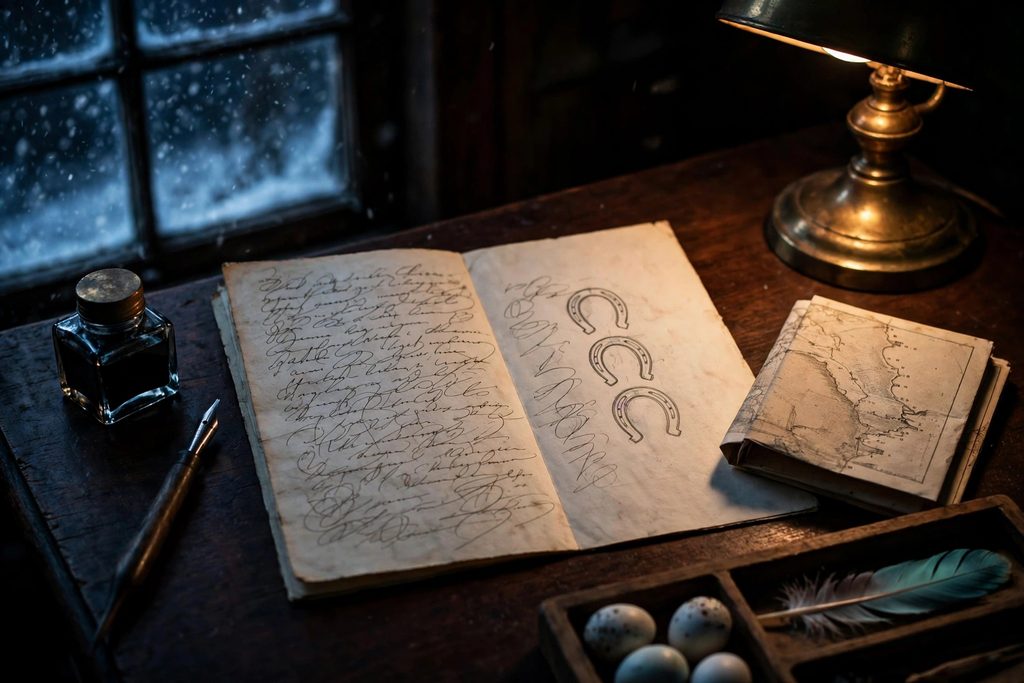
On 24 February the Illustrated London News printed a long letter signed only “South Devon”. Its writer claimed long experience of tracking animals, including in the backwoods of Canada. He described prints in which “foot followed foot, in a single line”, marks that went up to a wall said to be fourteen feet high and carried on from the top of it, and marks on roofs. He added the reports together and wrote that the trail “must have exceeded a hundred miles”, and that “no known animal could have traversed this extent of country in one night.”
This is the letter behind almost every retelling since. A century later, private papers revealed who wrote it. He was William D’Urban, a young naturalist of about nineteen who went on to become the first curator of the Royal Albert Memorial Museum in Exeter. He knew animal tracks. He was also adding together reports from places he had not walked between, and the hundred miles was his sum, not anyone’s measurement. The historian of the case, Mike Dash, found no reason to doubt his skill as a tracker, but wondered how far youthful enthusiasm had coloured his account.
Both Banks of the Exe
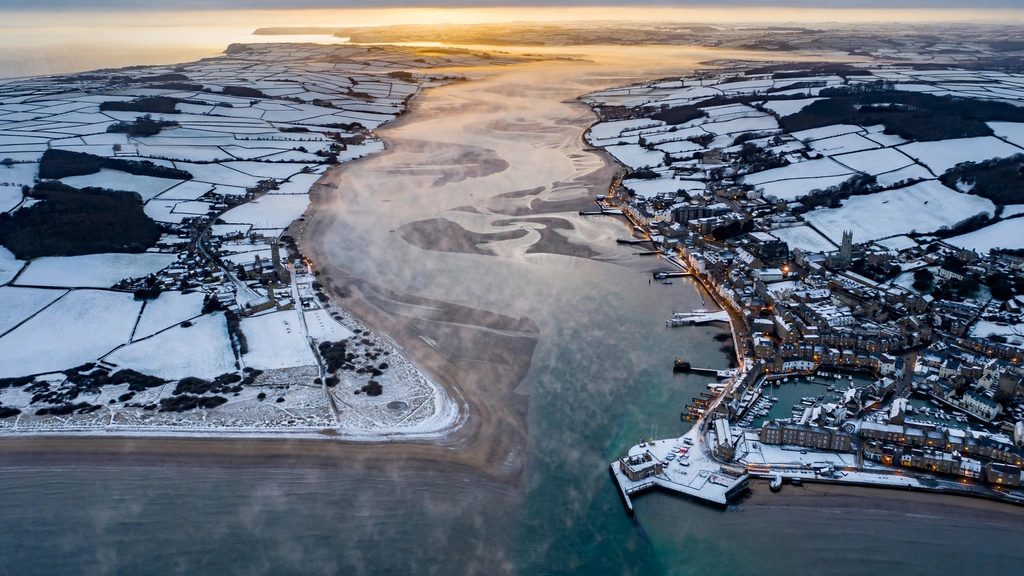
- TopshamNamed by The Times. Fresh marks were reported here five days after the snow.
- Clyst St GeorgeThe parish of the Rev. H. T. Ellacombe, who kept the letters and drawings of that month.
- LympstoneNamed by The Times.
- WithycombeThe parish of the Rev. G. M. Musgrave, whose people were “dreading to stir out after sunset”.
- ExmouthNamed by The Times.
- DawlishNamed by The Times. An armed party followed one set of tracks for about five miles.
- TeignmouthNamed by The Times, on the far side of a second river.
When Dash gathered every source in 1994, he counted more than thirty places where marks were reported. They lay on both banks of the estuary, along the coast and inland. What he could not find was a trail. No one in 1855 recorded following a single line of prints from one end to the other. The longest pursuit on record was an armed party of tradesmen from Dawlish, who followed one set of tracks for about five miles and found nothing at the end of them.
The Times called the prints a donkey’s shoe. Other witnesses described them as larger and rougher, up to about four inches long, with strides anywhere from eight to sixteen inches. The two drawings the Illustrated London News printed do not look like the same animal. One shows a neat curve of small horseshoe shapes. The other shows three large, ragged hoofmarks. And the marks did not all appear on one night. Fresh marks were reported at Topsham five days after the snow, by which time half the county was talking about the Devil.
The Vicar of Clyst St George
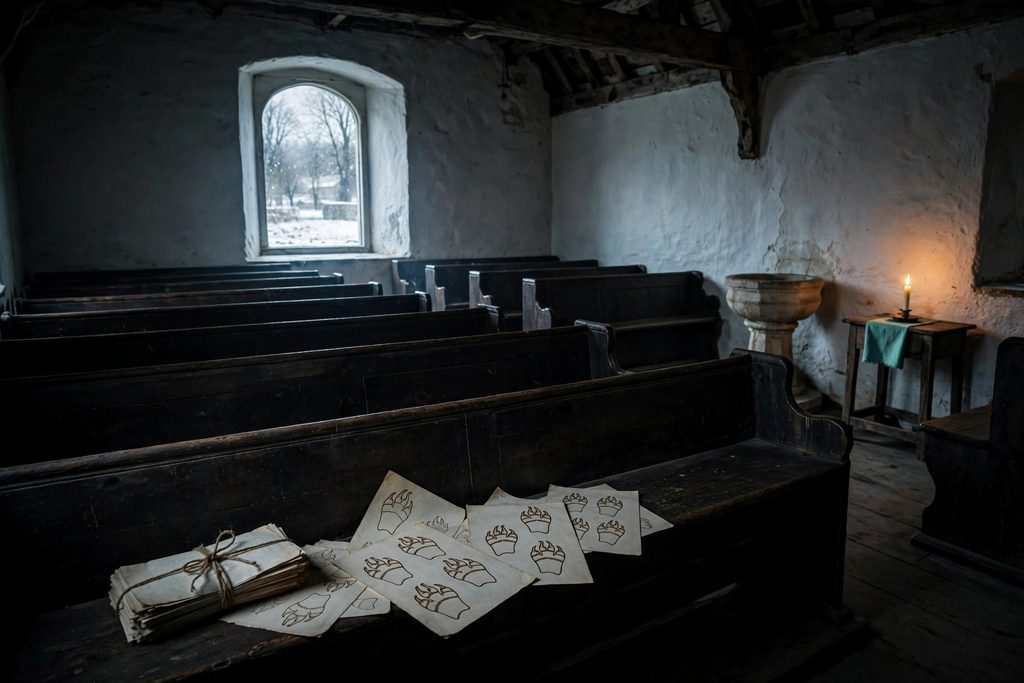
The best evidence for what people saw is a bundle of papers that sat unnoticed for nearly a hundred years. The Reverend Henry Thomas Ellacombe was the vicar of Clyst St George, a parish on the east side of the estuary, and a man with a scholar’s habits. That February he collected letters from friends and neighbours about the marks, together with tracings of the prints and a draft letter to the Illustrated London News marked “not for publication”.
The papers came to light after the Devon folklorist Theo Brown wrote about the footprints for the Devonshire Association in 1950. They show the case as it looked from inside it. There are clergymen trying to keep their parishes calm, a doctor guessing at animals he admits he does not know, and a great deal of honest confusion. They also show how a calming story could be made up on the spot.
The Reverend G. M. Musgrave of Withycombe had found his parishioners “dreading to stir out after sunset”. In his letter to the Illustrated London News he passed on a rumour that two kangaroos had escaped from a private menagerie at Sidmouth. In private he was more candid. He wrote that he had “found a very apt opportunity to mention the name of kangaroo”, because it gave frightened people something ordinary to believe in.
Eight Suspects, One Snowfall
The most famous answer came from the most famous naturalist of the day. Richard Owen, the anatomist who coined the word dinosaur, wrote to the Illustrated London News on 3 March that the marks were most likely made by a badger, the animal whose hind foot falls into the print of its fore foot. He did not need to prove it, he said. “The onus of the proof that one creature made them in one night rests with the assertor.” Later writers, among them the former naval officer Rupert Gould, pointed out that a badger leaves a broad, double track and does not climb onto roofs.
A week later Thomas Fox sent the paper drawings of the tracks left by a hopping rodent. A leaping mouse or rat lands with its feet together, and in thawing snow the paired prints can run into a single small horseshoe. In the twentieth century the zoologist Alfred Leutscher found trails just like them in Epping Forest, and Dash counted the wood mouse among the likeliest makers of the small prints. Mice can explain the small, neat prints. They cannot explain the large ones, or a trail across a county.
In 1985 the novelist Geoffrey Household offered the most cinematic answer. A Major Carter had told him a family story of an experimental balloon that broke loose from Devonport Dockyard and drifted over Devon, trailing shackles on the end of its ropes, before coming down near Honiton. The incident, the story went, was hushed up. No record of such a balloon has been found, and a rope dragging over the countryside for a hundred miles would have caught on the first tree. Dash was not persuaded by it.

Tracks Before and After
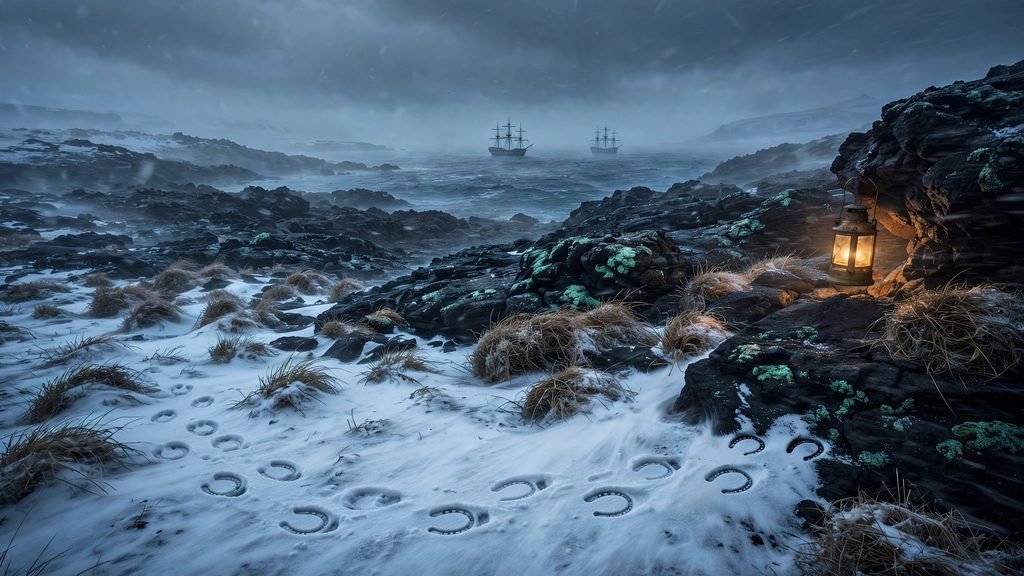
Devon was not the first place to wake up to hoofmarks it could not explain. In May 1840, on the bleak sub-Antarctic island of Kerguelen, a survey party from the expedition of James Clark Ross found what looked like the hoofprints of a pony or a donkey, about three inches long and shaped like a horseshoe, on an island with no ponies and no donkeys. They followed the tracks across the fresh snow until they lost them on bare rock. The party guessed the animal had come ashore from a wreck.
In March of the same year The Times reported tracks like those of a large foal running for miles across the mountains of Glenorchy and Glenlyon in Scotland. In March 1855, while Devon was still arguing, the Illustrated London News printed a report from a correspondent in Heidelberg about a hill in Galicia called Piaskowa Góra, where similar marks were said to appear in the snow every year and were “attributed by the inhabitants to supernatural influences.”
The marks have never stopped appearing. In March 2009 Jill Wade, a pensioner in the north Devon village of Woolsery, found a line of cloven prints across her snowy back garden, and the newspapers reached straight back to 1855. In 1919 the American collector of oddities Charles Fort mocked every explanation in The Book of the Damned. To fit all the reports, he said, you would need “a thousand one-legged kangaroos, each shod with a very small horseshoe.” He meant it as a joke against the scientists. It works just as well against the idea of a single walker.
Why the Trail Grew
Every part of the legend that sounds impossible came late. The unbroken line, the hundred miles, the fourteen-foot wall and the drain pipe all appear after the first reports, and most of them in one letter. When readers of Notes and Queries recalled the winter of 1855 thirty-five years later, the marks had spread to Totnes, Torquay, Weymouth and even Lincolnshire. Memory did to the story what thaw did to the prints. It softened the edges and made the shape larger.
The skeptic Joe Nickell argued in 1996 that once the word Devil was spoken, people went out looking for hoofmarks and found them in tracks they would have ignored a week earlier. It is the same pull that turned a few dancers into hundreds in the records of the Dancing Plague of 1518, and the same trick of shared memory explored in the Mandela Effect. A town that is frightened sees more, and remembers more, than a town that is not.
None of that makes the people of Devon foolish. They were looking at marks pressed into fresh snow, often in places they could not explain, during a winter when many of them had never seen a kangaroo, a badger’s trail or the track of a leaping mouse. The same kind of night, and the same kind of fear, sit behind later stories like the Dover Demon and the Mothman of Point Pleasant, where the first records are smaller and stranger than the legends that grew from them.
The Verdict | Debunked
Something left marks in the Devon snow on the night of 8 February 1855, and on nights after it. That is in the record, and so is the fear. What the record does not hold is the claim that made the case famous, a single creature walking more than a hundred miles in one night over roofs and walls. No one followed such a trail. The prints were not all alike. The hundred miles was a young man’s total of separate reports, published three weeks after the snow, and every telling since has built on it.
So the file is stamped Debunked, and the stamp is about the claim, not the snow. Which animals and which pranksters made which marks can never now be known. Mike Dash, who knew the sources better than anyone, ended his study with the words “the mystery remains”. What remains is a winter puzzle of many small answers. The Devil’s walk across Devon was never one of them.
- Claim tested
- On one night in February 1855 a single unknown creature left a trail of hoofmarks more than a hundred miles long across south Devon, over roofs and high walls, that no known animal could have made.
- Oldest record
- Rung 2 · Reported that week
The Western Luminary of Exeter, 13 February 1855, and The Times, 16 February 1855. Both report hoof-shaped marks in several towns, traced “for miles”, with no single path and no distance given. - The record supports
- Marks were found in the snow on both banks of the Exe after a heavy fall on 8 February 1855, in more than thirty places, and they frightened many people.
- It does not support
- One trail, one night or one maker. No one in 1855 followed a trail further than a few miles. The prints were described in different sizes and shapes, and fresh marks were reported days later. The hundred miles first appears in one letter of 24 February, which added separate sightings together.
- Explanations weighed
- The Devil, a badger, kangaroos, an otter, wood mice and rats, a runaway balloon, pranksters and a big cat. The best study of the sources concludes that the cause was almost certainly multiple.
- What would change it
- A record from 1855 of one trail followed continuously for many miles, or drawings showing the same print, at the same size, on both banks of the estuary.
Every verdict in the archive is listed in the Verdict Index, and the rules behind the stamps are set out in the Archive Standard. Topsham is pinned in the Atlas of Mysteries.
Quick Answers About the Devil’s Footprints
### What were the Devil’s Footprints?
They were hoof-shaped marks found in the snow in south Devon on the morning of 9 February 1855, after a heavy fall the evening before. They were reported in more than thirty places on both banks of the Exe estuary and along the coast, and many people believed the Devil had made them.
### Did the footprints run for a hundred miles?
No one measured a hundred miles. The figure comes from a letter in the Illustrated London News of 24 February 1855, which added together reports from many separate places. No one in 1855 recorded following one trail for more than a few miles.
### Did the prints go over roofs and through walls?
Some letters said so, and the same letter that gave the hundred miles described a wall fourteen feet high. The earliest newspaper reports describe marks across fields, gardens and roads, and do not mention roofs.
### What animal could have made them?
Several were suggested in 1855, including a badger, an otter, a great bustard and escaped kangaroos. The study that gathered every source concluded that the marks almost certainly had more than one cause, including wood mice and other small animals, donkeys and ponies, and pranksters.
### Has it happened again?
Similar marks were reported on Kerguelen Island in 1840, in Scotland the same year, in Galicia in the 1850s and in the north Devon village of Woolsery in 2009.