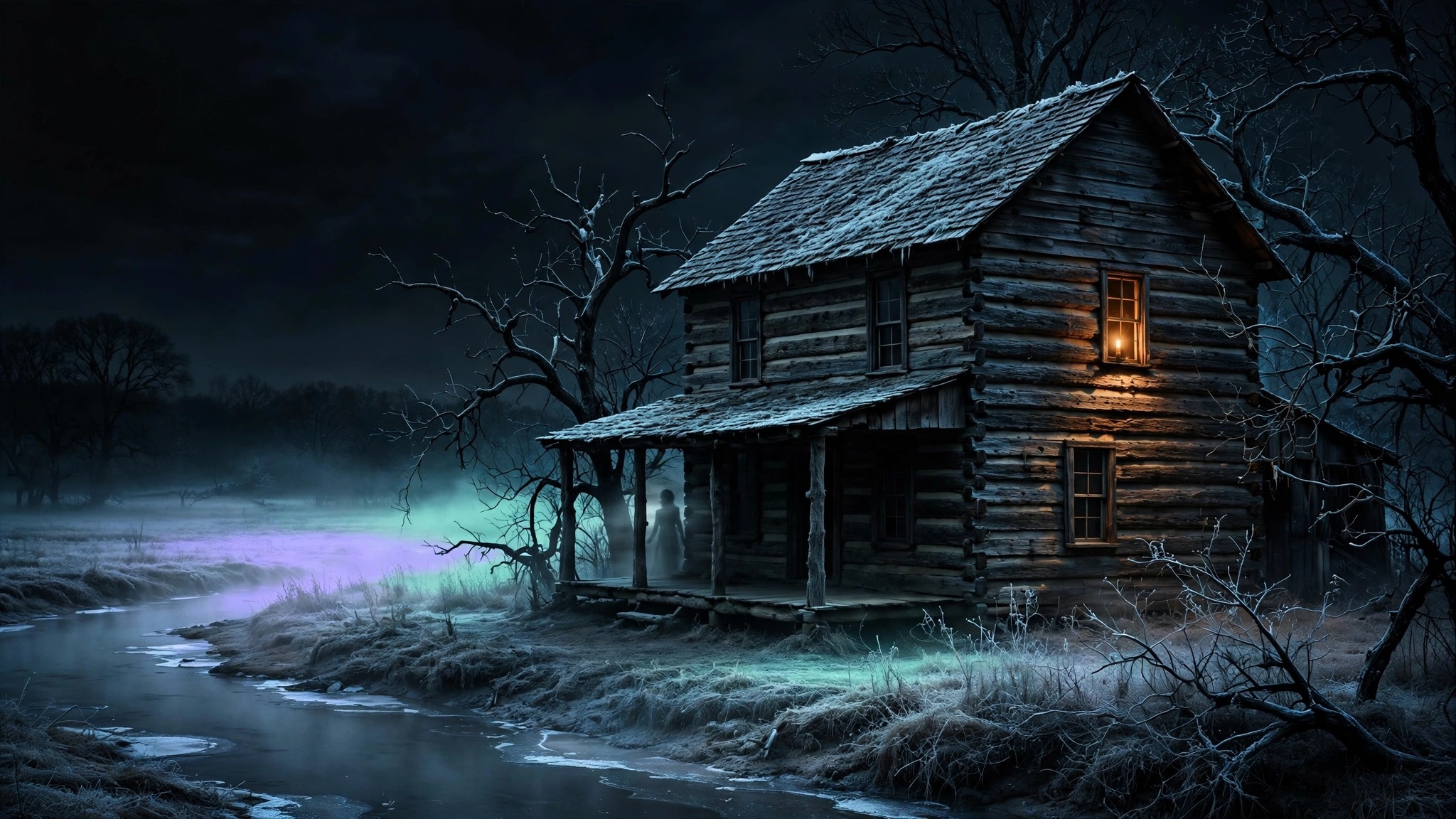
In the summer of 1817, a farmer named John Bell was walking the rows of his corn on the Red River in northern Tennessee when he saw an animal he could not name. It sat among the stalks with the body of a dog and the head of a rabbit. Bell raised his gun and fired, and the creature was simply gone. It was the first sign of what Tennessee would come to call the Bell Witch, and for the next four years, by the family’s own account, it would not leave them alone.
The noises began soon after. Something knocked on the outside walls at night and scratched at the windows. Something gnawed at the bedposts like a rat that could not be found. The Bells heard chains dragging across the floor, dogs fighting where no dogs were and a sound like someone choking in the dark. Covers were pulled from the beds. The children were slapped and pinched, and the youngest daughter, Betsy, suffered most of all. Then, out of the knocking and the whispering, came a voice.
It talked, it sang, it quoted scripture and it cursed. It mocked visitors in the voices of their own mothers. It said it was a spirit that had once been happy and had been disturbed, and before it was done it claimed to have killed the head of the house. The Bell Witch has been called America’s greatest ghost story, the haunting that would one day help inspire The Blair Witch Project. Yet for all its fame, no one has ever found a single page about it written while it was happening.

The Farm on the Red River
John Bell came west from Edgecombe County, North Carolina, and settled near what is now the town of Adams in Robertson County, Tennessee, around 1804. It was good land on the Red River, close to the Kentucky line, and he prospered on it. By 1817 his household included his wife Lucy, their sons John Jr., Drewry, Richard Williams and Joel, their daughter Elizabeth, known as Betsy, then about eleven years old, and the people the family held in slavery, among them a man named Dean.
The strange animal in the cornfield was only the beginning. In the stories gathered later, Drewry saw a bird of enormous size perched on a fence, which flew off as he approached. Betsy saw a girl in a green dress swinging from the limb of an oak. Dean, walking at night to visit his wife on a neighbouring farm, was followed by a great black dog. None of these sightings, on their own, would have frightened a frontier family for long. It was what happened inside the house that broke their nerve.
For a year the Bells kept the trouble to themselves. When the knocking and the gnawing turned into blows, and Betsy began to wake screaming with her hair pulled and her face stinging, John Bell finally confided in his neighbour and friend, James Johnston. Johnston and his wife stayed the night. They heard the sounds, and Johnston felt them too, and in the morning he gave his verdict. It was a spirit, he said, just like in the Bible.

John BellOld Jack
The farmer the voice swore to kill. Settled on the Red River around 1804.
Lucy BellHis wife
Kate sang hymns to her when she lay ill.
Betsy BellBorn 1806
Slapped, pinched and pleaded with. Died in Mississippi in 1888.
John Bell Jr.Eldest son
Said to have spoken with her again in 1828.
Richard Williams BellAbout six in 1817
Said to have written Our Family Trouble in 1846. No one but Ingram saw it.
DeanEnslaved on the farm
His night walks to see his wife became part of the legend.
Kate BattsA neighbour
The voice called itself Old Kate Batts’ witch. Nothing ties her to it.
Joshua GardnerBetsy’s fiancé
The voice begged her not to marry him, and she did not.
Richard PowellSchoolteacher
Her former teacher, and a suspect in some theories.
A Voice in the Dark
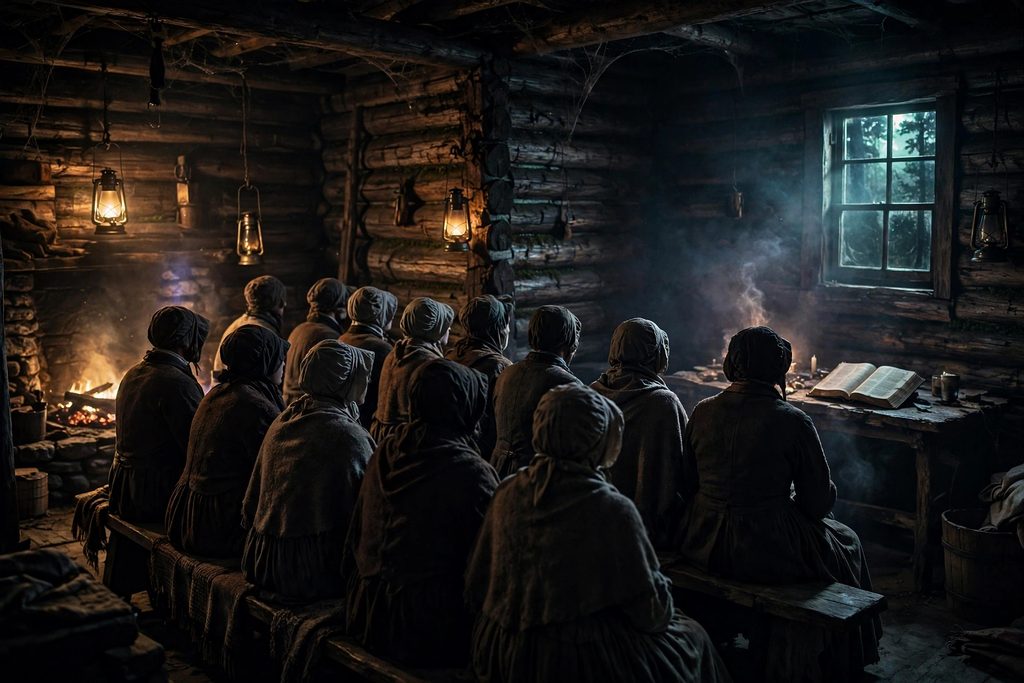
From whispers it grew to speech. At first the voice was faint, then clear, and soon it would talk to anyone who asked. Word spread through the settlements, and people came from far beyond Robertson County to sit in the Bell house at night and question it. When the county history of 1886 came to set down the story, it described an invisible being that would hold conversation and even shake hands with certain individuals.
Asked what it was, the voice gave many answers. It was a spirit from everywhere, it said, and had once been very happy but had been disturbed. It claimed to be the ghost of someone buried in an old Native American mound on the property, and it sent Drewry Bell and a friend digging for a treasure that was never there. It said it was one of a family of witches, and named the others, Blackdog, Mathematics, Cypocryphy and Jerusalem. And once it said that it was Old Kate Batts’ witch.
Kate Batts was a neighbour, an eccentric woman who, in later retellings, held a grudge against John Bell over a business deal. She was alive and well and living nearby, and she seems to have had nothing to do with any of it. But the name stuck. From then on the family and their visitors called the voice Kate.
Kate was clever and cruel and, now and then, kind. In the stories it repeated, word for word, two sermons preached at the same hour thirteen miles apart, mimicking each preacher’s voice. It spoke in the accent of a visitor’s Dutch grandmother. It sang hymns to Lucy Bell when she lay ill and brought her fruit from nowhere. It seemed to respect John Jr., and it could be gentle with the younger boys. For Betsy and for her father it had nothing but torment. It called John Bell Old Jack, and it promised, again and again, that it would see him dead.
Betsy
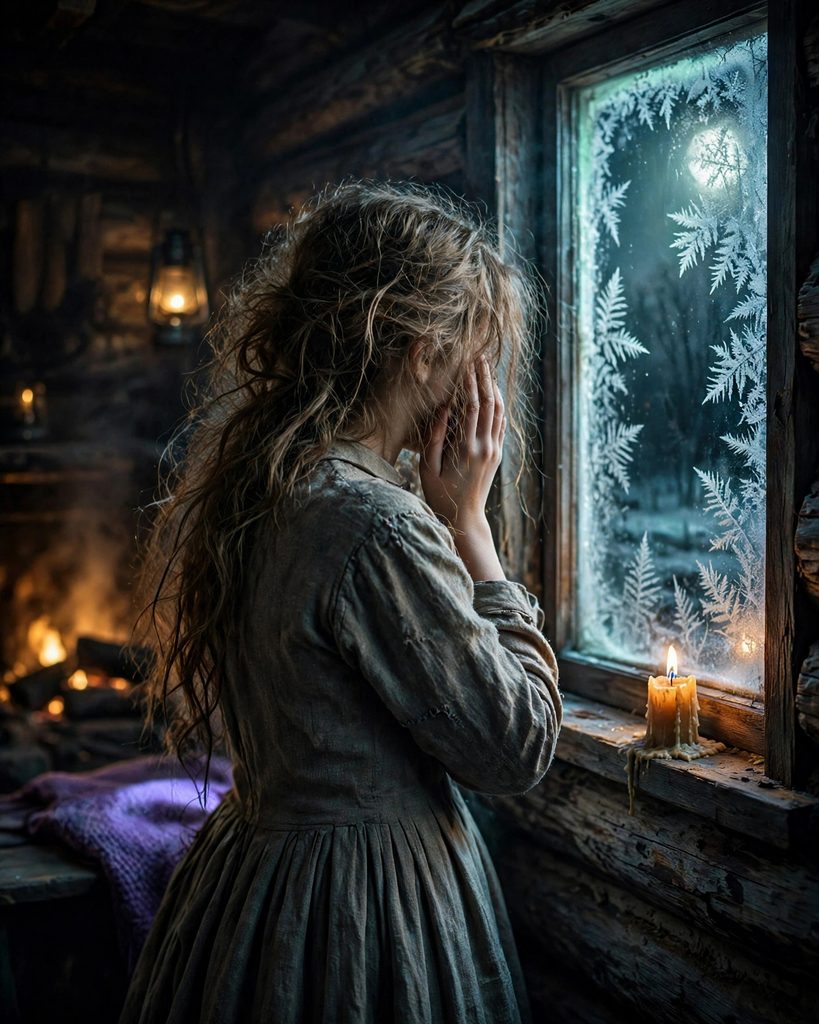
Of all the family, Betsy Bell bore the worst of it. She was slapped hard enough to leave marks, stuck with pins and dragged by the hair. She fell into fainting spells that came on without warning. Some visitors noticed that the voice seemed strongest when she was in the house, and that it fell silent when she slept elsewhere. That observation would shape almost every attempt to explain the haunting for the next two centuries.
As she grew into a young woman, Betsy became engaged to Joshua Gardner, a neighbour’s son. The voice set itself against the match with a strange, pleading fury. In the most famous lines of the legend it begged her, over and over, please, Betsy Bell, don’t have Joshua Gardner. Whether from fear, from exhaustion or from a doubt of her own, Betsy gave in. In the spring of 1821 she broke off the engagement.
She did marry, a few years later. Her husband was Richard Powell, her former schoolteacher, a man some years older than her who had known her since she was a girl. They had a family together, and after his death she moved to Mississippi to live with one of her children. Elizabeth Bell Powell died there on 18 July 1888, aged eighty-two, and is buried in Yalobusha County, a long way from the farm on the Red River. She died six years before the first book about her girlhood appeared.
The Death of Old Jack
John Bell’s health had begun to fail early in the haunting. His tongue would swell until he could neither eat nor speak, and his face twitched and jerked in a way no doctor could explain. Over the autumn of 1820 he grew steadily weaker, and on the morning of 19 December he did not wake as he should. He was found in a stupor, and he died the next day, 20 December 1820.
In the version of events published long afterwards, the family found a small smoky vial of dark liquid in the cupboard where his medicine was kept. No one knew where it had come from. A drop was given to the cat, which died at once. And Kate, by this telling, crowed that she had given Old Jack a big dose of it in the night, and that it had finished him. The vial was thrown into the fire, where it flared up in a flash of blue.
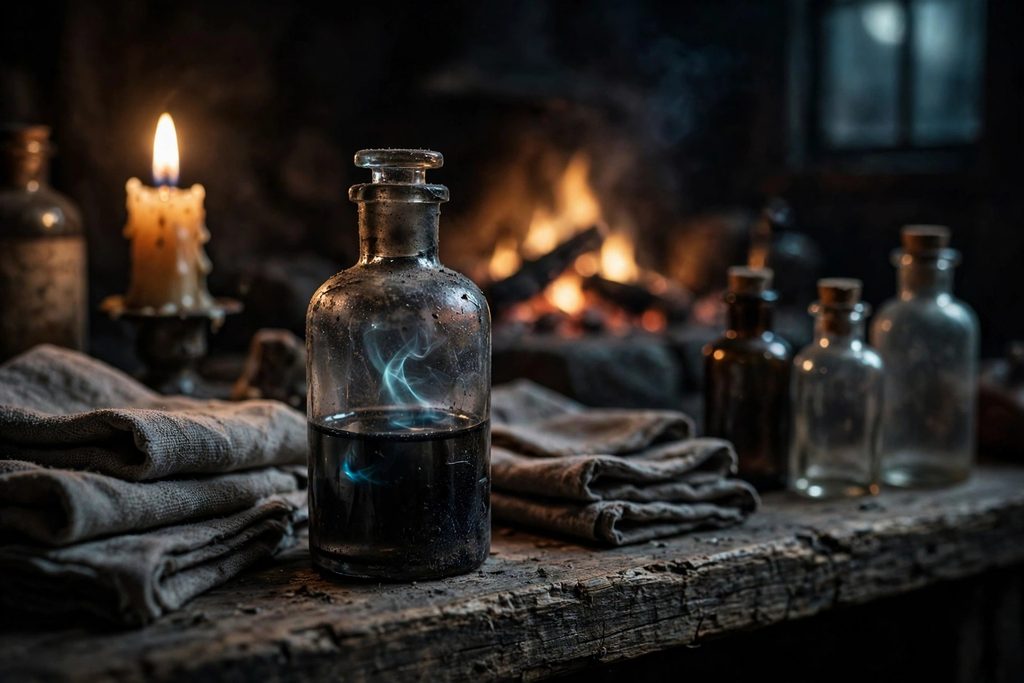
At the funeral, so the story goes, the voice laughed and sang a drinking song as the mourners filled in the grave. Then, over the following months, it faded. In 1821 it told Lucy Bell that it was leaving and would return in seven years. Betsy’s engagement was over, Old Jack was dead, and the house on the Red River fell quiet.
It is the darkest part of the legend, and the part with the least behind it. The death of John Bell on 20 December 1820 is a matter of record. The poison, the cat and the boast are not. The only paragraph about the haunting printed before 1894 does not mention a murder at all.
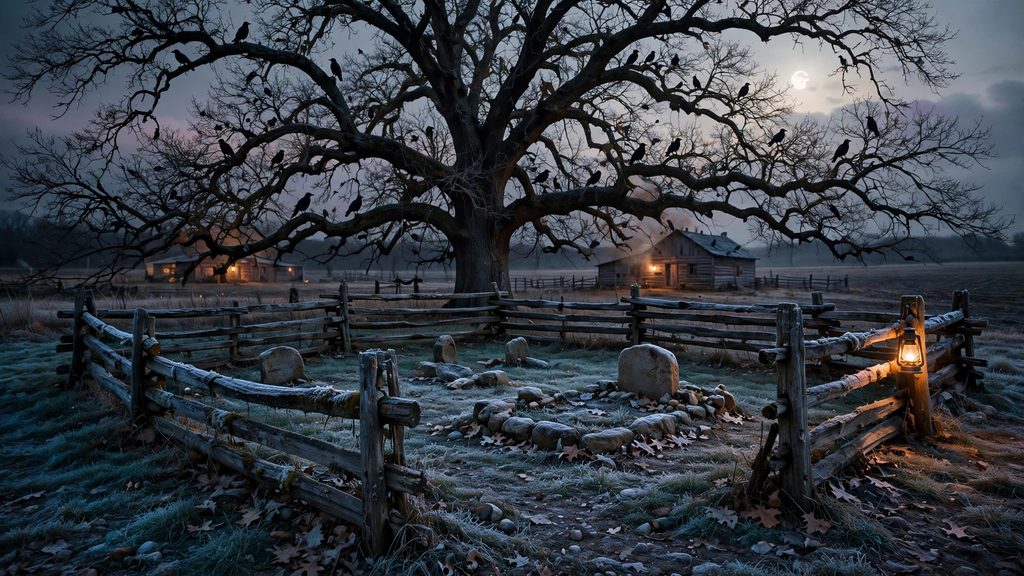
- c. 1804
John Bell settles near present-day Adams, Tennessee, from Edgecombe County, North Carolina.
- 1817
A strange animal in the corn, then knocking, gnawing and blows in the house.
- 1818 to 1820
The voice speaks, calls itself Kate and draws visitors from far away.
- 20 Dec 1820
John Bell dies. Kate is later said to have poisoned him.
- 1821
Betsy breaks off her engagement. The voice says it will return in seven years.
- 1828
A brief return to the Bell house, by Ingram’s account.
- 1856
A letter signed H. in the Saturday Evening Post blames Betsy’s ventriloquism.
- 1886
Goodspeed’s History of Tennessee gives the story one paragraph.
- 18 Jul 1888
Elizabeth Bell Powell dies in Yalobusha County, Mississippi.
- 1894
Ingram publishes An Authenticated History of the Famous Bell Witch.
- 1935
The promised return after 107 years passes without a sign.
- 1999 and 2005
The Blair Witch Project and An American Haunting carry Kate to the screen.
The General’s Wagon
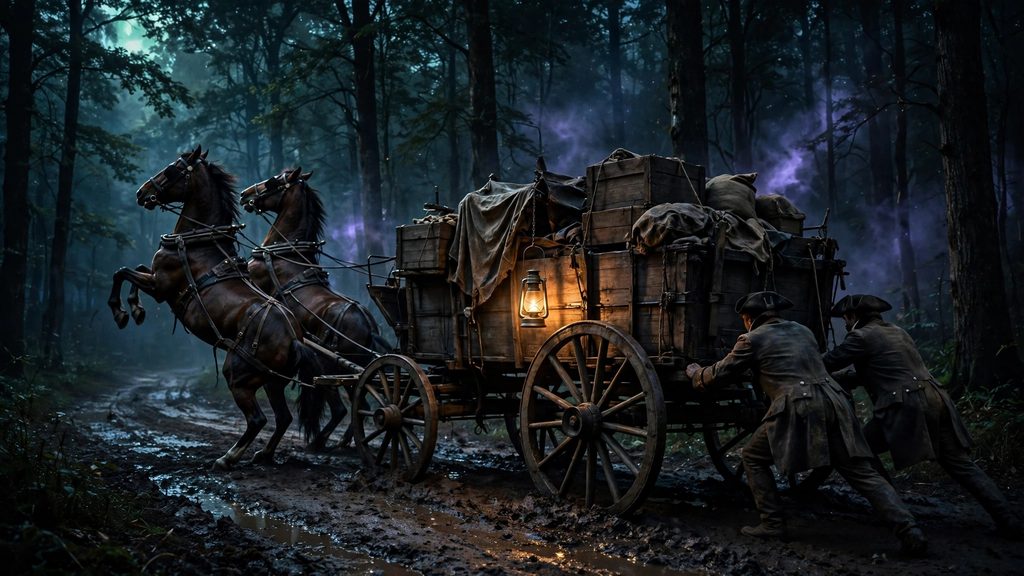
No episode of the legend is told more often than the visit of Andrew Jackson. In the 1810s Jackson was the hero of New Orleans, the most famous man in Tennessee, and his home at the Hermitage lay a long day’s ride from Adams. In the story, he came north with a party of men to see the witch for himself. As they neared the Bell farm, the wheels of their wagon locked fast on level ground, and no amount of whipping would move them. Then a voice spoke from the bushes. All right, General, it said, let the wagon move on. I will see you again tonight.
That night one of Jackson’s party, a self-styled witch tamer who carried a pistol loaded with a silver bullet, was set upon by something unseen, slapped and kicked until he ran from the house. By morning, the story goes, Jackson had had enough, and he is supposed to have said that he would sooner fight the British again than face the Bell Witch.
It is a wonderful tale, and there is no trace of it in Jackson’s life. His movements in those years are well known, and nothing places him in Robertson County. When he ran for president in 1824 and 1828, his enemies hurled every scandal they could find at him, and none of them mentioned a witch. The story first appears in print in 1894, in a letter from a Clarksville attorney named Thomas Yancey, passing on what his grandfather had told him.
Seventy Years of Silence
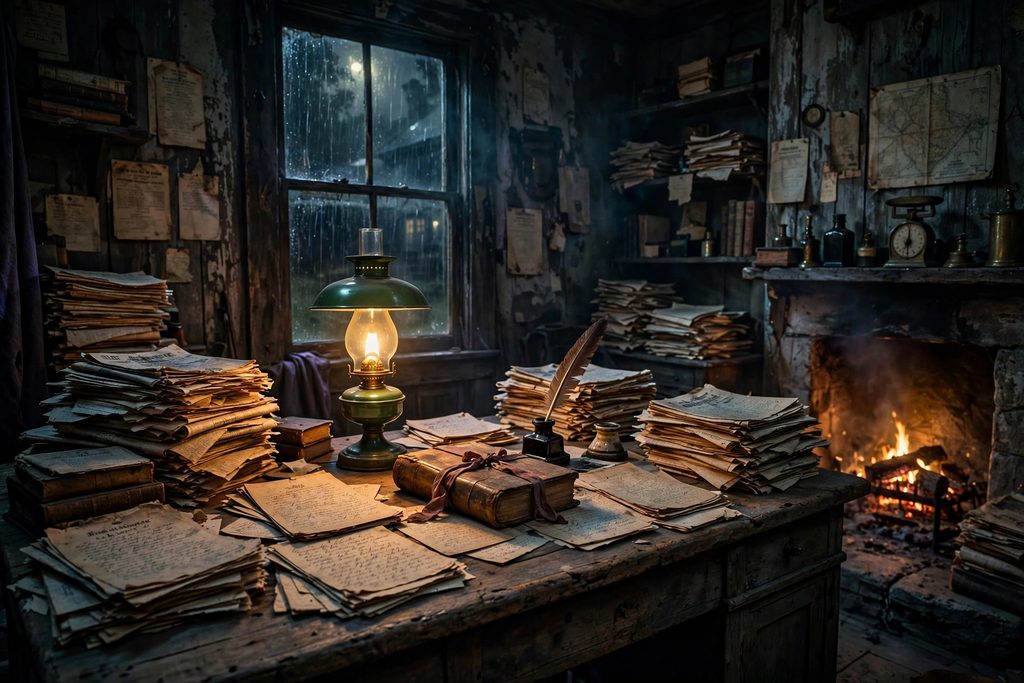
This is where the Bell Witch becomes a mystery of a different kind. A haunting that drew visitors from far and wide, that was said to have humbled a future president and killed a man, left no letter, no diary, no newspaper report and no court record behind it from the years 1817 to 1821. The story enters the written record decades later, and in pieces.
The earliest known trace is a letter printed in the Saturday Evening Post in January 1856 and reprinted in other papers, signed only with the letter H. It recalled the haunting and offered an explanation. Betsy, it claimed, had been throwing her voice. Thirty years later, in 1886, Goodspeed’s History of Tennessee gave the story a single paragraph in its pages on Robertson County. A remarkable occurrence, it began, which attracted wide-spread interest, was connected with the family of John Bell. It described a female spirit, invisible, talkative and cruel to the children. It said nothing of poison, of Joshua Gardner or of Andrew Jackson.
The full story came in 1894, when Martin Van Buren Ingram, a newspaper editor in Clarksville, published An Authenticated History of the Famous Bell Witch. Its centrepiece was a long memoir called Our Family Trouble, said to have been written in 1846 by Richard Williams Bell, who was about six years old when the haunting began. Richard had died in 1857. The manuscript, Ingram said, had passed to Richard’s son, and from him to Ingram. No one else has ever seen it.
Ingram also reported that the Saturday Evening Post had printed a story in 1849 accusing Betsy of causing the haunting, and that it had retracted the charge after she threatened to sue. Researchers have searched the Post’s archives, and no such article has been found. By the time Ingram’s book appeared, every adult who had sat in the Bell house at night was long dead. Almost everything people now know about Kate, from the cornfield animal to the vial in the cupboard, comes from that one book and the memoir no one else has read.
Who Was Kate?
If something did happen in the Bell house, and the 1856 letter and the county history suggest that people in the region believed it had, then what was it? The oldest answer is the one the letter gave. Betsy was at the centre of the disturbances, they grew quiet when she was away, and they ended soon after her engagement did. Investigators of later poltergeist cases, from the Fox sisters’ rapping in New York to the Enfield house in London, have often found a child or a young person at the heart of them. The writer Joe Nickell has called this the poltergeist-faking syndrome, a pattern of a young person who learns that a few tricks can hold a whole household in thrall.
A second answer points to the schoolteacher. Richard Powell was in love with Betsy, the theory runs, and had both motive and opportunity to frighten her away from Joshua Gardner. He married her in the end. Yet nothing ties him to the knocking, and a single schoolteacher could hardly have produced everything the legend describes.
Scholars of folklore have looked at the story from another angle altogether. The literary historian Keith Cartwright has read the Bell Witch beside the animal tales of the enslaved South and the removal of Native nations from their lands, a frontier haunting built on soil that had belonged to other people and worked by people who were not free. The historian Amy Fluker has argued that what matters most is not whether the haunting happened but that so many Tennesseans believed it had. Seen this way, Kate is the voice of a whole community’s fears, speaking through one unlucky family.
And then there are those who take the story at its word. To them the Bell Witch was exactly what it said it was, a spirit, disturbed and malicious, that talked with the living for four years and killed a man, and the absence of papers is no more than the silence of a frontier where few people wrote anything down.
The Cave and the Return
Kate kept her promise, according to Ingram. In 1828, seven years after she left, the old noises came back to the house where Lucy Bell still lived with her sons Joel and Richard. They ignored it, and after a couple of weeks it went away. In some tellings she also visited John Bell Jr. on his own farm, and spoke with him of the past and the future, and said she would return to his descendants one hundred and seven years later. In 1934 a descendant, Charles Bailey Bell, published a book of his own about the haunting, and the date came and went in 1935 without any sign of her.
By then Kate had found a new home. On the bluff above the Red River, on land that had once been part of the Bell farm, lies a limestone cave that the twentieth century came to call the Bell Witch Cave. The early accounts say nothing of it, but visitors have reported voices, footsteps and a figure on the cliff, and in 1937 a crowd gathered to watch a woman in white who, one minister later decided, was moonlight on a rock. The cave is open to visitors today, and the town of Adams still lives with its witch.
Her story has travelled far beyond Tennessee. It has become songs, a cantata performed at Carnegie Hall in 1947, a heavy-metal ballad and the name of a band, and a run of films, among them An American Haunting in 2005. Its shape, a family alone at night with an invisible thing that knows their names, runs through modern horror cinema. For a spirit with no papers to her name, Kate has never been short of a voice.

The Verdict | Disputed
John Bell lived on the Red River in Robertson County, Tennessee, and died there on 20 December 1820. His daughter Betsy grew up to marry Richard Powell and died in Mississippi in 1888. Kate Batts was a neighbour. By the 1850s a story of a haunting in the Bell family was being told far beyond the county, and by 1886 it had a place in the history of Tennessee.
Almost everything else is in contention. No account written during the haunting survives, the memoir of Richard Williams Bell has never been seen by anyone but Ingram, the 1849 newspaper story has never been found, and the visit of Andrew Jackson has no trace in his well-known life. The murder of John Bell first appears in print more than seventy years after his death. Something stirred the Bell household and the countryside around it between 1817 and 1821, but what it was, and how much of the famous story ever happened, is still argued over. The Bell Witch stands in the Archive as Disputed, a voice that has never stopped talking, and has never been heard on paper from its own time.
- Claim tested
- A spirit called Kate haunted the Bell family of Robertson County, Tennessee, from 1817 to 1821, spoke with hundreds of visitors and poisoned John Bell.
- Oldest record
- Rung 3 · Recalled later
A letter signed H. in the Saturday Evening Post of January 1856, about thirty-five years after the events, and one paragraph in Goodspeed’s History of Tennessee of 1886. - The record supports
- The Bell family and their farm, the death of John Bell on 20 December 1820, Betsy’s later marriage to Richard Powell, and a regional story of a haunting told by the 1850s.
- It does not support
- The poisoning of John Bell, the visit of Andrew Jackson, the 1849 newspaper story, or any account written while the haunting was happening.
- Explanations weighed
- A spirit as described, a young person’s tricks grown into legend, a hoax by someone close to the family, and folklore shaped by a frontier community and later writers.
- What would change it
- A letter, diary or newspaper report from 1817 to 1821, or the surfacing of Richard Williams Bell’s original manuscript.
Other spirits that talked and other households that could not sleep turn up across these files. A farm on the Isle of Man where a creature in the walls chattered and sang is visited in Gef the talking mongoose, and a London council house where a girl later admitted to some of the tricks in the Enfield poltergeist. Two sisters who started a movement with knocking in the night return in the Fox sisters, a spirit who dictated whole novels speaks through Pearl Curran’s pen, and the board people still use to call up the dead is taken apart in the Ouija board. How a ghost story can grow without any trace at its root is followed in Carmen Winstead. The old Bell land near Adams is marked on the Atlas of Mysteries, the Verdict Index lines this ruling up beside its neighbours, and the Archive Standard explains why a story first written down decades late sits low on its ladder of sources.
Quick Answers About the Bell Witch
What is the Bell Witch?
The Bell Witch is a spirit said to have haunted the family of John Bell on their farm near Adams, in Robertson County, Tennessee, from 1817 to 1821. It knocked, scratched, struck the children, spoke aloud and was called Kate after it claimed to be Old Kate Batts’ witch.
Did the Bell Witch kill John Bell?
John Bell died on 20 December 1820. The story that the witch poisoned him with a vial of dark liquid first appears in Martin Van Buren Ingram’s book of 1894, more than seventy years later. The 1886 account in Goodspeed’s History of Tennessee does not mention a murder.
Did Andrew Jackson visit the Bell Witch?
There is no record that he did. The tale of his stuck wagon and the voice that mocked him comes from a letter printed in 1894, and historians have found nothing that places Jackson in Robertson County during the haunting.
Who was Kate Batts?
Kate Batts was a neighbour of the Bell family, remembered as eccentric and said in later retellings to have quarrelled with John Bell over a business deal. The voice once called itself Old Kate Batts’ witch, so the spirit became known as Kate, but nothing links the woman herself to the haunting.
What happened to Betsy Bell?
Betsy broke off her engagement to Joshua Gardner in 1821 after the voice begged her not to marry him. She later married her former schoolteacher, Richard Powell, and died in Yalobusha County, Mississippi, on 18 July 1888.
Is the Bell Witch Cave part of the original story?
No. The cave lies on land that was once part of the Bell farm, but the early accounts never mention it. It became linked to the legend in the twentieth century and is now open to visitors in Adams, Tennessee.