


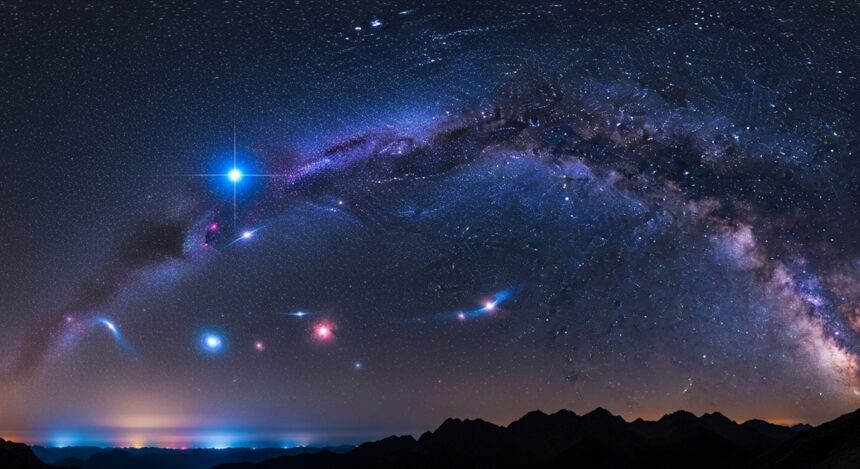
Imagine gazing up at the night sky, spotting the faint glow of distant stars like Proxima Centauri or the brilliant Sirius, and realizing that hidden pathways—vast cosmic corridors—might bridge the gulf between us and them. This isn’t the plot of a science fiction novel; it’s the reality unveiled by cutting-edge astronomy.
In a groundbreaking revelation, scientists have mapped out interstellar “tunnels” carved through space, connecting our solar system to neighboring stellar systems. These aren’t wormholes for instant travel, but enormous channels of hot plasma that challenge our understanding of the universe’s architecture. Drawing from data collected by advanced space observatories, this discovery opens doors to questions about our cosmic origins, the violent history of our galactic neighborhood, and even speculative ties to life’s evolution on Earth.
At the heart of this story is the Local Hot Bubble (LHB), a massive cavity in space where our Sun and planets reside. Spanning roughly 300 light-years, this bubble is filled with scorching, low-density plasma heated to temperatures around a million degrees Kelvin. But what makes this finding truly captivating is the identification of elongated “tunnels” extending from the bubble, one pointing toward the Centaurus constellation—home to Proxima Centauri, our closest stellar neighbor at just 4.2 light-years away—and another toward Canis Major, where Sirius, the brightest star in our sky, shines at 8.6 light-years distant. Reported by researchers at the Max Planck Institute for Extraterrestrial Physics and published in the prestigious journal Astronomy & Astrophysics, this revelation stems from meticulous analysis of X-ray emissions, painting a picture of a dynamic, interconnected cosmos.
The Role of eROSITA in Unveiling the X-Ray Sky
To grasp the magnitude of this discovery, we need to dive into the technology that made it possible. Launched in 2019 as part of the Spektr-RG mission—a collaborative effort between Russian and German space agencies—the eROSITA (extended ROentgen Survey with an Imaging Telescope Array) instrument represents a leap forward in X-ray astronomy. Orbiting at a Lagrange point about 1.5 million kilometers from Earth, eROSITA scans the heavens with unprecedented sensitivity, capturing soft X-ray emissions that are invisible from the ground due to Earth’s atmosphere absorbing them.
X-rays in space aren’t just random noise; they’re signatures of extreme cosmic events. Hot plasmas, supernova remnants, and black holes all emit in this high-energy band. eROSITA’s first all-sky survey, known as eRASS1, provided the cleanest dataset yet, free from much of the contamination that plagued earlier missions like ROSAT. By dividing the sky into approximately 2,000 regions and analyzing spectra from each, astronomers isolated the faint glow of the LHB’s plasma. What emerged was a surreal landscape | an irregular bubble with protruding “tongues” of plasma, resembling arms reaching out into the colder interstellar medium.
This mapping wasn’t straightforward. Researchers combined eROSITA’s data with archival ROSAT observations for lower-energy insights and calibrated densities using sightlines to distant molecular clouds. The result? A interactive 3D model that anyone can explore, showcasing the bubble’s bumpy, spiky contours—far from the perfect sphere we might imagine. It’s a testament to how modern astronomy blends big data with sophisticated modeling to reveal hidden structures.
Why X-Rays Matter in Cosmic Exploration
X-ray astronomy is like having night-vision goggles for the universe. While visible light shows us stars and galaxies, X-rays reveal the hot, violent underbelly—regions where matter is energized to extremes. Soft X-rays, in particular, are absorbed quickly in space, meaning any we detect must originate nearby, within hundreds of light-years. The excess soft X-rays around us hinted at a local source, leading to the LHB’s detailed profiling. Without tools like eROSITA, these tunnels might have remained invisible, buried in the cosmic background.
Inside the Local Hot Bubble | A Fiery Void in Space
Picture our solar system not as isolated in the vast emptiness but nestled inside a colossal, hot cavity. The LHB is a region of rarefied plasma—mostly hydrogen—with a density about ten times lower than the average interstellar medium, clocking in at around 0.5 atoms per cubic centimeter in some areas and as low as 0.1 in the hottest core. Despite temperatures soaring to 1.2–1.4 million Kelvin, this isn’t a blazing inferno you’d feel; the sparsity means particles zip around with immense energy, but collisions are rare. It’s “hot” in a physics sense, not a barbecue one.
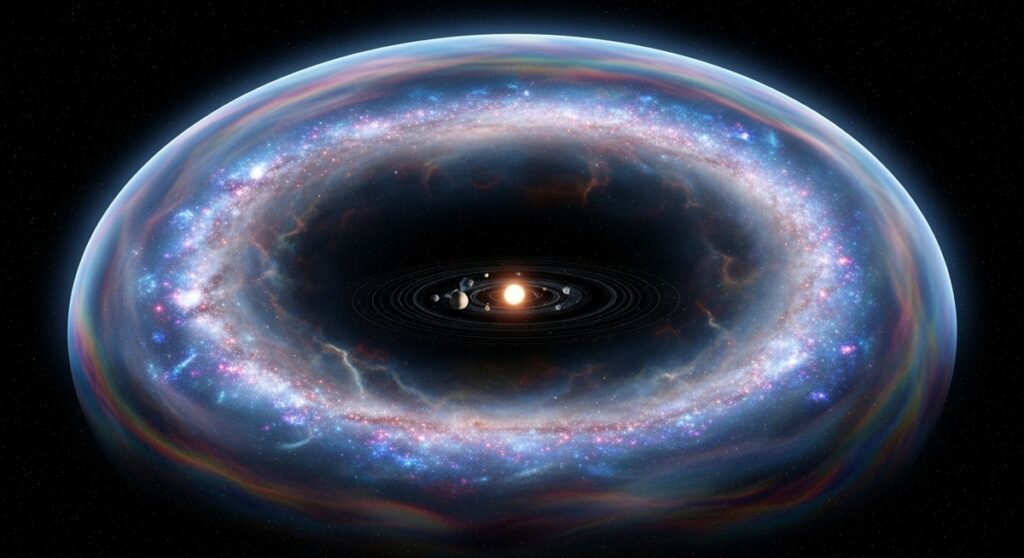
The bubble’s shape is anything but uniform. 3D reconstructions show it bulging toward the galactic poles, where resistance from denser gas is minimal, creating a bipolar form akin to some nebulae. A striking asymmetry exists in temperature | the northern galactic hemisphere hovers at 1.2 million Kelvin (0.10 keV), while the south reaches 1.4 million Kelvin (0.12 keV). This gradient suggests uneven heating, perhaps from sequential supernova blasts pushing energy in different directions.
The Violent Birth of the Bubble Through Supernovae
How did this bubble form? The culprit | a series of supernova explosions, those cataclysmic deaths of massive stars. When a star exhausts its nuclear fuel, gravity overwhelms the outward pressure, triggering a collapse and rebound that hurls material outward at speeds nearing light. Each supernova can release energy equivalent to billions of atomic bombs, carving out shells of expanding gas.
Estimates vary, but scientists believe 6 to 15 supernovae detonated in a cluster around 10–14 million years ago, their shockwaves merging to sculpt the LHB. These weren’t random; they likely occurred in a stellar nursery, triggered by a propagating shock wave from our galaxy’s spiral arms—dense regions where star formation is rampant, influenced by the central supermassive black hole. Over eons, these shells expanded, sweeping up cooler gas and leaving a hot, empty interior. The LHB is essentially a fossil of this ancient violence, with its walls marked by molecular clouds formed from compressed material.
Our Sun wandered into this bubble relatively recently, about 5 million years ago, as it orbits the galactic center at its own pace. Today, we’re smack in the hottest, emptiest part—a cosmic coincidence that has sparked intriguing, if speculative, discussions.
The Interstellar Tunnels | Pathways to Proxima Centauri and Beyond
The real showstopper? Those plasma-filled tunnels branching from the LHB. One extends toward Centaurus, aligning with Proxima Centauri, the red dwarf star hosting potentially habitable exoplanets. This “tunnel” isn’t a hollow tube but a channel of hot gas punching through colder surroundings, visible in X-rays as a gap in the interstellar medium.
Another tunnel points to Canis Major, toward Sirius—the “Dog Star” that’s been a fixture in human lore for millennia. This pathway may link to the Gum Nebula or another superbubble, hinting at a galactic network of interconnected cavities. Proposed in the 1970s, this “tunnel vision” of space suggests hot gas regions aren’t isolated but form a web sustained by ongoing stellar feedback.
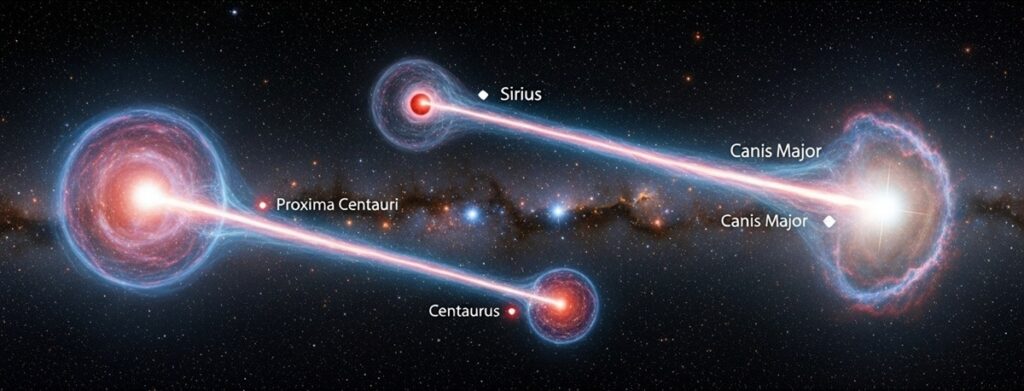
These corridors span hundreds of light-years, their plasma sleeves offering clues to how energy flows between star systems. They’re not shortcuts for travel—the interstellar medium is so tenuous that spacecraft like Voyager barely notice it—but they reshape our view of the Milky Way as a porous, dynamic entity.
Tunnel to Proxima Centauri | Our Nearest Neighbor’s Link
Proxima Centauri, part of the Alpha Centauri system, is tantalizingly close. The tunnel toward Centaurus could be a relic of shared supernova history, connecting our bubble to adjacent ones. While not a portal, it underscores how nearby stars share environmental influences, potentially affecting planet formation or cosmic ray fluxes.
Tunnel to Sirius | Echoes in the Canis Major Direction
Sirius, blazing in Canis Major, has mythical significance across cultures. The tunnel here might bridge to the GSH 238+00+09 superbubble, illustrating how supernovae chain reactions create vast structures. It’s a reminder that our cosmic backyard is shaped by interconnected events.
Speculative Ties | Supernovae, Evolution, and the Origins of Humanity
Here’s where things get provocative. Our entry into the LHB roughly 5 million years ago coincides with a pivotal era in Earth’s history | the rapid evolution of primates, leading to hominids and, eventually, us. Could cosmic rays or radiation from the bubble’s formation have influenced genetic mutations? Some researchers speculate yes, noting increased cosmic ray exposure in low-density regions might spur evolutionary leaps. However, this remains a heated debate with no concrete evidence—more correlation than causation.
The bubble’s supernova origins tie into broader questions about life’s resilience. Supernovae sterilize nearby systems but also seed elements like iron and oxygen essential for planets and biology. Our position in this remnant might be a stroke of luck, shielding us while fostering conditions for intelligence.
Myths, Aliens, and Conspiracy Theories Surrounding the Tunnels
No astronomical bombshell escapes the realm of speculation. The tunnels have ignited online buzz about alien highways, with some claiming they’re conduits for extraterrestrial visitors. Sirius, central to ancient Egyptian mythology and the Dogon tribe’s lore in West Africa, fuels this. The Dogon reportedly knew of Sirius B—a white dwarf invisible to the naked eye—long before telescopes, leading to theories of alien tutors from the star.
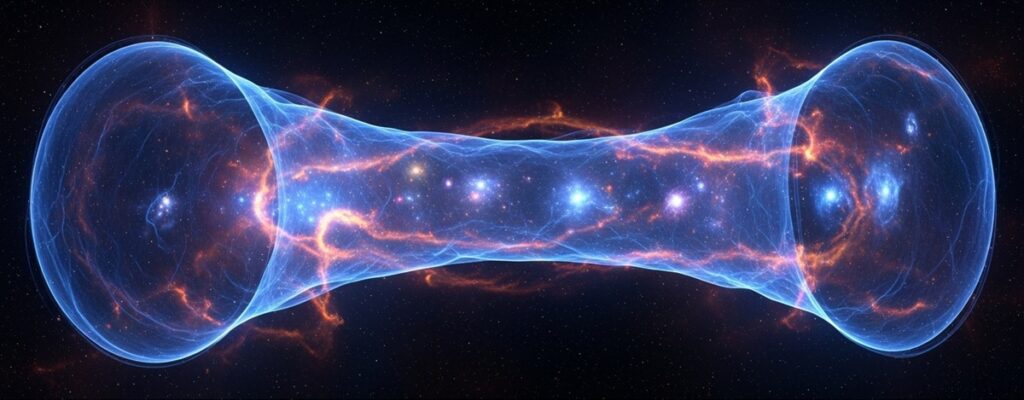
But let’s ground this | Sirius’s brightness naturally draws cultural attention, and Dogon “knowledge” has been debunked as likely influenced by 20th-century anthropologists. No evidence supports alien engineering of these tunnels; they’re natural outcomes of stellar physics. Conspiracy theorists envision wormhole-like passages, but reality is far more mundane—though no less wondrous.
Are These Tunnels Usable for Interstellar Travel? The Harsh Truth
Dreamers ponder | Could future starships zip through these low-density corridors? Accelerate to relativistic speeds without drag? Unfortunately, no. Space is already so empty that the tunnels’ slight density drop is negligible. As one expert notes, the interstellar medium’s “push” on probes like Voyager is less than their own antenna emissions. These are plasma sleeves, not express lanes.
Yet, they hold promise for science. Understanding tunnels could refine models of galactic evolution, cosmic ray propagation, and even dark matter searches. Future missions might probe them directly, enhancing our grasp of the universe’s scaffolding.
The Bigger Picture | What This Means for Our Place in the Cosmos
This discovery is a window into the Milky Way’s turbulent past and interconnected present. We’re not adrift in isolation but embedded in a web of plasma, shaped by eons of stellar drama. As eROSITA and successors like the upcoming Athena observatory delve deeper, expect more revelations about our cosmic home.
In the end, these interstellar corridors remind us of space’s beauty and mystery. They connect us, if only symbolically, to the stars, urging humanity to keep exploring.