



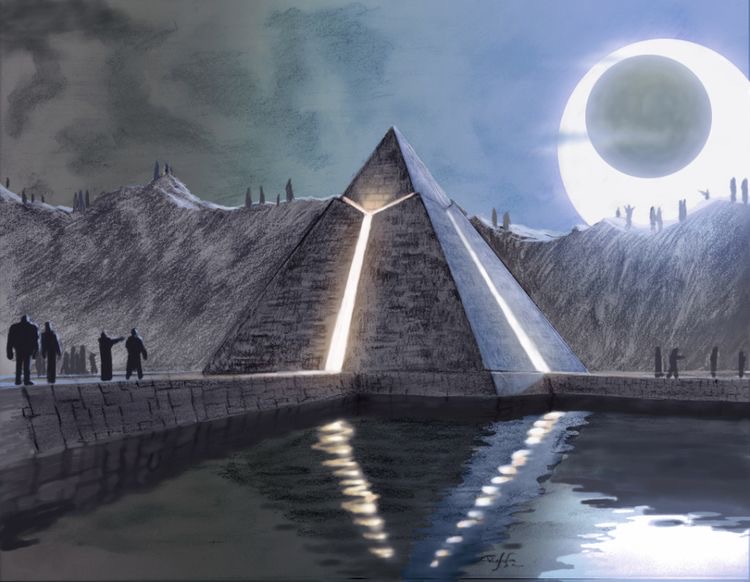
The Aztecs arrived at the ruins approximately seven hundred years after the city had been abandoned. They found the pyramids, the wide avenues, the precise astronomical alignments, and the evidence of a population that had numbered in the hundreds of thousands. They did not find any account of the builders because the builders had been gone for so long that even the memory of their identity had not survived.
The Aztecs named the city Teotihuacan: the Place Where Men Became Gods, or in some translations, the City Where the Gods Were Born. The name preserves the Aztec understanding that whoever had built this city was operating at a level that the Aztecs, themselves builders of sophisticated urban civilization, recognized as categorically different from ordinary human construction.
The scale of what they found justified this assessment. The Avenue of the Dead extends approximately two kilometers from the Pyramid of the Moon at its northern terminus through the Ciudadela complex at its southern end. The Pyramid of the Sun, flanking the Avenue on the east, rises approximately sixty-five meters and covers a base of approximately two hundred and twenty meters on each side. By volume, it is the third-largest pyramid in the world. Its construction required an estimated one million cubic meters of fill material.
The Pyramid of the Sun, the Pyramid of the Moon, and the Temple of Quetzalcoatl are aligned with each other and with the broader urban plan at approximately fifteen and a half degrees east of north. This orientation is not aligned to the cardinal directions. It is aligned to an astronomical event: the point on the horizon where the Pleiades rise at the latitude of Teotihuacan, corresponding to a period approximately two thousand years ago. Whatever designed the city’s layout encoded an astronomical reference whose recovery required modern archaeoastronomical analysis of a precision that the builders’ culture did not leave in any written record.
The Aztecs could not have known this. They simply knew that whoever had built this place was not ordinary.
Their stories said giants had done it.
Xelhua and the Seven
The Aztec flood account, recorded in the colonial period compilations by the Dominican friar Diego Durán and by the Franciscan Bernardino de Sahagún in his Florentine Codex, describes a time before the current world when the Earth was inhabited by giants. The flood came and destroyed the giant civilization. Seven giants survived by sheltering in caves. When the waters subsided, they emerged into a world emptied of the civilization they had known.
One of the seven, whose name Xelhua means he who tramples, went to the region of Cholula. The other six dispersed. Xelhua decided to build a monument that would reach the sky, preserving the memory of the flood and providing a refuge for himself and his brothers. He established a brick-making operation at Tiahuanaco, at the foot of the Sierra de Cecot, and organized the transport of bricks in a human chain from the production site to Cholula.
The detail of the brick transport chain is one of the most striking engineering claims in the Aztec giant account: a line of workers passing bricks hand to hand from Tiahuanaco to Cholula covers a distance of approximately fifteen hundred kilometers if referring to the Tiwanaku site in Bolivia. Whether this geographic reference is accurate, or whether the Aztec account is referring to a different Tiahuanaco in a more local region, is a question whose answer the available sources do not clearly establish.
Whether the reference is local or continental, the brick transport chain describes a logistics organization that this account attributes to giant builders. The same account records the divine response: the gods, angered by the audacity of a structure whose top was to reach the clouds, threw fire on the pyramid, killing workers and stopping construction. The monument was subsequently dedicated to Quetzalcoatl, transforming a project of human ambition into a sacred space of divine acknowledgment.
The parallel to the Tower of Babel story recorded in Genesis, a massive constructed structure reaching toward the sky whose construction was interrupted by divine intervention, is enough to have been noted by every Mesoamerican scholar who has encountered the Xelhua narrative. Whether the parallel reflects independent development of a universal mythological motif about human ambition and divine response, evidence that both accounts preserve memory of a real event, or the influence of biblical narrative on the colonial period compilation of Aztec oral history, is a question whose resolution depends on the dating of the story’s elements and their relationship to the colonial encounter.
Cholula: The Largest Pyramid on Earth
The Great Pyramid of Cholula, known as Tlachihualtepetl in Nahuatl, the Made-by-Hand Mountain, is by volume the largest pyramid structure in the world. Its base dimensions are approximately four hundred and fifty meters on each side, and its height is approximately sixty-five meters. The total volume is approximately four point four five million cubic meters, approximately four times the volume of Giza’s Great Pyramid, which measures approximately two point six million cubic meters.

Its physical scale makes the conventional accounts of its construction significantly more challenging than the scale of Giza’s Great Pyramid, which at least benefits from being one structure whose construction can be attributed to a single organized effort of the Egyptian Old Kingdom state. Cholula’s construction spans multiple building phases across approximately a thousand years, from approximately the third century BCE through the ninth century CE, with each successive culture building over and incorporating the existing structure rather than building a single pyramid in one effort.
The archaeological excavation of Cholula produced approximately eight kilometers of surveyed tunnels that allow study of the construction phases. The engineering of each phase, the use of adobe bricks in the earliest layers and volcanic stone in later phases, shows the construction technology available to successive cultures in the Cholula region. Whether any phase required the giant builders that Aztec belief attributes to the original construction is not established by the archaeological evidence.
What is established is that the original construction in the first centuries CE required the movement and placement of material volumes that represent a significant organizational and engineering achievement for any culture at that technological level. The Aztec attribution of this achievement to giants is the mythological framework that the scale of the achievement, for which no other explanation has been established, generated.
The Catholic church of Nuestra Señora de los Remedios sits on Cholula’s summit, built in 1594 by Spanish conquistadors who believed they were building on a natural hill rather than on a man-made pyramid. The church’s presence gives the structure its most immediately striking visual character and simultaneously represents the layering of civilizations whose each successive presence obscures the one beneath: the Spanish building over the Aztec, the Aztec building over earlier cultures, and those earlier cultures building over Xelhua’s original construction.
The Teotihuacan Mystery
The fundamental mystery of Teotihuacan in the archaeological literature is not its scale, which is well established and acknowledged, but the complete absence of information about who built it.
The major civilizations of Mesoamerica whose historical record is partially preserved, the Maya, the Aztec, the Zapotec, the Mixtec, did not build Teotihuacan. The Aztec arrived at the ruins centuries after the city’s abandonment and named it in reference to its clearly non-Aztec origin. The Maya had contact with Teotihuacan at its peak, recorded in the incorporation of Teotihuacan artistic motifs in Maya monumental art of the classic period, but the direction of influence was from Teotihuacan to the Maya rather than the reverse.
The city at its peak, approximately 100 to 550 CE, housed between one hundred thousand and two hundred thousand people, making it one of the largest cities in the world at that period. Its urban organization, with distinct residential compounds, market areas, a drainage system, and the monumental civic core of the Avenue of the Dead, represents a level of urban planning whose sophistication the archaeological record does not trace to any documented developmental sequence.
The absence of royal tombs, royal inscriptions, and the standard markers of the dynastic political structure that organizes every other Mesoamerican civilization’s major centers is Teotihuacan’s most distinctive archaeological characteristic. The city was organized to produce something other than royal legitimacy. What it was organized to produce has not been established.
The murals preserved in the residential compounds of Teotihuacan show iconographic themes that appear across multiple compounds: the water goddess, serpents, jaguars, and a figure that researchers have identified as connected to rain, fertility, and renewal. The absence of royal portraiture in this iconographic program is the contrast with every other Mesoamerican civilization that makes Teotihuacan most anomalous: a city that organized hundreds of thousands of people without apparently organizing them around a ruler’s glorification.
Whether this reflects an actual political organization that differed fundamentally from the dynastic kingdoms of other Mesoamerican civilizations, or reflects the destruction or removal of the artifacts that would evidence the expected royal program, is a question the available evidence cannot resolve.
The Astronomical Architecture
The fifteen and a half degree east-of-north orientation of Teotihuacan’s primary axis has been recorded by archaeoastronomers including Anthony Aveni, whose systematic study of Mesoamerican astronomical alignments is the standard reference in the field, and Stanislaw Iwaniszewski, whose analysis of the Teotihuacan orientation produced the Pleiades alignment conclusion.

The alignment of the Avenue of the Dead’s axis with the Pleiades at their heliacal rising, the moment when the Pleiades first become visible on the eastern horizon just before sunrise after a period of invisibility, corresponds to an astronomical moment that multiple Mesoamerican cultures treated as significant.
The Aztec New Fire ceremony, whose fifty-two-year cycle marked the completion of the Calendar Round, was timed by observation of the Pleiades reaching zenith at midnight. The anxiety surrounding the ceremony, the possibility that the universe would end if the Pleiades did not cross the zenith correctly, reflects the foundational importance of this astronomical event in the Mesoamerican cosmological framework.
Whether the Pleiades alignment at Teotihuacan reflects the same astronomical practice whose later expression in the Aztec New Fire ceremony is documented, or whether the alignment was chosen for reasons specific to the builders’ own astronomical framework that Aztec belief only partially preserved, is a question whose resolution requires identifying the builders’ cultural context.
The Pleiades connection appears in the Xelhua story’s context in a way that is not obvious from the source material: the claim that the giants built a structure reaching to the sky, and that the gods interrupted its construction, takes on additional resonance in an astronomical framework where the sky that the structure was reaching toward was specifically organized around the Pleiades. Whether the mythological sky-reaching and the astronomical sky-alignment are independent developments or aspects of the same original understanding is the interpretive question the convergence raises.
The Global Giant Pattern
The Aztec giant account recorded in the Xelhua narrative exists in the context of the global giant pattern covered across this library’s Nephilim and Watchers pieces, the Anomalous Skeletal Remains piece, and the Sumerian King List piece’s account of antediluvian giant rulers.
The convergence of Mesoamerican belief with Near Eastern belief is the most striking element: both describe a time before the flood when giant beings built massive structures, both describe a flood that destroyed the giant civilization, both describe survivors of the flood who continued or resumed the construction program in the post-flood world, and both connect the giant builders to divine or semi-divine status that distinguished them from ordinary humans.
The Aztec Xelhua survives the flood and builds Cholula. The Sumerian King List’s antediluvian kings, whose reigns in the thousands of years suggest non-human biological timescales, built the foundations of Mesopotamian civilization before the flood. The biblical Nephilim, offspring of the Watchers and human women, were the mighty men of old, the men of renown, before the flood destroyed them.
Whether these convergent accounts reflect independent development of a universal mythological response to physical evidence of giant stature in prehistoric human remains, transmission of a common story from a pre-deluge civilizational source whose dispersed survivors carried it to different geographic contexts, or genuine historical memory of a pre-flood civilization of anomalous physical stature who built the monumental structures that subsequent cultures found without being able to account for them, is the interpretive question that this multi-culture convergence makes genuinely pressing rather than easily dismissed.
The Anomalous Skeletal Remains piece in this library covers the physical evidence claims: reported skeletal remains of anomalous stature from multiple continents whose characteristics, if authentic, would corroborate the giant accounts’ physical claims. The recorded cases in that piece, combined with the cross-cultural textual evidence of these giant accounts and the architectural achievements attributed to giant builders, constitute the convergence that makes the pattern worth examining as potential historical memory rather than simply mythological elaboration.
What Was Built and Who Built It
Teotihuacan was abandoned around 550 CE, possibly following a fire that destroyed its major civic structures. The fire’s cause, whether internal conflict, external invasion, or something else, is not established. The population dispersed and the knowledge of who had organized its construction dispersed with them.
The Aztecs arrived and named it the Place Where Men Became Gods.
The Xelhua account said giants had built the Cholula pyramid to reach the sky, and that divine fire had stopped them.
The archaeological record shows a city whose astronomical precision, urban scale, and organizational complexity exceed what the conventional narrative of its builders’ developmental history would predict.
The conventional archaeological position is that Teotihuacan was built by an unidentified culture or confederation of cultures drawing on the available human technology and organizational capability of the first millennium CE. This position is not wrong. It is incomplete in the way that an account of Giza as built by an unidentified Egyptian culture using available bronze age tools is not wrong but is incomplete: the account is accurate at the level it addresses but does not address the questions that the evidence raises.
What the evidence raises at Teotihuacan: the absence of a developmental sequence consistent with the achieved sophistication, the absence of the royal program that organizes every other comparable Mesoamerican center, the precise astronomical encoding whose recovery required modern archaeoastronomical analysis, and the Aztecs’ own acknowledgment that whoever built this city was operating at a level that they, sophisticated urban builders themselves, recognized as categorically different from their own achievement.
The giants built it, said the people who came after them.
The gods were born there, said the people who named it.
The builders left no name for themselves and no record of why they built it the way they did.
The fifteen and a half degree alignment still points at the Pleiades. The Avenue of the Dead still runs between the pyramids. The Catholic church still sits on top of the largest pyramid on Earth.
Whatever was built here, and whoever built it, the scale of the achievement and the absence of explanation are both well established and both remain.