




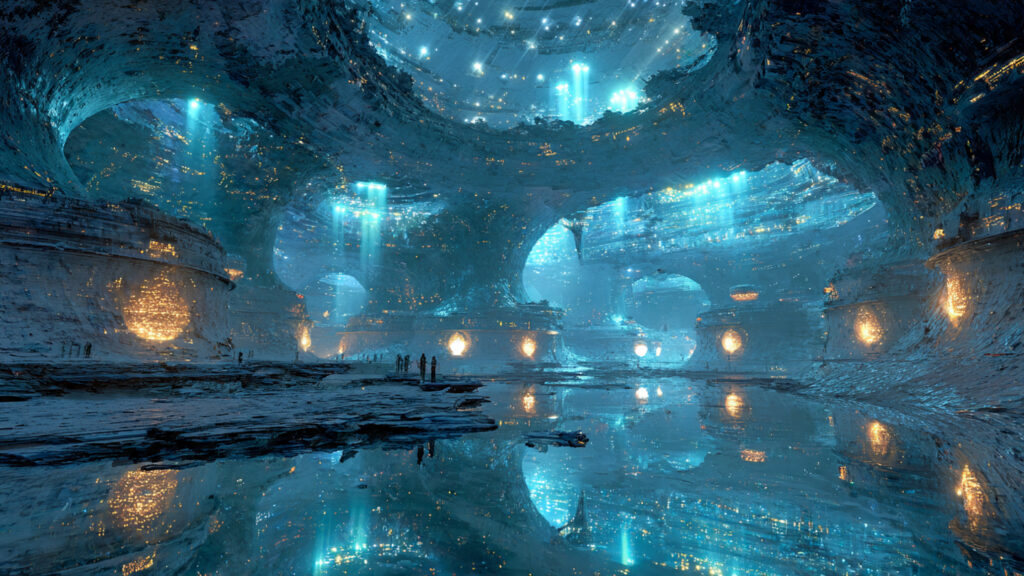
Few landscapes attract mythology as readily as caves and canyons. They hide what cannot easily be verified, preserve traces older than written memory, and invite stories of forgotten worlds waiting just beneath the visible one. The Grand Canyon, Central Asia, coastal California, and the tunnels beneath Central Europe have all accumulated legends over the past century, and untangling them reveals something more interesting than a single hidden civilization.
Some of these threads are rooted in genuine, sobering history. Others began as newspaper inventions. G.E. Kincaid never existed, and neither did Professor S.A. Jordan, the entire story traces to a single April 5, 1909 article in the Arizona Gazette that historians, librarians, and the Smithsonian itself have identified as fabrication. The USS Thresher and USS Scorpion were real, tragic losses with documented mechanical causes, a piping failure and a defective torpedo, neither one a tunnel entrance. Getting these specific, checkable facts right doesn’t make the underlying subject less interesting. It replaces invented catastrophe with several genuinely compelling pieces of real history.
The 1909 Story, Traced to Its Actual Source
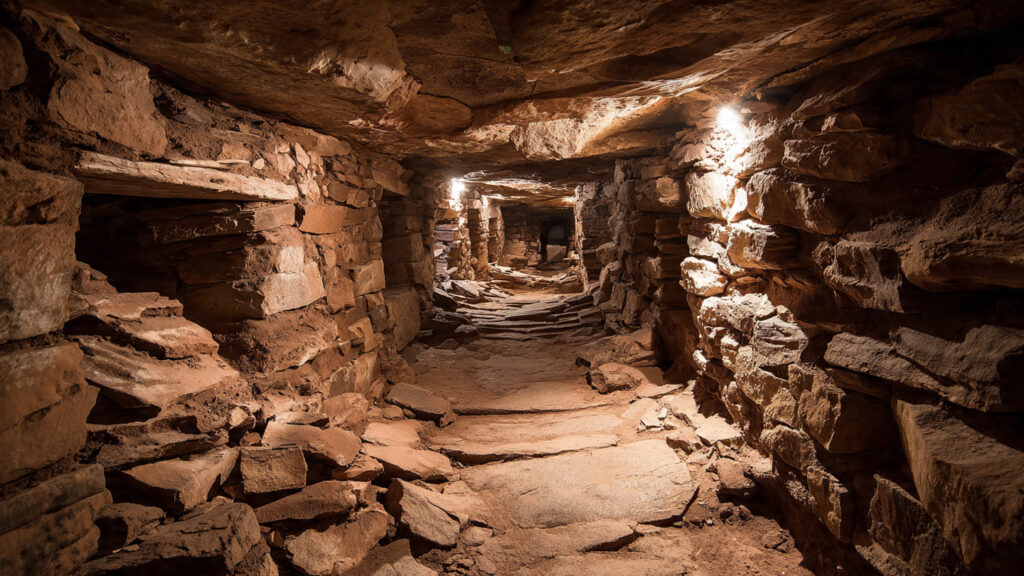
This deserves precise correction, because the actual paper trail is unusually well documented for a century-old hoax. The story ran in the Arizona Gazette, not the Phoenix Gazette, on April 5, 1909, under the headline “Explorations in Grand Canyon,” describing an explorer named G.E. Kincaid who supposedly found a vast cavern system while rafting the Colorado River, joined by a Smithsonian archaeologist named Professor S.A. Jordan.
Historians, librarians, and the Smithsonian Institution have all independently confirmed, over more than a century of inquiry, that no records exist for either man, no funded expedition matching the description ever took place, and no artifacts of the kind described entered any Smithsonian collection.
Genealogical and newspaper research strongly suggests the article was invented outright, quite possibly by Joe Mulhatton, a documented local tall-tale teller of the era nicknamed “the Liar Laureate of the World” for exactly this kind of fabricated news story. The Hopi people’s own origin traditions, involving emergence from an underworld, are genuine and significant on their own terms as living, sacred oral history, entirely separate from and unrelated to this specific fabricated 1909 newspaper story.
What Actually Sank the Thresher and the Scorpion
Both losses are extensively documented naval tragedies, and both have specific, technical, publicly investigated causes that have nothing to do with tunnel entrances. USS Thresher sank on April 9, 1963, killing all 129 aboard, the deadliest submarine disaster in US history. Declassified Navy investigation documents, released after a 2020 lawsuit forced their disclosure, point to a failed brazed piping joint in the engine room, causing a seawater leak that likely short-circuited electrical systems, triggered an automatic reactor shutdown, and left the crew unable to blow the ballast tanks fast enough before the hull imploded, roughly 400 to 730 meters down depending on which acoustic analysis is used. Admiral Hyman Rickover himself testified afterward that the loss reflected broader problems in submarine design and inspection standards, not a single isolated failure, a finding that led directly to the Navy’s SUBSAFE program. USS Scorpion sank in May 1968.
A Navy Court of Inquiry couldn’t determine a certain cause at the time, though later analysis, described by naval historians including Ed Offley, points most likely to an accidental detonation or malfunction of one of its own Mark 37 torpedoes, a design known to have unstable silver-zinc batteries prone to overheating. Neither investigation, spanning decades of formal inquiry, declassified documents, and independent historical research, ever identified tunnel entrances as a contributing factor.
Why Long Beach Actually Sank
Long Beach’s subsidence is genuine, well-documented, and thoroughly explained by conventional petroleum geology rather than a hollow crust. Oil extraction from the Wilmington oil field beginning in the 1930s and 40s caused the ground above it to sink nearly 9 meters in some areas by the 1960s, a textbook case of reservoir compaction: removing enough oil and gas from underground rock formations reduces internal pressure, allowing the overlying rock layers to gradually compress and settle. The subsidence halted once operators began reinjecting water into the depleted reservoir to restore pressure, a standard, still-used industry practice that directly confirms the compaction mechanism, since refilling the reservoir stopped the sinking. That’s a documented, measurable, mechanically understood process, not evidence the city rests on a void. If anything, it’s the opposite, proof that removing material from underground causes the ground above to settle downward and inward, not float.
Ossendowski, Roerich, and Agartha’s Actual History
This deserves accurate framing rather than embellishment, because the actual figures involved are genuinely fascinating without it. Ferdinand Ossendowski was an actual Polish scientist, writer, and adventurer who published Beasts, Men and Gods in 1922, recounting his documented travels through Mongolia and Central Asia during the Russian Civil War, including local legends he encountered about a hidden kingdom called Agartha. Nicholas Roerich was a Russian painter, philosopher, and archaeologist who led genuine expeditions through Central Asia in the 1920s and separately wrote about similar underground-kingdom traditions.
Both men were credentialed travelers relaying documented regional folklore they encountered, not claiming personal access to a hidden civilization themselves. Later esoteric and occult writers, working well after Ossendowski and Roerich, embellished and expanded these secondhand travel accounts into far more elaborate claims about an active, technologically advanced underground society, an evolution of myth-making worth understanding honestly as a layered process across nearly a century, not evidence that either original traveler encountered anything beyond the folklore they described.
What Underground Archaeology Actually Looks Like
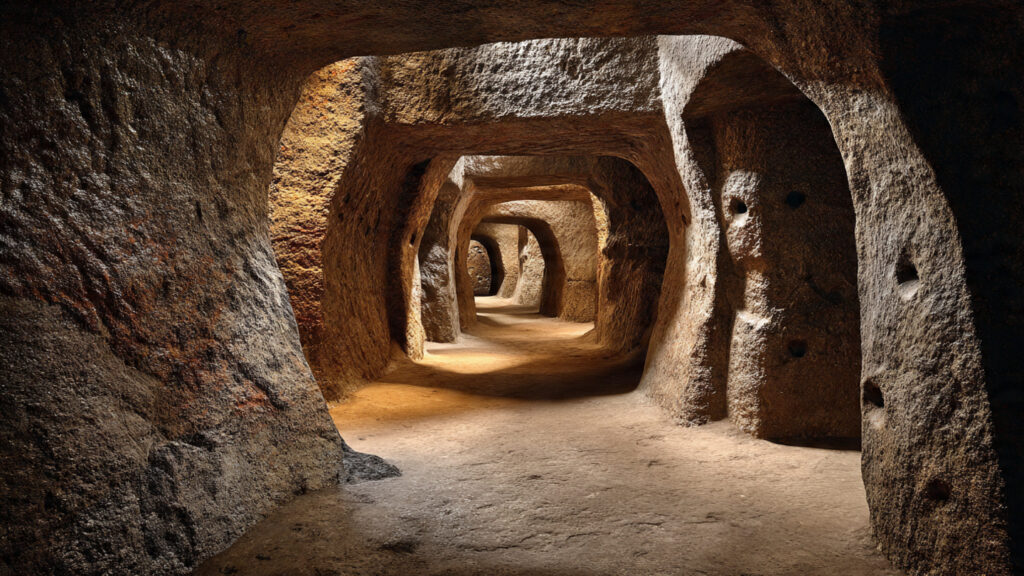
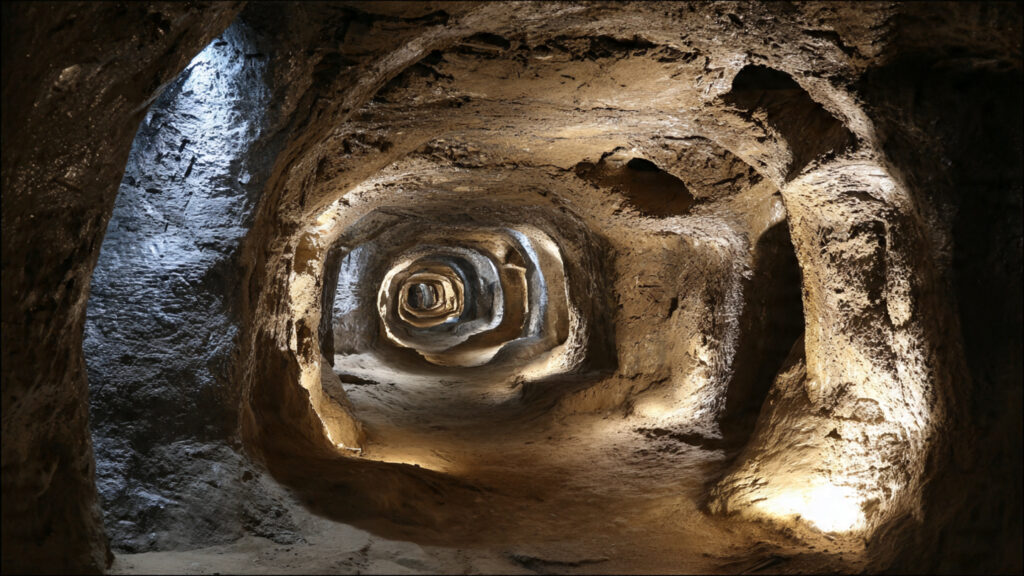
Genuine ancient underground construction exists and is worth knowing on its own terms, at a considerably more modest and well-documented scale than claimed here. Genuine Neolithic and Bronze Age tunnel systems, known as Erdställe, have been documented across parts of Central Europe, narrow, hand-dug passages, not a continent-spanning 12,000-year-old transit network, and their actual purpose remains genuinely debated among archaeologists between ritual use, storage, and refuge rather than settled fact either way. The specific claim of a University of Edinburgh-confirmed network stretching uniformly from Spain to Turkey doesn’t correspond to any publication in the archaeological literature. That more modest mystery, why scattered, genuinely ancient communities across Europe independently dug similar narrow passages, is worth exploring precisely because it doesn’t require a single global architect to remain unresolved and interesting.
Why Underground Worlds Appear Everywhere
There’s a real pattern worth naming across all four of these threads, and it doesn’t require any of them to describe the same physical place. Underground worlds appear in cultures across the globe because caves naturally invite symbolic thinking. They conceal, protect, and separate ordinary life from the unknown, a physical threshold that maps easily onto a psychological one. Long before archaeology existed as a discipline, caves and canyons became the places where imagination located ancestors, gods, spirits, and lost civilizations, precisely because their actual depths resisted verification.
The Hopi’s genuine emergence tradition, the folklore Ossendowski and Roerich encountered in Central Asia, and the newspaper fabrication about the Grand Canyon all draw on the same underlying human instinct, even though only one of them is documented invention and the others are living, sacred belief. Recognizing that shared instinct doesn’t collapse the real differences between a sincere origin story and a fabricated news article. It explains why both kept finding an audience.
What’s Actually Documented Here
The temptation to connect every mystery into one master narrative is deeply human. It promises that history is coherent, and that every anomaly, every unexplained disaster, every strange local legend, belongs to a single hidden design waiting to be uncovered all at once.
The documentary record tells a different story. It’s messier, more fragmented, and, in many ways, more fascinating. A fabricated 1909 newspaper story, a piping failure in a nuclear submarine, an oil field’s slow subsidence, a Polish traveler’s secondhand folklore, each leaves its own trail through history, distinct causes, distinct decades, distinct kinds of evidence. They don’t all lead to the same place. But followed on their own terms, each one is genuinely worth the trip.
This is one of eight such traced stories collected in one place.