



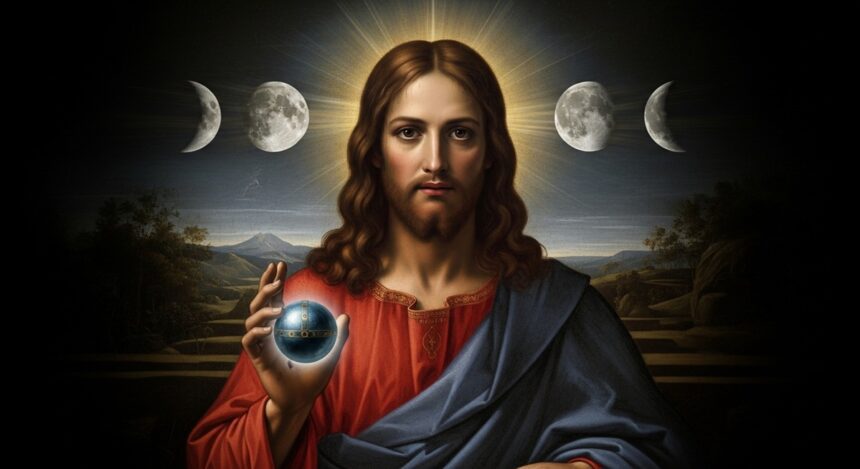
Leonardo da Vinci’s Salvator Mundi does contain a well established scientific puzzle: the crystal orb in Christ’s left hand doesn’t behave the way glass or rock crystal actually should.
What follows covers that puzzle accurately and in full, and separates it clearly from an unverifiable ethnographic story that circulates alongside it.
The Optical Puzzle
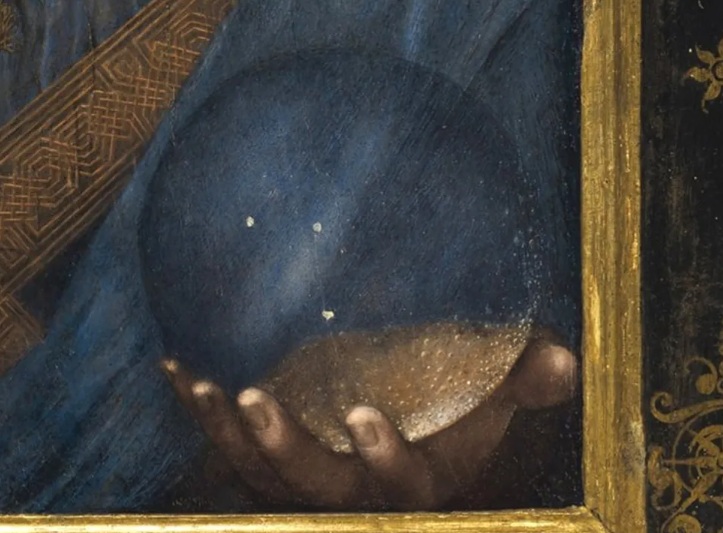
This is well established art historical territory, not fringe speculation. Leonardo was a serious, careful student of optics, and his surviving notebooks demonstrate detailed understanding of how transparent and reflective materials distort light. Art historians and scientists studying Salvator Mundi, including analysis referenced in Walter Isaacson’s 2017 biography of Leonardo, have noted that a solid glass or rock crystal orb of the size depicted should produce visible refraction and inversion of whatever lies behind it, the folds of Christ’s robe, most obviously. The orb in the painting does not show this expected distortion.

Several explanations have been proposed by art historians for this discrepancy. One holds that Leonardo deliberately simplified the optics for compositional and symbolic clarity, prioritizing legibility of Christ’s robe over strict physical accuracy, a choice consistent with religious painting conventions of the period more broadly. Another proposes the orb depicts a hollow rock crystal sphere rather than a solid one, a recorded type of luxury religious and royal object in Renaissance Europe, which would produce considerably less refractive distortion than a solid orb. A third, more skeptical position holds that Leonardo, despite his expertise, simply painted the reflective properties inaccurately, whether from working partly from memory, delegating parts of the technical execution, or prioritizing other concerns. All three explanations are seriously discussed in art historical literature. None of them requires a hidden cosmological message or lost civilization to explain the discrepancy.
The Three Dots
Small light-colored inclusions are visible within the painted orb, and this detail is real and observable in the actual painting, not an invented claim. What these represent is considerably less settled than confident retellings suggest. The most straightforward explanation, consistent with how rock crystal naturally forms, is that they depict mineral inclusions or air bubbles of the kind rock crystal specimens commonly contain, a detail Leonardo, working from an actual crystal object as reference, would have had every reason to observe and paint faithfully. Reading them as a specific astronomical reference to multiple moons is one speculative interpretation among several possible readings, not an established or widely accepted position among Leonardo scholars who study this painting professionally.
A Claim That Cannot Be Verified
A story attributed to a “German ethnographer Klaus Müller,” describing shamanic visions among a Peruvian tribe revealing a “pre-diluvian civilization known as the Chikhi” living under three moons roughly 150,000 years ago, circulates alongside discussions of this painting. No verifiable source could be located for this specific individual, this specific tribe, or this specific account in any academic, journalistic, or ethnographic record checked. Given how well documented actual ethnographic fieldwork in the Peruvian Amazon, including credentialed researchers’ published accounts of ayahuasca ceremonies and shamanic cosmology, actually is, the absence of any comparable published record for this specific claim is notable. It should be treated plainly as unverified rather than repeated as established historical fact in any future retelling of this painting’s story.
The Second Moon Science, Told Correctly
This is worth reporting accurately, because the science is fascinating on its own terms and doesn’t need embellishment. In 2011, planetary scientists Martin Jutzi and Erik Asphaug, then at UC Santa Cruz, published research in the journal Nature proposing that Earth may have once had a second, smaller moon that formed alongside our current Moon in the aftermath of the same giant impact event believed to have created it, roughly 4.5 billion years ago. Their model proposes this smaller companion moon eventually collided with and merged into the far side of the primary Moon in a slow-motion impact, a “big splat,” which could help explain the striking difference in crust thickness and terrain between the Moon’s near and far sides, an established geological asymmetry that predates any human observation by billions of years.
This is peer-reviewed planetary science, published in one of the world’s most rigorously reviewed scientific journals, and it’s worth being precise about its actual timescale and implications, since these specific details are essential to the finding’s meaning: this proposed second moon merged with the first roughly 4.4 to 4.5 billion years ago, long before life existed on Earth in any form, let alone before any human civilization could have observed or recorded it. It’s a hypothesis about the ancient formation history of our single current Moon, not evidence of multiple moons visible to any human witness at any point in the last several hundred thousand years, and connecting it to a 150,000-year-old human civilization requires ignoring the actual timescale the research itself establishes.
The Complicated Attribution History
This specific painting’s unusual modern history deserves its own context, since it’s a legitimately remarkable story on its own terms. The painting resurfaced in 2005, badly overpainted and damaged, purchased for under $10,000 by a small consortium of art dealers who suspected it might be an authentic Leonardo beneath centuries of restoration and repainting. A careful, multi-year conservation and attribution process followed, led by conservator Dianne Modestini, whose restoration work involved painstaking removal of centuries of overpainting and damage, reviewed by several independent Leonardo scholars along the way, before the painting was publicly exhibited as an authentic Leonardo at the National Gallery in London in 2011, a significant moment in the painting’s documented rediscovery. This attribution has not been universally accepted. An ongoing scholarly debate exists about how much of the final painting represents Leonardo’s own hand versus significant studio assistance or later restoration, a substantive art historical controversy independent of anything to do with the orb’s symbolism. Whoever painted how much of it, the documented restoration and attribution process itself is a fascinating story about how a damaged, unrecognized painting can be rediscovered through careful technical and historical scholarship.
Why Fabricated Ethnographic Sources Attach to Real Art Mysteries
Why an invented account like the “Klaus Müller” story finds a natural home attached to a genuinely puzzling detail like the orb’s optics is worth explaining. The puzzle creates a legitimate opening, a documented, unresolved question that credentialed scholars actually debate, and that legitimate uncertainty can make an entirely fabricated addition feel more credible by association, since a reader who has just learned the orb’s physics doesn’t add up may be primed to accept the next claim with less scrutiny than it deserves. This is worth recognizing as a general pattern, not just in this specific case: an unresolved detail is not the same as an invitation to accept any explanation offered for it, and the most responsible response to genuine uncertainty is naming it as uncertain, clearly and without embarrassment, rather than filling the gap with an unverifiable story that happens to feel satisfying simply because it arrives with enough specific, confident-sounding detail.
What’s Actually True About Leonardo
Leonardo da Vinci’s extensively recorded genius across painting, anatomy, engineering, and optics deserves appreciation on its own honest terms. His surviving notebooks demonstrate careful study of light, water flow, human anatomy, and mechanical systems well ahead of his contemporaries, historical fact that needs no embellishment. Salvator Mundi itself, regardless of what the orb’s small inclusions represent, is a sophisticated work demonstrating careful technical mastery, and its recorded attribution history, sale, and 2017 auction for $450.3 million, the highest price ever paid for any painting at auction, are all independently verifiable facts, entirely separate from any speculative cosmological reading of its content.

Where the Painting Is Now
One more verified detail about the painting’s physical condition grounds the broader conversation about its authenticity and history. Technical examination during the 2011-2017 restoration and attribution process, including infrared reflectography and X-ray fluorescence imaging, standard conservation science techniques used across the field, revealed underlying changes Leonardo made to the composition as he worked, including a shift in the position of the blessing hand’s thumb, a telling sign for art historians, since underlying revisions of this kind are considered strong evidence of an artist’s own original working process rather than a later copy or workshop reproduction, which would typically follow a single fixed design without this kind of visible, in-progress revision.
The painting’s actual current status also gets frequently distorted in less careful retellings. Following its record-breaking 2017 Christie’s sale, Salvator Mundi was purchased by Saudi Crown Prince Mohammed bin Salman, and its planned unveiling at the Louvre Abu Dhabi was postponed indefinitely without official explanation. The painting’s precise current physical location has not been publicly confirmed since that postponement, a genuine mystery in the narrow sense that the information remains unknown, though an entirely mundane one by the ordinary standards of high-value private art transactions generally: extremely valuable artworks in private hands are frequently kept out of public view for reasons of security, ongoing negotiation, or simple owner preference, without requiring any exotic explanation. This is distinct from the painting’s actual content and symbolism, which remain fully accessible and available for study through the high-resolution photography and the extensive conservation and attribution scholarship produced before its sale, all of which remains publicly available regardless of where the physical object itself currently sits.

A Useful Comparison | The Mona Lisa’s Real Mysteries
Comparing the treatment of Salvator Mundi’s orb to the genuinely well-studied mysteries surrounding Leonardo’s most famous work, the Mona Lisa, is instructive, since the comparison illustrates the difference between a legitimate open art historical question and an invented one. Established mysteries about the Mona Lisa include genuine uncertainty about the sitter’s precise identity, though Lisa Gherardini remains the most widely accepted candidate based on documentary evidence, unresolved questions about the specific landscape depicted in the background, and ongoing technical analysis of Leonardo’s sfumato technique, the subtle blending of tones that produces the famously ambiguous smile. These are actively studied questions pursued through infrared reflectography, X-ray analysis, and archival research by credentialed conservators and art historians, producing incremental, published findings over decades. This is what a genuine art historical mystery actually looks like: not a single origin story that either checks out or doesn’t, but an ongoing, methodical accumulation of technical and documentary evidence that gradually narrows the range of plausible answers. Salvator Mundi’s orb deserves exactly this kind of careful, methodical treatment, and it’s already receiving it from scholars, without needing an invented ethnographic account to make the question more interesting than it already is.
A Painting Worth Studying on Its Actual Merits
The honest version of this story is interesting without requiring an invented ethnographer or a misapplied planetary science paper to support it. Leonardo’s expertise in optics makes the orb’s inaccurate refraction a legitimate, still-debated art historical puzzle, one that scholars continue to discuss through several credible, competing explanations. The 2011 lunar formation hypothesis is a remarkable finding about our solar system’s ancient history, valuable and interesting on its own scientific terms. Both deserve to be understood accurately rather than combined into a single speculative narrative that neither one actually supports.
Salimbeni’s 1600 painting in Poggibonsi raises the same kind of question from an earlier, less studied canvas, an object nobody has formally identified.