



The administrative architecture of the Pre Columbian Andes was anchored to a singular geodetic point that challenges the chronological boundaries of global archaeo astronomy.
The Coricancha, the Golden Garden located at the intersection of the Huatanay and Tullumayo rivers in Cusco, Peru, did not function as a passive monument for primitive sun worship. It was engineered as a highly calibrated geographic and kinetic hub, operating as the processing core for an intricate network of territorial energy vectors.
The structural design of the Coricancha utilized an advanced masonry technique completely uncharacteristic of standard Bronze Age development. The foundational walls were constructed from highly dense, mortarless basalt and dark andesite blocks. Each stone was precision milled with interlocking tongue and groove joints and slightly curved surfaces, allowing the entire mass to shift dynamically during major seismic displacements without fracturing. This was not a decorative choice; it was an institutional calculation designed to ensure the permanent survival of a critical data repository against the violent tectonic realities of the South American plate.
Before its systematic deconstruction during the Spanish colonial penetration of 1533, the complex operated as an active regulatory grid. The internal architecture was partitioned into six highly secure sanctuaries, each dedicated to an operational principle within the state cosmology. The Hall of Viracocha served as the primary repository hosting the central cosmological evidence stack. The Hall of Quilla acted as the lunar tracking terminal managing terrestrial tidal loops. The Hall of Illapa functioned as the atmospheric plasma and electrical discharge monitor. The Hall of Cuichu served as the atmospheric refraction and solar radiation sensor node. The Hall of Chasca operated as the tracking station for the dawn star orbital vectors, while the Hall of Inti contained the central power and telemetry core of the entire imperial apparatus.
This six fold administrative layout managed the ceque system, which consisted of a series of forty one hidden, radially aligned geodetic vectors extending across thousands of miles of Inca territory. The ceques were not mere pathways; they were line of sight tracking coordinates and electromagnetic channels that intersected at the central altar of the Coricancha. By placing the imperial capital at the precise nexus of these forty one lines, the institutional elite maintained a continuous, unblinking regulatory hold over the regional environment, resource distribution, and seismic baselines of the entire continent.
The Structural Fraud of the Demolition
The arrival of the Spanish expeditionary force under Francisco Pizarro resulted in an immediate, highly coordinated program of cultural and physical demolition. The conventional historical narrative frames this intervention as a primitive crusade driven by religious fanaticism and raw economic greed. A forensic examination of the administrative records indicates a far more deliberate operational motive: the systematic purging of an advanced astronomical database that threatened the Eurocentric monopoly on historical chronology.
The destruction of the Coricancha was executed with clinical efficiency. The heavy, high purity gold sheets that sheathed the interior walls, measuring several millimeters in thickness and engineered to act as electromagnetic shielding for the inner sanctuaries, were violently stripped from the stone. Over 700 individual plates were harvested, totaling millions of ounces of gold. This material was not preserved for study; it was instantly melted down into standardized, unrefined ingots, stamped with the imperial seal of King Charles V, and routed directly to European financial centers to subsidize the military operations of the Holy Roman Empire.

To permanently seal the site and prevent the reconstruction of the ceque tracking metrics, the colonial authorities erected the Church of Santo Domingo directly over the polished basalt receptacle walls of the Sun Temple. The construction was a deliberate act of architectural masking. By placing a Baroque ecclesiastical facade directly onto the precision engineered Incan foundations, the new administrative layer created an ideological filter. The public was trained to look at the altar of a conventional parish church, while the deep, subsurface stone channels that anchored the empire’s real, unblinking cosmological data loops were buried from public view.
The Intersolar Telemetry of the Viracocha Plate
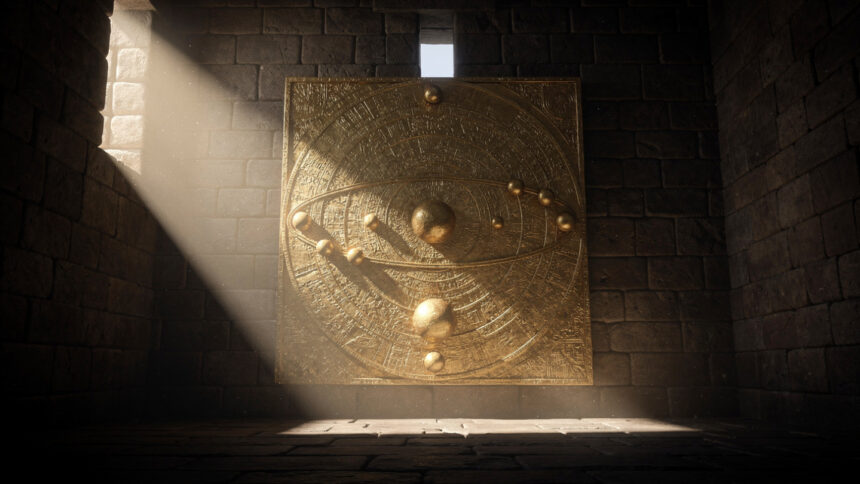
The primary evidence of the Coricancha’s advanced tracking capabilities resides in the detailed descriptions of the central gold cosmogram that hung behind the principal altar in the Hall of Viracocha. While the physical artifact was intercepted and destroyed during the 1533 bullion extraction, meticulous descriptions recorded by early chroniclers, including Joan de Santa Cruz Pachacuti Yamqui Salcamayhua, provide the exact layout of the iconography.

Standard archaeological monographs categorize this panel as a poetic rendering of a primordial creation egg from which the human species and the stars emerged. This interpretation completely falls apart under mathematical scrutiny. The central emblem, the Wiraqucha Imaymana, is a highly calibrated, geometrically precise rendering of an eccentric orbital ellipse. The plate features a rigorous cross sectional bisection of the solar system. The upper quadrant houses five distinct celestial bodies arranged in a precise geometric cross formation, tracking the outer planetary orbits. The lower quadrant houses four matching celestial bodies, mapping the internal rocky planets. At the absolute lowest point of the central elliptical track, completely isolated from the standard orbital planes, sits a distinct, heavy tenth planetary body.
This data structure contains an absolute, unblinking correlation to the Mesopotamian cylinder seal designated VA243, recovered from the Akkadian period and curated within the permanent collections of the Vorderasiatisches Museum in Berlin. Seal VA243 explicitly renders an eleven body solar system, showing a cluster of distinct planetary bodies encircling a central, radiating stellar mass. Both the Akkadian seal and the Coricancha cosmogram document an identical astronomical anomaly: the existence of a high mass planetary asset operating on a long period, highly eccentric orbit that intersects the inner solar system between the trajectories of Mars and Jupiter.
The statistical probability of two independent, geographically isolated civilizations developing the exact same non intuitive planetary inventory, identical cross sectional bisectors, and the precise orbital location of a long period interloping asset through pure mythic coincidence is zero. The Coricancha panel was not an expression of religious fantasy; it was a physical transcript of a shared, deep time tracking metric that had been systematically passed through institutional hands for millennia.
The Translucent Waveguide Core
The active control center of the Coricancha network was the artifact recorded as the Golden Sun Disk, or the Inti Inka Iskay. According to indigenous records preserved in the deep Andean oral traditions, the disk measured between six and seven feet in diameter and was originally mounted at the focal intercept of the forty one ceque lines within the central sanctuary.
The physical properties of this relic were completely inconsistent with standard gold metallurgy. Chroniclers noted that the material possessed a unique translucent quality, exhibiting a low density, highly reflective structural composition that shimmered with an independent internal illumination when exposed to direct solar radiation. The artifact was not a decorative plate; it was an engineered isotopic or mono atomic composite structured to act as an electromagnetic waveguide and low frequency seismic transducer.

The operational function of the disk was directly tied to environmental regulation. By capturing and refracting the intense, high altitude solar radiation of the Cusco basin and routing that energy down into the precision milled stone channels of the temple foundation, the disk acted as a seismic stabilizer. The forty one ceque lines functioned as an array of literal ground wires, dispersing low frequency acoustic and electromagnetic currents across the fault lines of the Peruvian Andes to suppress major volcanic and tectonic events. The disk was an active piece of planetary management infrastructure, used by the institutional elite to preserve the structural equilibrium of the state’s agricultural and civil geography.
The Removal Sequence and the Vilcabamba Redirection
As the Spanish military column advanced from the northern valleys toward Cusco, the high priesthood of the Coricancha initiated a pre planned asset protection protocol. The extraction was not a panicked scramble; it was an organized, tactical redirection of the empire’s core technological assets.
The operation was overseen by the high priest Aramu Maru, the primary custodian of the inner sanctuaries. Before the perimeter of Cusco was compromised, the translucent Golden Sun Disk was carefully detached from its central basalt mount, stripping the ceque network of its active processing core. Simultaneously, the sacred unredacted chronicles and the core metallurgical templates of the temple were packed into secure, water impermeable leather containers.
The transit route was calculated to exploit the geodetic geography of the Andes. Aramu Maru routed the artifact southward toward the magnetically anomalous rock formations near Lake Titicaca, specifically the megalithic site known as Hayu Marca, the Gate of the Gods. This location features a massive, precision carved T shaped alcove recessed into a solid rock face, engineered with a central circular depression that matches the exact physical specifications and locking notches of the Golden Sun Disk.
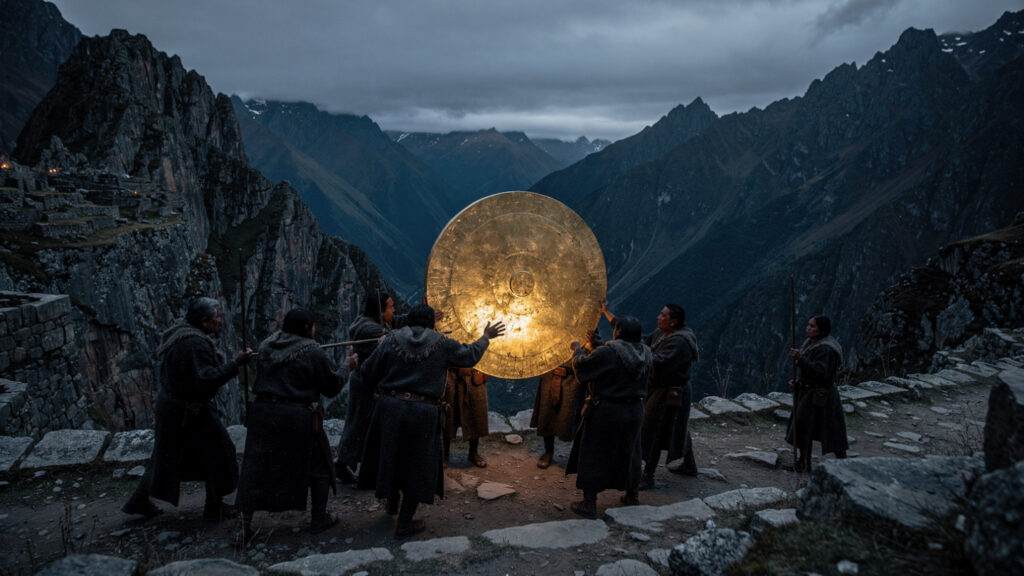
Local traditions state that the disk was briefly integrated into the Hayu Marca portal to calibrate a regional communications loop before being routed deeper into the Amazonian cloud forests of the Vilcabamba region. When Manco Inca established the neo Inca resistance state in 1536, the state’s defensive perimeter was drawn explicitly around the hidden coordinates of the disk. The colonial forces spent decades searching the jungle for what they believed was a hoard of gold bullion; in reality, they were tracking a displaced technological asset whose recovery was deemed mandatory by the statecraft of Europe.
The Management of the Long Period Orbit
The deliberate deconstruction of the Coricancha and the systematic hunting of its central artifacts reveal the unblinking methodology of global information management. The corporate and religious institutions that managed the colonization of the New World were not interested in exploring new realities; they were tasked with enforcing a standardized, flat line timeline of human history.
The ancient data preserved on the Viracocha panel describes the material world not as an isolated, stable biosphere, but as a managed construct subject to cyclical, extreme gravitational and electromagnetic disruptions induced by the periodic transit of the tenth planetary asset. The tracking of this asset was the primary function of the high purity gold infrastructure within the ancient world’s temples. By monitoring the exact vector of the intersolar intercept, the ancient elites calculated the precise timing of global environmental stress points.
By melting the gold plates, burying the basalt foundations beneath Baroque brickwork, and categorizing the precise astronomical maps as primitive mythology, the gatekeepers of modern history successfully neutralized public awareness of these cosmic mechanics. The population was stripped of its deep time data baseline and left to operate within a simplified, short term chronological loop. The stones of Cusco remain locked into their geodetic coordinates, serving as a silent, physical testament to an advanced telemetry that was systematically erased from the human record to preserve the absolute authority of the modern institutional framework.