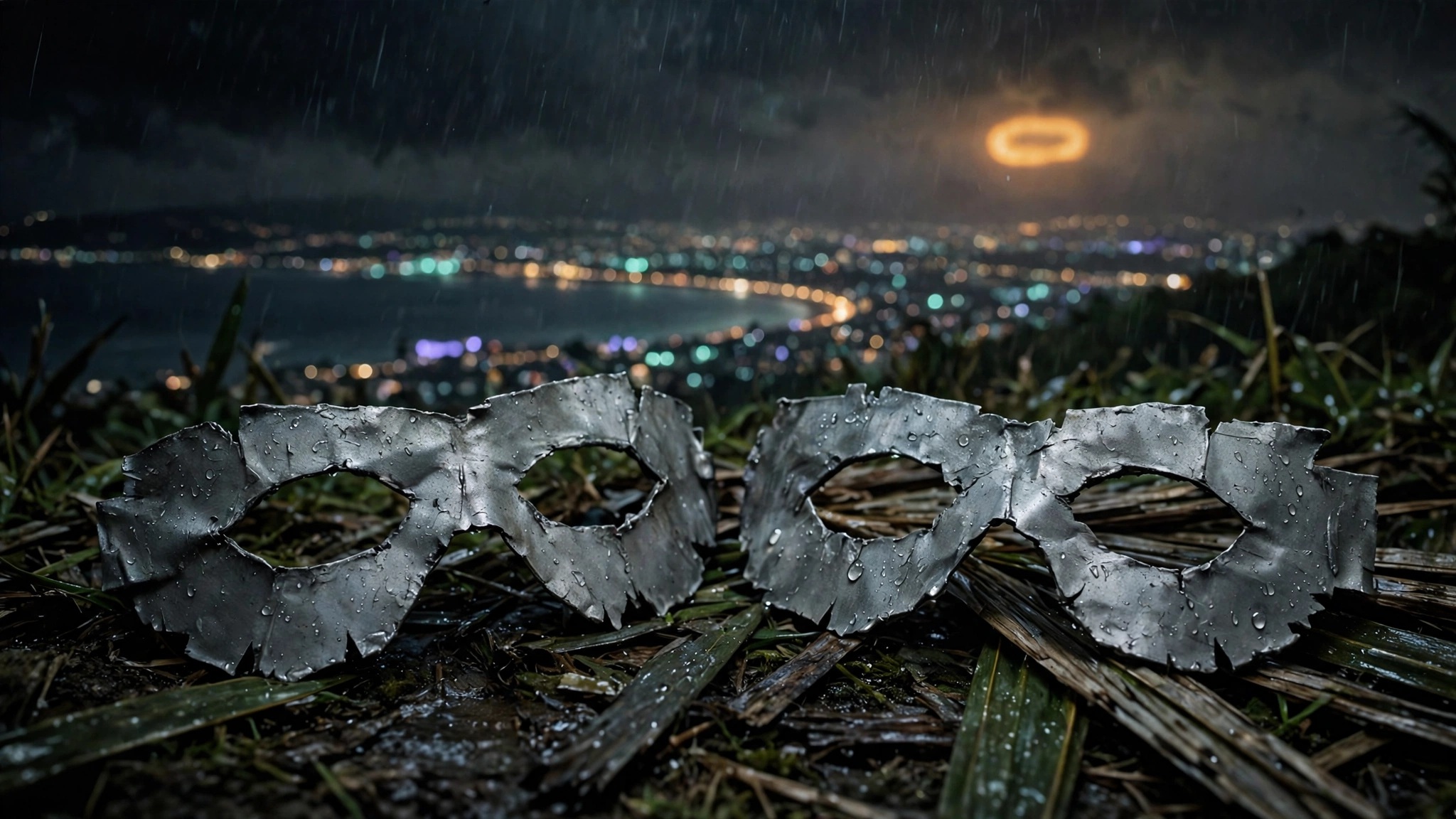
On the afternoon of Saturday 20 August 1966, a boy named Jorge da Costa Alves climbed Morro do Vintém, a scrubby hill above the city of Niterói, across the bay from Rio de Janeiro, to look for a lost kite. He noticed the smell first. Then, in the tall grass near the top, he found two men lying side by side on their backs, as neatly as if they had been laid out for a wake. They wore good suits under new raincoats. Over their eyes, each wore a crude mask cut by hand from a sheet of lead.
Beside them the police found an empty bottle of mineral water, a paper parcel holding two towels and a small notebook. In a pocket was a note that has haunted Brazil ever since. It gave a time to be at a chosen place, a time to swallow capsules and an order to wait for a signal. This is the Lead Masks case, the Caso das Máscaras de Chumbo, and almost sixty years later no one can say how the two men died.
They were Manoel Pereira da Cruz and Miguel José Viana, two radio and television repairmen from the town of Campos dos Goytacazes, and they had left home three days earlier with a story about buying a car. On the night they climbed the hill, a woman driving below it with her children saw an orange light hang over the summit. In the months that followed, the police would chase spiritualists, a missing fortune, a jeep that nobody could trace and a prisoner who swore he had helped to kill them. The hill gave up none of its answers.

Two Men From Campos
Campos dos Goytacazes is a sugar town near the mouth of the Paraíba do Sul river, a long bus ride north-east of Niterói. Manoel Pereira da Cruz was 32 and Miguel José Viana was 34. Both were married, both repaired radios and televisions, and they ran a small business together. In the middle of the 1960s that trade still carried a little of the glamour of the new. Television had not long reached the Brazilian interior, and the men who could coax a picture out of valves and copper wire knew things their neighbours did not.
On Tuesday 16 August, Manoel told his wife, Neli, that he and Miguel were going to São Paulo to buy a used car and parts for the workshop. He took about 2.3 million cruzeiros with him, a large sum for a repairman and, by most accounts, enough for the car he spoke of. Early the next morning the two men boarded a bus at nine o’clock. A friend named Élcio saw them off at the station. The bus was not bound for São Paulo. It was bound for Niterói.
Why they lied is the first of the case’s silences. Neither family knew of any business in Niterói beyond the shops where the men bought parts. Neither man left a letter or a word of farewell. Manoel carried an almost empty packet of cigarettes, as a man does on an errand that will be over by evening, and nothing either of them packed suggests two men who meant to die.

The Last Afternoon
The bus pulled into Niterói at about half past two in the afternoon. In 1966 the city was the capital of the old state of Rio de Janeiro, a busy port facing the larger city across Guanabara Bay. The two men seem to have known exactly where they were going. Police later traced them to an electronics shop where they were regular customers, and then to a clothing store, where they bought two identical raincoats. It had begun to rain.
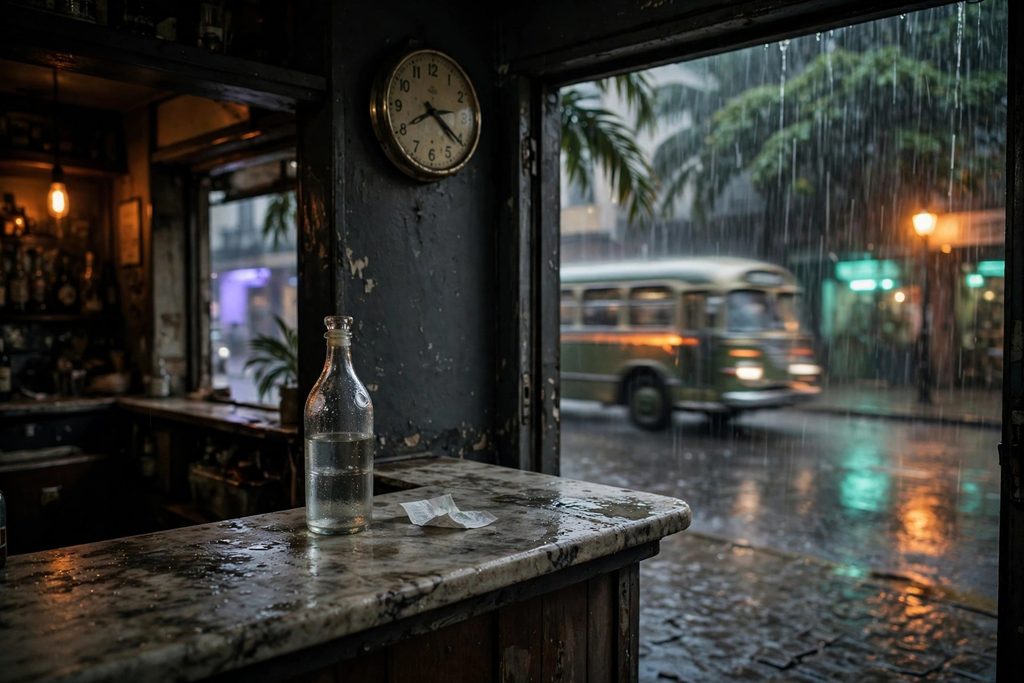
At a bar on Avenida Marquês do Paraná they bought a bottle of mineral water and asked for a receipt, so that the empty bottle could be returned for its deposit. That small, careful act has troubled everyone who has studied the case. It is the habit of a man who expects to be back in town tomorrow. The woman behind the counter remembered Miguel well. He seemed nervous, she told the police, and kept looking at his watch, as if he had an appointment he could not miss.
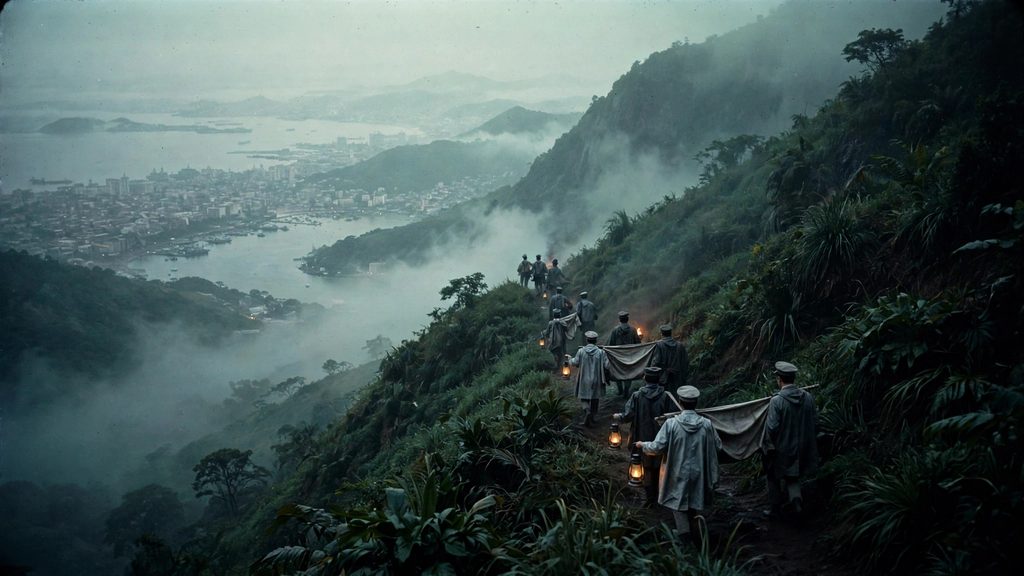
Dusk came early under the rain. A watchman who lived near the foot of Morro do Vintém, Raulino de Matos, later said he saw two men in raincoats arrive at the hill in a jeep with two other men he did not know. The four of them set off on foot up the slope. The two men from the jeep were never identified, and they never came forward. After that evening, nobody admits to having seen Manoel and Miguel alive.
- 16 Aug, Tue
Manoel tells his wife the two men are going to São Paulo to buy a used car and parts.
- 17 Aug, 9:00
They board a bus in Campos. It is bound for Niterói, not São Paulo.
- 17 Aug, 14:30
Arrival in Niterói. An electronics shop, two raincoats and a bottle of water.
- 17 Aug, dusk
A watchman sees them reach the hill in a jeep with two unknown men.
- 17 Aug, evening
Gracinda Barbosa and her children see an orange object hovering over the hill.
- 18 Aug, Thu
A young bird hunter is said to have found the bodies and told a guard, who waited.
- 20 Aug, Sat
Jorge da Costa Alves, searching for his kite, finds the two men in the grass.
- 21 Aug, Sun
Police and firefighters carry the bodies down. No cause of death can be named.
- 14 Sep 1966
O Globo reports the police verdict, a parapsychological experiment gone wrong.
- 1969
Prisoner Hamilton Bezani claims he and three others poisoned the men. Police reject it.
- May 1969
The court closes the case for lack of evidence.
The Note in Miguel’s Hand
Among the papers in their pockets was a note written in Miguel’s handwriting. In Portuguese it reads: 16:30 estar no local determinado. 18:30 ingerir cápsulas, após efeito proteger metais aguardar sinal máscara. In English it runs roughly like this. 4.30 pm, be at the chosen place. 6.30 pm, swallow capsules. After the effect, protect metals, wait for the signal. Mask.
Every phrase in it opens a door. The times fit the afternoon almost too well. At half past four the two men would have been leaving the bar in the rain, and by half past six night had fallen over the hill. The capsules were never found, not in their pockets and not in the grass. Protect metals may mean the masks themselves, or something else they carried. And the signal, whatever it was meant to be, was something they expected to see, which is why so many have argued that the lead was there to shield their eyes from a light they believed would come.
There is a detail in the Brazilian accounts that makes the note colder still. Investigators felt that its wording did not sound like either man, as though Miguel had written down words that someone else was speaking. If that is so, the note is not a plan the two friends made together. It is an instruction they were given.
The rest of the scene was just as orderly. The men lay on a bed of palm leaves that had been cut with a blade, though no knife was found. One sheet of paper held a few lines of basic electronics, Ohm’s law among them, and the notebook listed codes for radio valves. Their watches had been taken off their wrists and placed in their pockets. And of the 2.3 million cruzeiros Manoel had carried from Campos, the police found only about 157,000 in one pocket and 4,000 in another.

Two lead masksCut by hand
Thin sheet lead shaped like spectacles. Offcuts were found in Miguel’s workshop.
The noteIn Miguel’s hand
Times, capsules, metals, a signal and a mask.
Suits and raincoatsCoats bought that day
Good clothes under new coats, as if dressed for a ceremony in the rain.
Mineral waterBottle empty
Bought at a bar, with a slip to return the bottle for its deposit.
Two towelsIn a paper parcel
Their purpose has never been explained.
Palm leavesCut with a blade
A bed prepared on the hilltop. No knife was found.
The notebookValve codes
The parts lists of a repairman, read by some as a cipher.
Two watchesTaken off
Removed from their wrists and tucked away.
The money157,000 cruzeiros
Most of what they left Campos with was gone.
Nothing on that hilltop had been thrown about. There were no signs of a fight, no wounds that anyone could see and no torn clothing. Whoever or whatever had been with them on Morro do Vintém had left the place as tidy as a chapel.
A Body No One Could Read
The bodies had lain on the hill for days, through rain and hard sun, before anyone came for them. Even the discovery is tangled. One account says that a young man out hunting birds, Paulo Cordeiro Azevedo dos Santos, came across them on Thursday 18 August and told a patrol guard, who did nothing for two days. The police chief who led the inquiry, Venâncio Bittencourt, later questioned that guard closely, and there were suspicions that he had gone through the dead men’s pockets. Nothing was ever proved. It was Jorge and his kite on the Saturday evening that brought the police, and it was Sunday morning before firefighters, officers, reporters and a crowd of onlookers climbed the slope to carry the men down.
By then decomposition was far advanced. The medical examiner, Dr Astor Pereira de Melo, found no wounds, no fractures and no sign of a struggle, and he could not name a cause of death. What happened to the toxicology is one of the sorest points in the whole affair. Most English accounts say the tests were never done, because the organs were too decayed, or the coroner’s office too overloaded, to run them in time. Brazilian accounts published by Revista UFO say the tests were run and came back negative, and that no trace of radiation was found. Either way, the one examination that might have named the capsules produced nothing.
Several writers have noted something else. In all those days on an open hillside, no dogs, rats or vultures had touched the bodies. On 25 August 1967, according to the same Brazilian accounts, the two men were exhumed for fresh examinations in Rio de Janeiro and São Paulo, and nothing new was found. Later still, an examiner was quoted as saying there had been slight burns on the bodies, hidden at the time by decay. It is a tantalising remark and a thin one, and it has carried much of the weight of every theory since.
The Light Over Fonseca
On the evening of Wednesday 17 August, a woman named Gracinda Barbosa Coutinho de Sousa was driving through the Fonseca district of Niterói with her three children. Her seven-year-old daughter, Denise, pointed at the sky. Above Morro do Vintém hung an oval object glowing orange, ringed with what Gracinda described as a ring of fire that threw off blue rays. It hovered over the hill for several minutes in silence, and then it was gone. Reports put the time at around seven or eight in the evening, within an hour or two of the moment the note set for the capsules.
Gracinda told her story after the deaths were in the newspapers, and she was not alone. The police were flooded with calls from people who said they had seen lights over the hill that night, and the weekly magazine O Cruzeiro gave the case a long spread in September. In the magazine’s telling, the two men had gone up the hill to meet something that would arrive in a blaze of light, and they had worn the lead to save their eyes.
Niterói had seen such things before. Jacques Vallée, who studied the case years later, recorded a sighting earlier that year of an elliptical luminous object over the city. To those who believe the men went to keep an appointment, the hill was a known meeting place. To sceptics, the timing is the trouble. The sightings surfaced only after the story broke and fit it a little too neatly, and the writer Brian Dunning, who reviewed the case for the Skeptoid podcast in 2014, could find nothing that tied the light to the deaths at all.

Scientific Spiritualists
The answer the police leaned toward came from Campos itself. Manoel’s widow told investigators that both men had been drawn into what their circle called scientific spiritualism, a mix of séance, electronics and the hope of contact with beings from other worlds. Brazil was fertile ground for it. Spiritism, the movement built on the writings of the French teacher Allan Kardec, had a vast following there, and it is easy to see how two men who spent their days among valves and antennas might hope that the voices of spirits could be caught like a distant station.
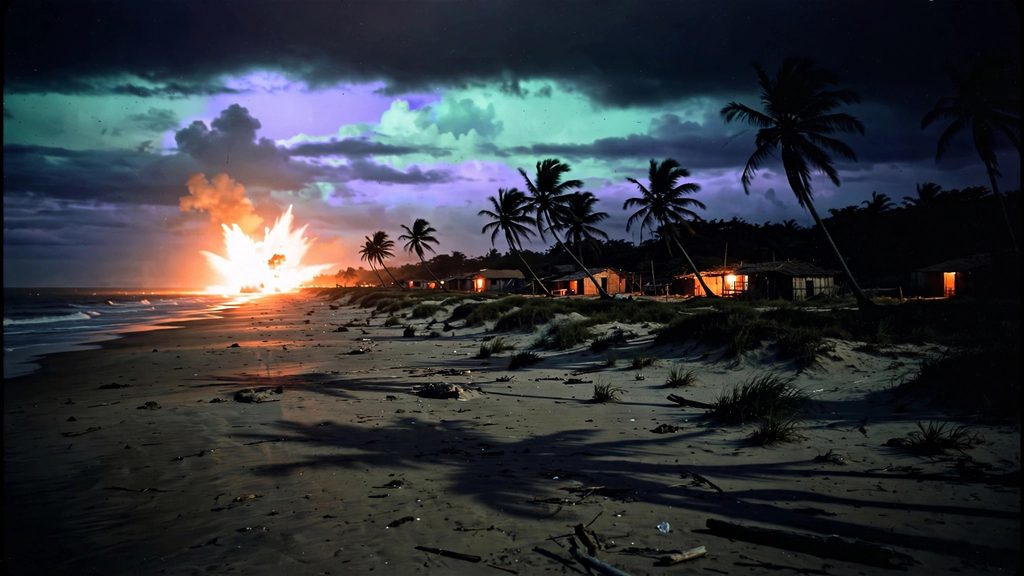
Their friend Élcio, whose surname appears in some reports as Correia Gomes and in others as Correa da Silva, was the man who had seen them off at the bus. He had worked with them on experiments. One device the three of them built in Manoel’s garden exploded. Another, set off on the beach at Atafona near Campos, produced a blast so loud and bright that people along the coast thought there had been an earthquake, and the Brazilian Navy came to investigate. Élcio was arrested a few days after the bodies were found and released when the police found nothing to hold him on. Witnesses placed him in Campos on the night of the deaths.
When the police searched Miguel’s workshop, they found scraps of lead and the tools to cut them, along with a book on scientific spiritualism in which passages about the intense luminosity of spirits had been underlined. On 14 September 1966, O Globo reported that the police chief Idovan Ferreira had reached his conclusion. The deaths were a parapsychological experiment that had gone wrong. Six weeks later Élcio gave his own account, printed in Correio da Manhã. The men, he said, went to lonely places to perform a ritual and take drugs, believing that beings from beyond would come into their minds.
Others filled in the shape of it. A teacher of yoga told the Folha de S.Paulo that the group often used psychedelics, and that an accidental overdose was the likeliest end. The Jesuit parapsychologist Óscar González-Quevedo told O Globo that lead masks had a place in certain dangerous occult tests involving fasting, trance and drugs. And a man named José de Sousa Arêas told of a television technician called Hermes, found dead four years earlier on another hill in the region, Morro do Cruzeiro, untouched and with a lead mask beside him. That earlier death has never been traced.
The Man Who Confessed
For almost three years the file stayed open. Then, in 1969, a prisoner in a high-security jail in São Paulo, Hamilton Bezani, told the police that he knew how the two men had died. He and three accomplices, he said, had met the technicians through a spiritualist centre, lured them to Niterói with the promise of an experiment and forced them at gunpoint to swallow poison. They had taken six million cruzeiros. One of his partners, he claimed, had told him afterwards that they had killed them both.
It was the confession the case had been waiting for, and it fell apart almost at once. Bezani had the money wrong, the positions of the bodies wrong and the way they were found wrong. The police concluded that he had invented the story to be moved to the prison in Niterói, from which he had escaped twice before, and he was sent back to São Paulo. In May 1969 the court closed the case for lack of evidence.
Yet the confession left something behind. Strip away Bezani himself, and the outline of his story fits the scene uncomfortably well. Two men who believed they were about to meet beings of light, a guide who told them what to write and when to swallow, money that walked away, watches tidied into pockets, and two men in a jeep who were never found. A fraud built on faith needs no wounds. It only needs someone willing to hand over the capsules and walk back down the hill.

Return to the Hill
In 1980 the French-born astronomer and computer scientist Jacques Vallée, one of the few scientists to give UFO reports sustained attention, climbed Morro do Vintém himself. With him went his wife Janine, a detective named Saulo Soares de Souza, the police reporter Mário Dias, a photographer and an interpreter. Everything he knew about the case, he wrote, had reached him second-hand through the rumour mill, and the only way to learn more was to fly to Rio and climb that hill.
What they found on the summit has become part of the legend. Fourteen years after the deaths, the patch where the men had lain was still bare. Vallée’s party reported that nothing grew there and that the ground looked scorched. When the television reporter Saulo Gomes went up in 1997, he described the same bare, burned-looking earth. Vallée wrote up the case in his 1990 book Confrontations, beside other Brazilian encounters in which witnesses had been hurt, or worse, by lights in the sky. He did not claim to know what had killed the two men, only that the old theories had not explained it.
There are duller explanations for the bare ground. Some have suggested that the chemicals used when the bodies were recovered could have poisoned the soil, and a hilltop trampled by the curious seldom keeps its grass. But the image stuck, two shapes of dead earth on a hill above the bay.
In 2004 the Globo television series Linha Direta Justiça reconstructed the case for a national audience, and a new generation learned the note by heart. Ten years after that, Brian Dunning went through every account he could find. He pointed out that thin lead over the eyes is useless against radiation, observing that there is no environment in which such shields would be useful, and he leaned toward the friends’ account of psychedelics taken on a hilltop in the hope of seeing a great light. Even so, he did not close the file. Without the original police papers, he said, he could go no further.

The Verdict | Unresolved
Two men from Campos dos Goytacazes died on Morro do Vintém in August 1966, and the heart of the story stands on firm ground. Police, doctors and the Brazilian press recorded the bodies, the suits and raincoats, the lead masks, the empty bottle and the note in Miguel’s hand. The men had lied about where they were going, they belonged to a circle of scientific spiritualists who sought contact through light, and most of the money they set out with was gone.
Everything after that is open. No cause of death was ever named, the capsules were never found, and the toxicology either failed or was never run. The two men in the jeep were never traced, the confession of 1969 collapsed, and the orange light over Fonseca was reported only once the story was already in the papers. An accidental overdose, a fraud that turned deadly, a lightning strike on a storm-lashed hill and an encounter with something unknown all remain on the table. The Archive files the Lead Masks as Unresolved, a ritual that ended in silence with its last instruction still waiting to be obeyed. Wait for the signal.
- Claim tested
- Two Brazilian technicians died on a hilltop in 1966 wearing lead masks, following written instructions, as a strange light hovered overhead, and no cause of death was ever found.
- Oldest record
- Rung 2 · Reported at the time
Police and medical reports of August 1966, and the coverage in O Globo, O Cruzeiro and Correio da Manhã that followed within weeks. - The record supports
- The deaths of Manoel Pereira da Cruz and Miguel José Viana, the lead masks and the note, the missing money, the failure to name a cause of death, and reports of a light over the hill that night.
- It does not support
- Any link between the light and the deaths, a named poison, the identity of the two men in the jeep, or the 1969 confession.
- Explanations weighed
- An accidental overdose during a spiritualist ritual, robbery and poisoning by a third party, a lightning strike, and a fatal encounter with an unknown light.
- What would change it
- Recovery of the original police file and autopsy reports, or the identification of the men who drove them up the hill.
Other deaths without a cause, and other notes nobody could fully read, lie elsewhere in these files. A man found on an Adelaide beach with a scrap of Persian poetry hidden in his pocket is followed in the Somerton Man, and the Brazilian lights said to have burned and killed in Jacques Vallée’s files. An amateur prospector scorched by a craft he touched in the Canadian woods appears in the Falcon Lake incident, and a young pilot who vanished while describing a light above his plane in the Valentich disappearance. The dream of hearing the dead through wires and valves runs through Edison’s spirit experiments, the scientist who took drugs to meet other minds through John C. Lilly, and the knocking that started modern spiritualism through the Fox sisters. Morro do Vintém has a pin of its own on the Atlas of Mysteries, and every ruling made so far, this one included, is gathered in our Verdict Index, while the Archive Standard sets the bar a case must clear to earn any of its four ratings.
Quick Answers About the Lead Masks Case
What happened in the Lead Masks case?
In August 1966 two electronics repairmen, Manoel Pereira da Cruz and Miguel José Viana, were found dead on Morro do Vintém in Niterói, Brazil. They wore suits, raincoats and crude lead masks over their eyes, and carried a note about capsules and a signal. No cause of death was ever found.
Who were the two men found with lead masks?
Manoel Pereira da Cruz, 32, and Miguel José Viana, 34, were married radio and television technicians from Campos dos Goytacazes in Rio de Janeiro state. They ran a small business together and belonged to a circle interested in what it called scientific spiritualism.
What did the Lead Masks note say?
In Portuguese it read: 16:30 estar no local determinado. 18:30 ingerir cápsulas, após efeito proteger metais aguardar sinal máscara. Roughly, be at the chosen place at 4.30 pm, swallow capsules at 6.30 pm, after the effect protect metals, wait for the signal, mask.
How did the men die?
No one knows. The autopsy found no wounds or signs of a struggle, and decomposition defeated or blocked any useful toxicology. The leading theories are an accidental drug overdose during a ritual, poisoning by someone who took their money, and a lightning strike.
Was a UFO seen over Morro do Vintém?
Gracinda Barbosa Coutinho de Sousa and her children reported an orange oval object with a ring of fire hovering over the hill on the evening of 17 August 1966, and other callers told the police of lights. No link between the sightings and the deaths has ever been shown.
Has the Lead Masks case been solved?
No. A Brazilian court closed the case in May 1969 for lack of evidence, after a prisoner’s confession to the killings was rejected. Investigators including Jacques Vallée and Brian Dunning have revisited it since, and it remains unsolved.