
If consciousness awakens to its conditioning, what should it do with that freedom?
There is a version of awakening that ends the moment someone sees through something.
They discover that perception is filtered. They discover that institutions shape belief. They discover that memory is reconstructive, that identity is partly inherited, that attention can be manipulated, that fear can be engineered, that the stories people tell about reality are not reality itself. They discover that the self they had assumed was solid is, in many respects, assembled.
And then they stop. The discovery becomes an identity.
They become the person who has seen through it. They divide the world into the awakened and the asleep, the people who know and the people who don’t. They collect confirmations. They learn the vocabulary of hidden systems. They become increasingly certain that they are less deceived than everyone around them.
The trap has changed shape. That is not awakening. It is another form of conditioning.

The deeper question is therefore not whether a human being can become conscious of the machinery shaping consciousness. The seven Foundations before this one have approached that possibility from different directions: the systems that organize themselves, the observer who cannot step entirely outside observation, the perceptual filter between mind and world, the problem of sovereignty under conditioning, the mechanisms by which humans manufacture meaning, and finally the boundary presented by death.
The Return begins where those investigations leave off. Suppose awakening is real. What then?
Awakening Is Not the Destination
The word awakening has accumulated an extraordinary amount of baggage. In religious traditions it can mean liberation from ignorance. In Buddhism, awakening concerns seeing through craving, attachment, and mistaken conceptions of a permanent self. In Hindu traditions, liberation can involve recognizing the deepest identity of consciousness as something other than the ordinary ego. Mystical Christianity speaks in the language of transformation, surrender, union, and the death of the old self. Sufism describes the stripping away of the ego and the return toward God.
Modern psychology has its own vocabulary for related phenomena: metacognition, decentering, cognitive flexibility, and the recognition of unconscious patterns. Modern spiritual culture has added another layer: awakening as the discovery that reality is not what it appears to be.
These traditions are making radically different metaphysical claims. They should not be collapsed into one universal doctrine simply because they use similar language. But beneath their differences is a recurring human possibility: the discovery that the way the world is ordinarily experienced is not the whole story. That discovery can be destabilizing. It can also be liberating. But liberation from one assumption creates a new problem that is rarely discussed with equal seriousness.
Freedom from what? And freedom for what?

If the self is conditioned, seeing the conditioning does not automatically eliminate it. If perception is constructed, recognizing that fact does not provide unfiltered perception. If beliefs are inherited, discovering their origins does not instantly replace them with truth. If the ego is partly a story, understanding that story does not make the body stop needing food, the nervous system stop responding to threat, or the person stop wanting to be loved.
Awareness creates distance. It does not automatically create wisdom. That distinction is the beginning of The Return. The point of seeing is eventually to return to living.
The First Freedom Is Seeing
There is a genuine kind of freedom in becoming aware of forces that previously operated invisibly. A person who recognizes conditioning can begin to distinguish between an impulse and a decision. A person who recognizes the machinery of attention can become more deliberate about what is allowed to occupy the mind. A person who recognizes that identity is partly inherited can examine beliefs once treated as self-evident. A person who recognizes the power of narrative can become more careful about the stories through which events are interpreted.
None of this requires supernatural belief. It is what happens when previously automatic processes become objects of conscious examination. The first freedom is therefore not the ability to do whatever one wants. It is the ability to notice what is happening before automatically becoming it.

Anger appears. There is a space in which anger can be noticed before it becomes an action. Fear appears. There is a space in which fear can be recognized before it becomes a worldview. The desire for approval appears. There is a possibility of seeing the desire rather than immediately organizing behavior around satisfying it.
The person has not become free of anger, fear, or desire. Something more subtle has happened. They are no longer completely identical with them. That distance is small. It is also enormous, because everything that follows depends on it.
But Seeing the Cage Is Not Leaving It
This is where much contemporary awakening culture makes its first major mistake. It assumes that knowledge produces liberation automatically. It doesn’t.
A smoker can know exactly what nicotine does and continue smoking. A person can understand attachment patterns and repeat them. Someone can recognize that social media is engineered to capture attention and still spend hours inside it. A person can understand the psychological mechanisms of status and continue structuring an entire life around being admired.
Knowledge and transformation are different events. The intellect can understand a pattern while the organism continues to enact it. That distinction appears everywhere in human life. People know that resentment damages relationships and still rehearse old grievances. They know that fear distorts judgment and still allow fear to make decisions. They know that mortality is certain and still live as though postponement were equivalent to escape.
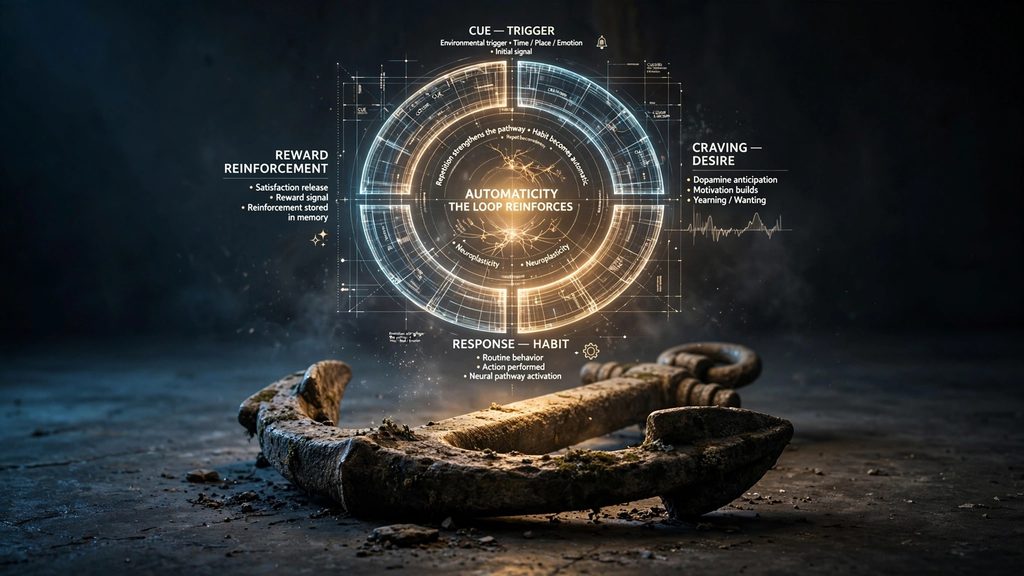
Awakening, if the word is going to mean anything useful, cannot simply mean accumulating better explanations. It has to mean that the relationship between awareness and behavior changes. Otherwise the person has simply acquired a more sophisticated vocabulary for describing the same cage. This is why the Return matters. The point of seeing is eventually to return to living.
The Awakening Trap
There is another danger after the first awakening. It is certainty.
The person discovers one framework that seems to explain everything. For one person it is simulation theory. For another it is ancient wisdom. For another it is consciousness as fundamental reality. For another it is materialism. For another it is political power. For another it is trauma. For another it is quantum mechanics. For another it is God. For another it is the claim that there is no God.
The framework changes. The psychological structure can remain identical. Everything is now explained. This is seductive because uncertainty is difficult to tolerate.

The human brain continually generates predictions about the world and updates those predictions against incoming information. Karl Friston’s predictive-processing framework formalizes one influential version of this idea, in which perception and action are deeply bound up with prediction, inference, and the reduction of prediction error. The framework is far more technical than the popular phrase “the brain is a prediction machine” suggests, but the underlying point matters here: human beings do not approach experience as blank recording devices. They actively model what they expect to encounter.
That capacity is extraordinarily useful. It can also become a liability when a worldview becomes so comprehensive that every possible observation can be absorbed into it. Every contrary fact becomes evidence of the conspiracy. Every failed prediction becomes evidence that the prediction was misunderstood. Every disagreement becomes proof that the other person is asleep. Every uncertainty becomes an invitation to invent another layer of explanation.

At that point the worldview has become self-sealing. It no longer investigates reality. It protects itself from reality. The awakened person can therefore become trapped in precisely the structure they thought they had escaped. The difference is that the new prison has better language.
The Discipline of Not Knowing
The Return requires something that the modern search for answers often treats as failure: the ability to remain uncertain. Not vague. Not apathetic. Not incapable of reaching conclusions. Uncertain.
There is a profound difference between saying “I don’t know” because a subject has never been considered seriously and saying “I don’t know” after following the question as far as the evidence allows. The second is intellectual discipline. The mystery is real. The interpretation is not automatically real. The question remains open.
That principle applies equally to extraordinary claims and conventional ones. If someone reports an unexplained experience, the appropriate response is not automatically belief. But neither is it automatically dismissal. If a scientific model explains an enormous amount of observable reality, that matters. But its success does not automatically answer every metaphysical question that can be asked about existence. If an ancient tradition contains an astonishing insight, that does not make every story associated with that tradition historically factual. If a modern institution makes a claim, institutional authority does not make the claim immune to examination.

The Return therefore does not produce a new orthodoxy. It produces a relationship to uncertainty. The person becomes capable of holding a possibility without turning it into a certainty. That may be one of the rarest forms of freedom available to the human mind.
Freedom Is Not the Absence of Conditioning
There is an even deeper problem. Suppose the self is shaped by genetics, childhood, culture, language, memory, social incentives, biology, environment, education, and millions of interactions that occurred before conscious choice entered the picture. What would freedom even mean?
The traditional fantasy of sovereignty imagines a little commander inside the skull making independent decisions. But if that commander is itself the product of everything that came before it, where does the independent self begin? The question is not easily solved. Some philosophical traditions defend versions of free will. Others argue that determinism or causal dependence leaves little room for the kind of freedom people ordinarily imagine. Still others attempt to redefine freedom rather than abandon it.
The Return does not require settling that centuries-old dispute. It asks a more practical question. What kind of freedom is actually available to a human being? Perhaps freedom is not the ability to become uncaused. Perhaps it is the ability to become increasingly conscious of one’s causes.
The person who cannot stop reacting to an insult has less practical freedom than the person who can experience the same insult without being compelled into the same response. The person who cannot question an inherited belief has less intellectual freedom than the person capable of examining it. The person who cannot tolerate uncertainty is governed by the need for certainty. The person who cannot be alone is governed by the need for distraction. The person who cannot lose status is governed by the social field around them.
Freedom, under this interpretation, is not escape from causality. It is increasing the range of responses available within causality. That is a much less glamorous idea than omnipotence. It may also be much closer to the freedom human beings can actually possess.
What Happens to the Ego?
The ego is one of the most abused words in modern spirituality. It can mean the psychological structure that organizes identity. It can mean narcissism. It can mean self-importance. It can mean the ordinary sense of being a separate individual. It can mean almost anything the speaker wants it to mean.

That makes ego death especially easy to turn into another form of spiritual status. I have killed my ego. I am more conscious than others. I am no longer attached. I have transcended ordinary human concerns. The paradox is obvious. The ego has discovered a new costume.
The Return therefore does not require destroying the self. A functional human being needs some coherent sense of identity. A person needs to remember who they are, maintain commitments, navigate relationships, protect the body, plan for the future, and distinguish one person’s experience from another’s.

The question is not whether the self exists. It is whether the self understands what it is. A map is useful when it knows it is a map. A story can be useful when it does not mistake itself for the territory. An identity can be useful without becoming a prison. The mature position may therefore be less dramatic than ego destruction. Use the self without worshiping it. Let identity function. Do not let identity become absolute.
How Should an Awakened Person Love?
This may be the most important practical question in the entire Foundation, because almost every metaphysical system eventually encounters the same human fact: human beings are relational creatures. Whatever consciousness ultimately turns out to be, human life is experienced through relationships. People depend on one another. People hurt one another. People need one another. People misunderstand one another. People love one another.
And if awakening makes a person less capable of relationship, something has gone wrong. There is a form of spiritual detachment that can become emotional avoidance. Nothing matters. Everything is illusion. Everyone is merely consciousness. The relationship is attachment. The body is temporary. The ego is unreal. The result can sound profound while functioning as a sophisticated refusal to be vulnerable.
But vulnerability is not evidence of unconsciousness. Love requires exposure to loss. To care about someone is to become vulnerable to their absence. To commit to something is to accept the possibility that it will fail. To love a finite human being is to love something that will eventually die.

If the Death Boundary asks what survives when the organism stops, The Return asks something equally difficult: what should be done with the fact that everything loved is temporary? The answer cannot be permanent possession. Nothing can be possessed permanently. The answer has to be participation. A person is loved not because permanence can be guaranteed, but because the person is here. The finite nature of something does not make it meaningless. It may be precisely what gives it meaning.
How Should an Awakened Person Create?
Creation is another form of return. If the universe is uncertain, create anyway. If consciousness is mysterious, make something. If meaning is constructed, construct carefully. If no cosmic authority has handed humanity a complete instruction manual, that does not mean nothing matters. It means responsibility becomes unavoidable.
Art is one of the clearest demonstrations of this. A painting does not need to be eternal to matter. A song does not need to survive civilization to have been worth singing. A conversation does not become meaningless because nobody recorded it. A kindness does not become worthless because it disappears from history. Human beings are constantly creating things that are temporary. And yet they create them.

This suggests something important about meaning. Meaning may not be a substance hidden somewhere in the universe waiting to be discovered. It may be something that emerges through participation. A meal becomes meaningful because of who sits at the table. A place becomes meaningful because of what happened there. A life becomes meaningful through relationships, commitments, experiences, sacrifices, creations, memories, and the ways one person’s existence enters another person’s.
That does not make meaning imaginary. Money is invented too. That does not make it causally irrelevant. Language is constructed. That does not make words powerless. Institutions are human creations. That does not make them unreal. The fact that humans participate in the creation of meaning does not make meaning fake. It makes humans responsible for it.
The Return Rejects Nihilism
There is a tempting conclusion at the end of all this questioning. If nothing is certain, nothing matters. If consciousness is temporary, nothing matters. If the self is constructed, nothing matters. If reality is filtered through perception, nothing matters. If there is no guaranteed cosmic purpose, nothing matters.
But that conclusion does not follow. Uncertainty does not equal meaninglessness. The absence of a guaranteed external purpose does not logically entail the absence of all value. In fact, the opposite possibility is worth considering. Perhaps the absence of guaranteed meaning is precisely what makes human participation significant.
If every action were cosmically predetermined, there would be little room for creation. If every life came with an objectively assigned script, there would be little need for courage. If every question had already been answered, inquiry would be unnecessary. If every outcome were guaranteed, responsibility would lose much of its force.

The fact that human beings do not know may be part of what makes the human condition what it is. There is finite time. Outcomes cannot be guaranteed. Everything cannot be known. And still people choose. Still they love. Still they build. Still they ask.
The Return Is Not a Return to Ignorance
Returning to ordinary life does not mean forgetting what has been discovered. A person does not have to become naive again. They do not have to stop questioning. They do not have to surrender intellectual skepticism. They do not have to accept the first explanation offered by authority. They do not have to abandon mystical experience because some interpretations of mystical experience are unsupported. They do not have to accept mystical claims because some experiences remain unexplained.
The Return is not regression. It is integration. The person carries the question back into life. They become more difficult to manipulate because they understand how manipulation works. They become more careful with certainty because they understand how easily humans mistake models for reality. They become more compassionate because they recognize that other people are also operating inside histories they did not choose. They become more responsible because uncertainty removes the comfort of pretending someone else possesses the final answer. They become more curious because the unknown is no longer something that must immediately be conquered. They become more capable of changing their minds.
And perhaps most importantly, they become less interested in performing awakening for other people.
The Test Is What Happens When Nobody Is Watching
This is where every philosophy eventually becomes practical. Not in the lecture. Not in the book. Not in the post. Not in the declaration that a hidden structure of reality has been discovered. In the moment when nobody is watching.
What happens with power? What happens when lying would produce a benefit? What happens when someone weaker cannot retaliate? What happens when admitting ignorance would lower status? What happens when a favorite theory encounters evidence against it? What happens when someone loved disappoints? What happens when fear arrives? What happens when being wrong becomes unavoidable? What happens when the future refuses to behave according to prediction?

These are not secondary questions. They are the questions. Because an idea that never changes conduct has not necessarily changed a person. The deepest measure of awakening may therefore be almost embarrassingly ordinary. How does the person behave?
The Mystery Does Not Need to Be Solved to Be Lived
There is a tendency to imagine that the ultimate achievement of spiritual or philosophical inquiry must be a final theory. Perhaps everything is consciousness. Perhaps everything is information. Perhaps reality is simulated. Perhaps there is a divine intelligence. Perhaps there are many levels of reality. Perhaps consciousness emerges from matter. Perhaps matter emerges from consciousness. Perhaps death is the end. Perhaps it is not. Perhaps humanity is being influenced by forces it does not understand. Perhaps the anomaly is simply the human mind encountering the limits of its models.

The Return does not require choosing one prematurely. It asks what kind of person can remain alive inside the question. That is harder than adopting an answer. An answer gives the mind somewhere to rest. A question asks the person to keep walking.

The Danger of the Final Answer
Every civilization eventually creates authorities. Every movement creates insiders. Every revelation creates interpreters. Every interpretation eventually develops boundaries. This is true of religions. It is true of political movements. It is true of scientific communities. It is true of spiritual organizations. It is true of conspiracy cultures. It is true of online communities built around supposedly forbidden knowledge. And it can become true of awakening itself.
The person who began by questioning authority can eventually become an authority. The person who rejected dogma can create a dogma. The person who warned others not to follow blindly can gather followers. The person who said to think independently can eventually demand that everyone think exactly as they do.
This is why the Return cannot end with a new revelation. It has to end with a discipline. Keep examining the machinery, including the machinery of its own conclusions. The question applies to everyone. It applies to governments. It applies to religions. It applies to scientists. It applies to skeptics. It applies to mystics. It applies to this website.
Monkey & Elf is not exempt from the same standard it applies to everything else. If the site becomes a place where readers come to obtain certainty rather than investigate uncertainty, it has failed its own Foundation. The archive can offer questions. It can present evidence. It can distinguish documented fact from testimony, interpretation, speculation, and belief. It can follow an anomaly without pretending to know what caused it. But the final judgment belongs to the person doing the looking.
What Should an Awakened Person Do With Freedom?
Return. Not because the investigation failed. Because the investigation succeeded in revealing what investigation was for.
Awakening is not a permanent performance of having awakened. It is not a competition to become more enlightened than everyone else. It is not a new identity built around being free of identity. It is not a license to dismiss ordinary life as illusion. The point of seeing is to become more capable of inhabiting life consciously.

Conditioning becomes visible. Then there is greater possibility in choosing how to respond to it. The stories become visible. Then there is greater responsibility for the stories that are told. Perception becomes visible as a filter. Then certainty about perception becomes harder to justify. Identity becomes visible as constructed. Then there is less reason to demand that everyone protect its boundaries. Mortality becomes unavoidable. Then postponement becomes harder to defend. Uncertainty becomes permanent. Then the manufacture of certainty becomes easier to recognize.
Other people become visible not as supporting characters in a private narrative, but as equally complicated, conditioned, frightened, hopeful, temporary beings. Perhaps that produces greater kindness. That is not a small consequence. It may be the entire point.
The Human Life
There is a tendency to imagine that the ultimate spiritual achievement must look extraordinary. A vision. A revelation. A supernatural ability. A permanent altered state. A cosmic download. A final escape.
But perhaps the more difficult achievement is ordinary. To remain present. To tell the truth. To love without possessing. To act without certainty. To change one’s mind without humiliation. To accept that other people are not characters written for a private story. To experience beauty without needing to prove what beauty ultimately means. To face suffering without immediately converting it into a theory. To face death without pretending that it has been solved. To build something knowing it may disappear. To give something without guaranteeing that it will be returned. To keep asking questions without allowing questions to prevent life from being lived.
There is nothing spectacular about any of this. That may be precisely why it is so difficult.
Return
The word return carries an implication that awakening does not. Something was left. Something was discovered. And now there is a coming back. Not to the world as it was previously understood. To the same world without the same certainty.
The same body. The same people. The same unanswered questions. The same mortality. The same strange fact that there is something rather than nothing.
But now there is a difference. The map has been seen as a map. The observer has been seen as part of the investigation. Perception has been recognized as a filter rather than a transparent window. Conditioning has become visible. Meaning has been recognized as something human beings actively construct. Death has been encountered as the boundary beyond which certainty becomes extraordinarily difficult.
And after all of that, the human being is still here. That is not an anticlimax. That is the point. The great investigation of reality eventually returns to the person conducting it.

What should be done with the life that has been given? What should be done with a consciousness that cannot yet be fully explained? What should be done with people who cannot be kept? What should be done with freedom that cannot be conclusively defined? What should be done with uncertainty that no final theory has removed?
Life continues. Love continues. Creation continues. Questioning continues. Wonder continues. The possibility of being wrong continues. And the mystery remains a mystery without needing to be turned into another prison.
The Seven Do Not End With an Answer
The Foundations began as an attempt to follow the deepest questions without pretending they were simpler than they are.

The Whirlpool Principle asks how order emerges from systems without requiring a central controller. The Observer Trap asks what happens when the instrument investigating reality is itself part of the reality being investigated. The Reality Filter asks how much of the world reaches consciousness before perception, memory, language, expectation, and culture have transformed it. The Freedom Problem asks whether sovereignty is possible when the self making decisions is itself conditioned. The Meaning Engine asks how human beings transform events into stories, symbols, purposes, identities, and worlds. The Death Boundary asks what happens when consciousness reaches the limit of biological life, and what, if anything, would have to survive for that continuity to count as survival.
And The Return asks the question that follows if any of those investigations genuinely changes the person conducting them: what should be done with what has been seen?
The answer cannot be another theory. It has to be a life. That is why this is the final Foundation. Not because the mystery has been solved. Because eventually the investigation has to become human.
And Above the Seven
There is still a question the Foundations themselves cannot contain.
If consciousness can question itself, if reality can be investigated, if perception can be filtered, if freedom can be questioned, if meaning can be created, if death can be approached as a boundary, and if a human being can return to ordinary life carrying all of that uncertainty, then what is the larger fact within which all of these questions are occurring?
Not what is the universe made of? Not which theory wins? Not who is controlling whom? Not even what is consciousness?
Something more primitive comes first. Why is there anything at all? And then, immediately behind it: why is there experience within it?
There is something. And somehow, something is experiencing that something. The question is not being asked from outside existence. It is being asked from within it. The investigator is part of the mystery being investigated.
That is where the seven Foundations ultimately lead. Not to certainty. Not to a final cosmology. Not to an escape from the world. To the strange and irreducible fact that existence exists, experience exists within existence, and somehow there is a first-person point of view from which the whole mystery is being encountered.

The next question is not another Foundation. It is the question beneath all of them.
Why is there something rather than nothing? And why, within that something, is there anyone here to ask?