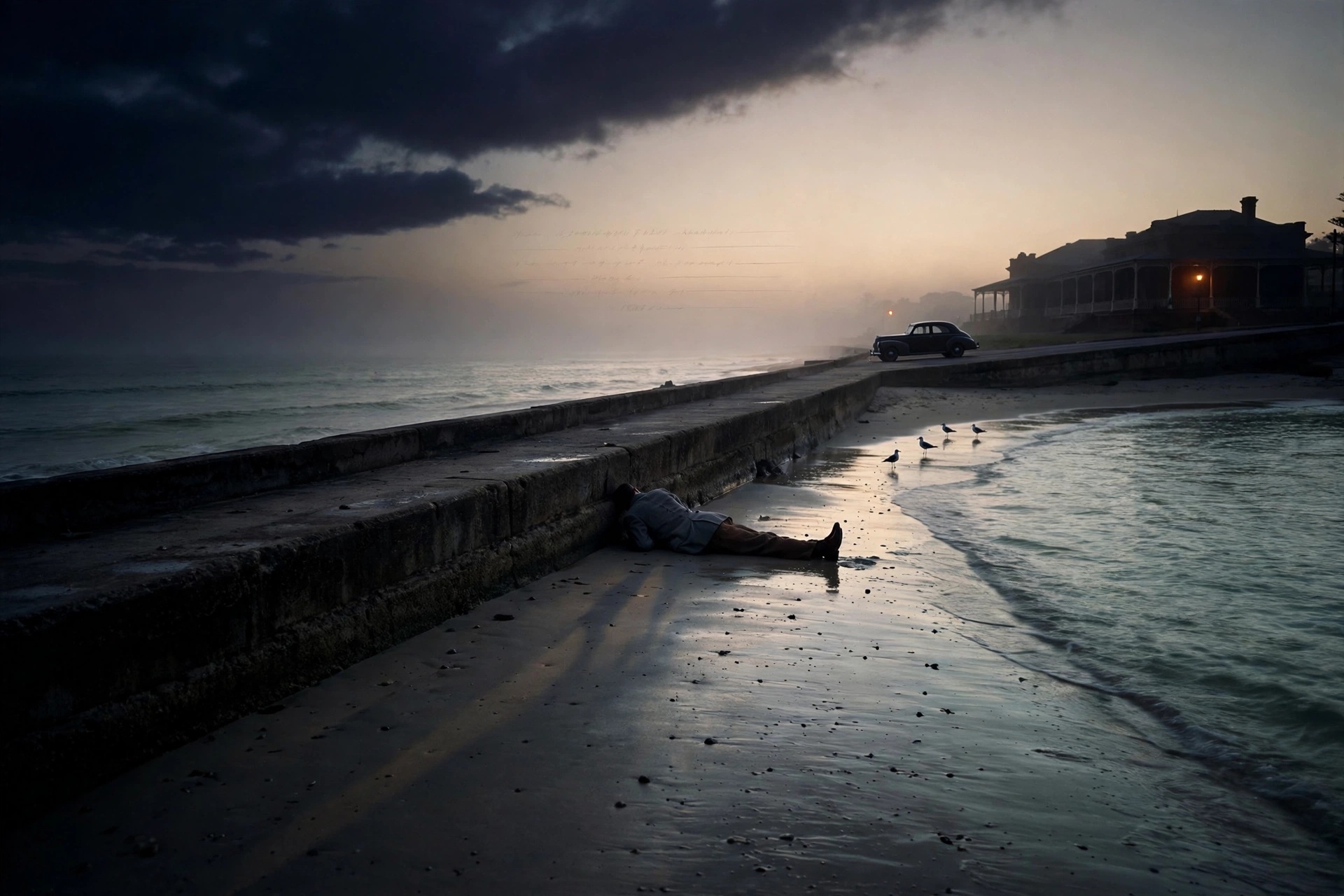
On the warm evening of Tuesday 30 November 1948, a man lay on the sand at Somerton Park, a quiet beach suburb south of Adelaide. He was propped against the low seawall opposite the Crippled Children’s Home, legs stretched out towards the sea, feet crossed at the ankles. A couple walking past at about seven saw him lift his right arm and let it fall. Later another couple noticed that the mosquitoes did not seem to bother him. Nobody thought much of it. On a summer night in Adelaide, a man asleep on the beach was not news.
At dawn on 1 December he was still there, in the same place and almost the same position. A half-smoked cigarette had come to rest on his collar. He was dead.
- The Man on the Seawall
- No Poison, No Name
- The Suitcase at Adelaide Station
- Tamam Shud
- Five Lines in Pencil
- The Nurse in Moseley Street
- A Grave With No Name
- The Spy Years
- The Engineer Who Would Not Let Go
- The Exhumation
- Carl Webb
- What the Name Does Not Answer
- The Verdict | Unresolved
- Quick Answers About the Somerton Man
He was well dressed, clean-shaven and fit, perhaps forty or forty-five. He carried no wallet and no identification, and every maker’s label had been cut from his clothes. Over the next year the police would find a suitcase he had left at the railway station, a scrap of paper hidden in a secret pocket, a book of Persian poetry with five lines of code pencilled in the back, and the telephone number of a young nurse who lived a few hundred metres from where he died. They would not find his name. That took seventy-three years, a plaster bust, a few strands of hair and an engineer who would not let the case go. Even now, the name explains less than anyone hoped.
The Man on the Seawall
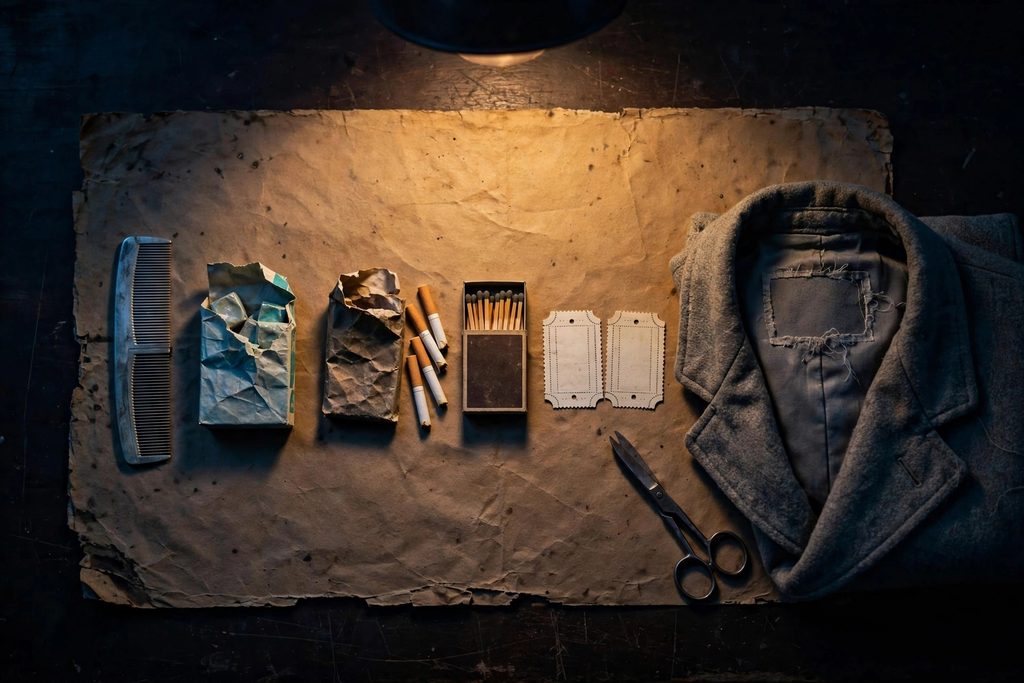
The police were called at about half past six that Wednesday morning. In the dead man’s pockets they found an unused second-class railway ticket from Adelaide to Henley Beach, a bus ticket, an aluminium comb of American make, a half-empty packet of Juicy Fruit gum, a packet of Army Club cigarettes holding seven of a different brand, Kensitas, and a box of Bryant and May matches.
He wore a white shirt, a red, white and blue tie, brown trousers, a brown knitted pullover and a grey and brown double-breasted jacket. Detectives thought the cut of the jacket looked American. He had no hat, which was unusual for a man of his age and dress in 1948. His shoes were polished and clean, though he had been on the beach. His calves were high and strongly developed, and his toes were wedged together at the ends, as if he had spent years in tight or pointed shoes. Some who saw the body thought of a dancer, or a runner.
The labels were what unsettled people. A man who cuts every label from his clothes does not want to be traced. Someone else who cuts them does not want him traced either.
No Poison, No Name
The post-mortem was carried out by Dr John Dwyer, and the leading pathologist of the state, Professor John Burton Cleland, examined the body later. They agreed on what they could see and disagreed with nothing, because there was so little to disagree with. The heart was healthy. The spleen was strikingly enlarged, the liver and stomach congested with blood, and there was blood mixed with the food in the stomach. The last meal was a pasty, eaten three or four hours before death. Cleland put the time of death at around two in the morning on 1 December.
Dwyer was blunt. “I am quite convinced the death could not have been natural,” he told the inquest. He suspected a barbiturate or another soluble sleeping drug. Yet the laboratory found nothing. The physiologist Sir Cedric Stanton Hicks told the court that there were two drugs that could have killed a man this way and vanished from the body soon afterwards. He gave their names to the coroner in writing rather than say them aloud. Decades later they were revealed as digitalis and ouabain, both heart poisons drawn from plants.
The fingerprints went to police forces across the English-speaking world. Nobody recognised them. The photographs ran in every newspaper in Australia, and men came forward to identify the body as a lost friend, a missing workmate, a timber cutter, a stablehand. Each lead was followed and each one failed. In 1949 the coroner said that he would be prepared to find that the man died of poison, probably a glucoside, and that it was not taken by accident. He could not say who gave it.

The Suitcase at Adelaide Station
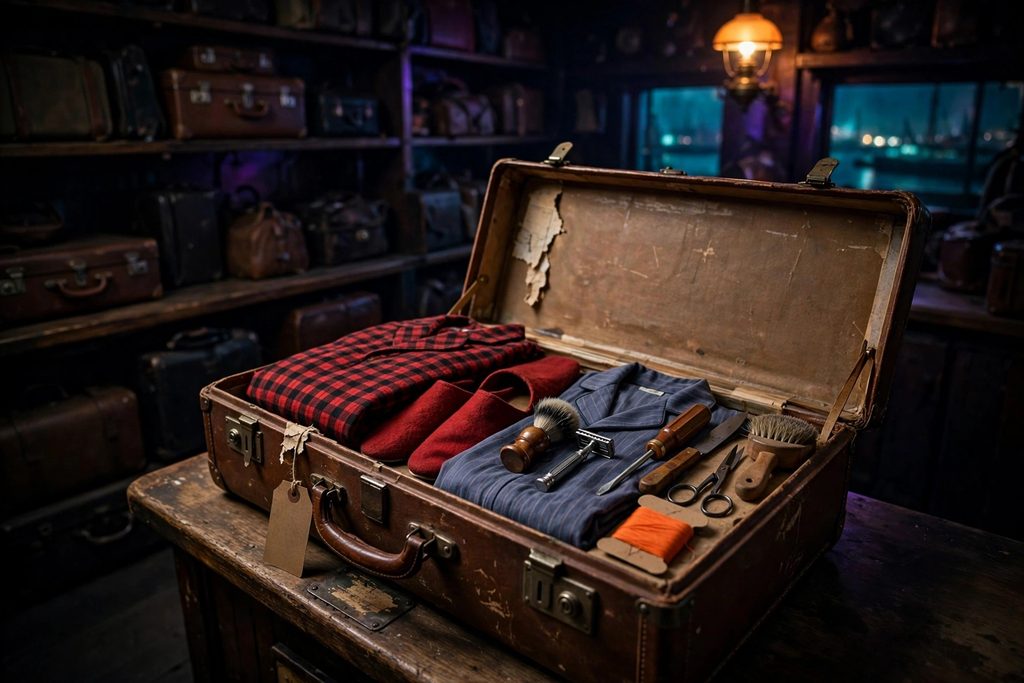
On 14 January 1949, staff at Adelaide Railway Station found a brown suitcase in the cloakroom. Its label had been removed. It had been checked in on the morning of 30 November, the last day the man was seen alive.
Inside were a red checked dressing gown, a pair of red felt slippers, pyjamas, underwear, shaving gear, a pair of light brown trousers with sand in the turn-ups, an electrician’s screwdriver, a table knife cut down into a short sharp blade, a pair of scissors with sharpened points, a stencilling brush of the kind used on ships to mark cargo, and a card of orange waxed thread. The police said the thread was a brand not sold in Australia, and it matched the thread used to mend a pocket in the trousers the dead man was wearing.
Three items carried a name. A tie was marked “T. Keane”, a laundry bag “Keane” and a singlet “Kean”. Police searched the English-speaking world for a missing Keane and found no one who fitted. For decades the name looked like a deliberate false trail, the one label the man had chosen to leave.
Tamam Shud
In the months after the inquest opened, a closer examination of the dead man’s trousers turned up a tiny fob pocket sewn inside the waistband. In it was a tightly rolled scrap of paper, torn from a printed page, with two words in an ornate typeface. “Tamam Shud.”
Librarians identified the words at once. They are Persian, meaning “ended” or “finished”, and they close The Rubáiyát of Omar Khayyám, the collection of quatrains about wine, fate and the shortness of life that Edward FitzGerald made famous in English. Readers in the 1940s often carried the little book as a gift or a keepsake. The police released the detail and asked anyone missing a copy with its last words torn out to come forward.
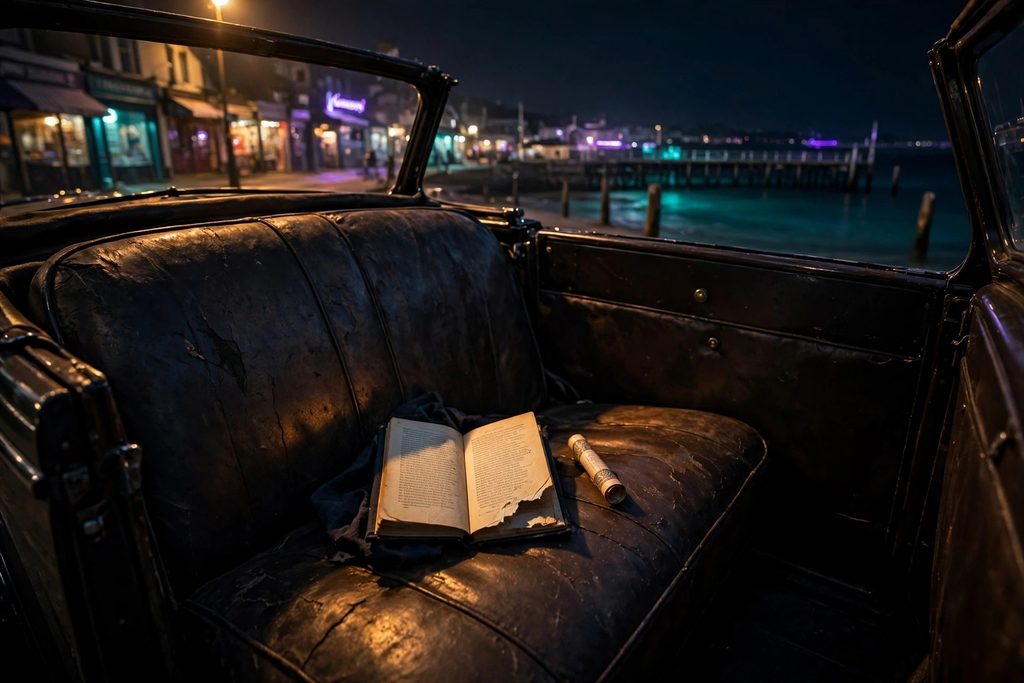
In July 1949 a man did. He said that at about the time of the death he had found a copy of the Rubáiyát lying on the back seat of his car, parked with its roof open on Jetty Road in Glenelg, a short walk along the shore from the place where the body was found. He had put it away in his glovebox and forgotten it until he read the papers. It was a 1941 edition printed by Whitcombe and Tombs in New Zealand. The last words had been torn from the final page, and under the microscope the tear matched the scrap.
Five Lines in Pencil
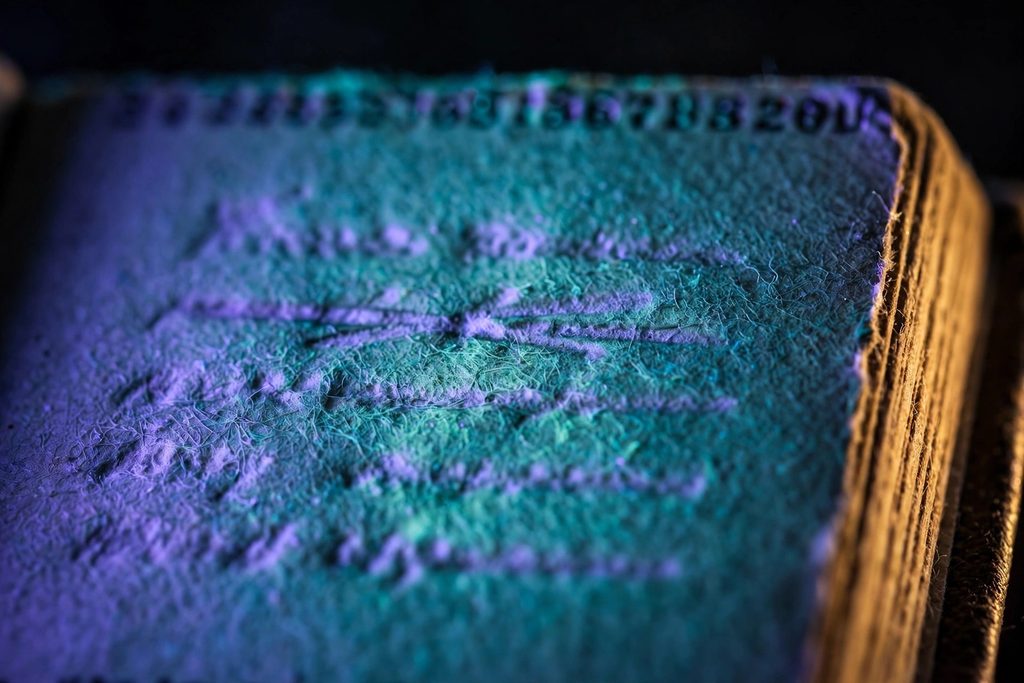
The back cover of the book held two more things. One was a telephone number. The other was a set of faint pencil impressions that, under ultraviolet light, became five lines of capital letters. The second line had been crossed out, as if the writer had made a mistake and started again.
Transcribed from the police photographs. The first letter of lines 1 and 2 can be read as M or W. The second line was crossed out, and a small cross sits beside the fourth.
Too few letters for a satisfactory answer. It could be a cipher, or meaningless.
The letter frequencies fit the first letters of English words better than any cipher they tested.
Most likely an abbreviation of an English text, which may never be recovered.
In 1978 cryptographers of the Australian Department of Defence studied the letters and said that there were too few of them to give a satisfactory answer. They could be a cipher, a list of initials, or the meaningless scribbles of a disturbed mind. Amateurs have offered hundreds of solutions since, some of them involving horse races, spies and lost love.
The most careful work has come from statistics. In the late 2000s a team at the University of Adelaide compared the frequency of the letters with ordinary English and found that they behaved most like the first letters of English words. In 2014 the computer scientist John Rehling reached a similar view, that the lines were probably an abbreviation of some text written in English, and that the text itself may be impossible to recover. If that is right, the code is less a lock than a set of footprints. It tells us that someone wrote down the beginnings of words, and it will not tell us which words.
The Nurse in Moseley Street
The telephone number belonged to a young nurse who lived in Moseley Street, Glenelg, around four hundred metres from the spot where the man had died. She was Jessica Thomson, born Jessie Harkness, and for half a century the police and the press protected her identity. In their files and in the stories that followed she was known only as Jestyn.
She told detectives that she did not know the dead man. She did admit that during the war, in Sydney, she had given a copy of the Rubáiyát to an army officer she knew, a lieutenant named Alf Boxall. She had written a verse in it and signed it Jestyn. For a few days it looked as if the case had been solved and the dead man was Boxall. Then Sydney detectives found Alf Boxall alive and well, working at a bus depot, with his copy of the book intact and its last page still in place.
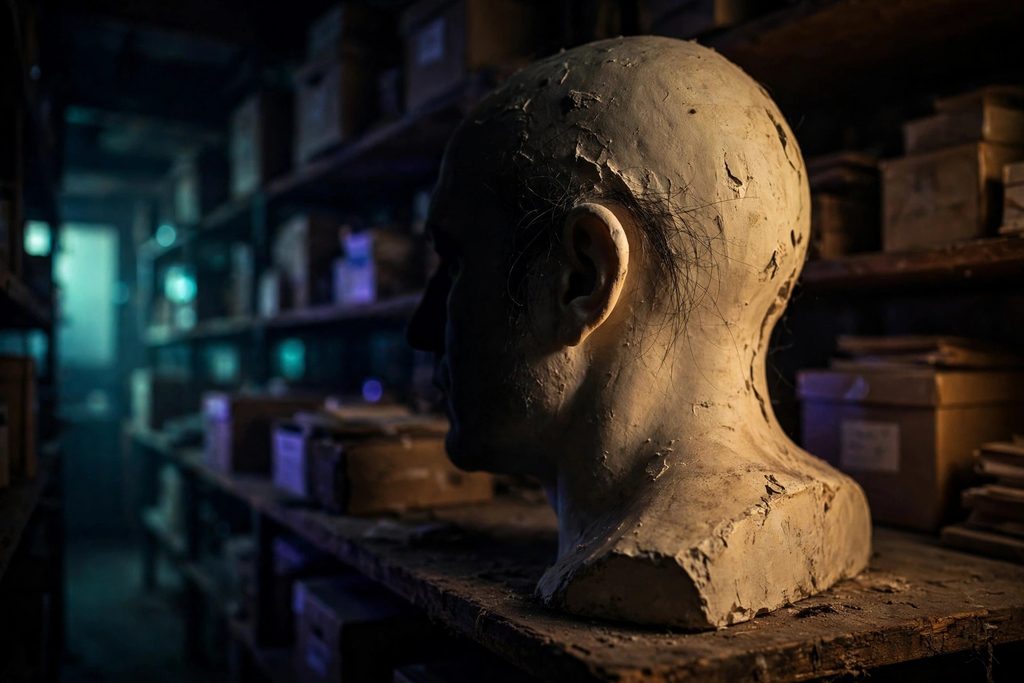
On 26 July 1949 the police showed Jessica Thomson the plaster cast that had been made of the dead man’s head and shoulders. Paul Lawson, the technician who had made it, was in the room. He said later that she looked at it once and seemed about to faint, then turned away and would not look again. She told the police she did not recognise the man and asked them not to keep her name on the record. They let her go home.

A Grave With No Name
The inquest opened in June 1949 under the coroner Thomas Erskine Cleland and ended without a finding of who the man was or how he died. The body had been embalmed in December, and it was buried that year at West Terrace Cemetery in Adelaide after a Salvation Army service. The bookmakers of the Adelaide racecourses paid for the funeral. In 1958 the inquest was reopened briefly and adjourned again with nothing new to add.
Before the burial, Paul Lawson’s cast preserved the face. The bust passed into the keeping of the South Australia Police Historical Society, and for decades it sat on a shelf, an unknown man with closed eyes and a few hairs caught in the plaster. Nobody then imagined that the hairs would one day speak.
The Spy Years
As the Cold War deepened, the case drifted from the police file into legend. Adelaide in 1948 was not a backwater. The joint British and Australian rocket range at Woomera was being built to the north, and in the same year leaks of secret material from Canberra led to the founding of the Australian Security Intelligence Organisation in 1949. A man with no name, cut labels, an American jacket, a code and a poison that left no trace looked to many people like an agent who had been silenced. A former detective of the case later said he believed the man had come from behind the Iron Curtain.
The nurse in Moseley Street fed the legend without meaning to. She died in 2007, still saying nothing. In 2013 her daughter, Kate Thomson, told the television programme 60 Minutes that her mother had lied to the police, that she had known who the man was, and that his identity was “known to a level higher than the police force.” She said that her mother had taught English to migrants, had held communist sympathies and spoke some Russian, and she suggested that her mother and the dead man may both have been spies.
None of this was backed by a single paper from any intelligence service. Australia’s security archives have been opened in part, and no file on the Somerton Man is known to have surfaced in them.
The Engineer Who Would Not Let Go
In 2009 Derek Abbott, a professor of electrical engineering at the University of Adelaide, set his students a puzzle for a coding project. It was the Tamam Shud code. The case took hold of him, and he spent the next thirteen years on it, often ten hours a week.
He started with the body. Photographs taken at the autopsy showed that the dead man’s upper ear had a hollow larger than the one below it, a feature found in only a small share of people. They also showed hypodontia, the absence of the lateral incisors from birth, which is rarer still. Abbott found both features in one other person connected to the case. Jessica Thomson had a son, Robin, born in July 1947. He had grown up to be a dancer with the Australian Ballet, and he had the same ear and the same missing teeth. Abbott proposed that the Somerton Man was Robin’s father. Robin had died in March 2009, before he could be asked.
The case then took a turn no novelist would risk. Through his research, Abbott met Robin’s daughter, Rachel Egan. They married in 2010. A professor searching for the Somerton Man had married a woman who might be his granddaughter, and both of them wanted the answer.
The Exhumation
Abbott and Rachel Egan pressed for years to have the body raised for DNA testing. In 2019 the Attorney-General of South Australia, Vickie Chapman, approved an exhumation, and on 19 May 2021 the remains were lifted from West Terrace Cemetery and taken to Forensic Science South Australia. The police named the work Operation Persevere.
Abbott did not wait for the state laboratory. With police permission, hairs had been taken from Paul Lawson’s plaster bust years earlier. The first tests on them gave only the mother’s line, a common European type, which could say nothing about Robin Thomson’s father. Then the forensic genealogist Colleen Fitzpatrick, who had helped identify unknown bodies in the United States, suggested sending a hair to Astrea Forensics in California. The laboratory recovered about two million genetic markers from a single five-centimetre strand without a root, enough to search the genealogy databases where people upload their own DNA.
The closest match was a distant cousin in Victoria. From there, Abbott and Fitzpatrick built a family tree of more than four thousand people and searched it for a man of the right age with no recorded date of death. One name was left standing.

Carl Webb
Carl Webb, known as Charles, was born on 16 November 1905 in Footscray, an industrial suburb of Melbourne, the youngest of six children of a baker. He trained at a technical college, now Swinburne University of Technology, played football in its junior team and became an electrical engineer and instrument maker. He worked for a firm in Melbourne that made electric tools. In October 1941 he married Dorothy Robertson, a pharmacist and chiropodist. A descendant of one of his mother’s sisters agreed to a DNA test, and on 22 July 2022 the result came back as a match. Four days later Abbott and Fitzpatrick told the world the Somerton Man’s name. Abbott said that he was 99.99 per cent sure.
Webb was forty-three at the end of November 1948, the right age. He was an instrument maker, which explained the screwdriver, the sharpened scissors and the cut-down knife in the suitcase. A later analysis of the lead in his hair suggested high exposure in the month before his death, of the kind a man might get from soldering, and lower levels afterwards, as if he had moved. And the Keane labels at last made sense. Webb’s eldest sister had married into a Melbourne family named Keane, and a photograph in the family album shows Charles standing with his hand above the head of his brother-in-law. Abbott believes the clothes marked with the name were hand-me-downs from that family, perhaps from a Keane nephew who died in the Second World War.
The divorce papers told a darker story. Dorothy filed for divorce in 1951 on the grounds of desertion. In her statement she described her husband as violent, threatening and moody, with no particular friends of his own. “He has written many poems,” she said, “most of them on the subject of death.” He claimed, she wrote, that death was his greatest desire. In March 1946 she had come home to find him lying in a wet bed, gazing into space, in a flat that reeked of ether. She nursed him back to health. He told her she was a fool for helping him.
She left him in September 1946. He moved out of the flat in 1947, left his job around the same time, and then dropped out of every record that anyone has found. In 1955 one of his sisters died and left him money, and her lawyers could not find him. They were seven years too late, and some seven hundred kilometres away.
What the Name Does Not Answer
The name closes one door and opens several others. Nobody knows what Charles Webb did in the eighteen months after he left his job, or why he travelled to Adelaide at the end of November 1948. There is a suggestion, unproven, that Dorothy had moved to South Australia, and her later divorce papers do give an address in that state. It is possible he went looking for her. It is also possible he went for reasons that died with him.
Nobody knows how he died. The divorce papers point towards a lonely, troubled man with a history of despair, which makes suicide a sad and plausible reading of the beach at Somerton. They do not prove it. Abbott himself has said that the cause of death is unlikely ever to be found in the bones. Nobody knows why a book with the phone number of a nurse in Glenelg was lying in a car on Jetty Road, or who wrote the five lines of letters in its back cover, or what they meant. No DNA result has been published linking Webb to Jessica Thomson or to her son Robin.
And the state has not yet spoken. In July 2026 South Australia Police said that their investigation was complex and ongoing, and that a report would go to the coroner once it was complete. Abbott was told it would be finished very soon. Until the coroner rules, Carl Webb is the Somerton Man in the opinion of the scientists who found him, not yet in the record of the state where he died.
The Verdict | Unresolved
The Somerton Man is no longer nameless. The DNA work of Derek Abbott and Colleen Fitzpatrick points with great strength to Carl Webb, a Melbourne engineer who wrote poems about death and walked out of his own life in 1947. That name makes the spy of legend much harder to believe. Nothing in Webb’s known life touches espionage, and the clues that once seemed sinister, the Keane labels, the American jacket, the tools, now have ordinary family and working explanations.
What the name cannot give back is the night itself. The poison the doctors suspected was never found, so murder, suicide and a natural death no one could diagnose all remain open. The five lines of letters have never been read, and no one has explained what tied the dead man to the nurse in Moseley Street. Until a coroner rules on how he died, this case stays Unresolved. The only farewell he left was a scrap of paper in a pocket sewn into his trousers, torn from the last page of a book of Persian verse. Tamam shud. It is ended.
- Claim tested
- The man found dead at Somerton in 1948 was murdered with a poison that left no trace, and the code and the telephone number in his book explain why.
- Oldest record
- Rung 1 · Records of the inquiry
The police inventory and post-mortem of December 1948, the suitcase found on 14 January 1949, and the evidence heard at the inquest of June 1949, including Dr John Dwyer and Sir Cedric Stanton Hicks on poison. - The record supports
- A death the doctors of 1948 believed was not natural, an enlarged spleen and congested organs, labels cut from his clothes, a scrap reading Tamam Shud, five lines of letters, and the number of a nurse who lived nearby. DNA from his hair points with great strength to Carl Webb, an engineer from Melbourne.
- It does not support
- Murder, a named poison or a spy. No poison was found, no killer was ever identified, and nothing in Webb’s known life touches espionage. His wife’s divorce papers describe a man who wrote of wanting to die. The code has never been read, and no link between Webb and Jessica Thomson has been shown.
- Explanations weighed
- Murder by poison, suicide by poison, a natural death the doctors could not diagnose, espionage, and a private tragedy linked to the Thomson family.
- What would change it
- A coroner’s finding on the cause of death, a reading of the code that others can test, or evidence of how Webb knew Jessica Thomson. If the coroner accepts the Webb identification, the file stays Unresolved unless the cause of death is also settled.
Other lost names have come back to the archive long after their owners. Kaspar Hauser walked out of nowhere into Nuremberg in 1828, and his claim to be a lost prince was finally put to the test of DNA. The pencilled letters in the Rubáiyát belong beside other writing that has defeated every reader, the Voynich Manuscript and the Phaistos Disc. The beach at Somerton has its own marker on our Atlas of Mysteries map. This ruling sits alongside all the others in the Verdict Index, and how each ruling is reached is laid out in the Archive Standard.
Quick Answers About the Somerton Man
Who was the Somerton Man?
A man found dead on Somerton Park beach in Adelaide on 1 December 1948, with no identification and the labels cut from his clothes. In July 2022 Professor Derek Abbott and the genealogist Colleen Fitzpatrick identified him through DNA as Carl “Charles” Webb, an electrical engineer from Melbourne born in 1905. South Australia Police had not yet put that identification before the coroner as of July 2026.
What does Tamam Shud mean?
It is Persian for “ended” or “finished”. The words close The Rubáiyát of Omar Khayyám, and a scrap bearing them was found rolled up in a hidden pocket of the dead man’s trousers. It had been torn from a copy of the book later found in a car in Glenelg.
Has the Somerton Man code been solved?
No. The five lines of capital letters in the back of the Rubáiyát have never been decoded. Statistical studies suggest they are most likely the first letters of English words, which would make the original text very hard to recover.
How did the Somerton Man die?
Nobody knows. The doctors in 1948 believed he had been poisoned, possibly with digitalis or ouabain, but no poison was ever found. His wife’s divorce papers describe a man who wrote about wanting to die, which makes suicide possible, though it has never been shown.
Who was Jestyn?
The name the police used for Jessica Thomson, a nurse whose telephone number was written in the back of the book. She lived about four hundred metres from where the body was found. She told police she did not know the man, and she never said otherwise in public before her death in 2007.
Was the Somerton Man a spy?
No evidence shows it. The spy theory grew from the Cold War setting, the cut labels, the code and the untraced poison. The DNA identification points to a Melbourne engineer with no known link to any intelligence service, and no file on him is known in Australia’s security archives.