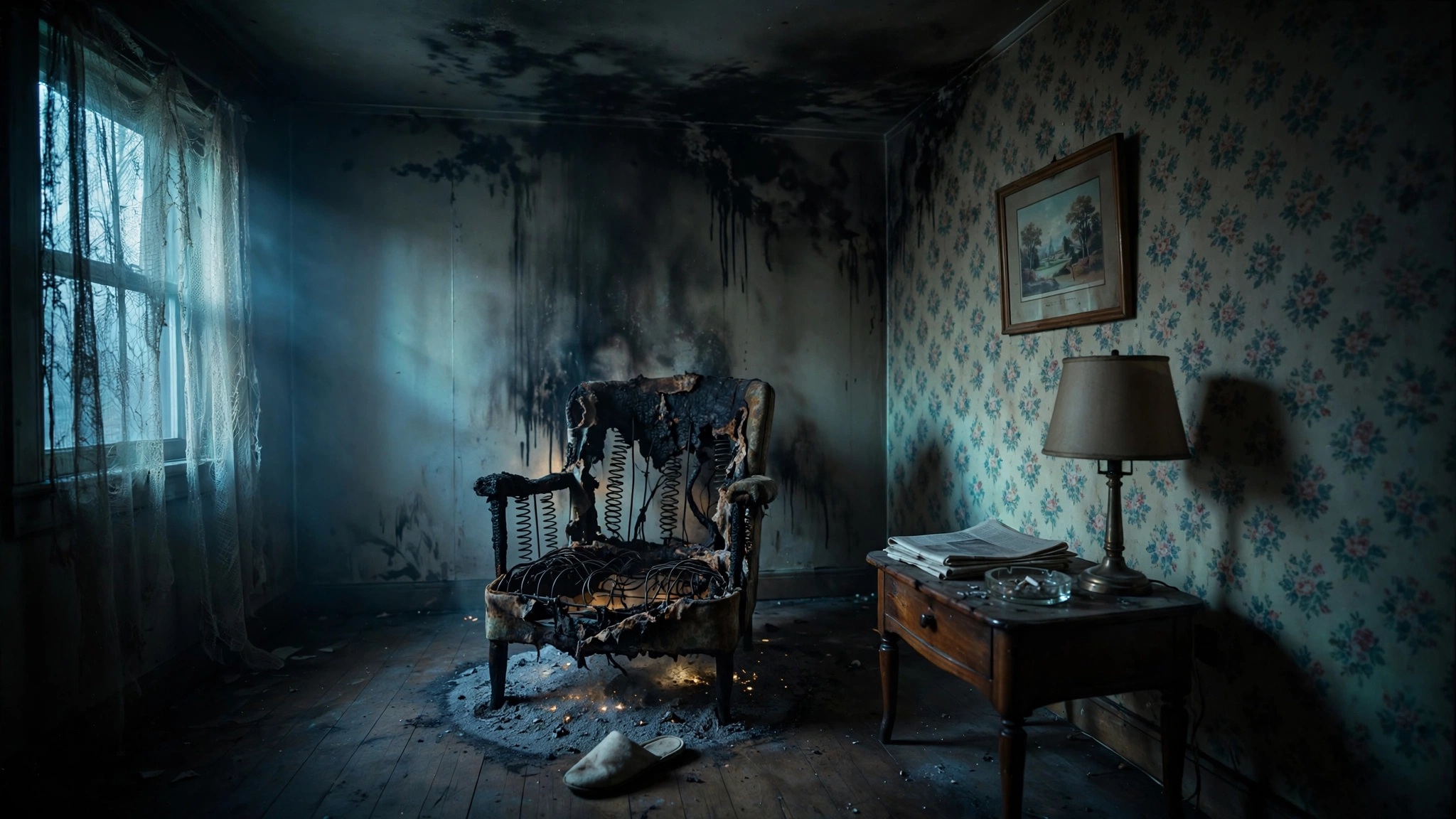
When the maid came into the bedroom that morning, the air was thick with soot. About four feet from the bed, lay a heap of ashes. Beside it were two legs, untouched from the knees down, the stockings still on. Of the rest of the Countess Cornelia Bandi, who had gone to bed the night before in good health after three hours of talk with that same maid, there was almost nothing left. Three blackened fingers. Part of the skull. And a fine, foul-smelling soot coating every surface in the room.
The bed was barely damaged. The furniture had not burned. Whatever had consumed a woman of sixty-two in the town of Cesena, in 1731, had done it without setting her room on fire.
For nearly three hundred years, cases like hers have kept coming back. An old woman reduced to ash in an armchair that is still standing. A retired doctor gone through his own bathroom floor, leaving one leg and a slipper. A pensioner in Ireland found burned beside a fireplace the coroner said did not do it. The scenes look impossible, and they have a name that sounds like a verdict in itself: spontaneous human combustion.
The Countess in the Ashes
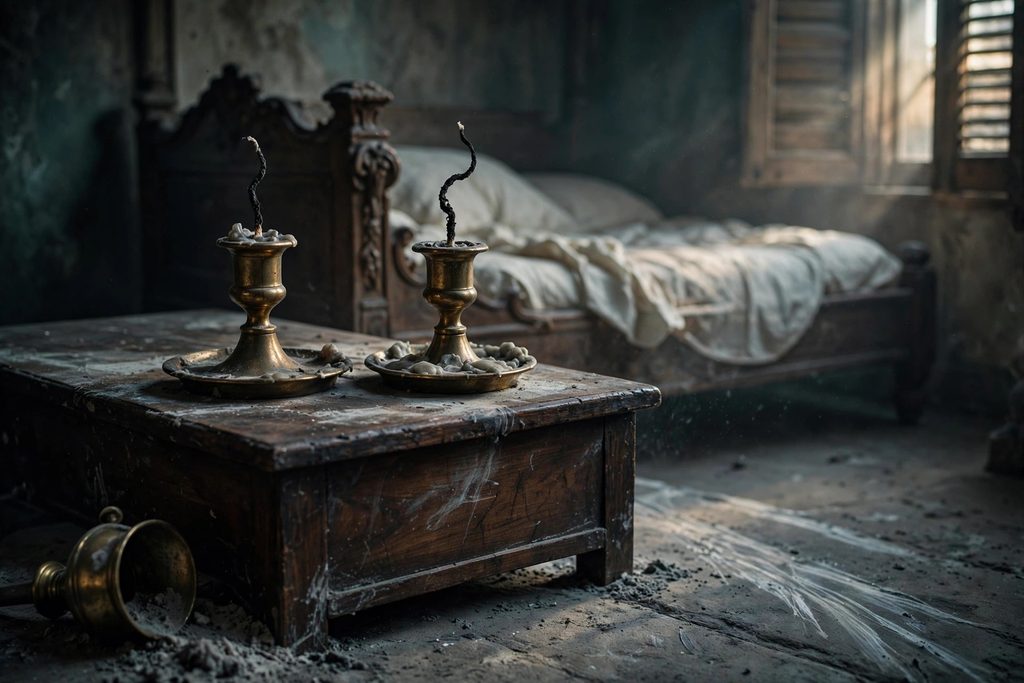
The account of Cornelia Bandi’s death was written by Giuseppe Bianchini, a prebendary of Verona, and it is precise in a way that still unsettles readers. He noted that two candles on a table had lost all their tallow while their cotton wicks were left behind. He noted a small oil lamp on the floor, covered in ashes and empty of oil. He noted that the countess, when she felt unwell, liked to rub herself with camphorated spirit of wine, and may have done so that night.
Bianchini did not blame the lamp. He blamed the countess’s own body, inflamed vapours and fermentations rising from her stomach until they caught fire. In the 1740s Paul Rolli, a Fellow of the Royal Society, published an English extract of Bianchini’s account in the Society’s Philosophical Transactions, and the countess became the founding case of a new and terrible idea.
The idea had already been tested in a courtroom. In France in 1725 a man was accused of burning his wife, Nicole Millet, to death. Her body had been found burned in a chair that was not. The surgeon Claude-Nicolas Le Cat persuaded the court that she had combusted on her own, and the husband went free. By 1763 there were enough stories for Jonas Dupont to collect them into a book, De Incendiis Corporis Humani Spontaneis, on the spontaneous fires of the human body.
A Disease of the Drinkers
The nineteenth century gave the fire a moral. Physicians noticed, or thought they noticed, that the victims were usually elderly women and usually heavy drinkers. An 1823 Treatise on Medical Jurisprudence listed the common features of the recorded cases, among them that the victims were chronic alcoholics and that “the hands and feet usually fall off.”
The explanation wrote itself. A lifetime of spirits, the theory went, soaked the tissues until they were as flammable as the bottle. For the temperance movement it was a gift, a sermon with a body attached. Drink enough, and one night you might simply ignite.
Dickens Sets Fire to Mr. Krook
In December 1852 Charles Dickens killed off one of the strangest characters in Bleak House. Krook, a rag-and-bottle dealer who drinks gin in a squalid shop full of hoarded papers, is found as a smouldering stain on the floor, a thick yellow grease on the window and a smell no one can name. He has died, Dickens tells his readers, of spontaneous combustion.
The critic George Henry Lewes, who had trained in physiology, was furious. He accused Dickens of “giving currency to a vulgar error.” The liver breaks down alcohol, he argued, so a drinker’s organs are not soaked in it, and a body that is three-quarters water does not catch light on its own. Dickens refused to back down. In the preface to the finished novel he cited the Countess Bandi as “the most famous” case and wrote that “there are about thirty cases on record.” Then he added a line that is still quoted: “I shall not abandon the facts until there shall have been a considerable spontaneous combustion of the testimony.”
It is worth remembering when this argument took place. Only a few years earlier, two sisters in upstate New York had started a religion out of knocks in the dark. The Victorian imagination was ready to believe that the body held forces science had not yet named.
The Cinder Woman of St. Petersburg
At about eight o’clock on the morning of 2 July 1951, Pansy Carpenter went to deliver a telegram to her tenant in St. Petersburg, Florida. The metal doorknob of Mary Reeser’s apartment was so warm she could hardly hold it.
Reeser, sixty-seven, had been sitting in an armchair the night before. Now the chair was almost gone, and so was she. What remained was part of her left foot, still in its slipper, a section of backbone and her skull. Plastic objects in the room had softened and sagged from the heat, while things a few feet away seemed untouched. The newspapers called her the Cinder Woman, and one detail spread faster than any other, the claim that her skull had shrunk to the size of a teacup. A fire researcher who saw the scene later disputed it, but the image never went away.
The local police chief, J. R. Reichert, sent what was left to the FBI with a note for J. Edgar Hoover. Glass fragments. A section of carpet. Six small objects thought to be teeth. The surviving slipper. He wanted to know how a fire could do this to a woman and leave the furniture “not even scorched or damaged by smoke.”
The Doctor in the Bathroom
Fifteen years later, on 5 December 1966, a gas company meter reader named Don Gosnell let himself into the house of Dr. John Irving Bentley in Coudersport, Pennsylvania. Bentley was ninety-two, a retired physician who walked with a frame, and Gosnell was allowed to come in and read the meter in the basement. Down there he noticed a strange smell, a haze of light blue smoke and a small heap of ash on the floor.
Upstairs, in the bathroom, he found where the ash had come from. A hole had burned through the floor. Across it lay Bentley’s walking frame, its rubber tips intact. Beside it was the lower half of his right leg, still wearing a slipper. The rest of him had fallen through to the basement as ash. The bathtub a few feet away was barely scorched. The coroner recorded death by asphyxiation and “90 percent burning of the body.”
Bentley’s pipe was found on its stand in the next room. Whatever lit him, it was not the obvious thing.
How Hard It Is to Burn a Body
To feel the full strangeness of these cases, it helps to know how much work it takes to destroy a human body on purpose. A modern crematorium runs at around 800 to 1,000 degrees Celsius and takes an hour or two, and even then the bones survive and have to be ground down afterwards. In Cesena, St. Petersburg and Coudersport, bodies were reduced further than that in ordinary rooms, while candles, chairs and bathtubs a short distance away came through almost unharmed.
That contrast is the heart of the mystery. And it is exactly where the first answer came from.
In 1965 the British pathologist David Gee, investigating a burning death in Leeds, tried a simple experiment. He wrapped a small roll of human fat in cloth and held it in a Bunsen flame. It took about a minute to catch. Once it did, it burned on its own with a slow, smoky yellow flame for about an hour, until it was consumed. The cloth acted as a wick. The fat was the fuel. Gee had made a candle.
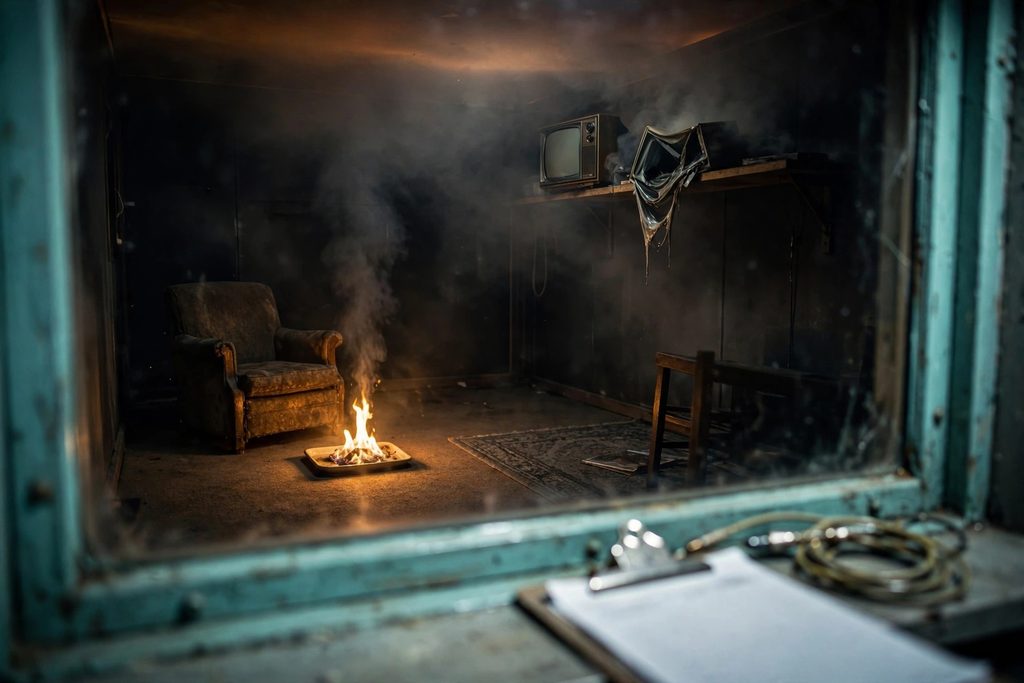
In 1998 the American fire investigator John DeHaan tried it at full scale for the BBC science programme QED. He wrapped a dead pig in a blanket, placed it in a furnished room and lit it with a small amount of petrol. The body was slow to catch. Then the fat took over, and it burned for hours with low flames at a very high temperature. Heat pooled near the ceiling and melted a television set, while the rest of the room suffered very little. In a later test that DeHaan and a colleague measured and published in the Journal of Forensic Sciences in 2001, a pig carcass wrapped in a cotton blanket and lit with a litre of petrol kept itself burning for more than six and a half hours, rendering its own fat into the charred blanket and carpet beneath it, until more than sixty percent of its weight was gone and the large bones had turned fragile and ashen. A pig is not a person, but its skin and fat are close enough that fire investigators have used pigs in place of human bodies for decades. The study also found two things the old cases had puzzled over. The fire needed an outside flame for several minutes to get going. And parts of the body with little fat, like the lower legs, could not keep the flame alive.
The wick effect, as it is called, explains almost everything that makes these scenes look impossible. The fire is small and slow, so it does not spread. The heat rises, so the ceiling and high objects suffer while the floor and nearby furniture survive. Hours of burning destroy far more than a short, hot blaze would. And the lower legs, with little fat to feed the flame, are so often left behind.
The Missing Flame
The wick effect still needs a spark. In 1984 the investigator Joe Nickell and the forensic analyst John F. Fischer published a two-part study in The Fire and Arson Investigator, the journal of the International Association of Arson Investigators. They had spent two and a half years on thirty historical cases, from 1725 to 1982. In case after case they found a candle, a lamp, a fireplace or a pipe close to the body. And in case after case, that ignition source had dropped out of the versions of the story that got retold.
Read the old cases again with that in mind. The Countess Bandi’s oil lamp lay on the floor beside her ashes, empty. Her skin may have been wet with camphorated spirit. The candles on her table had been rendered down to their wicks by the heat of a fire burning a few feet away. Mary Reeser was a smoker and had taken sleeping pills that evening. The FBI concluded she had dozed off with a cigarette and set her nightclothes alight. As her daughter-in-law put it, her body fat “was the fuel that kept her burning.”
Dr. Bentley’s pipe was on its stand, but Nickell found that his clothes were dotted with old burn holes from years of dropping hot ash on himself. His robe was found smouldering in the bathtub. No one saw the fire begin, so Nickell’s reconstruction is an informed reading of the scene, not a certainty. It is simple and grim. Bentley woke to find his clothes on fire, made his way to the bathroom, perhaps for water, and collapsed. The burning robe and his body set the linoleum alight, and air drawn up through the floor from the basement below fed the fire like a chimney.
The victims share a profile, and it is not the one the Victorians drew. They were mostly old, often alone, often unwell, sedated or unable to move quickly. Many smoked. Almost all of them were close to a small flame and too slow or too unconscious to put it out. Nickell and Fischer warned against forcing every case into a single tidy explanation, and they were right to. But the pattern is plain enough.
The Fires With Nothing to Light Them
Not everyone accepts that answer. Some writers have proposed that the fire starts inside after all. In his 1995 book Ablaze!, Larry Arnold counted around two hundred reports over three centuries and suggested a new subatomic particle he called the pyrotron. Others have pointed to ball lightning, or to the acetone a body produces in ketosis, or to unusual electrical fields. None of these has ever been seen to set a living person alight, in a laboratory or anywhere else.
And yet the cases keep arriving. In December 2010, Michael Faherty, a seventy-six-year-old man, was found badly burned in the sitting room of his home in Galway, in the west of Ireland. A fire was burning in the open fireplace nearby. The only other damage was to the ceiling directly above him and the floor directly beneath. After a nine-month inquiry, the West Galway coroner, Dr. Ciaran McLoughlin, concluded that the fireplace was not the source and that the death fitted “into the category of spontaneous human combustion, for which there is no adequate explanation.” In twenty-five years of investigating deaths, he said, it was the first time he had reached that verdict.
The ruling went around the world. The forensic pathologist Stephen Cina, speaking to reporters in the United States, said he had never seen such a case and that there was no good evidence a body could generate enough heat inside itself to burst into flame. When similar deaths were investigated fully, he said, they usually led back to a cigarette.
The Faherty case shows where the mystery lives now. Not in the burning, which the wick effect explains, but in the first flame. Sometimes it is never found. A coroner’s honest “no adequate explanation” records a gap in what investigators could prove in one room in Galway. It is not evidence that the fire came from inside the man.
The Verdict | Debunked
The idea that a human body can burst into flame by itself, with no outside source of fire, has never survived a full investigation. Every famous case, looked at closely, puts a candle, a lamp, a cigarette or a fireplace within reach of the victim. The impossible details, the untouched furniture, the surviving legs, the greasy soot, are exactly what a slow fire fed by body fat leaves behind.
The stamp judges that one claim, self-ignition. It does not pretend every death in these files has been reconstructed second by second. Some, like Michael Faherty’s, never will be.
What replaced the legend is not much more comforting. Some files in this archive concern a body that would not decay. These concern bodies that, given one small flame and a few quiet hours alone, will consume themselves almost completely, like a candle left burning in an empty room.
The clue was there from the very first case. On the countess’s table in 1731, two candles had melted away to nothing, leaving their wicks behind. Bianchini wrote it down and looked past it. It took two and a half centuries for anyone to see that the room had been describing exactly what happened to her.
To see how this file’s stamp compares with the rest of the archive, visit the Verdict Index.