




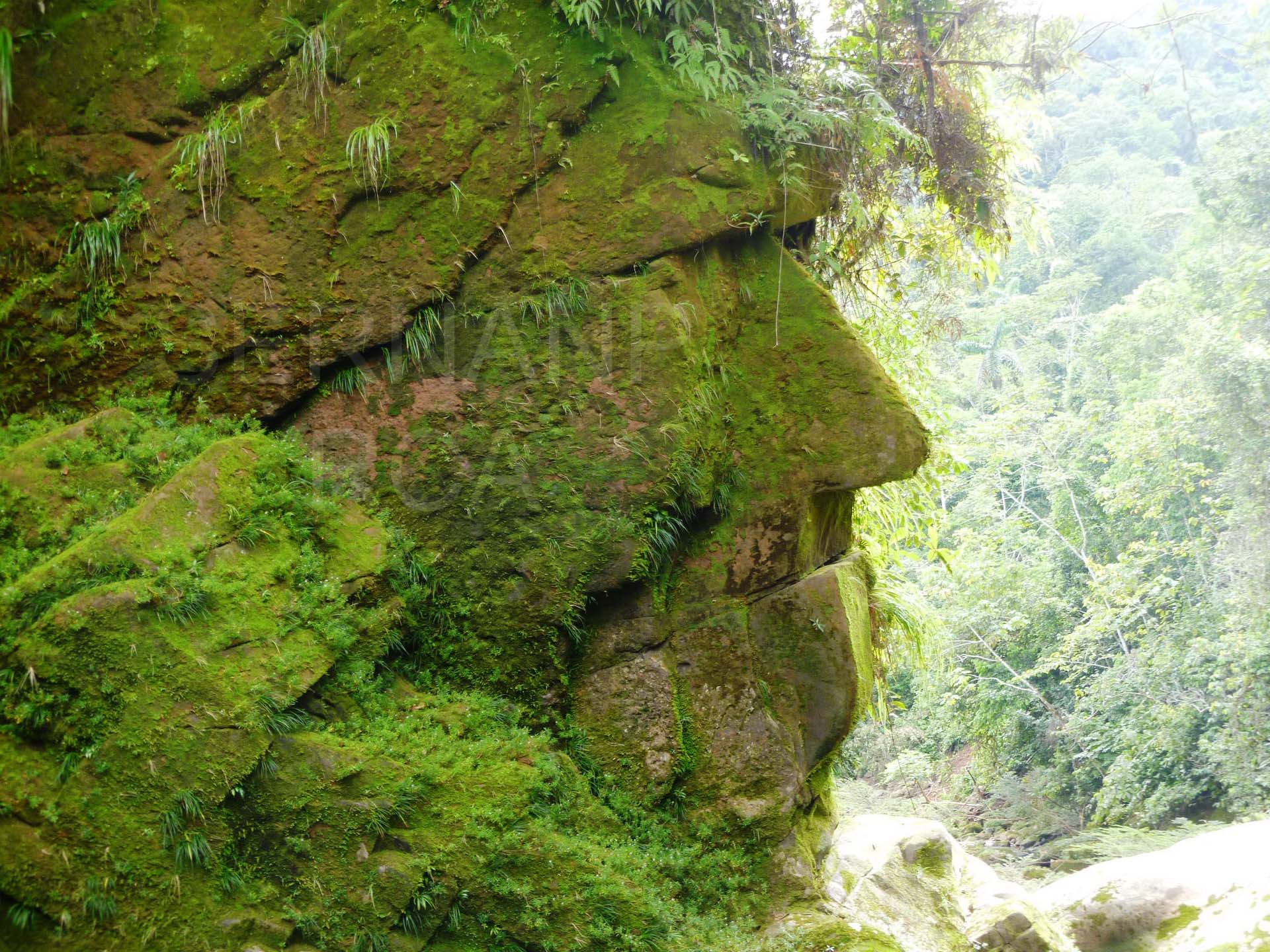
Deep in the Peruvian Amazon, where rainforest closes around rivers, waterfalls and mountains with a density that can make the landscape feel almost deliberately hidden, there is a stone formation that looks uncannily like a human face. The Harakbut people know it as the Rostro Harakbut—the Harakbut Face—and for generations it existed not as an archaeological curiosity but as a place embedded in oral tradition, memory and sacred geography. When a group of Harakbut leaders finally reached the formation with outsiders in 2014, the expedition was described as a rediscovery. Yet the deeper story is stranger than the idea of a lost monument waiting to be found. The evidence suggests that the face may be a natural geological formation, while the meaning attached to it is unmistakably human: a landscape feature became an ancestor, a sacred place became a cultural landmark, and a remote formation eventually became protected national heritage.
The Rostro lies inside the Amarakaeri Communal Reserve in Peru’s Madre de Dios region, in an extraordinarily remote part of the southeastern Amazon. For people arriving from outside, the journey is difficult enough that the formation can seem almost inaccessible, but the Harakbut relationship with the place does not begin with the expedition that brought it to wider public attention. The Face was already part of Harakbut knowledge and tradition. The problem was not that nobody knew the Face existed. The problem was that knowledge of the place had survived more easily than the precise route back to it. In October 2014, Harakbut leaders Luis Tayori and Jaime Korisepa travelled into the forest with filmmaker Paul Redman, Rainforest Foundation US, Handcrafted Films and ECA-RCA in an expedition that sought to locate the Rostro and document the journey for the film The Reunion.
They call it “el Rostro Harakbut”—the Harakbut Face.
That distinction matters because the usual language of discovery can quietly distort what happened. In the modern imagination, a place becomes “lost” when outsiders no longer know where it is, and “discovered” when outsiders finally arrive. Indigenous memory does not always work according to that map. The 2014 expedition was, in an important sense, a reunion rather than a discovery: Harakbut knowledge had preserved the significance of the place even while access to it had become difficult. The title of the resulting film captured that idea directly. When Tayori stood before the formation, he described the moment as a reunion with his ancestors and spoke of the emotional force of finally seeing the Rostro in person.
And then there is the face itself. Rising dramatically above its surroundings and associated with a waterfall and basin, the formation possesses exactly the quality that makes certain landscapes impossible to look at neutrally: once the human features become visible, the rock stops behaving like ordinary rock. The forehead, nose, mouth and overall profile create an image that appears intentional to the eye. Tom Bewick, who accompanied the expedition, argued that markings on the formation looked to him like evidence of rudimentary tool work and pointed to the position of the rock within the surrounding landscape as further evidence that it had been deliberately shaped. Other observers have reached different conclusions. The disagreement is not over whether the formation looks like a face. It plainly does. The disagreement concerns how that face came to exist.

The Question Hidden Inside the Face
For years, popular accounts tended to reduce the mystery to a dramatic binary: either an ancient people carved an enormous face into the rock, or nature somehow produced an astonishing imitation of one. That framing is understandable, but it is too narrow. A formation can be natural in its geological origin and still become deeply cultural in its human history. A mountain can be natural, yet a sacred mountain is not merely a pile of stone. A cave can be geological, yet a cave containing paintings is also an archaeological site, part of a pattern examined in a related discovery of ancient rock art elsewhere in the Amazon rainforest. A river can be entirely natural, yet the stories, boundaries, journeys and ceremonies attached to it can make the river one of the most culturally constructed places imaginable. The Harakbut Face sits precisely at this intersection between physical formation and cultural meaning.
This is where the 2018 research becomes crucial. In Rock Art Research, Raoni Valle, Gori-Tumi Echevarría López and colleagues examined the Harakbut Face as part of a broader investigation into how Indigenous Amazonian peoples understand geological features that resemble images, bodies or other meaningful forms. Their paper did not simply dismiss Indigenous interpretations as superstition, nor did it accept every claim of human manufacture at face value. Instead, it asked a more difficult question: what does “anthropogenic” actually mean when a geological feature becomes part of a cultural system?
The researchers describe the Harakbut Face as a sedimentary outcrop traditionally known as El Rostro and explain that, within Harakbut tradition, the large heads of the territory represent ancestors. Their analysis of the site produced an important result: from a Western geological and forensic perspective, the structure appeared to have been produced by geomorphological processes rather than carved into its present form by human beings. In other words, the most substantial academic evidence located for this article does not support the simple claim that an ancient civilization sculpted a gigantic face out of solid rock. It points instead toward a natural geological formation whose resemblance to a face became the foundation for an elaborate cultural interpretation.
When Nature Produces a Face
The scientific concept that helps explain part of this process is pareidolia: the tendency of the human perceptual system to recognize meaningful patterns in ambiguous or random stimuli. We see faces in clouds, animals in shadows and familiar shapes in landscapes because the brain is extraordinarily good at detecting patterns, especially patterns that carry biological significance. A face is not just another geometric arrangement. Humans are highly attuned to eyes, mouths, symmetry and expressions because recognizing another living being quickly has obvious evolutionary value. In a forest filled with irregular rock, fractured surfaces and changing light, the moment a configuration resembles a human face it can become perceptually dominant.
Yet calling the process pareidolia does not mean saying that the Harakbut were simply “fooled by a rock.” That would miss the central point of the research. Valle and his colleagues argue that perception can become culturally productive. A naturally occurring form may be recognized as meaningful, incorporated into stories, connected to ancestors and placed within a system of ritual knowledge. Once that happens, the geological object and the culture surrounding it are no longer separable in any simple way. The rock remains geological, but the place has become something more than geology.
The researchers describe precisely this process at the Harakbut site. Their analysis suggests that a naturally shaped rock outcrop became associated with ancestral imagery and was incorporated into Harakbut mythology and cosmology. They use the language of “cultural-cognitive exaptation” to describe how an existing natural form can acquire a new cultural function. The important idea is that humans do not always need to manufacture the physical shape in order to manufacture meaning. Sometimes the landscape provides the form, and culture provides the story, the memory, the ritual and the identity that make the form significant.
The Harakbut Had Already Given the Stone a History
The Harakbut understanding of the Rostro is therefore not an incidental interpretation added after the modern “discovery.” The 2018 research records a tradition in which the Face and other large heads in Harakbut territory represent ancestors and are connected with Toto, an old and powerful spiritual being. The researchers also describe the place as an Amana, a sacred location whose significance is embedded in Harakbut ritual life. From this perspective, asking only whether the face was physically carved risks asking the wrong question. The more revealing question is how a particular geological feature became a durable node in a people’s understanding of ancestors, territory and the living landscape.
This also explains why the formation mattered so much to Harakbut leaders during the period when the site was being documented. The surrounding reserve has faced pressures from illegal gold mining, road building and resource extraction, and the Face became more than a remarkable object hidden in the forest. It was evidence of a cultural relationship to a particular landscape. When Luis Tayori and other Harakbut leaders spoke about the site, they were not simply presenting an unusual geological formation to the outside world. They were bringing attention to a place that belonged within a much larger geography of memory and identity. The Face could become a symbol of the territory precisely because its importance was not dependent on proving that somebody had carved it.
This is one reason the 2014 expedition deserves to be understood on its own terms. The journey was not an archaeological excavation designed to settle the question of authorship. It was a cultural mapping and documentation effort involving Harakbut leaders and their ancestral territory. The resulting film brought the Rostro to a much wider audience, but the journey also strengthened something that already existed within the community: a connection between living people and a place associated with their ancestors. The emotional response recorded in the film is therefore not evidence that the stone was carved. It is evidence of what the place meant to the people who had come to see it again.
The Tool Marks That Complicate the Story
There remains a legitimate reason the carved-face hypothesis has been so persistent. Tom Bewick, who saw the formation firsthand, reported what he believed were markings consistent with rudimentary tools and argued that the arrangement of the rock within the valley made purely natural explanations less convincing to him. He also described what he interpreted as a second face within the larger formation. Those observations should not simply be erased because a later academic analysis reached a different conclusion. They belong to the history of the site and explain why the question has remained compelling.
But an observation is not automatically an identification. A mark that resembles a tool scar is not necessarily a tool scar, just as a surface that resembles a face is not necessarily a sculpture. Establishing human modification archaeologically requires more than visual impression: researchers need to distinguish intentional alteration from natural fracturing, weathering, exfoliation and other geological processes, ideally through repeatable analysis of the material itself and its archaeological context. The 2018 study is important precisely because it moved the discussion beyond the original visual impact and examined the formation within a broader geological and anthropological framework. Its conclusion—that the lithological structure appeared to have formed through geomorphological processes—does not prove that no human ever modified any part of the site, but it substantially weakens the stronger claim that the giant facial form itself is an ancient sculpture.
That leaves a much more interesting middle ground. It is entirely possible for humans to have interacted with a natural formation without creating its fundamental shape. A naturally face-like rock could have been noticed, visited, ritually marked, incorporated into oral tradition or otherwise culturally transformed without ever being carved into existence. In archaeological terms, “natural” and “culturally significant” are not opposites. The landscape can be natural in origin and cultural in consequence.
A Face Does Not Need a Sculptor to Become a Monument
This is the point at which the Harakbut Face escapes the usual ancient-mystery formula. We are accustomed to monuments having obvious makers. Someone built the wall. Someone raised the stones. Someone painted the cave. Someone carved the statue. When we encounter an enormous human-like form in a remote landscape, our instinct is to search for the lost civilization that made it. The possibility that the landscape itself supplied the first image is somehow less satisfying, even when the evidence points in that direction.
Yet natural landscapes have always been incorporated into human systems of meaning. A mountain becomes a sacred mountain. A spring becomes a holy place. A cave becomes an entrance into another world. A rock becomes an ancestor. The physical object may never have been manufactured, but its social life can be profoundly constructed. The Harakbut Face demonstrates this with unusual clarity because its resemblance is so powerful and its cultural history so deeply rooted. The stone did not have to be carved by human hands to become part of a human world.
The 2021 Decision Changed the Story
The most consequential chapter came several years after the 2014 expedition. The effort to document and protect the site continued through cooperation between Harakbut organizations, the Executor of the Administration Contract of the Amarakaeri Communal Reserve, SERNANP, FENAMAD, COHARYIMA and Peru’s Ministry of Culture. In August 2021, Peru formally declared the Rostro Harakbut Archaeological Site a Cultural Heritage of the Nation through Vice-Ministerial Resolution No. 000202-2021-VMPCIC/MC. The official resolution places the site in the district of Huepetuhe, province of Manu, in Madre de Dios and approves its technical delimitation as a protected archaeological site.
The significance of that decision is easy to misunderstand if the story is reduced to the question of whether the Face was carved. Peru did not need to declare the formation culturally important because somebody had conclusively demonstrated that an ancient sculptor created it. The state recognized the site because of its cultural and historical significance to the Harakbut people and because it forms part of a landscape whose protection is inseparable from the protection of Indigenous cultural heritage. SERNANP described the Rostro as a sacred place of pilgrimage and emphasized its importance to Harakbut identity and ancestral history.
That is a remarkable resolution to a mystery that began with a face in a rock. The modern state did not settle the ancient argument by announcing, “Yes, this was carved.” Instead, it effectively recognized something more important: whatever its geological origin, the place has a cultural history worthy of protection. The landscape became heritage because people had invested it with memory, meaning and identity.
The Mystery Beneath the Mystery
There is still room for further research. The 2018 study is significant, but it should not be inflated into the claim that every possible human interaction with the site has been ruled out forever. Nor should the observations of people who believe they saw tool marks be presented as equivalent to a controlled archaeological demonstration. The responsible conclusion is narrower and stronger: the available academic evidence examined here supports a geomorphological origin for the main facial formation, while the cultural evidence establishes that the Face has long occupied an important place in Harakbut knowledge and sacred geography. The question of precisely how, when and whether humans modified any part of the formation remains separate from the question of why the place matters.
And perhaps that separation is exactly what the original mystery was missing. If the Face is natural, then nature produced something that humans immediately recognized as human. If the Harakbut subsequently incorporated that image into stories of ancestors and sacred geography, then perception became culture. If generations preserved the place in oral tradition, then memory became a form of cartography. If Harakbut leaders later used its recognition to strengthen the case for protecting their ancestral territory, then culture became political protection. And when Peru finally recognized the site as national heritage, that chain of meaning entered the legal world. The rock remained the same. Almost everything around it changed.
The Face Was Never Really Lost
There is an irony at the heart of the Harakbut Face. From the outside, the story looks like the rediscovery of a gigantic ancient monument hidden in one of the world’s most inaccessible forests. From within the Harakbut story, it is something else entirely. The place had not ceased to exist simply because outsiders did not know how to reach it. Its significance had survived in oral tradition, in the memories of elders and in the cultural geography of the people who belonged to the landscape. What was lost was not the story. What was lost was the path.
And once the path was found, the Face entered another world. Cameras recorded it. Journalists argued over its origin. Researchers examined its geology and anthropology. Environmental campaigns used its presence to draw attention to threats facing the surrounding territory. Indigenous leaders continued the work of documenting ancestral places. Eventually, the Peruvian state gave the site legal recognition. The sequence is more complicated than the familiar tale of a lost civilization leaving behind an impossible monument, but it is also more human. A place survived because people remembered it, and it became protected because people insisted that the memory mattered.
Perhaps the strangest thing about the Harakbut Face is therefore not that an ancient sculptor may have hidden a gigantic face in the Amazon. The evidence does not require that story. The stranger possibility is that nobody needed to carve the face for it to become a monument. Nature supplied the form; perception recognized it; culture gave it a history; generations gave it meaning; and the people who inherited that meaning eventually brought the place into the protection of the modern state. The stone may be geological. The face may be natural. But what happened around it is unquestionably human—and that may be the more extraordinary mystery.