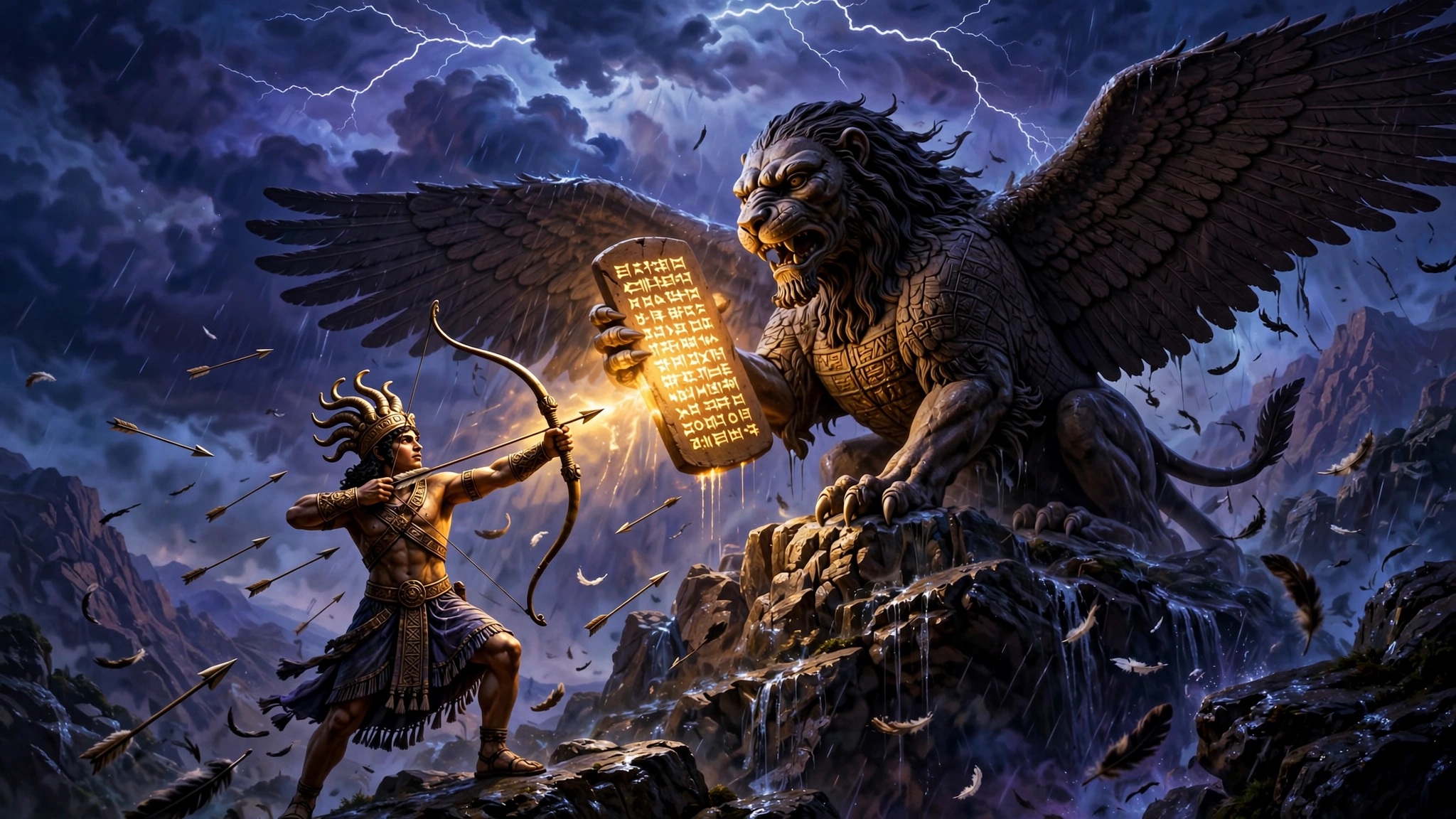
In the house of Enlil, king of the gods, there was a tablet that held the destinies of everything. Whoever held it held the power to decree fates, command the gods and rule the universe. Enlil set a guard at the door of his chamber, a monstrous bird with the head of a lion, born in the mountains. Its name was Anzu.
One day, as Enlil took off his crown to bathe, Anzu seized the tablet and flew away to the mountains. The rule of heaven stopped. The gods fell silent, the sanctuaries lost their splendour, and the order of the world began to fail.
This is the oldest story of a stolen tablet of power, and it has been retold many times since, most recently as a tale of renegade astronauts. The cuneiform tablets that tell it survive.
What Is the Tablet of Destinies?
The Tablet of Destinies, in Akkadian ṭuppi šīmāti, is a clay tablet in Mesopotamian myth that gave its holder supreme authority over the universe, the power to decree the fates of gods and people. It belonged to Enlil, the king of the gods. In the Myth of Anzu it is stolen by the lion-headed bird Anzu and recovered by the warrior god Ninurta. In the Babylonian creation epic, the Enuma Elish, the sea goddess Tiamat gives it to her champion Kingu, and Marduk takes it from him. It is a symbol of kingship among the gods, a seal on the right to rule.
The Myth of Anzu
The Myth of Anzu survives in an Old Babylonian version and a longer Standard Babylonian one, copied in the first millennium BCE and found in the libraries of Assyria. In it the gods gather in alarm after the theft. Anu, the sky god, asks for a champion to kill Anzu and take back the tablet. He turns first to Adad, the storm god, then to Girra, the god of fire, then to Shara, the son of Ishtar. Each refuses. Anzu, they say, now holds the Tablet of Destinies, and whatever he decrees will happen. Whoever he curses will turn to clay.
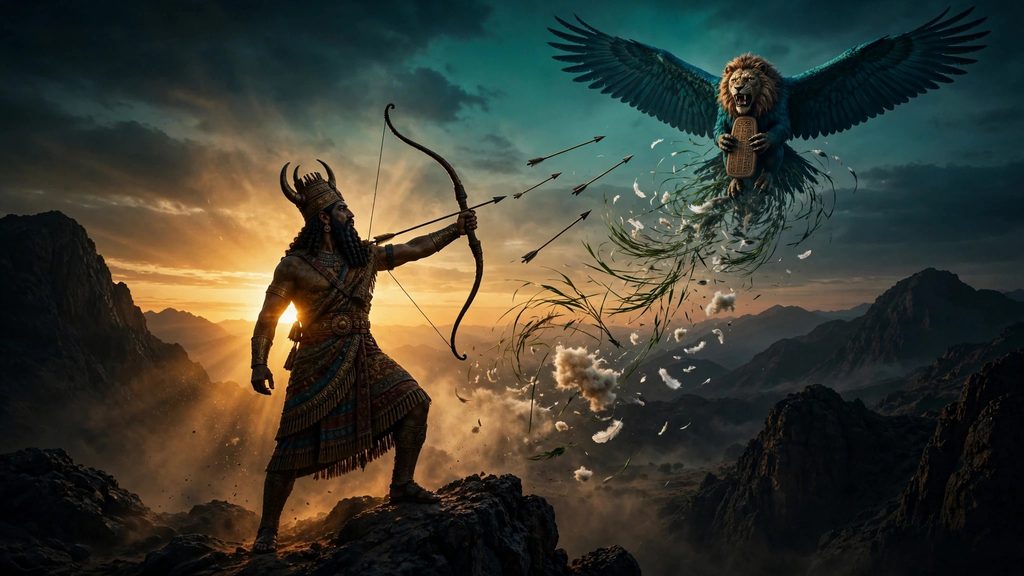
Ea, the god of wisdom, has a plan. He asks the mother goddess, Belet-ili, to send her son Ninurta. Ninurta goes up into the mountains with his storm weapons and his bow, and meets Anzu in battle. He looses his arrows, but Anzu, holding the tablet, speaks a decree. “Reed, return to your canebrake,” he commands, and the arrow turns back to the reeds it was cut from, its feathers to the birds, its bowstring to the sheep.
Ninurta sends word to Ea, and Ea sends advice. Tire the bird, cut off its wings, and when it calls to its wings to return, strike. Ninurta does as he is told. He brings Anzu down, kills it and returns the tablet to the gods, and the poem ends with a hymn of praise to him and his many names. It was recited in honour of Ninurta, whose temple at Nippur, the city of Enlil, held him as the champion who restored order to heaven.
Anzu Before the Demon
Anzu was not always an enemy. In older Sumerian texts the great bird, then called Anzud, is a creature of the mountains that can be helpful as well as dangerous. In the epic of Lugalbanda, the young hero feeds and honours Anzud’s chick, and the grateful bird rewards him with the power to travel at great speed. A lion-headed eagle spreading its wings over two lions or stags was the emblem of the god Ningirsu at Lagash, and it appears on one of the most famous monuments of early Sumer, the Stele of the Vultures, carved around 2450 BCE.
The bird of the storm, enormous and lion-headed, could guard a god or rob him. In the Myth of Anzu, it does both.
Kingu and the Tablet
In the Enuma Elish, the tablet appears again. Tiamat, the primordial sea, goes to war against the younger gods and makes her consort Kingu her commander. She gives him the Tablet of Destinies and fastens it on his breast. When Marduk defeats Tiamat and her army, he takes the tablet from Kingu, seals it with his own seal and fastens it on his own breast. Kingu is later executed, and from his blood, in this version, humanity is made, to do the work of the gods. The same tablet that Anzu stole from Enlil passes to Marduk, the god of Babylon, as the sign of his new kingship over the gods. The story of how the Babylonian epic raised Marduk above the older gods is told in our file on the Anunnaki.

Pazuzu, the Demon Who Protects
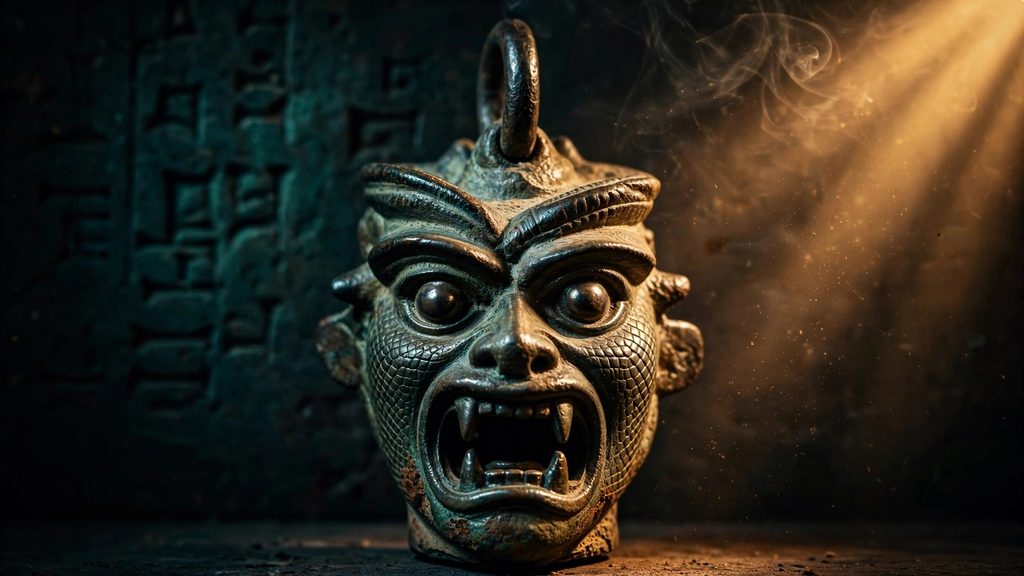
The viral retellings of the theft name a different villain, Pazuzu. No surviving text connects Pazuzu with the Tablet of Destinies. He belongs to the first millennium BCE, a demon with a dog-like face, bulging eyes, scaly body, wings and the talons of a bird, described as the son of Hanbi and the king of the evil wind-demons. He was feared as the bringer of the hot winds that carried disease.
He was also a protector. Bronze and stone heads and amulets of Pazuzu were hung in houses and worn by pregnant women to drive away Lamashtu, a demoness who was believed to attack mothers and newborn babies. One demon was set to fight another. Pazuzu’s modern fame comes from a film. In 1973, The Exorcist opened at an excavation in northern Iraq, where an archaeologist uncovers an amulet and a statue of Pazuzu, and the demon became the one that possesses a twelve-year-old girl in Washington.
The Viral Version
The modern retelling that circulates online merges the Anzu myth, a different myth in which the goddess Inanna takes the divine powers from Enki, and Pazuzu into a single story of a rebel faction of Anunnaki astronauts. Around it it gathers claims that have nothing to do with the tablets. Comet names are said to hide Sumerian words, though Comet ISON is named after the International Scientific Optical Network whose astronomers found it in 2012, and Comet Encke after the astronomer Johann Franz Encke, who calculated its orbit. The Vatican is said to hold 60,350 tonnes of gold, more than a quarter of all the gold ever mined, which by the World Gold Council’s estimate comes to about 216,000 tonnes. Francis Bacon is called a “33rd-degree Freemason,” a rank created nearly two centuries after his death.

The framework behind it, the Anunnaki as astronauts from the planet Nibiru, comes from the books of Zecharia Sitchin, starting with The Twelfth Planet in 1976. What the tablets say about the Anunnaki, and how Assyriologists answered Sitchin, is set out in our file on the Anunnaki, and the planet he made of a Babylonian star in our file on whether the Anunnaki will return.
The Tablet in the Mountains
The myth outlived the gods who told it. The image of a written tablet that fixes the fate of the world has been compared with the heavenly books of life and judgement in later Jewish and Christian tradition, and the bird-demon who stole the power of heaven still stands, wings spread, in museum cases from Paris to London. The Anzu poem was copied for the libraries of Assyrian kings as a story of how order is lost and won back, by a young god who knew when to listen to wisdom.
Quick Answers About the Tablet of Destinies
What is the Tablet of Destinies? A tablet in Mesopotamian myth that gave its holder the power to decree the fates and rule the universe. It belonged to Enlil, the king of the gods.
Who stole the Tablet of Destinies? Anzu, a lion-headed bird who guarded Enlil’s chamber. He was killed by the god Ninurta, who returned the tablet. In the Enuma Elish, Tiamat gives it to Kingu, and Marduk takes it from him.
Who is Pazuzu? A Mesopotamian demon of the first millennium BCE, king of the wind-demons, whose image was also used to protect mothers and babies from the demoness Lamashtu. He has no part in the Tablet of Destinies myth.
Who was Anzu? A giant lion-headed bird of Mesopotamian myth, called Anzud in Sumerian, sometimes helpful and sometimes a thief, and the emblem of the god Ningirsu at Lagash.
The Verdict | Debunked
The Tablet of Destinies and the theft by Anzu are authentic Mesopotamian myths, preserved on cuneiform tablets and recovered by Ninurta in the poem, and the tablet passes to Marduk in the Enuma Elish. The viral version, in which Pazuzu leads renegade Anunnaki astronauts in stealing it, merges separate myths, gives Pazuzu a role no text records, and surrounds it with false claims about comet names, Vatican gold and Francis Bacon. As a story of the Anunnaki and Pazuzu, it is debunked.
The wider story of Sumer and its gods is gathered in our Sumer and Mesopotamia case files.
For how this verdict sits beside the rest of the archive, see the Verdict Index.