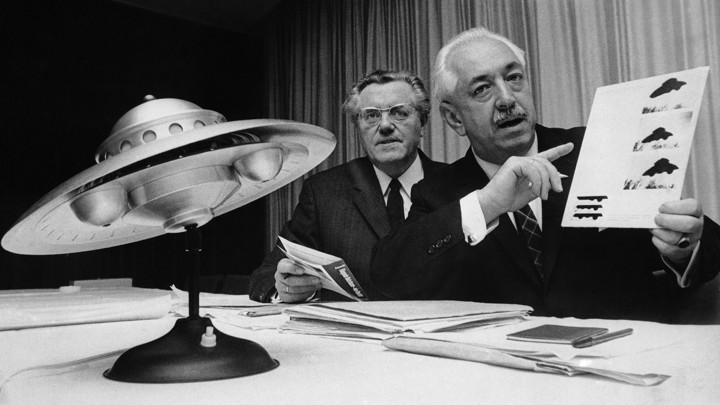
The Pentagon really did spend millions investigating UFOs. Military personnel really did report unexplained objects. Nuclear weapons facilities really did appear in some of the most famous cases. And the U.S. government really has kept large amounts of UAP-related information classified. But none of those facts, individually or together, establishes the much larger story that has grown around them: recovered extraterrestrial spacecraft, secret reverse-engineering programs, alien retaliation against Soviet missile crews, or a decades-long government possession of non-human technology. The documented history is real. The mythology built on top of it is a different thing.
That distinction matters more now than it did in 2017. The modern UAP story began entering mainstream American politics when reporting revealed a genuine Pentagon intelligence program, and it has since expanded into congressional hearings, whistleblower allegations, official investigations, public databases, and a growing release of historical records. Some cases remain unidentified because the underlying data are inadequate. Some claims have been investigated and rejected. Others remain allegations without the physical evidence needed to decide them. The interesting question is therefore no longer whether the government has ever taken UFO reports seriously. It plainly has. The harder question is what the evidence actually shows once every layer of the story is separated from the next.
The $22 Million Program Was Real, But Its Name Became Confusing
The event that changed the public conversation came on December 16, 2017, when The New York Times reported that the Pentagon had operated a classified effort examining unidentified aerial phenomena with roughly $22 million in funding. The reporting identified the program as the Advanced Aerospace Threat Identification Program, or AATIP, and connected it to then-Senate Majority Leader Harry Reid, defense contractor Robert Bigelow, and former intelligence official Luis Elizondo. The same investigation brought renewed attention to the 2004 Navy encounter later known as the “Tic Tac” incident. The underlying government interest was not invented by UFO culture after the fact: the Defense Intelligence Agency’s own FOIA records contain AATIP-related material and records concerning the program’s activities. What became controversial was the interpretation of what exactly AATIP was, what its precise mandate was, how much authority Elizondo possessed, and how directly the program should be connected to later UAP claims.

There is an important historical complication here that often disappears in simplified retellings. The Pentagon’s broader effort also involved the Advanced Aerospace Weapon System Applications Program, or AAWSAP, associated with Bigelow Aerospace and DIA funding, and the names AATIP and AAWSAP subsequently became intertwined in public discussion. That does not make the underlying programs imaginary, it means the institutional history is messier than the popular version suggests. A genuine government investigation of unusual aerospace reports is not equivalent to a government confirmation that the reports were extraterrestrial. The first establishes that officials considered the subject worth investigating. The second would require evidence of a completely different order.
What the Pentagon Actually Admitted
The most important official admission is also the least sensational: some UAP reports cannot be identified with the information available. That is not the same statement as “the Pentagon knows what they are and is hiding aliens.” It is the ordinary consequence of investigating observations made with imperfect sensors, incomplete metadata, limited eyewitness information, or classified systems whose details cannot be publicly released. AARO, the Pentagon’s All-domain Anomaly Resolution Office, has repeatedly said that many cases are resolved as balloons, birds, aircraft, satellites, drones, or other conventional objects, while others remain in an active archive because there is insufficient information to reach a conclusion. In its historical review, AARO found no evidence that any U.S. government investigation had confirmed a UAP as extraterrestrial technology. Its conclusion was not that every sighting had been explained, it was that unresolved sightings are not evidence of extraterrestrial origin.
That distinction became especially important in AARO’s later reporting. The office has acknowledged that a small number of cases remain potentially anomalous and deserve further investigation, but it has also stated that it has found no verifiable evidence of extraterrestrial beings, activity, or technology. Its FY2025 reporting continued the same pattern: hundreds of cases were resolved to ordinary causes, while cases lacking sufficient data remained open for possible future resolution. The unresolved category is therefore real, but it is an evidentiary category, not an extraterrestrial one.
The Nuclear-Weapons Connection Is More Complicated Than the Legend
Few stories have done more to cement the idea of a deliberate UFO interest in human nuclear weapons than the incidents associated with Malmstrom Air Force Base in Montana in 1967. The underlying missile malfunction is real. On March 16, ten Minuteman missiles assigned to Echo Flight lost their strategic alert status in rapid succession, an extraordinary failure during the Cold War. The Air Force’s historical record documented the outage and described an electronic problem affecting the missile systems. What it did not establish was that a UFO caused the failure. In fact, the same record states that rumors of UFO activity around Echo Flight were investigated and reported as disproven.
The later UFO narrative came largely through former personnel and subsequent investigations. Robert Salas has described a separate missile incident involving reports of an unusual object, while Walter Figel, who was the deputy crew commander at Echo Flight, has recalled receiving a report from security personnel about a large object near a launch facility, testimony belonging to a much longer tradition documented in the secret tradition of US presidents with UFOs. But the testimony does not line up neatly. Captain Eric Carlson, the Echo Flight commander, denied a UFO connection, and the historical record does not establish that an unidentified craft interfered with the missiles. Even the strongest version of the case therefore has to be stated carefully: a remarkable missile failure occurred. UFO reports existed in the surrounding testimony, former personnel disagree about what was seen and how it relates to the malfunction, and no publicly available evidence establishes causation.
The Soviet “Stone Soldiers” Story Is a Completely Different Category
This is where the evidentiary floor drops out. One of the most spectacular stories attached to the UFO-and-weapons mythology claims that Soviet troops encountered a saucer in Siberia around the end of the Cold War, attacked it with a missile, and then watched alien beings emerge from the wreckage and turn roughly two dozen soldiers to stone. The story has circulated for years as supposedly declassified Soviet or CIA material, a genre of claim examined at length in a separate secret report to Congress claiming Russian fighter jets engaged UFOs in dogfights. But the underlying tale is not supported by a verifiable government document, authenticated military record, physical evidence, or credible chain of custody. It belongs to the folklore layer of the UFO tradition, not to the evidentiary layer represented by actual military records.
That distinction is crucial because sensational stories can contaminate the cases next to them. Once a documented missile malfunction, an unresolved pilot report, a classified program, and a tabloid story about petrified soldiers are presented as pieces of one continuous history, the reader is encouraged to treat the weakest evidence as though it inherits the credibility of the strongest. It does not. A government document can authenticate the existence of a military investigation without authenticating every story later attached to that investigation.
Then Came the Crash-Retrieval Claims
The modern mythology became substantially larger in 2023 when former intelligence officer David Grusch publicly alleged that the U.S. government possessed intact and partially intact craft of non-human origin and had concealed a long-running retrieval and reverse-engineering effort. Grusch’s allegations were serious enough to reach Congress, and his testimony became one of the most consequential developments in the modern UAP debate. But seriousness is not confirmation. The public record still does not contain an independently authenticated extraterrestrial vehicle, biological specimen, materials analysis demonstrating non-human manufacture, or documentary chain proving that the alleged program exists in the form described.
AARO’s subsequent historical investigation is particularly important because the office was tasked with examining many of the same allegations. Its report concluded that it had found no empirical evidence supporting the government’s alleged possession of extraterrestrial craft or beings and noted that many of the modern reverse-engineering allegations could be traced through a relatively interconnected group of people involved in earlier UAP and paranormal-research efforts. That does not mathematically prove that every classified program has been exposed or that every allegation is false. It does mean the public evidence has not crossed the threshold required to turn the crash-retrieval story from allegation into established fact.
But Government Secrecy Really Is Real
This is the part conspiracy narratives get right, and it should not be minimized simply because some extraordinary claims fail. Governments genuinely classify aerospace information. Military sensors, aircraft capabilities, electronic warfare systems, intelligence methods, satellite technology, weapons testing, and foreign surveillance capabilities can all create legitimate reasons for withholding information. A strange object observed by a military aircraft can therefore be secret for reasons that have nothing to do with the object’s origin. The classification of the sensor or the circumstances of the encounter can be more sensitive than the object itself.
That is why “the government is hiding something” is such a weak conclusion by itself. Of course governments hide things. The question is what they are hiding and why. A classified radar capability, an electronic-warfare test, an experimental aircraft, or intelligence collection method would all produce secrecy without requiring an alien explanation. Secrecy establishes restricted information. It does not establish extraterrestrial information.
The Disclosure Era Has Actually Changed the Equation
The story has also entered a genuinely new phase. In 2026, the federal government began releasing UAP-related records through the Presidential Unsealing and Reporting System for UAP Encounters, or PURSUE. The releases began in May and continued through multiple tranches, with a fifth release issued in August. That does not mean every relevant document has become public, nor does it mean classification has disappeared. It does mean the modern UAP debate now has a growing primary-source archive that can be examined directly rather than reconstructed entirely from anonymous claims and decades-old anecdotes.
And the early lesson from disclosure is almost the opposite of what the mythology predicts. More records do not automatically turn ambiguity into aliens. They often turn ambiguity into context: aircraft, balloons, sensor limitations, classified programs, incomplete observations, conflicting testimony, and ordinary events that looked extraordinary from a particular vantage point. Some cases remain genuinely unresolved. That is important. But an unresolved case is precisely what its name says it is: a case awaiting sufficient evidence.
The Evidence Hierarchy Matters
There is a useful hierarchy hiding underneath the entire UAP controversy. At the strongest end are primary records, sensor data, physical materials with documented chain of custody, contemporaneous military reports, and independently reproducible analysis. Below that are firsthand testimonies, which can be valuable but remain vulnerable to perception and memory. Further down are retrospective accounts, secondhand testimony, anonymous sources, books, documentaries, and claims repeated through media. At the bottom are stories that acquire authority merely because someone says they came from “a classified file.” A PDF with a government-looking stamp is not automatically a government document, just as an alleged whistleblower statement is not automatically proof of what the whistleblower claims.
This is not skepticism for its own sake. It is the same evidentiary standard that should be applied to any extraordinary claim. If someone says a classified program exists, ask for the program documentation. If someone says a craft was recovered, ask for the material. If someone says the material is non-human, ask for the laboratory analysis and chain of custody. If someone says a weapon was disabled by an unknown craft, separate the verified malfunction from the alleged object and establish the causal link. The burden becomes clearer the moment the story is broken into individual propositions.
What Remains Genuinely Unexplained
There is still a legitimate mystery here, and admitting that is not a concession to extraterrestrial belief. Military pilots and other observers have reported objects or events they could not identify. Some footage remains difficult to interpret. Some historical incidents contain contradictory testimony and incomplete records. AARO itself maintains an active archive for cases that cannot yet be resolved because the available evidence is insufficient. Those facts justify investigation, better sensors, better data-sharing, and continued public scrutiny.
What they do not justify is filling every evidentiary gap with the most dramatic available explanation. “We don’t know” is not an embarrassing answer. In intelligence work, aviation, science, and history, it is often the most accurate one available. The problem begins when an unresolved observation is quietly promoted from “unknown” to “extraterrestrial,” and then from “extraterrestrial” to “recovered technology,” and finally from “recovered technology” to an entire hidden history that nobody has independently demonstrated.
The Pentagon Story Is Already Strange Enough
The strongest version of the UAP story needs no petrified soldiers, no invented crash-retrieval files, and no assumption that every classified program conceals an alien spacecraft. The Pentagon really investigated unidentified objects. Military personnel really reported anomalous incidents. A nuclear missile flight really did suffer a remarkable simultaneous shutdown. Congress really has taken testimony from people making extraordinary allegations. AARO really has unresolved cases. And the government is now releasing thousands of pages and other records through an expanding public disclosure effort.
But the most important fact remains the one that keeps getting lost between the classified files and the alien mythology: an unexplained object is not the same thing as an extraterrestrial object. A secret program is not proof of a secret alien program. A witness is not a laboratory, a distinction worth remembering alongside accounts like the alien entity who spoke to a British pilot. A rumor about a classified document is not the document itself. And a government that withholds information can be hiding something important without hiding visitors from another world.
The real story is therefore neither “there are no UFO mysteries” nor “the government has admitted aliens.” It is more uncomfortable than either conclusion. We have enough evidence to know that something has been investigated, enough anomalies to justify continuing the investigation, enough secrecy to demand transparency, and nowhere near enough public evidence to declare that humanity has recovered non-human technology. The mystery survives, but it survives precisely because the evidence has not yet told us what the answer is.
The same distinction between real investigation and invented mythology runs through this specific disclosure story, where a genuine UAP hearing gets described with claims the public record does not actually support.
Gary McKinnon’s Pentagon intrusion belongs to the same broader pattern, a hacker who went looking for hidden UFO evidence and came away with claims the public record has never been able to verify