What if nothing around you changed, but the version of reality you occupied did?
Not with a flash of light, not with a visible rupture in the sky, but through an interval so small that no human instrument noticed it and no memory could preserve the boundary. You would wake up with the same face, the same room, the same history, and the same physical laws, yet somehow the world would feel fractionally wrong. A familiar detail would no longer match. A sequence you remembered would seem to have happened differently. Millions of people might even insist that they remembered the same thing.
It is an intoxicating idea because modern physics has already destroyed the comfortable picture of time as a single universal clock ticking identically everywhere. Relativity makes time dependent on motion and gravity. Quantum theory makes the underlying description of physical reality stranger still. Cosmology forces us to ask whether time itself had a beginning and whether the universe has a fundamental temporal direction. But none of those discoveries establishes the existence of a hidden temporal jump, a shifted timeline, or a universe that quietly replaced itself while leaving every measurable trace intact. That distinction matters. The fabric of reality is genuinely strange. The evidence for having secretly moved into a different version of it is another matter entirely.
Time Was Never the Universal Clock We Imagined
For everyday life, time appears almost embarrassingly simple. A second passes, then another. Clocks agree. Yesterday becomes today and today becomes tomorrow. Newton’s classical mechanics treated time as an absolute background against which events unfolded, effectively the same universal parameter everywhere in the cosmos. Einstein’s relativity broke that picture. A moving clock does not accumulate time at exactly the same rate as a clock at rest relative to it, and clocks at different gravitational potentials do not remain perfectly synchronized either. These are not philosophical possibilities. They are measured physical effects, incorporated into technologies such as GPS, where relativistic corrections are necessary for the system to function accurately.
That does not mean someone can step outside a timeline and watch another version of history running beside it. Relativity gives us different amounts of elapsed proper time between events depending on an observer’s path through spacetime, it does not provide evidence that reality periodically forks and secretly moves us from one branch to another. The distinction is easy to lose because both ideas use the language of different timelines. Physicists use that language mathematically and precisely. Internet folklore often uses it metaphorically, turning a real property of spacetime into a story about reality being edited.
The Universe Can Make Time Behave Strangely
General relativity goes further. Time is not simply something that happens inside the universe while remaining untouched by matter. Spacetime itself is part of the physical system, and mass and energy affect its geometry. Near a sufficiently massive object, clocks run differently relative to clocks farther away. Near a black hole, the effect becomes extreme. An observer falling toward the horizon experiences their own proper time normally, while a distant observer describes the process using a very different coordinate description. Neither observer is watching reality malfunction. They are describing the same spacetime from different physical circumstances.
There are also mathematical solutions to Einstein’s equations containing closed timelike curves, paths through spacetime that return to an earlier event. These solutions are the source of some of the most serious discussions of time travel in theoretical physics. But a mathematical solution is not automatically an engineering blueprint for nature. Many proposed mechanisms require exotic conditions, unusual spacetime geometries, or assumptions whose physical realizability remains uncertain. The existence of equations that permit strange temporal structures therefore cannot be converted into evidence that our own history has already been altered.
Then There Is Quantum Mechanics
Quantum theory is where the story becomes even more tempting. The quantum state does not resemble the solid, classical world of everyday intuition, and interpretations of quantum mechanics differ over what the mathematics ultimately means about reality. The Many-Worlds interpretation, associated with Hugh Everett’s 1957 relative-state formulation and later developed into its modern branching interpretation, describes quantum evolution without a traditional collapse of the wavefunction. Popular culture transformed that into a picture of endlessly splitting universes, every possibility becoming real somewhere.
That picture is fascinating, but it does not establish that human beings can remember crossing from one branch to another. Even within interpretations that involve branching, the theory does not provide a known mechanism by which a person could compare their present history against the history of another branch and discover that they had been transferred between them. A statement such as “we shifted into another timeline” therefore adds a physical process that the underlying theory does not supply. Quantum mechanics gives us genuine interpretive puzzles. It does not give us a documented memory of changing universes.
The More Ordinary Problem | We Do Not Experience Time Directly
There is another reason a temporal discontinuity can feel real without one having occurred. Human beings do not experience the mathematical structure of spacetime directly. We experience sequences of perception, attention, memory, expectation, and reconstruction. The brain continuously stitches those processes into an apparently seamless flow called the present. When attention breaks, memory fails, or expectation conflicts with perception, that continuity can become surprisingly fragile.
This is one reason the Mandela Effect became such a powerful cultural phenomenon. People discover that a detail they remember confidently does not match the surviving record, and then discover that other people remember the same wrong detail. The shared nature of the error feels qualitatively different from an ordinary mistake. But cognitive science provides a mechanism capable of producing convergence without requiring communication, conspiracy, or altered spacetime: people exposed to the same culture, language, symbols, stories, and expectations can reconstruct information in similar ways. A false memory can therefore be both sincerely experienced and socially widespread without becoming evidence that the underlying event changed.
What Would a Real Time Shift Leave Behind?
This is where the hypothesis becomes testable. If an external event genuinely moved the physical world into a different historical state, the problem would not be finding people who felt that something was wrong. The problem would be identifying a physical discontinuity that cannot be explained by error, incomplete records, coincidence, ordinary variation, or changes in measurement. A civilization does not consist only of human memory. It leaves astronomical observations, geological layers, tree rings, ice cores, fossils, radiation records, spacecraft telemetry, photographs, databases, physical artifacts, clocks, laboratory measurements, and countless other independent traces.
A sufficiently large temporal alteration would therefore create an extraordinary evidentiary problem. It would have to modify not only what people remember, but the enormous distributed archive of physical processes that occurred across the planet and beyond it. If the alteration were so complete that every independent record changed with it, the hypothesis would become extraordinarily difficult to distinguish from a universe in which the altered history simply had always been the history. That is not evidence against the idea in the philosophical sense. It is a problem of testability. A claim that predicts no possible observation capable of distinguishing it from ordinary reality has stopped functioning as a scientific explanation.
The Strange Case of “Missing” History
Human history is full of apparent discontinuities that can look much more mysterious when viewed without their surrounding evidence. Records disappear. Photographs are misdated. Archives are destroyed. Names change spelling. Companies redesign logos. Films are quoted incorrectly for decades. Governments revise classifications. Languages evolve. Families remember events differently. Entire archaeological cultures remain poorly understood because the physical evidence survived only partially. The existence of gaps in the record is therefore not surprising, what requires explanation is the leap from a gap to a hidden alteration of reality.
The same principle applies to personal experience. The fact that you cannot remember a particular interval does not mean time stopped during it. The fact that a familiar place feels different does not mean the place has crossed into another branch of reality. The fact that several people remember the same event differently does not tell us, by itself, which memory is correct. Human beings are extraordinarily good at detecting inconsistencies and extraordinarily vulnerable to constructing explanations for them before they have established what actually happened, the same gap between anomaly and evidence examined at length in the shifting shadows of quantum conspiracy claims.
Could Reality Have More Than One History?
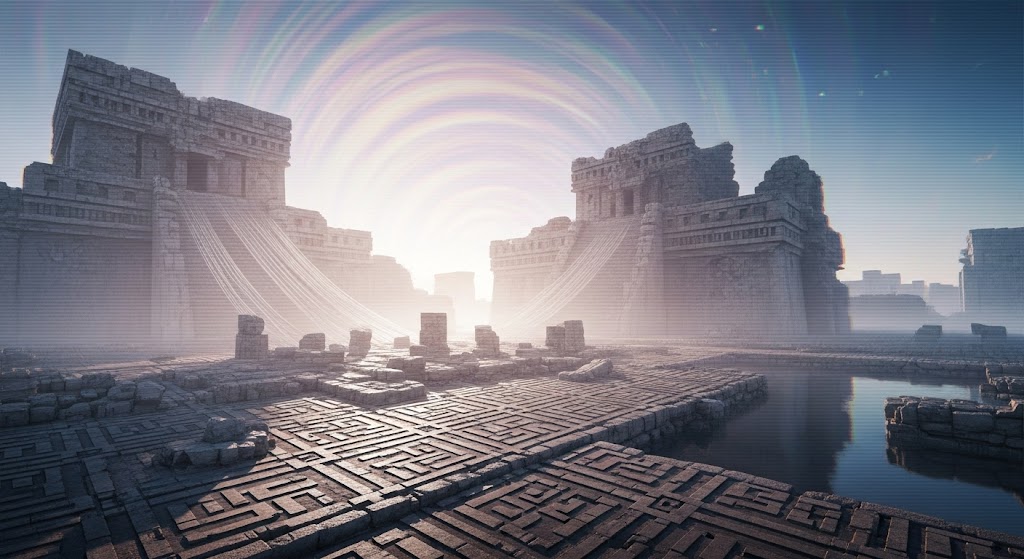
In theoretical physics, the question is not absurd. Multiple-history models, branching interpretations of quantum mechanics, and spacetime geometries containing closed timelike curves all give physicists legitimate ways to ask whether our ordinary picture of one simple linear history is fundamental. But these ideas are not interchangeable. A branching quantum interpretation is not the same thing as a universe physically jumping between branches. A closed timelike curve is not the same thing as a parallel universe. And the mathematical possibility of an unusual spacetime is not evidence that such a structure exists in our cosmic neighborhood.
This is precisely where popular discussions tend to collapse several different ideas into one. “Quantum,” “timeline,” “observer,” “simulation,” and “time shift” become interchangeable words for a single feeling: reality is not what it appears to be, a pattern that recurs in claims about paraphysical anomalies more broadly. Physics does justify the first half of that sentence. Reality is not what classical intuition tells us it should be. What physics does not justify is the second leap: that a personal sense of discontinuity is evidence that the universe has secretly rewritten its own history.
The Experiment We Are All Running
There is an experiment hidden inside the entire question, and it is simpler than any particle accelerator. Check the record. Compare independent sources. Look for observations that were made before the alleged shift. Separate what you personally remember from what another person remembers. Distinguish a changed interpretation from a changed fact. Ask whether an explanation makes a prediction that could actually prove it wrong. Those steps sound almost disappointingly ordinary, but they are exactly what turns an uncanny experience into an investigation.

The deeper lesson is more unsettling than a hidden timeline because it does not require the universe to cooperate. We carry only fragments of the past inside our minds, and we experience only a narrow slice of the physical world at any given moment. Between those two limitations lies an enormous space in which certainty can outrun evidence. The feeling that something has changed is real. The explanation we attach to that feeling may not be.
The Fabric Does Not Need to Tear to Be Strange
Perhaps the most important mistake is assuming that rejecting a hidden time shift makes reality less mysterious. It does the opposite. We live in a universe where time passes differently for different observers, where gravity changes the rate of clocks, where spacetime can curve, where quantum theory resists a single intuitive interpretation, and where the origin and ultimate nature of time remain among the deepest problems in fundamental physics. We do not need to invent a secret rupture to make the universe strange enough.
There is no reliable evidence that humanity has awakened inside a different version of history after an imperceptible temporal shift. What there is, instead, is something quieter and arguably more profound: reality is already stranger than the human mind evolved to imagine, while the instrument we use to reconstruct its past, memory, is itself imperfect. The universe does not have to change behind our backs for the world to feel unfamiliar. Sometimes the alteration happens at the boundary between perception and recollection, where certainty becomes convincing long before it becomes true.
And that leaves the real question standing. Not whether we secretly crossed into another timeline, but how much of the timeline we think we remember was ever recorded inside us correctly in the first place.