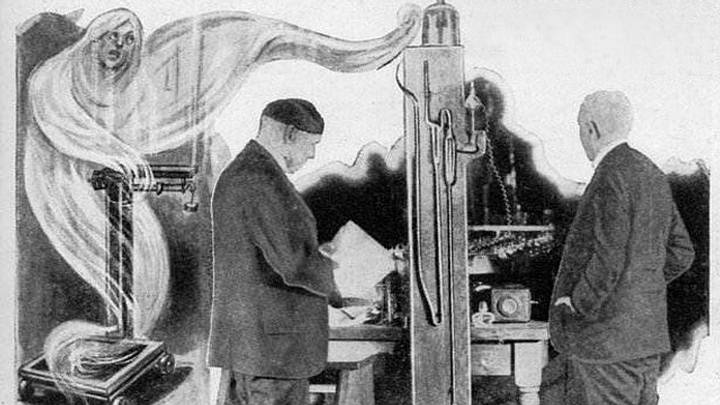





Every theory of reality requires an observer, and no theory can fully place that observer inside the reality it describes. That’s the actual trap: not that perception deceives, but that the instrument doing the perceiving cannot step outside itself to check its own work. Beneath nearly every question humans ask about reality sits this same unasked question: who is doing the looking? The world seems obviously divided into an observer and the observed, a self here and reality out there. But every serious tradition that has examined that division closely, from Plato’s cave to modern predictive-processing neuroscience, arrives at some version of the same finding: the observer cannot be located inside the observation.
That’s not proof that consciousness creates the universe, and it’s not evidence for any specific mystical or scientific theory. It’s a genuinely destabilizing gap at the center of how humans know anything at all, one worth descending into carefully rather than rushing to fill.
The Brain Doesn’t Record Reality. It Predicts It.

The predictive-brain framework deserves precise, current sourcing, since it’s active neuroscience rather than philosophical speculation. Neuroscientist Karl Friston developed the free energy principle across the 2000s, formalized in a widely cited 2010 Nature Reviews Neuroscience paper, proposing that the brain continuously generates predictions about incoming sensory information and updates them based on prediction error, rather than passively recording an external world. Philosopher and cognitive scientist Andy Clark has done much of the work translating this into accessible terms, and neuroscientist Anil Seth has described the resulting picture memorably: perception functions as a “controlled hallucination,” a published phrase describing a mainstream framework in current cognitive science, not a fringe claim. None of this means the external world is unreal. It means that what arrives in awareness is already an interpretation, built from sensory input plus prediction, memory, and expectation, before it ever registers as “the room” or “the table.”
What Quantum Measurement Actually Requires, and Doesn’t
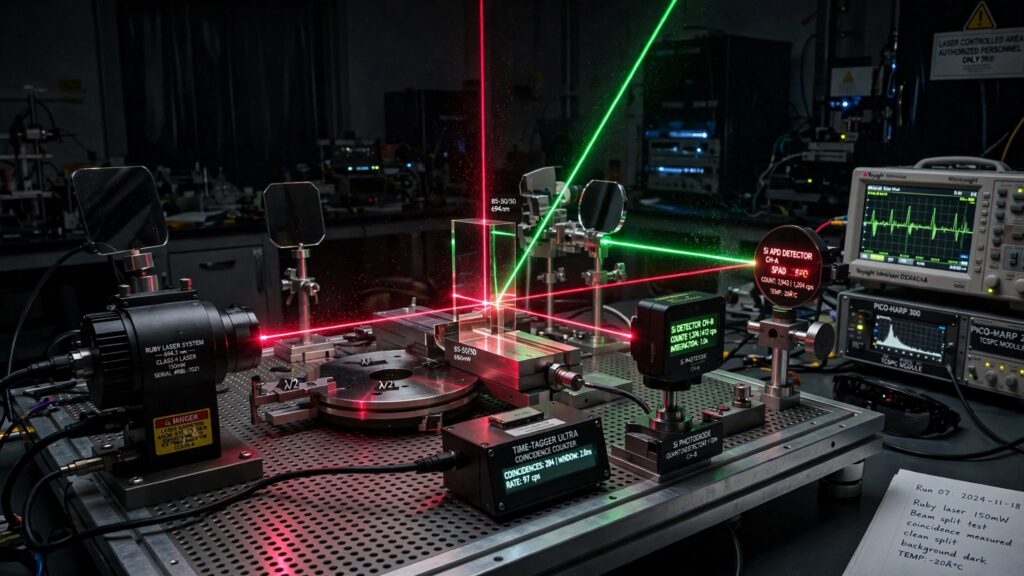
This distinction deserves precision, since it’s exactly where popular science writing most often goes wrong, and where it deserves the sharpest possible language. Four different words get collapsed into one in casual retellings, and they aren’t the same thing. Measurement, in physics, means a physical interaction that produces a definite outcome from a system in superposition. Observation, in ordinary English, implies a perceiver, but in physics it can mean nothing more than that measurement occurring. Registration means the outcome gets recorded somewhere, a needle moving, a photon striking a detector, a bit flipping in a computer’s memory. Conscious awareness means a mind becomes cognizant of that recorded outcome, and this fourth step is the one no experiment in the history of quantum mechanics has ever shown to be necessary. Quantum mechanics does show that measurement isn’t philosophically neutral, what counts as a measurable property depends on the experimental setup, a genuinely strange feature of the theory. But a detector interacting with a particle produces decoherence whether or not any conscious being ever checks the readout. A camera receiving photons registers an event in a dark room with nobody present. Conflating “measurement changes outcomes” with “human consciousness creates physical reality” turns one of the most mathematically rigorous theories in science into a screen for whatever metaphysical conclusion a reader already wanted. The careful version of the claim is narrower and stranger: the structure of an observation participates in determining what can be observed, a claim about physical interaction and experimental design, not a claim that a conscious mind is doing the collapsing.
The Hard Problem Is Real, and Still Genuinely Unsolved

Philosopher David Chalmers gave this problem its name in an influential 1995 paper in the Journal of Consciousness Studies, distinguishing the “easy problems” of consciousness, explaining attention, memory, and information processing, from the hard problem: why any of that processing is accompanied by subjective experience at all. Multiple serious, competing frameworks have been proposed since, global neuronal workspace theory, recurrent processing theory, integrated information theory, predictive processing combined with Friston’s free energy principle, each backed by published research and genuine ongoing disagreement. None has achieved consensus. That unresolved status isn’t a weakness to paper over. It’s the honest current state of one of philosophy and neuroscience’s most active open questions, and it’s precisely the kind of documented uncertainty that shouldn’t be treated as a blank check for any particular metaphysical conclusion, materialist or mystical, to declare victory.
The Ancient Version of the Same Problem

Long before modern neuroscience, several independent philosophical traditions destabilized the same naive assumption, that ordinary perception delivers reality directly, though they didn’t arrive at the same doctrine to replace it. Plato’s actual allegory of the cave, a foundational text in Western philosophy dating to roughly 375 BCE, describes people mistaking shadows on a wall for reality itself. Advaita Vedanta, systematized by the philosopher Shankara around the 8th century CE, holds that beneath the changing body, thoughts, and emotions sits an unchanging, permanent witness-consciousness, the sakshi, identical with ultimate reality itself, expressed in the tradition’s own Mahavakyas such as “Tat Tvam Asi,” that thou art. Buddhist philosophy developed the doctrine of anatta directly against this kind of claim, arguing there is no permanent self behind experience at all, only interdependent processes arising and passing. Those two documented positions aren’t the same conclusion wearing different language. They actively disagree with each other, and later Advaita philosophers wrote detailed refutations of Buddhist arguments specifically on this point. What they share isn’t a doctrine. It’s a recurring destabilization: each tradition, working independently, found that naive realism about the self or the world doesn’t survive close examination, even though they reached sharply different conclusions about what replaces it.
Why the Observer Trap Catches Spiritual Seekers Too
This is the section worth taking most seriously, because it turns the whole essay’s caution back onto itself, and it cuts against every side of this question equally. A genuine, well-documented shift can occur when someone learns to notice a thought or emotion arising rather than being fully identified with it, a documented technique with genuine support in contemplative and clinical psychology alike. That’s the first move: escaping identification with the contents of consciousness, the specific thought, the specific fear, the specific story. A second move often follows it, subtler and more consequential: the person doesn’t stop at noticing thoughts, they begin identifying with the noticing itself, “I am not my thoughts, I am the awareness watching them.” That’s a coherent contemplative position, not a mistake in itself. The trap appears at the third move, when that observer-position quietly stops being a live hypothesis and becomes a settled metaphysical fact, “I am consciousness experiencing reality,” treated as something already proven rather than something still being investigated.
The question that exposes this most precisely is old, and it’s worth asking with full seriousness rather than as rhetorical flourish: who, exactly, is aware of the awareness? Analytic philosophy has its own name for a version of this problem, sometimes called the homunculus regress, the difficulty that arises whenever a theory of perception proposes an inner observer watching mental representations, since that immediately raises the question of what watches the watcher, threatening an infinite chain with no natural stopping point. Philosopher Daniel Dennett has written directly about why this regress represents a genuine structural problem for certain models of consciousness, not a mystical doorway. What’s striking is that serious contemplative traditions arrived at the identical problem from the opposite direction, through practice rather than argument, and didn’t treat it as a dead end. The twentieth-century Advaita teacher Nisargadatta Maharaj addressed it directly, teaching that even the sense of being a witness is itself an object appearing within awareness, a position awareness assumes rather than what awareness ultimately is, and pointed past it toward what the Upanishads call turiya, a fourth state underlying waking, dreaming, and dreamless sleep alike, prior to even the sense of being a witness. That’s a historically documented answer from inside the tradition itself, not a refutation of the observer trap but a further descent into it, arguing that the regress stops not by finding a final observer but by recognizing that the search for one was the trap all along.
Once a person concludes “I am consciousness experiencing reality” as a settled fact rather than a live hypothesis, whether or not they’ve engaged with the regress problem at all, every subsequent experience tends to get recruited to confirm it: good fortune becomes manifestation, hardship becomes cosmic lesson, coincidence becomes communication, contradiction becomes suppression. That pattern, a belief system flexible enough to explain everything after the fact, is a recognizable structure regardless of whether it shows up in a conspiracy theory, a rigid materialism, or a spiritual awakening narrative. The problem was never having the insight. It’s mistaking a genuinely useful contemplative practice, or a genuinely serious philosophical argument, for a finished metaphysical conclusion that no longer needs to justify itself.
The Observer Is Never Neutral

The point about cultural conditioning deserves stating plainly, since it extends the problem beyond any individual mind. Human perception is shaped continuously by prior history: culture supplies the categories available for interpreting experience, language shapes which distinctions feel natural, memory and emotional state alter what registers as significant in the moment. A person in genuine danger and a person in safety don’t process the same street identically. None of this requires a coordinating conspiracy to explain. It’s simply what it means for perception to be embodied and situated rather than a neutral window onto an unfiltered world. That’s also a workable explanation for why intelligent, careful people examining the same evidence can arrive at entirely different conclusions: the evidence never lands in an empty mind. It lands in a structure already primed by everything that came before it.
Why Science Isn’t Undone by Needing an Observer

The relationship between science and the observer problem deserves stating plainly, since this is the point where it could tip into an argument for total relativism, and shouldn’t. Science requires observers, instruments, models, and interpretive frameworks at every stage, a telescope is built according to a theory of optics, a study is designed according to a theory of statistics, a result is interpreted according to an existing body of prior findings. None of that makes scientific knowledge arbitrary. What makes science different from an unfalsifiable belief system isn’t the absence of an observer, every human endeavor has one, it’s the discipline of building institutions specifically designed to catch the observer’s own errors: peer review, replication, adversarial collaboration, pre-registered predictions that can fail publicly. Science doesn’t escape the observer trap by achieving a view from nowhere. It escapes the worst consequences of the trap by building a structure that keeps checking its own instrument for bias, repeatedly, in public, over time.
Constructed Perception Doesn’t Mean Anything Goes

This is worth separating from everything discussed so far, because it’s the distinction most likely to get lost. The fact that perception is constructed, filtered through a nervous system, culture, memory, and expectation, does not mean every interpretation of experience is equally valid, or that reality is simply whatever a given observer decides to believe. A predictive brain still gets corrected by a world that pushes back: step off a curb misjudging the distance, and the resulting fall doesn’t care how confidently the prediction was held. Some claims remain far better supported by evidence than others, and that fact survives everything said here about perception being mediated. The observer trap is a caution about certainty, not a license for its opposite. Recognizing that no one sees reality from nowhere is the beginning of intellectual honesty, not the end of the ability to tell better explanations from worse ones.
The Discipline the Gap Actually Recommends

None of this collapses into relativism, and it isn’t a license to treat every claim as equally valid. Some explanations remain demonstrably better supported than others, and evidence still does genuine work distinguishing them. What the observer’s unresolved position actually recommends is narrower and more useful: separating what was experienced from how it was interpreted from what is being claimed about reality as a result, three distinct steps that get collapsed into one far too easily. It also recommends documented caution toward any framework, spiritual, scientific, or conspiratorial, whose central appeal is that it can never be wrong, since an explanation flexible enough to absorb every possible outcome has stopped doing the work an explanation is supposed to do.
What Hasn’t Been Earned Yet

The temptation, at the end of an essay like this, is to land somewhere definite: consciousness creates reality, or consciousness is nothing more than neural computation and the sense of a watcher is a useful fiction the brain generates. Both positions have serious, credentialed defenders. Neither has earned the right to declare the matter closed. The honest position isn’t “nothing can be known,” and it isn’t agnosticism dressed up as depth. It’s holding open the actual difference between what has been shown and what has merely been made to feel certain, and treating that difference as worth protecting rather than resolving before the evidence exists to resolve it. Perhaps the goal was never to finally identify who or what the observer is. Perhaps it’s noticing, honestly and without flinching, that this is one of the very few questions where saying “not yet” is the most rigorous answer available, and staying with that admission longer than feels comfortable.
The Foundations