Every culture that has left a historical record developed protection systems.
Not protection against physical threats in the conventional sense. Not fortifications against armies or tools against predators. Protection against a category of threat whose defining characteristic was that it was not physically visible and could not be addressed by physical means. The threat required ritual responses: substances placed at locations, symbols inscribed on surfaces, plants burned or hung or worn, times of day or year when the threat was heightened and the protection required intensification.
The cross-cultural consistency of what these systems used is the pattern that deserves examination before the systems themselves are described.
Salt appears in the protective practices of ancient Egypt, Mesopotamia, Greece, Rome, the Slavic cultures, Hebrew practice, Japanese practice, and across indigenous American cultures. The use is consistent across these independent cultures: salt at thresholds, salt in circles, salt in combination with water for purification of spaces and bodies. Cultures with no recorded contact with each other independently identified the same substance as specifically effective against the same category of threat.
Iron appears in the protective practices of Europe, Africa, Japan, and Celtic and Norse cultures with consistency: iron tools, iron nails, iron horseshoes placed at thresholds and in foundational positions in buildings. The electromagnetic properties of iron are well established. Whether ancient populations discovered through empirical observation that iron’s electromagnetic properties interfered with the threat they were protecting against, or whether this iron protection practice reflects purely symbolic thinking that independently converged on the same symbol across unconnected cultures, is a question whose answer depends on what the threat actually was.
Fire appears in purification practices across every major ancient culture. The use of smoke from plants in purification rituals is recorded across ancient Mesopotamia, Egypt, Greece, Rome, Hebrew practice, indigenous North American cultures, and Hindu practice. The plants used vary by geographic availability, but the function is consistent: burning aromatic plants in locations at times produces a condition in the space described as inhospitable to the category of threatening entity.
Running water appears in the protective and purifying practices of virtually every ancient culture. The property attributed to running water, that it carries away harmful influence and that entities of the threatening category cannot cross it, is recorded across European folklore, Japanese Shinto purification practice, Hindu sacred river purification, and multiple indigenous cultures.
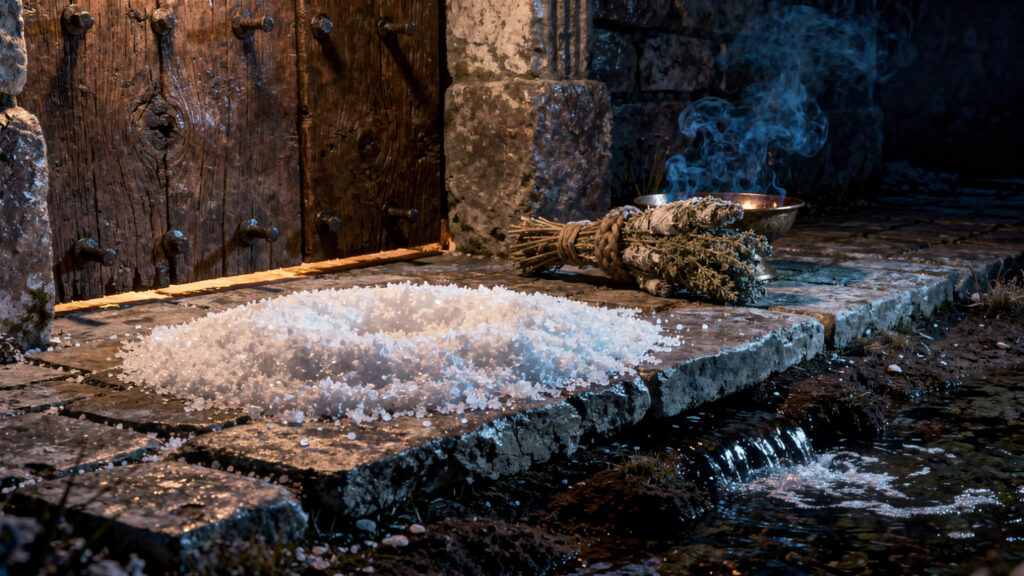
The threshold appears in the protective practices of ancient Mesopotamia, Egypt, Greece, Rome, and Slavic, Celtic, Norse, Chinese, and Japanese cultures. The concept, that the boundary between interior and exterior space requires protective marking and that this boundary is the primary point of entry for threatening entities, is recorded with remarkable consistency across cultures whose geographic and chronological separation precludes cultural transmission as a complete explanation.
Whatever ancient populations were protecting against, they were protecting against it with the same tools, in the same locations, in the same ways, independently.
The Threshold
The threshold’s significance in these protective practices is the most theoretically developed element in the cross-cultural record and the one that connects most directly to the broader framework this library has built.
The threshold is the physical boundary between the interior and exterior of a dwelling. In these protective practices, it is simultaneously the physical boundary and the metaphysical boundary: the place where the category of threatening entity can most easily penetrate from the exterior world into the protected interior space.
The Slavic practice recorded in the source, burying a deceased relative under the threshold to serve as a guardian of the living family, is one of the most striking examples of the threshold’s dual character: it is both a physical location in the built environment and the boundary between the world of the living and the world of the dead. The deceased relative placed at the threshold is specifically positioned to operate in both domains simultaneously, protecting the living from what comes from the direction of the dead.
The ancient Greek practice of placing Hermes figures, herms, at thresholds reflects the same understanding: Hermes is the god of thresholds and transitions, specifically the deity who crosses between the living and the dead worlds and who guides souls through the death transition. Placing his image at the threshold deploys his power over the boundary between states of being at the location where that boundary is most permeable in the domestic built environment.
The mezuzah in Hebrew practice, a text from Deuteronomy inscribed on a parchment and placed in a case at the doorpost, marks the threshold with the words that invoke divine protection at the boundary between interior and exterior. The text invoked, from Deuteronomy 6:4-9 and 11:13-21, includes explicit instructions to place the words at the doorposts, connecting the protective practice directly to the foundational text of the faith.

The Japanese shimenawa, a rope of twisted rice straw hung at thresholds and around sacred spaces, marks the boundary between the ordinary and the sacred in Shinto practice. Its function, excluding malevolent spirits from the sacred interior, appears in the ritual context as an active rather than passive protection: the shimenawa does not simply mark the boundary but enforces it against categories of entity.
The cross-cultural threshold protection pattern implies a shared understanding: the boundary between interior and exterior is simultaneously a boundary between different conditions of being, and this boundary requires protective marking because it is the primary point of vulnerability to a category of threatening entity whose access to the protected interior is limited by the protection placed at the boundary.
Whether the protective marking works because it creates genuine energetic conditions that the threatening entities cannot cross, because it creates psychological conditions in the dwelling’s inhabitants that prevent the psychosomatic expression of the threats, or because it encodes a genuine practical understanding of entity behavior that the contemporary scientific framework has not characterized, is the question that the cross-cultural consistency raises without resolving.
Salt and Iron and What They Have in Common
The two substances most consistently deployed in protective practices across independent cultures are salt and iron. Both are used at thresholds, in protective circles, and in combination with other protective elements. Both are specifically associated with the category of threatening entity rather than with physical threats. And both have electromagnetic properties that distinguish them from most other common materials.
Salt, sodium chloride, is an ionic compound whose aqueous solution is one of the most effective electrolytes known. Salt water conducts electricity. The electromagnetic properties of salt in solution appear in electrochemistry: it dissociates into sodium and chloride ions that carry electrical charge through the solution. Whether this electrochemical property is the mechanism through which salt protection works, in the sense that salt creates conditions that are inhospitable to entities whose interaction with physical space involves electromagnetic field effects, is a speculation that the available evidence does not confirm.
What the available evidence does confirm is that salt is universally used for the same protective purpose across independent cultures, and that its properties in the physical world include well established preservation effects on organic material and well established ionic properties that distinguish it from most other common protective substances.
Iron’s electromagnetic properties are more directly established in modern physics: iron is ferromagnetic, meaning it has magnetic properties that are unique among common materials. Iron objects can be magnetized and demagnetized and respond to external magnetic fields in ways that non-ferromagnetic materials do not. The folk belief that iron repels supernatural entities, recorded across European, African, Japanese, and Celtic cultures, attributes to iron a protective property against a category of entity rather than against physical threats.
Whether iron’s ferromagnetic properties are the mechanism through which the protection works, in the sense that ferromagnetic material creates conditions in the electromagnetic environment of a space that are inhospitable to entities whose interaction with physical reality involves electromagnetic field manipulation, is the speculative hypothesis that the consistency of this iron protection practice across independent cultures makes worth considering.

Iron’s real ferromagnetic properties are a genuine, distinctive physical fact about the material, and it’s worth being precise about what that fact does and doesn’t support. It doesn’t require, and the evidence doesn’t support, treating iron as a real countermeasure against a real, electromagnetically-interacting threatening entity. What it does support is a more modest, better-established point: iron’s genuine physical unusualness, a material that responds to magnetic fields in ways ordinary stone, wood, and bone don’t, is exactly the kind of distinctive, sensorially and practically notable property that human cultures reliably encode into symbolic and protective meaning, independent of whatever they believed that meaning was protecting against.
That’s a real, sufficient explanation for iron’s cross-cultural protective role on its own. It doesn’t require, and shouldn’t be read as quietly implying, that the entities these cultures feared were themselves electromagnetic phenomena iron could physically counteract.
The Plants
The plants that appear most consistently in protective practices across independent cultures are garlic, wormwood, rosemary, sage, and various resins including frankincense and myrrh. Each of these plants has well established biochemical properties that distinguish it from most other plant species.
Garlic contains allicin, a sulfur compound produced when garlic is crushed or cut, whose antimicrobial properties are among the most extensively studied in the ethnobotanical literature. Its protective use, placing cut or crushed garlic at thresholds and points of entry, maximizes the allicin release and therefore the antimicrobial effect. Whether this practice, predating modern microbiology, reflects empirical discovery of garlic’s antimicrobial properties attributed to supernatural mechanism, genuine effectiveness against a different class of entity through a different mechanism, or purely symbolic ritual, is not established.
Sage and rosemary contain volatile compounds whose antimicrobial and antifungal properties have been analyzed in modern ethnobotanical research. The use of smoke from these plants in space purification rituals, burning them to produce smoke that permeates the interior space, maximizes the distribution of their volatile antimicrobial compounds throughout the space. Whether the purification effect recorded in these practices is the result of the antimicrobial properties reducing the microbial burden in the space and therefore reducing the infection-related illness that might have been attributed to malevolent entity activity, or whether the smoke also produces direct effects on the entities these cultures identify as threats through a different mechanism, is not established.
Wormwood, used in the threshold protection practice recorded in the source, contains artemisinin, the compound that modern medicine has developed as the primary treatment for drug-resistant malaria. Its biochemical properties include recognized effects on cellular processes that are distinct from its antimicrobial properties. Whether this threshold protection practice’s use of wormwood reflects empirical discovery of its biochemical properties through observation of its effects, attributed to supernatural mechanism, or genuine effectiveness against the category of threatening entity through a mechanism that the biochemical analysis has not captured, is not established.
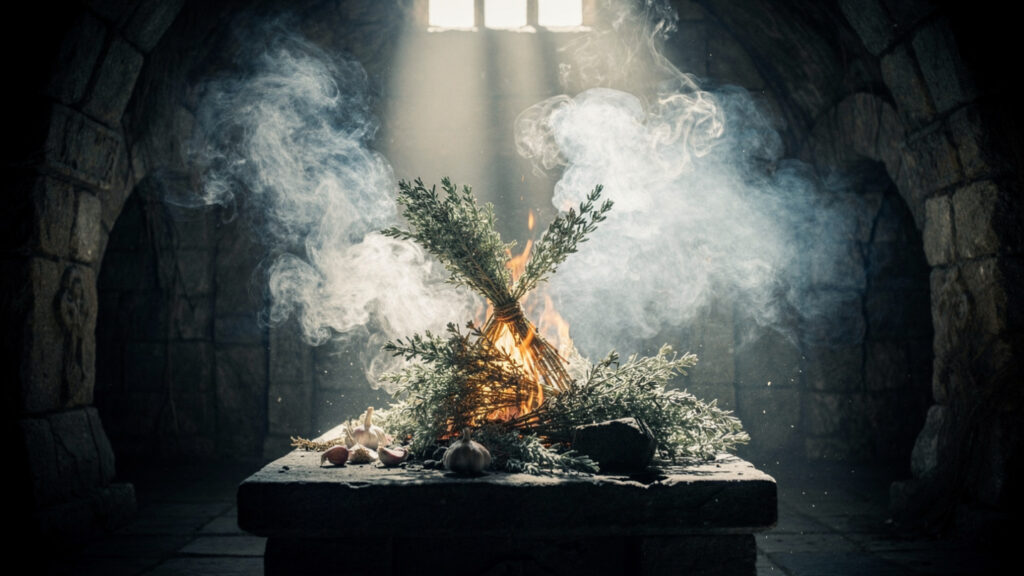
The consistent pattern across these protective plants is that they are not randomly selected from the available botanical inventory. They are plants with recognized unusual biochemical properties that distinguish them from most other plant species. Whether ancient populations discovered these properties empirically and embedded them in a supernatural framework for transmission, or whether the supernatural framework reflects genuine effectiveness against entities whose nature the contemporary biochemical analysis does not fully characterize, is the interpretive question that the cross-cultural consistency makes impossible to dismiss as obviously resolved.
The Evil Eye and the Gaze
The evil eye belief, that a type of malevolent gaze can cause harm to its target, is recorded across the Mediterranean, the Middle East, South Asia, and parts of Africa and Latin America with a consistency that makes it one of the most widely distributed protective beliefs in the world.
The protection against the evil eye typically involves objects that return the gaze: reflective surfaces, eyes depicted on amulets and talismans, and symbols that redirect the harmful gaze back toward its source. The nazar, the blue glass eye amulet found across Turkey, Greece, and the broader Mediterranean, reflects the evil gaze back through its eye-like appearance. The hand of Fatima and the hamsa in Islamic and Jewish practice deploy the eye symbol in a protective configuration.
The sleep paralysis piece in this library covers the case of an entity whose gaze is described as dangerous: the Hat Man whose attention produces fear responses in the experiencer. This belief’s focus on the gaze as the vehicle of harmful influence, and the use of reflective or eye-like objects to return or intercept the gaze, is consistent with a worldview that understood the gaze of entities as capable of transmitting harmful influence through a mechanism.

Whether the mechanism is psychological, in the sense that the belief in the evil eye produces psychosomatic effects that the protection objects resolve through the same belief system, or physical, in the sense that the gaze of entities or consciousness states transmits genuine harmful influence through a mechanism that the protective objects genuinely intercept, is a question that this belief’s design principles raise without resolving.
The use of reflective surfaces as the primary protection mechanism is the element that distinguishes evil eye protection from purely symbolic belief: a mirror or reflective surface positioned to return the gaze is not simply a symbol of protection but a physical object whose reflective properties are the mechanism of the protection. Whether the mechanism is metaphorical, returning the social influence of malevolent attention to its source, or literal, reflecting a electromagnetic or subtle energetic transmission, is the interpretive question.
What the Consistency Implies
The cross-cultural consistency of protective practices across populations with no recorded contact is the central evidential pattern that distinguishes these beliefs from simple folklore.
When independent human populations develop identical solutions to the same problem without any communication that could explain the convergence, the standard scientific interpretation is not automatically that they are responding to the same external entity. It is that they share the same human cognitive architecture and, often, the same underlying practical reality, and the library’s evidentiary standard requires stating that alternative plainly before weighing it against the entity hypothesis.
Each substance covered here has a mundane explanation that does not require any threatening entity at all. Salt is a universal preservative and antiseptic with an intense, unmistakable sensory signature, exactly the kind of substance human cognition reliably recruits for symbolic purity across unrelated cultures, independent of any invisible threat. Running water is hygienically distinct from standing water in ways ancient populations would have observed directly through disease patterns, giving it a real, practical association with cleanliness that predates any supernatural elaboration. Iron’s symbolic power tracks closely with the historical transition from earlier tool-making eras to the Iron Age: a dramatically superior new technology becoming culturally coded as belonging to the present, human, ascendant world, with older or liminal entities correspondingly coded as vulnerable to the new metal that displaced the old order. Thresholds are the literal, physical boundary of controlled space in any culture that builds enclosed dwellings, and cognitive anthropologists have documented extensively that human minds treat physical boundaries as natural sites for symbolic and ritual elaboration regardless of what, if anything, is being kept out. None of this requires cultural contact between these cultures, because it does not depend on a shared external cause. It depends on a shared human mind and, in several cases, a shared physical reality that these substances and materials would present to any observant population anywhere.
This does not close the question the piece is asking. It does mean the convergence, on its own, is not strong evidence for a real external entity, since a well characterized alternative explanation predicts the same convergence without one. The consistency of salt, iron, running water, fire, threshold marking, and plant use across independent ancient protective practices is real and worth documenting. What it establishes, on the current evidence, is that human beings across cultures reliably arrive at similar symbolic and practical responses to similar categories of experience and similar available materials, which is itself an interesting and well studied pattern, not by itself proof of what, if anything, they were responding to.
What generated the belief in the first place, whether it was a genuine, unusual class of shared human experience these cultures independently interpreted through the tools available to them, or simply the ordinary machinery of human meaning-making encountering the ordinary hazards, illnesses, and unexplained misfortunes of pre-modern life, is a real, open question. This piece’s own evidence points more strongly toward the second explanation than the first, and that’s worth stating plainly rather than leaving the question artificially balanced.
These practices themselves do not answer this question. They record the response without fully explaining the threat. What they establish is that the threat was real enough to produce consistent practical responses across independent human populations throughout recorded history, and that those populations invested significant cultural resources in developing, refining, and transmitting the protection practices to their successors.

Whatever they were protecting against was real to the people doing the protecting, in the sense that mattered to them: real enough to organize a household around, real enough to pass down for generations, real enough to invest genuine cultural resources in refining. That’s not the same claim as saying the threat was real in the way this piece’s own mundane explanation shows it doesn’t need to be. A shared human cognitive architecture, responding to shared, observable features of the physical world, produces exactly this kind of convergence on its own, and that explanation remains the one the current evidence actually supports.
The salt is still on the shelf. The threshold is still the most protected point in the house. The plants whose smoke is used for purification are still the same plants recorded across these independent cultures. The contemporary account of human psychology and folk belief formation, outlined above, does explain why these specific practices recur, salt’s sensory intensity, iron’s cultural coding, thresholds as universal boundary-markers, plants with real antimicrobial properties. What it doesn’t require is anything more than a shared human mind meeting a shared physical world.
These practices persist because the belief that generated them persists, transmitted the way durable cultural knowledge always is, across generations who found it useful enough to keep.