




The inscription should not be there.
This piece’s opening claim, that the Great Pyramid contains no text at all, needs to be corrected directly rather than repeated, because it is not accurate. The Great Pyramid does lack the elaborate wall inscriptions found in later Old Kingdom monuments, but it is not textless. In 1837, British antiquarian Richard William Howard Vyse discovered a set of painted quarry marks and workers’ gang graffiti in the relieving chambers above the King’s Chamber, real hieroglyphic inscriptions that include the pharaoh Khufu’s cartouche, appearing a dozen or more times in different forms. These marks, made by the construction crews rather than as formal royal inscriptions, are the primary physical evidence used to attribute the pyramid to Khufu and the Fourth Dynasty in the first place. Their authenticity has been challenged by a small number of fringe researchers over the decades, but this remains a minority position outside mainstream Egyptology, and the marks are treated as genuine by the field generally. The claim that this piece’s central “Berber tetragram” theory rests on, that the pyramid is otherwise entirely without inscription, does not hold up.
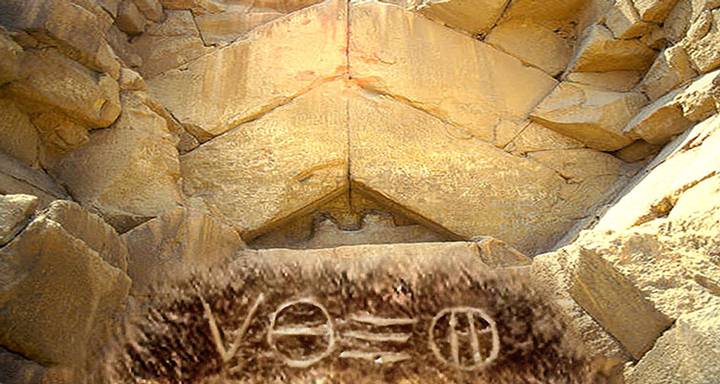
The specific claim that follows, a Berber Tifinagh inscription on the entrance lintel, is not supported by any mainstream Egyptological, epigraphic, or Berber-studies scholarship this piece has been able to verify. It should be read as a fringe claim without independent scholarly confirmation, not as an established archaeological finding.
Given the corrections above, this framing does not hold: real hieroglyphic marks from the Fourth Dynasty construction crews are already inside the monument, and the claimed Berber tetragram lacks independent scholarly confirmation.
Three thousand years later, four thousand miles away, in the wreckage of something that came down in the desert of New Mexico, a military officer found a rod engraved with symbols that his son spent the rest of his life describing as identical to what appears on that lintel.
What Major Marcel Brought Home
Jesse Marcel was a military intelligence officer with the 509th Bomb Group at Roswell Army Air Field, the only nuclear-capable unit in the American military in July 1947. His presence at the recovery site on the ranch of Mac Brazel appears in the official record. His subsequent public account of what he found there is enough to require either formal refutation or serious engagement.
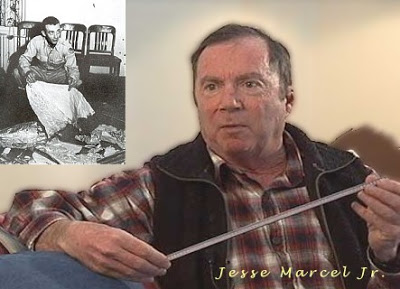
In the middle of the night following his return from the recovery site, Marcel brought a selection of the recovered material to his home so that his wife and son could see it. His reasoning, as Jesse Marcel Jr. later described it, was simple. It was something from another world that they would never see again in their life. He wanted his family to have seen it.
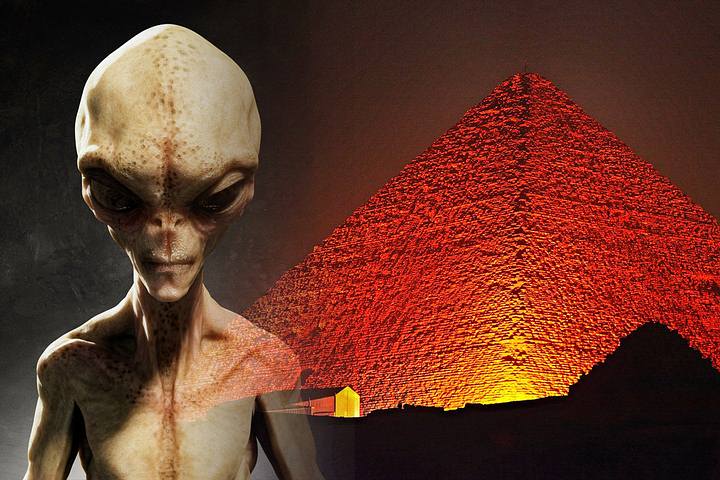
The material’s physical properties occupy Marcel Sr.’s testimony with a specificity that confabulation does not typically produce. The metal resembled tinfoil from a cigarette pack in its flexibility and weight. A sixteen-pound mallet applied with full force left no mark on it. The material could not be ignited by any flame he attempted. These three properties, flexible as foil, impervious to percussive force, non-combustible, describe a material whose mechanical characteristics are mutually exclusive in every alloy and polymer in the recorded materials science literature of 1947 or since.
The rod that most fascinated Jesse Marcel Jr. on that night was small, roughly the size a person could hold comfortably. Its surface carried symbols engraved in a purple tone. His description of those symbols, given in multiple interviews across decades and maintained without variation until his death in 2013, corresponds to geometric forms that his accounts locate specifically in the Berber writing tradition.
He did not know what the symbols meant. He was eight years old when his father showed him the rod. He spent sixty-five years telling the same story about it.
The Translation
The Berber tetragram on the Great Pyramid’s entrance lintel has been analyzed by researchers working in the Tifinagh tradition, the writing system that Berber communities have used continuously from the deep pre-Islamic period to the present day. The translation requires working backward through the Islamization that has reshaped the phonemic meanings of the symbols since the spread of Arabic, recovering pre-Islamic root meanings that the linguistic record preserves even as the surface vocabulary has changed.

This piece’s source cites a specific published translation chain for the supposed inscription. That source and its claims have not been independently corroborated by mainstream Egyptological or Berber linguistic scholarship, and should be treated as an unverified claim rather than an established translation.
Given the unverified status of the underlying translation, the claim that it functions as a location marker pointing toward the pyramid’s summit should not be treated as established.
In 2017 an international research team using muon tomography, a technology that detects density variations in large stone structures using cosmic ray muons, published their findings from a survey of the Great Pyramid’s interior. The scan detected a previously undocumented void above the Grand Gallery. The void measures approximately thirty meters in length. It sits between the Grand Gallery and the apex region of the pyramid.
The tetragram translation says something is buried near the summit. The muon scan found an undocumented thirty-meter space between the Grand Gallery and the summit region. The inscription was carved before the muon scan by somewhere between four and six thousand years.
Whatever occupies that void has not been accessed. The Egyptian Antiquities Authority has not announced an excavation program targeting the region the muon datan identified.
The Rendlesham Sketch
The Roswell rod is not the only post-ancient instance of this symbol system appearing in the record of contact events.
In December 1980, Sergeant Jim Penniston of the United States Air Force was among the personnel who approached a landed craft in Rendlesham Forest near the RAF Woodbridge base in Suffolk, England. His account of the encounter, recorded in his official report and expanded in subsequent testimony, describes physical contact with the craft’s surface. He touched it. He felt symbols beneath his fingertips.
He described them as hieroglyphic in character, a term he used before any comparison to Egyptian or Berber scripts was presented to him by researchers. Immediately following the encounter he sketched the symbols in his notebook from memory. The sketches are in the documented record, reproduced in multiple publications about the Rendlesham incident and referenced in the congressional testimony of Luis Elizondo and others during the UAP hearing period of 2020-2023.
The geometric characteristics of Penniston’s sketched symbols share properties with the Berber tetragram on the Great Pyramid lintel and with the purple hieroglyphs that Jesse Marcel Jr. described on the Roswell rod. The comparison has been made in the alternative research community without formal linguistic analysis. The formal linguistic analysis, applying Tifinagh decoding methodology to Penniston’s sketches, has not been published by any institution with the relevant expertise.
Betty and Barney Hill, whose 1961 abduction account is among the most thoroughly recorded in the literature, described seeing symbols on the interior surfaces of the craft they were taken into. Antônio Villas Boas, whose 1957 encounter in Brazil preceded the Hill case by four years and shares no apparent connection to it, described symbols on the exterior hull of the craft he encountered. The consistency of hieroglyphic symbol reports across independent contact cases spanning four decades and three continents has not been formally analyzed as a single dataset.
The Writing Before Writing
The Berber inscription’s dating presents a problem that the conventional timeline of the Great Pyramid’s construction has not resolved. This entire line of reasoning depends on the unverified tetragram claim being accurate, which this piece has not been able to establish through any mainstream source.

The second possibility, a deliberate single inscription by someone who knew exactly what they were marking and chose to mark it in a script that would outlast the language of the civilization building the structure, implies a level of intentionality about the inscription’s longevity that the tomb hypothesis for the pyramid cannot account for.
The Turin King List, the papyrus held in the Egyptian Museum in Turin and dated to the reign of Ramesses II, preserves a list of rulers extending back before the conventional First Dynasty to a pre-dynastic period in which reign lengths are measured in thousands of years. Egyptology categorizes the pre-dynastic section as mythological. The document itself does not distinguish between the sections. It lists them in continuous sequence as a historical record.
The pre-dynastic rulers in the Turin list governed for periods ranging from hundreds to thousands of years each. The total duration of the pre-dynastic period in the list runs to tens of thousands of years before the conventional dynastic period begins. If those reign lengths encode anything other than pure mythology, the construction of the Great Pyramid could fall within a period of pre-dynastic governance that the conventional Fourth Dynasty attribution does not capture.
The Berber tetragram would then be contemporary with the construction rather than anomalously early.
The Three Data Points
The symbol system claimed for the Great Pyramid’s entrance lintel, whose authenticity remains unverified, is compared in this piece’s source to two separate later reported contexts.
A claimed Berber Tifinagh inscription on the original entrance to the most precisely engineered structure in the ancient world, whose authenticity and translation remain unverified by mainstream scholarship, connected here to a real 2017 muon scan finding a genuine unexplained void, though the connection between the two is speculative rather than established.
Engraved in purple on a small rod of non-combustible, percussive-resistant metal recovered from a crash site in New Mexico in July 1947 by a military intelligence officer who maintained the account until his death and whose son maintained it until his own.

Sketched from memory in a notebook by a United States Air Force sergeant immediately after touching the surface of an unidentified landed craft in a Suffolk forest in December 1980, described before any comparison to ancient scripts was suggested to him.
Three separate events. Three separate individuals with no apparent connection to each other. The same geometric language appearing in each case associated with objects or structures of non-human manufacture or non-human origin.
Either the same civilization left all three instances, which requires accepting a continuous presence in human affairs spanning the entire duration of recorded history. Or the correspondence is coincidence, which requires three independent geometric convergences on the same symbol system across thousands of years and thousands of miles.
Both possibilities are disturbing in different ways. The piece does not resolve which is more accurate because the evidence does not yet permit resolution.
The muon scan found the void, and that part is real and peer-reviewed. What, if anything, the unverified tetragram claim has to do with it remains unestablished. The Egyptian Antiquities Authority has not opened the void.
Whatever is near the summit of the Great Pyramid has been there since before the inscription was carved to mark it. The inscription says to proceed with caution. It says a holy being is buried under the dome.

Three separate witnesses across three thousand years have encountered the same symbols associated with the same kind of object.
The caution the inscription recommends may still be warranted.