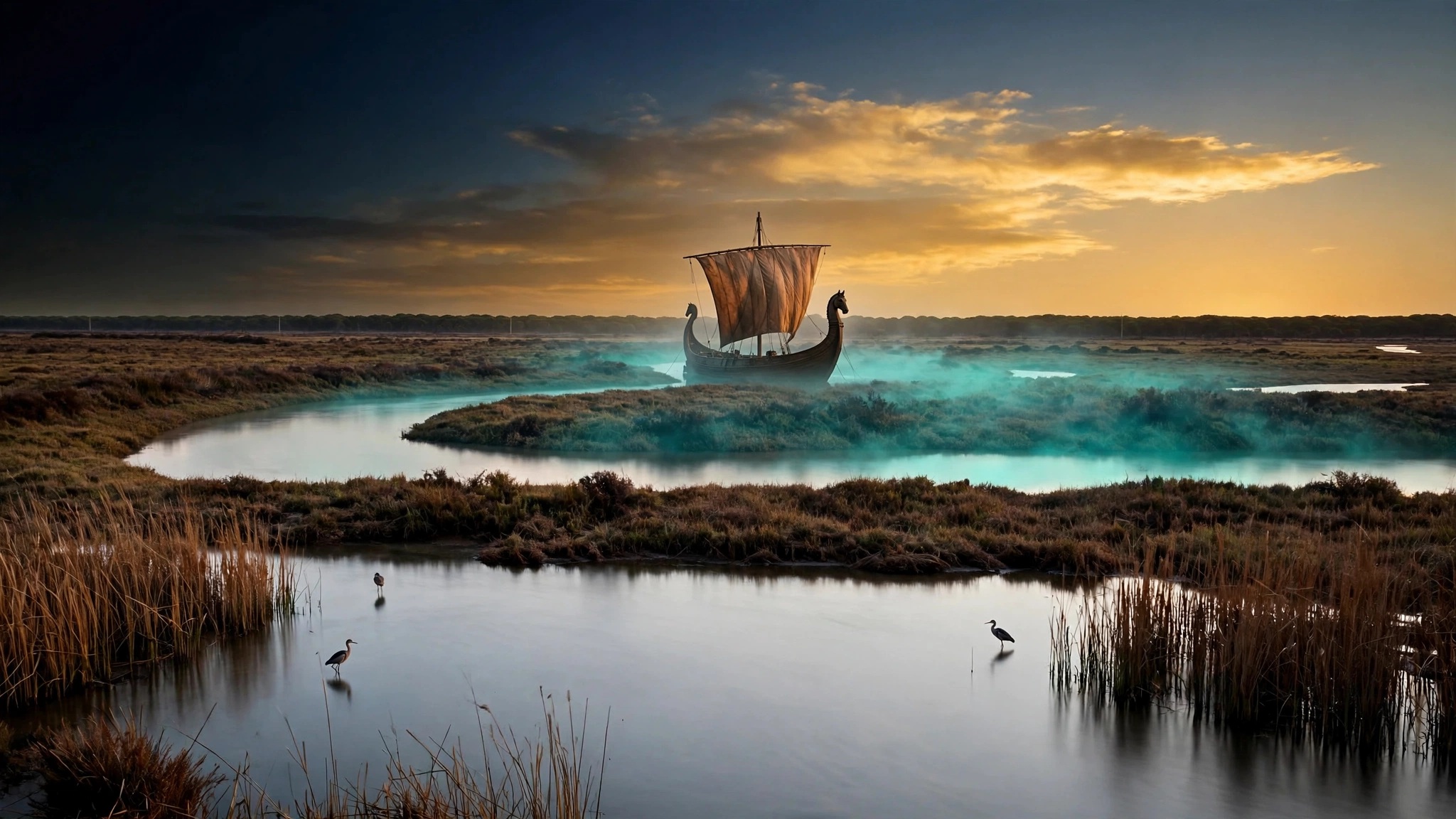
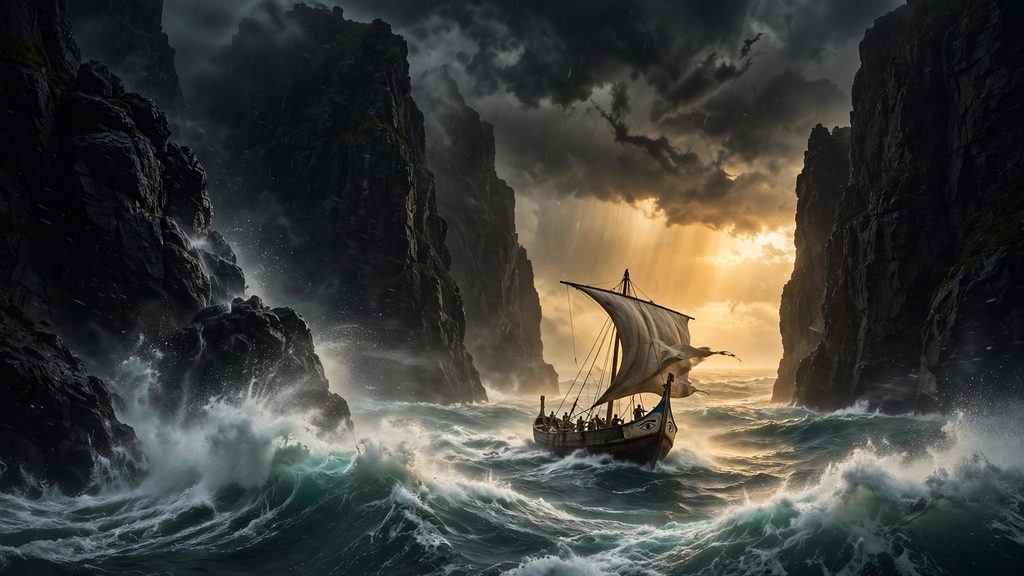
Some time around 630 BCE, a merchant ship from the Greek island of Samos was caught by an east wind and driven the length of the Mediterranean. Its captain, Kolaios, was carried past the Pillars of Heracles, the rocks at the mouth of the known world, and came ashore at a place no Greek had traded with before. Herodotus calls it Tartessos, an untouched market. Kolaios sailed home with a cargo so rich that a tenth of his profit paid for a great bronze mixing bowl, ringed with griffin heads, which he dedicated in the temple of Hera on Samos.
The place he found existed. For four centuries a kingdom in the far south-west of Spain grew wealthy on silver, traded with Phoenicians and Greeks, wrote in a script no one can read today, and then faded so completely that even its capital has never been found. Into that empty space, over two and a half thousand years, people have poured legends. The most persistent is that Tartessos was Atlantis.
- The Timeline | From Kingdom to Legend
- A Kingdom Built on Silver
- What the Greeks Remembered
- Gold Under a Pigeon-Shooting Club
- The Kingdom Moves Inland
- The Courtyard of the Sacrifice
- The Writing No One Can Read
- How Tartessos Became Atlantis
- Why Tartessos Disappeared
- The Verdict | Debunked
- Quick Answers About Tartessos
This file follows what the ground has given back, and what the Atlantis story has claimed, side by side.
The Timeline | From Kingdom to Legend
Dates before the 6th century BCE are approximate. Kolaios’s voyage is dated by scholars from Herodotus’s account, which gives no year. Gold-coloured points in the right column are archaeological results, teal points belong to the Atlantis story.
A Kingdom Built on Silver
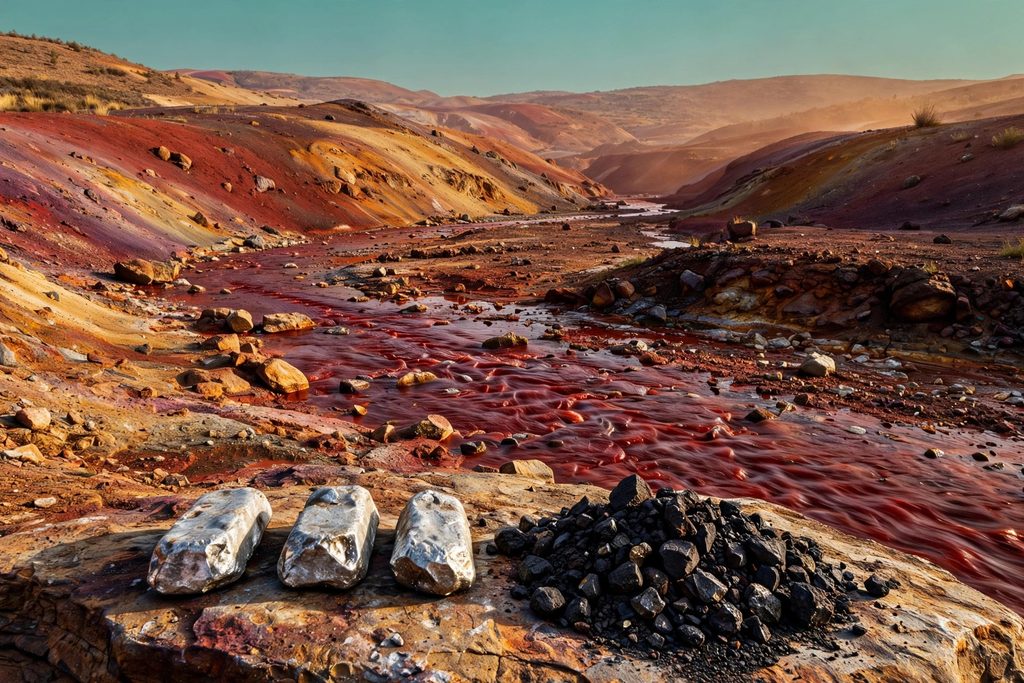
Tartessos grew up where the Guadalquivir river met the Atlantic, in the land between modern Huelva, Seville and Cádiz. Behind it rose the Iberian Pyrite Belt, a stretch of hills so rich in copper and silver that it was still being mined in the twentieth century. In the ancient world, that silver was the kingdom’s fortune.
In the ninth century BCE, traders from the Phoenician city of Tyre arrived and founded Gadir, modern Cádiz, on an island just off the coast. At Huelva, excavators have recovered tens of thousands of pottery fragments from a harbour market that was busy from the tenth to the eighth century BCE, with wares from Phoenicia, Greece, Cyprus and Sardinia. Tartessos was not Phoenician and not quite native. It was what archaeologists call a hybrid culture, local communities who took eastern goods, techniques and gods and made something of their own.
The Hebrew Bible may remember the same trade. The prophet Ezekiel describes Tarshish supplying Tyre with silver, iron, tin and lead. Jonah flees from God on a ship bound for Tarshish, the furthest place he can think of. Since the early twentieth century many scholars have identified Tarshish with Tartessos, though others place it at Tarsus in Anatolia or treat it as a byword for any distant source of metal. The link is attractive. It is not proven.
What the Greeks Remembered
The Greek writers knew Tartessos as a place at the edge of the map, rich beyond reason.
Herodotus, writing in the fifth century BCE, tells two stories. The first is Kolaios. The second is a king. When Greek sailors from Phocaea, on the coast of modern Turkey, reached Tartessos, they were welcomed by a ruler named Arganthonios, who reigned for eighty years and lived to a hundred and twenty. He urged the Phocaeans to settle in his land, and when they declined he gave them money to build a wall around their city at home. His name seems to come from the old Indo-European word for silver.
Eighty years is too long for one reign, and some historians think several kings shared the name or title. The pattern behind the story is sound. Tartessos was rich in silver, welcomed foreign traders and had rulers powerful enough for Greeks to remember by name. A century after Herodotus, the historian Ephorus still described Tartessos as a very prosperous market, trading in tin, gold and copper.
Gold Under a Pigeon-Shooting Club
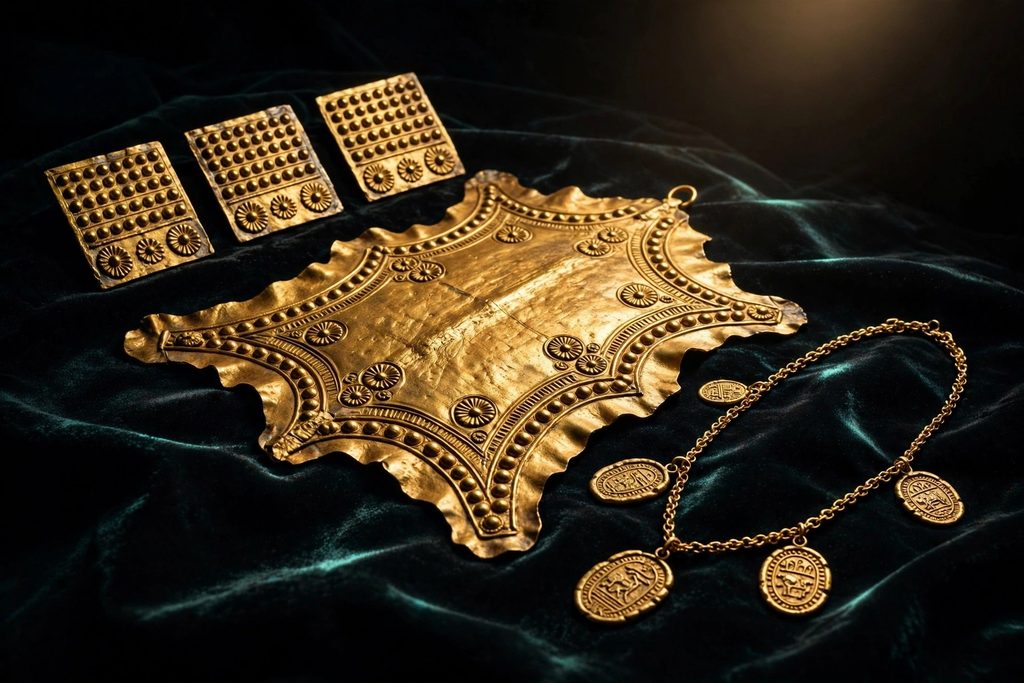
On 30 September 1958, construction workers renovating a pigeon-shooting club on the hill of El Carambolo, at Camas just west of Seville, broke open a buried ceramic vessel. Inside were twenty-one pieces of gold: a necklace with pendants, two bracelets, two pectorals shaped like stretched ox hides, and sixteen small plaques.
The El Carambolo treasure became the emblem of Tartessos, and for a while the press called it the treasure of Atlantis. The pieces date to around the eighth and seventh centuries BCE and were buried, it seems deliberately, in the sixth. Archaeologists have suggested that the plaques once decorated a priest or the animals led to sacrifice.
In 2018 a study of the metal settled a long argument. The jewellery was made largely with Phoenician techniques, but the gold came from mines about twenty kilometres away. The Spanish archaeologist Alicia Perea, asked about the Atlantis connection, called it complete madness. Since 2012 the originals have been on permanent display in the Archaeological Museum of Seville.
The Kingdom Moves Inland
From the seventh century BCE, Tartessian life spread north and inland, up the rivers into the Guadiana valley of modern Extremadura. There, far from the coast, archaeologists have found the most spectacular Tartessian buildings yet known.
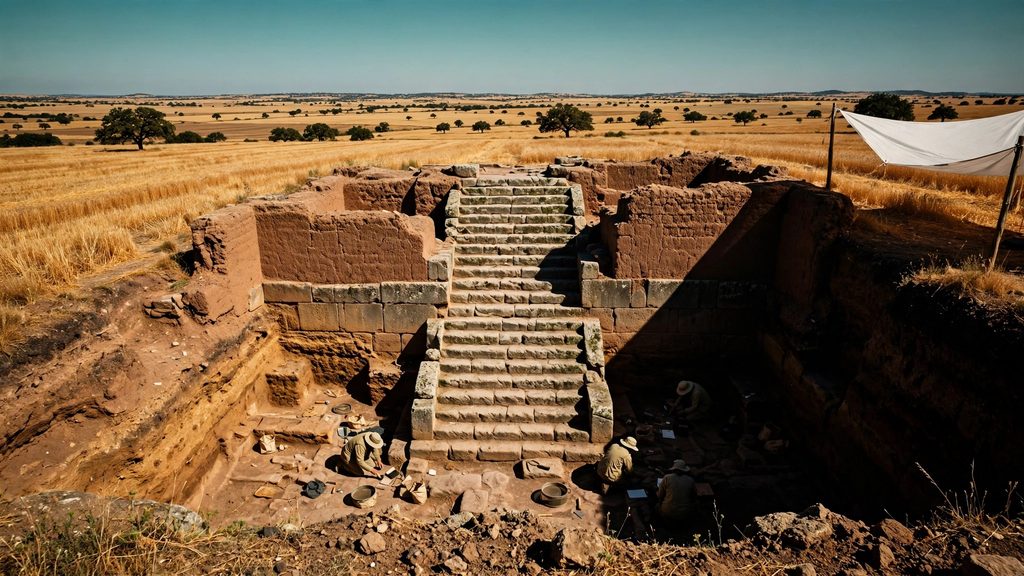
At Cancho Roano, near Zalamea de la Serena, stands a monumental building that has been read as a palace, a sanctuary or both. At Casas del Turuñuelo, near Guareña, a mound in farmland turned out to hide a two-storey adobe building with a monumental staircase almost three metres high, preserved under earth. Excavation began in 2015 under Sebastián Celestino and Esther Rodríguez González of the Spanish National Research Council, and only a fraction of the site has been uncovered.
What they found reads like a sealed room. A bronze cauldron almost a metre across, a grill, jugs and a perfume burner from a banquet hall. A marble statue from Greece. Six glass vessels from across the Mediterranean. Linen sacks of seeds, braided grass mats and the oldest piece of wool yet found in the Iberian Peninsula.
The Courtyard of the Sacrifice
Source: Iborra Eres and others, PLOS ONE 18(11), 2023. Radiocarbon dates place the three phases of sacrifice in the 5th century BCE, over a span of several years.
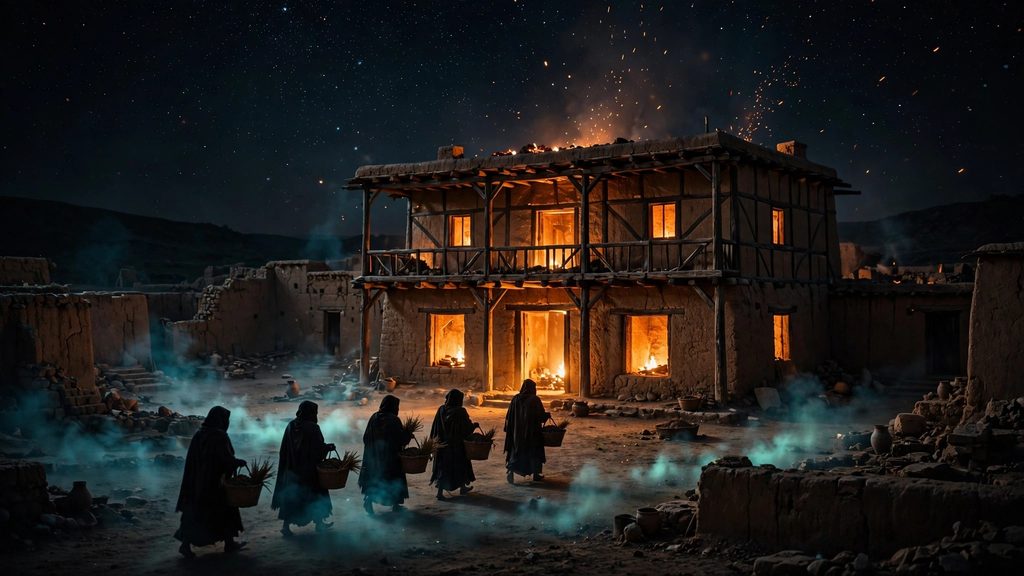
In the courtyard of the building lay the remains of a ritual on a scale unknown anywhere else in the western Mediterranean. Fifty-two animals had been sacrificed in three phases, most of them horses, laid out in pairs and whole in the first two phases. Several horses show wear from bits and harness, so they had been ridden or driven before they were killed. In the last phase, all the animals except the horses were butchered and eaten in a ritual meal.
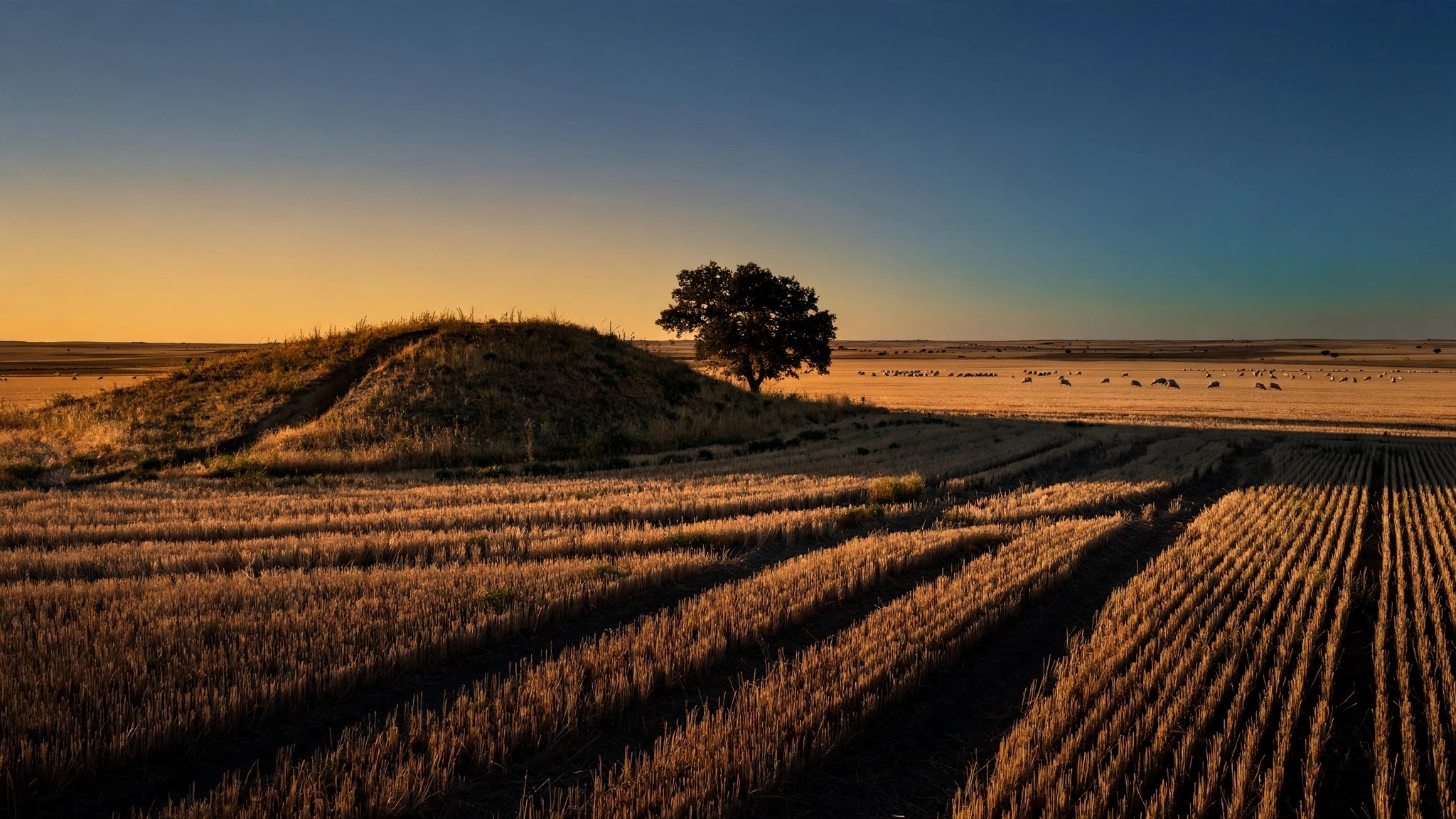
Then the building was set on fire, demolished and buried under a mound ninety metres across and six metres high. Whoever closed Turuñuelo did not abandon it. They ended it, on purpose, and hid it.
In April 2023 the excavators announced a second surprise. Among the rubble were stone reliefs carved with human figures, two of them the faces of women who may be goddesses, and one a warrior. Until then Tartessian religion had been thought to avoid showing its gods in human form. The Spanish National Research Council called the find a profound shift in how the Tartessian people are understood.
The Writing No One Can Read
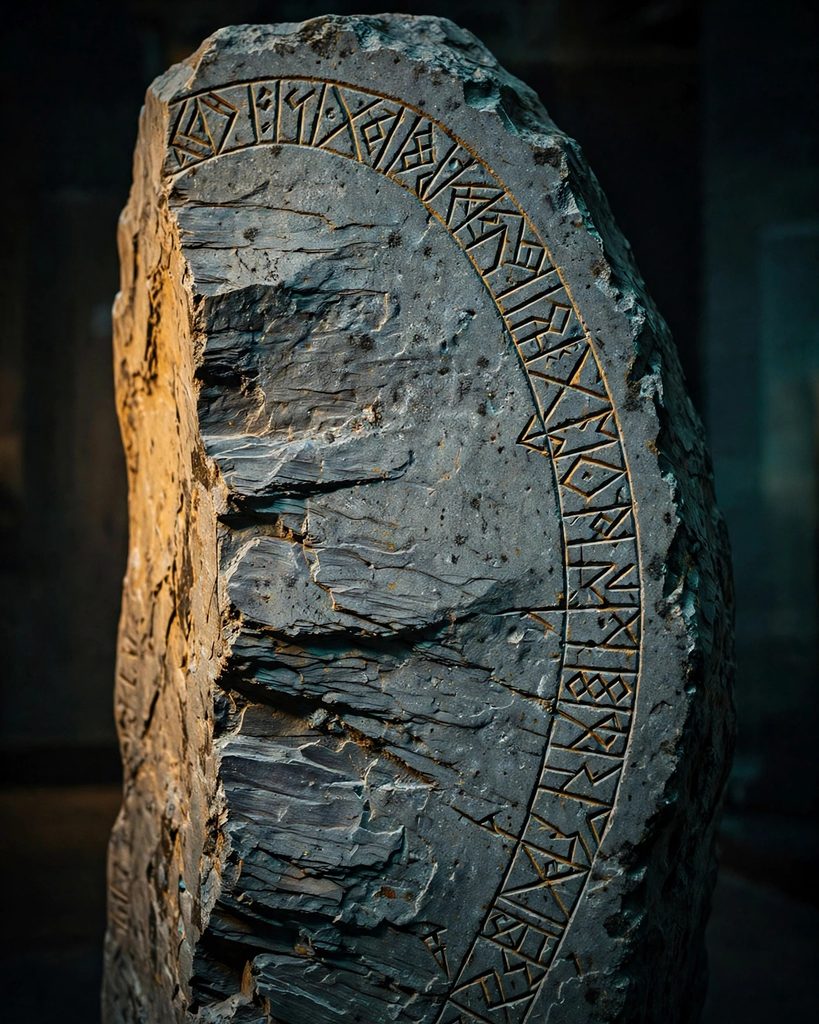
Tartessos left behind the oldest native writing in the Iberian Peninsula. About ninety-seven inscriptions survive, most of them carved on stone grave markers in southern Portugal, in the Algarve and the lower Alentejo, and dated to the seventh and sixth centuries BCE. The script runs mostly from right to left, and borrows from the Phoenician alphabet while mixing letters and syllables in a system of its own.
The sounds of the script can be read with some confidence. The language behind them cannot. It is not clearly related to any other known language, and a proposal by the scholar John Koch that it was an early form of Celtic remains strongly disputed. Like the Phaistos Disc in Crete, the stones of the south-west keep their words to themselves.
How Tartessos Became Atlantis
Around 360 BCE, in two dialogues called the Timaeus and the Critias, the philosopher Plato described a great island power beyond the Pillars of Heracles. It was larger than Libya and Asia together, built in concentric rings of land and sea, rich in metals, and it sank in a single day and night of earthquakes and floods, about nine thousand years before the Athenian lawmaker Solon. Plato said the story came from Egyptian priests by way of Solon. No earlier source mentions it.
It is easy to see why the two have been joined. Tartessos lay beyond the Pillars, it was famous for metal wealth, and it vanished. Its heartland at the mouth of the Guadalquivir was once a wide lagoon that the Romans called the Lacus Ligustinus, which slowly silted into the marshes of the Doñana National Park. A sunken city in a vanished bay makes a good story.
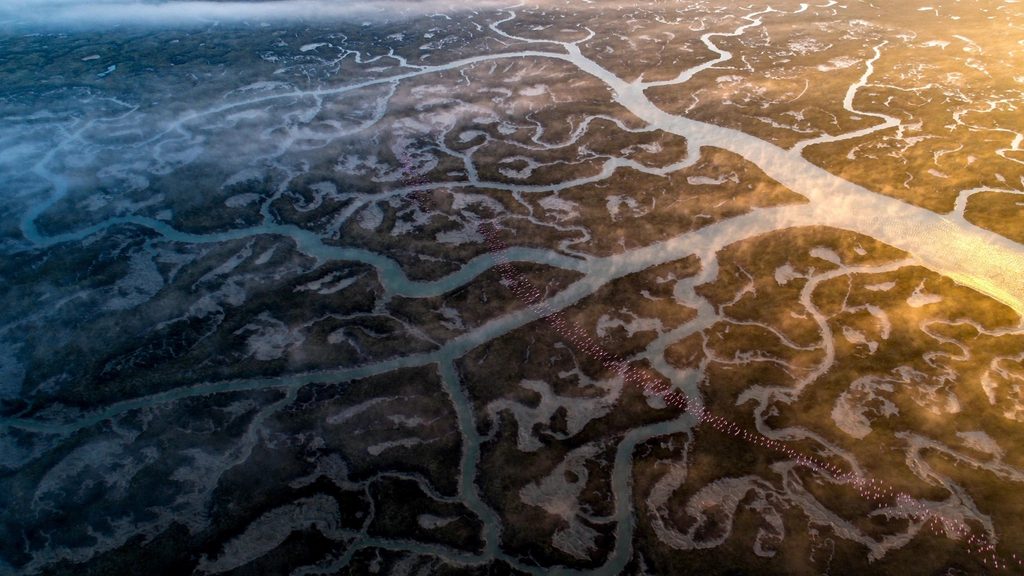
In the 1920s the German archaeologist Adolf Schulten called Tartessos the western source of the Atlantis legend and searched the Doñana marshes for its capital. He never found it. From 2005 a Spanish research team returned to the same marshes with satellite images and geophysical surveys. Two rectangular shapes ringed by curves looked promising from above. On the ground, geomagnetic studies found no buildings beneath the marsh, and the team described its work as testing a hypothesis, not proving one.
In March 2011 a television film called Finding Atlantis presented the claim of the American archaeologist Richard Freund, of the University of Hartford, that Atlantis had stood in those same marshes, destroyed by a tsunami, and that refugees had built memorial cities inland. Freund had joined the Spanish project late and helped fund some of its surveys. The project’s coordinator, the anthropologist Juan José Villarías-Robles, said his team was surprised by the film and called its claims fanciful.
The problems were never subtle. Plato’s Atlantis was an island larger than two continents. Tartessos was a network of settlements on the mainland. Plato placed its destruction nine thousand years before Solon. Tartessos flourished in the first millennium BCE, and Ephorus described it as a thriving market in Plato’s own century. Plato’s city was ringed by canals. The marsh has given back no city at all. The broader history of the legend, and why it keeps finding new homes, is traced in the archive’s file on Atlantis, alongside rival candidates such as the Eye of the Sahara.
Why Tartessos Disappeared
There was no single day and night of catastrophe. Tartessos faded, and the evidence suggests it was ended as much as it was lost.
In the sixth century BCE the trading world around it shifted. Around 540 BCE, at the sea battle of Alalia off Corsica, Phocaean Greeks fought Carthaginians and Etruscans, and in the decades that followed Carthage tightened its grip on the far western trade. Older histories blamed a Carthaginian conquest. Today most archaeologists see a slower crisis, with changing trade routes, pressure on the old elites and a move of people and power inland.
By the end of the fifth century BCE, the great buildings of the Guadiana valley were burned and buried in ritual, as at Turuñuelo and Cancho Roano. On the coast, the Tartessian name gave way to the Turdetanians that the Roman geographer Strabo described, people he thought the most cultured in Iberia, with written laws and long memories. The kingdom became a word in Greek books, and the word became a legend.
The Verdict | Debunked
Tartessos existed. Its gold sits in the museum in Seville, its writing is carved on stones in Portugal, its harbour pottery fills storerooms in Huelva, and the bones of its sacrifices have been counted one by one in Extremadura. It traded with Tyre and with the Greeks, and it had kings whose names reached Herodotus.
The claim that Tartessos was Atlantis does not survive contact with the evidence. The island Plato described has the wrong size, the wrong shape, the wrong age and the wrong end, and the marsh where its believers looked has turned up no city. The claim is stamped Debunked, and the kingdom does not need it. A wealthy, literate civilisation at the edge of the ancient world that buried its own sanctuaries and slipped out of history is strange enough without a philosopher’s island.
Every stamp in the archive is gathered in the Verdict Index, and the Tartessian sites are pinned on the Atlas.
Quick Answers About Tartessos
What was Tartessos? A civilisation of south-western Spain from about the ninth to the fifth century BCE, wealthy from silver and metal trade, shaped by contact with Phoenician and Greek traders.
Where was Tartessos? Around the lower Guadalquivir river, between modern Huelva, Seville and Cádiz, later spreading inland to the Guadiana valley in Extremadura. Its capital, if it had one, has never been found.
Was Tartessos Atlantis? No. Plato’s Atlantis was a vast island that sank about nine thousand years before Solon. Tartessos was a mainland culture of the first millennium BCE that faded gradually. Surveys of the Doñana marshes found no buried city.
What happened to Tartessos? It declined in the sixth and fifth centuries BCE as trade routes shifted and power moved inland. Several of its great buildings were deliberately burned and buried at the end of the fifth century BCE.
What language did the Tartessians speak? An unclassified language written in the Southwest script, the oldest native writing in Iberia. About ninety-seven inscriptions survive, and they can be read aloud but not understood.
Is Tartessos the biblical Tarshish? Possibly. Many scholars link the two because both are tied to metal trade with Tyre, but the identification is not proven.
What is the El Carambolo treasure? A hoard of twenty-one gold pieces found near Seville in 1958, made with Phoenician techniques from local gold and now displayed in the Archaeological Museum of Seville.