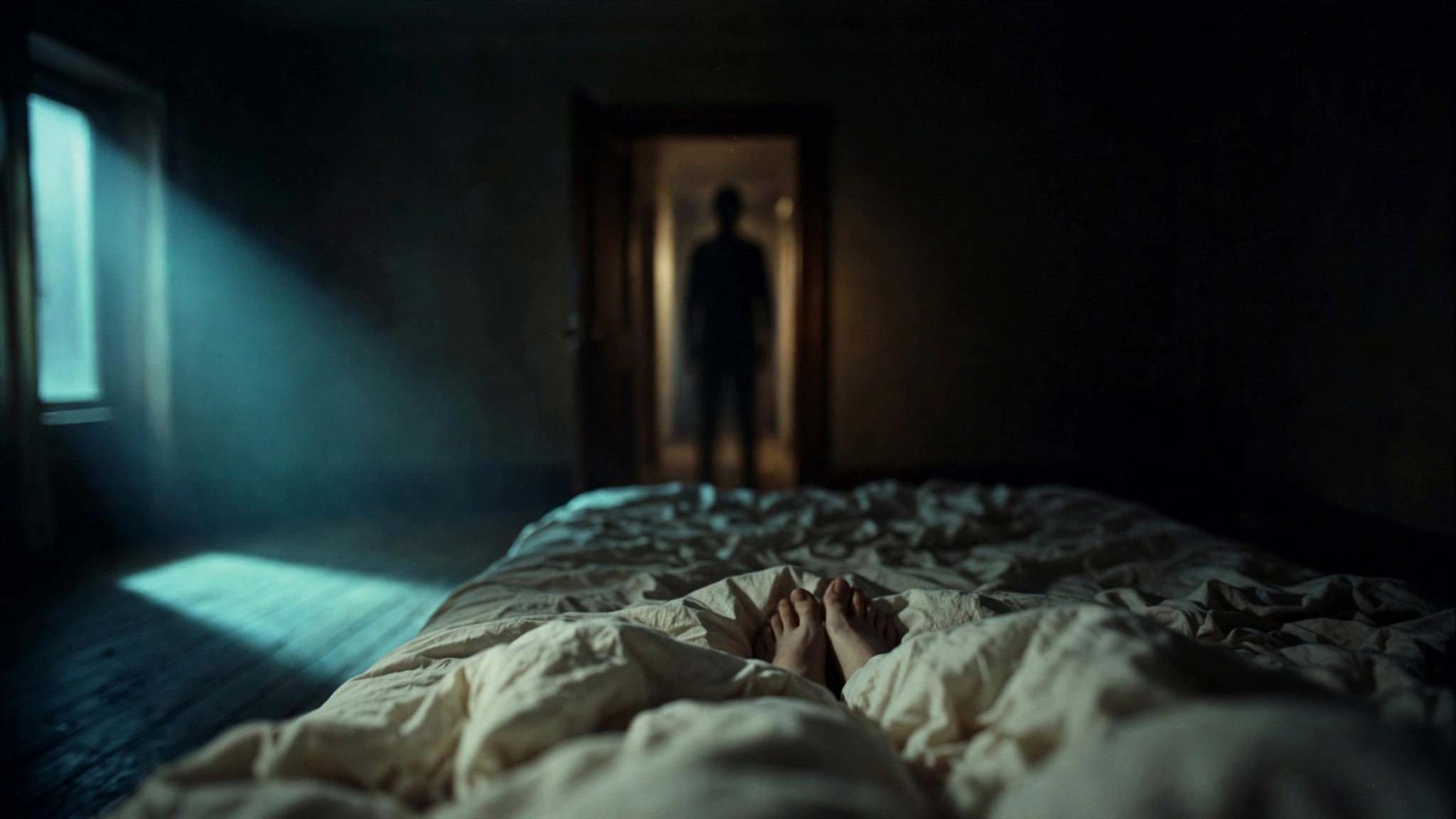
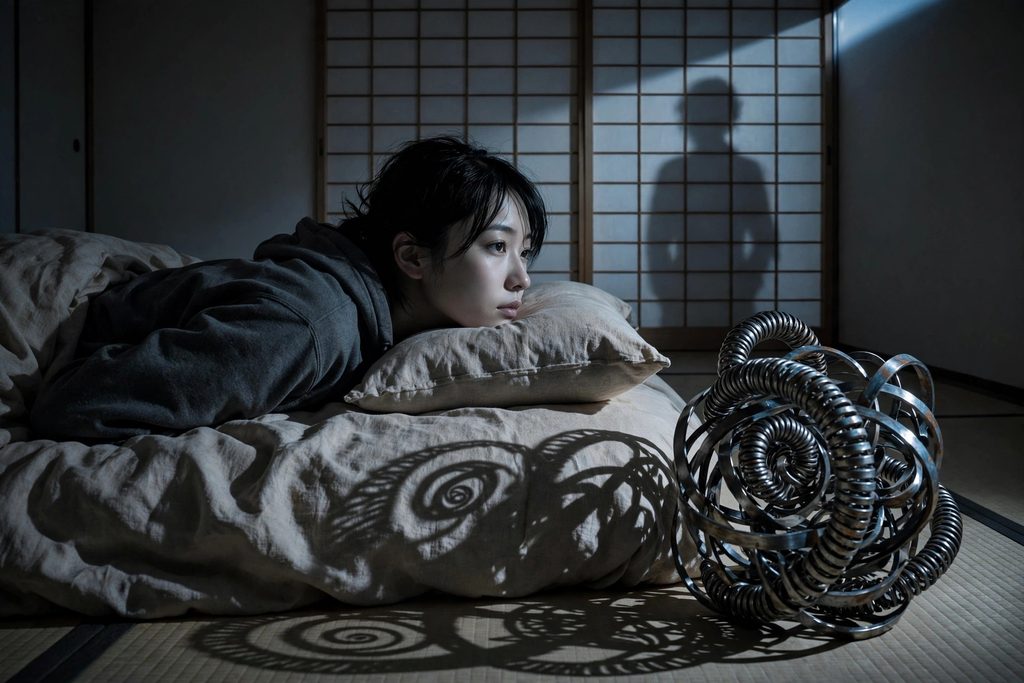
You wake in the dark and something is wrong. Your eyes are open, but your body will not move. You cannot lift an arm or turn your head, and when you try to call out, nothing comes. Then you realise you are not alone. Someone is standing at the end of the bed, or in the doorway, or in the corner where the light does not reach. It has no face, only a shape darker than the dark around it. And it is watching you.
Then, as suddenly as it began, it ends. You can move. The room is empty.
Millions of people have lived through those seconds, in every country and in every century we have records for. What makes the experience so hard to shake off is not only the terror. It is that people who have never met, never read the same books and never shared a language keep describing the same figure in the same room.
The Experience Has a Name
Sleep researchers call it sleep paralysis. It happens on the border between sleep and waking. During the stage of sleep in which most vivid dreams happen, known as REM sleep, the brain switches off almost every muscle in the body, so that we do not act out what we dream. Normally that switch turns off before we wake. In sleep paralysis, the mind wakes up first. Consciousness returns while the body is still locked, and the dream is not quite finished.
It is far more common than most people think. In 2011 the psychologists Brian Sharpless and Jacques Barber pooled 35 studies covering more than 36,000 people. About 7.6 percent of the general population had experienced it at least once. Among students the figure was 28 percent, and among psychiatric patients almost 32 percent. Stress, broken sleep, jet lag, shift work and sleeping on your back all make it more likely.
For most people it happens once or twice in a lifetime. For some it returns again and again. And it is rarely just paralysis.
The Intruder, the Weight and the Fall
In the 1990s the Canadian psychologist J. Allan Cheyne and his colleagues collected thousands of accounts and found that the hallucinations of sleep paralysis fall into three groups.
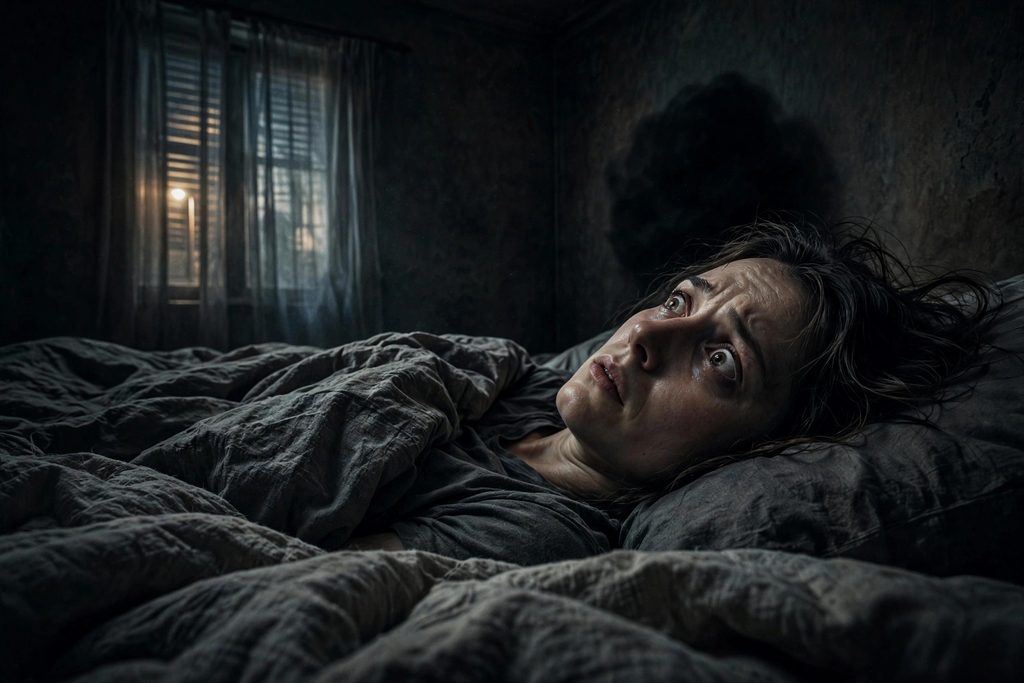
The first is the intruder. A sense, often overwhelming, that someone or something is in the room. Sometimes it is only felt. Sometimes it is heard, as footsteps, breathing or whispering. Often it is seen: a dark shape, a silhouette, a figure in a hat or a hood.
The second is the incubus. A crushing weight on the chest, difficulty breathing, the feeling of being held down or strangled, sometimes of being attacked.
The third is a group of strange bodily sensations: floating, falling, spinning, or the feeling of leaving the body and looking down at it.
Cheyne found that the intruder and the incubus tend to come together. The figure is in the room, and then it is on you. That pairing is the oldest nightmare in the world, and it has a name in almost every language.
The Same Figure on Every Continent
In Newfoundland it is the Old Hag. The folklorist David Hufford collected accounts there in the 1970s and published them in 1982 as The Terror That Comes in the Night. Then he found something he had not expected. Students in Pennsylvania, who had never heard of the Hag, described the same experience in close detail. That convinced him the experience came first and the folklore grew around it, not the other way round.
In Japan it is called kanashibari, “bound in metal”. In Turkey it is the karabasan, the dark presser. In the Abruzzo region of Italy it is the Pandafeche, an evil witch, a ghost or a huge cat that comes for sleepers. In Greece it is the Vrachnas (Βραχνάς), or the Mora, a creature that presses on the chest and tries to steal the sleeper’s voice. In parts of the Muslim world it is blamed on a jinn. The English word “nightmare” itself comes from the Old English mare, a spirit that sat on sleepers in the night. Long before psychiatry, as our file on how ancient people explained possession shows, the explanation for what came in the dark was almost always a visitor.
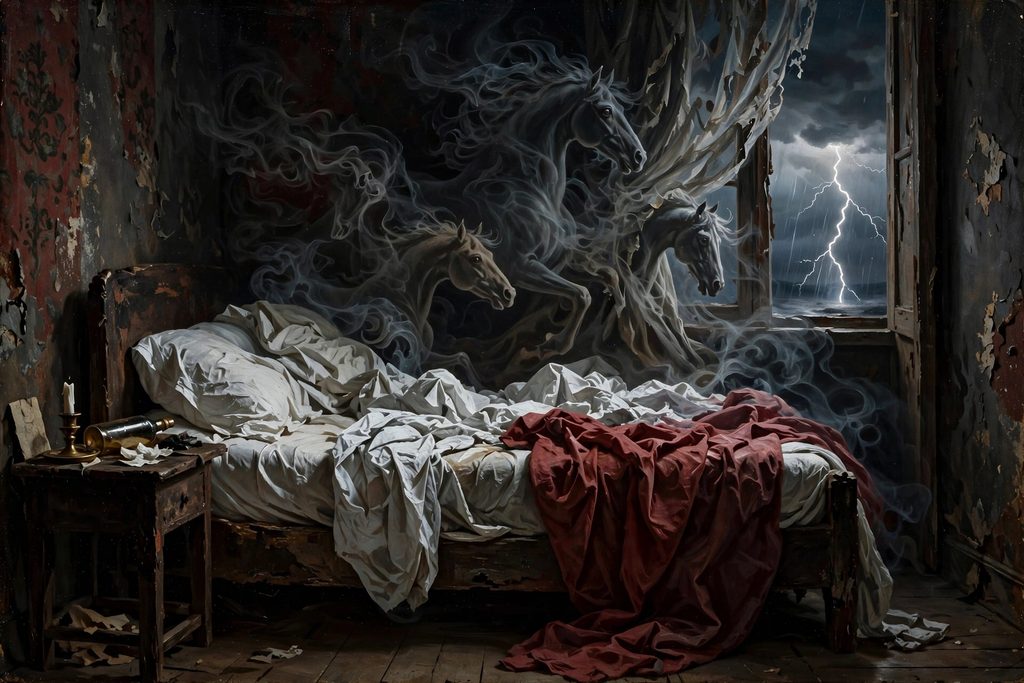
In 1781 the Swiss-born painter Henry Fuseli painted The Nightmare: a woman flung back across a bed, a squat demon sitting on her chest, and a horse’s head pushing through the curtains. It caused a sensation in London. Two centuries later, sleep researchers still use it to illustrate the incubus.
When Belief Makes It Worse
The figure is the same everywhere. What people believe about it is not, and that turns out to matter.
The researchers Baland Jalal and Devon Hinton compared sleep paralysis in Egypt and Denmark. In their Egyptian sample, where it is widely blamed on a jinn, 43 percent had experienced it. In the Danish sample the figure was 25 percent. The Egyptians also remembered their episodes lasting longer, and more than half of those who had lived through one believed it could kill them. In Denmark, where most people put it down to stress or poor sleep, it was a nasty experience but rarely a terrifying one. In Abruzzo, where more than a third of the people surveyed thought the Pandafeche might be behind their episodes, the pattern repeated: longer paralysis, and more fear.
These were particular groups of people, not whole nations, and belief is unlikely to be the only cause of the difference. But the link keeps appearing. The sensation is the same. The story you bring to it decides how frightening it becomes.
The darkest example comes from the United States. Between the late 1970s and the late 1980s, more than a hundred men, most of them young Hmong refugees from Laos, died suddenly in their sleep. Many of their families blamed the dab tsog, a pressing spirit from Hmong tradition. The deaths were real, and they still need a medical explanation. Doctors have since linked a similar pattern of night-time deaths in Southeast Asia to an inherited heart rhythm disorder, Brugada syndrome. But the medical anthropologist Shelley Adler, who spent years studying the Hmong cases, argued that the spirit belief mattered too. Men cut off from the shamans and rituals that would have protected them in Laos met the visitor alone, and believed it would kill them. She did not claim that fear alone killed them. She argued that terror on top of a vulnerable heart may have been enough. The deaths also gave the film director Wes Craven the idea for A Nightmare on Elm Street.
Where the Shadow People Came From
The modern name for the figure is younger than you might think. “Shadow people” spread through American late-night radio. On 12 April 2001, the host Art Bell devoted an episode of Coast to Coast AM to them and asked listeners to send in drawings of what they had seen. Many did, and the drawings went up on the show’s website while the programme was still on air. For the first time, strangers could set their visitor next to someone else’s and see the likeness. Books followed, and by the late 2000s so did a famous variant, the Hat Man, a tall dark figure in a brimmed hat who often stands in a doorway.
The Hat Man has a second, stranger link. People who take large overdoses of the antihistamine diphenhydramine, sold as Benadryl, describe him so often that the figure has become a warning in drug-safety forums. Different triggers, the same visitor.
Not Every Shadow Is the Same Shadow
That is also where the label starts to mislead. “Shadow people” now covers very different experiences. A figure in the doorway while you lie paralysed is one thing. A dark shape at the edge of your vision in the middle of the afternoon is another. So is a visitor seen after three nights without sleep, or in a fever, or in the grip of a drug. They may share a look without sharing a cause, and lumping them together is how one mystery gets built out of several ordinary ones. The question to ask of any account is simple: what was the body doing when the figure appeared?
The sleep paralysis cases are the core of the file, and they explain the most. Some of the rest may never be explained at all, because nobody recorded what was happening when they occurred.
Why the Brain Builds a Visitor
The best clue to why the figure looks so similar everywhere came from an operating theatre in Geneva. In 2006 the neuroscientist Olaf Blanke and his colleagues were mapping the brain of a young woman before epilepsy surgery. When they stimulated a small area called the left temporoparietal junction, she reported that someone was standing behind her. When she sat up, the figure sat up. When she leaned forward and wrapped her arms around her knees, she felt it wrap its arms around her. The “shadow person”, as the team called it in their paper in Nature, was copying her own posture.
That area helps the brain work out where your body is and where it ends. When the signals it uses get scrambled, the brain can place a copy of your own body outside yourself, and experience it as someone else. In sleep paralysis those signals are badly scrambled. You are awake, but your body is paralysed and your brain is receiving almost no feedback from it. Meanwhile, the threat-detection systems of the brain are running at full alert, and the dream machinery of REM sleep is still switched on.
The result is a mind that knows it is in danger, cannot move and cannot see clearly. The room is dark, so there is little detail to correct it. And human brains are tuned to over-detect other people, because for most of our history mistaking a shadow for a stranger cost far less than the opposite. So it does what it has always done with a shape in the dark. It finds a someone, the same way we find a bear in the stars or a stranger in a mirror in a dim room. And because every human brain is built the same way, the figure it finds looks much the same, whether the sleeper is in Cairo, Copenhagen or a fishing village in Newfoundland.
Not identical, though. Some people see an animal, an old woman, a person they know, or nothing at all, and many have sleep paralysis without any visitor. The Geneva experiment shows that the brain can make a convincing someone out of nothing. It does not prove that every shadow figure is made in exactly that way.
What Helps
Sleep paralysis is frightening, but it is not dangerous in itself. For most people the most useful thing is simply knowing what it is. Regular sleep, less stress and sleeping on your side all reduce the chances. Jalal has developed a simple technique for the moment it happens: remind yourself that it is a known, harmless state that will pass, do not fight the paralysis, turn your attention inward and relax your muscles. In a small pilot study with narcolepsy patients, it halved the number of episodes in eight weeks.
If it happens often, or comes with heavy daytime sleepiness or sudden muscle weakness, it is worth seeing a doctor, because it can be a sign of narcolepsy or another sleep disorder.
The Verdict | Documented
The experience is real, it is common, and its mechanics are well understood. The paralysis, the weight on the chest and the visitor in the room have all been measured, mapped and in one case even produced on demand in a laboratory. What the record does not contain is a single piece of evidence that the figure exists outside the person who sees it.
What remains strange is not whether shadow people are real. It is how faithfully the human brain draws the same figure, in the same doorway, across every culture that has ever slept. We have explained how the visitor is made. We have not stopped seeing it. The people of Ishinomaki, who met their own dead after the 2011 tsunami, would recognise the feeling.
To see how this file’s verdict sits among the others, visit the Verdict Index.