At around 10:30 on the night of April 21, 1977, seventeen year old Bill Bartlett was driving his Volkswagen down Farm Street in Dover, Massachusetts, with two friends in the car, Mike Mazzocca and Andy Brodie. His headlights swept across a low stone wall at the edge of the road and caught something crouched on top of it. Bartlett slowed down enough to get a clear look. His friends, looking somewhere else in the car at that exact moment, missed it entirely.
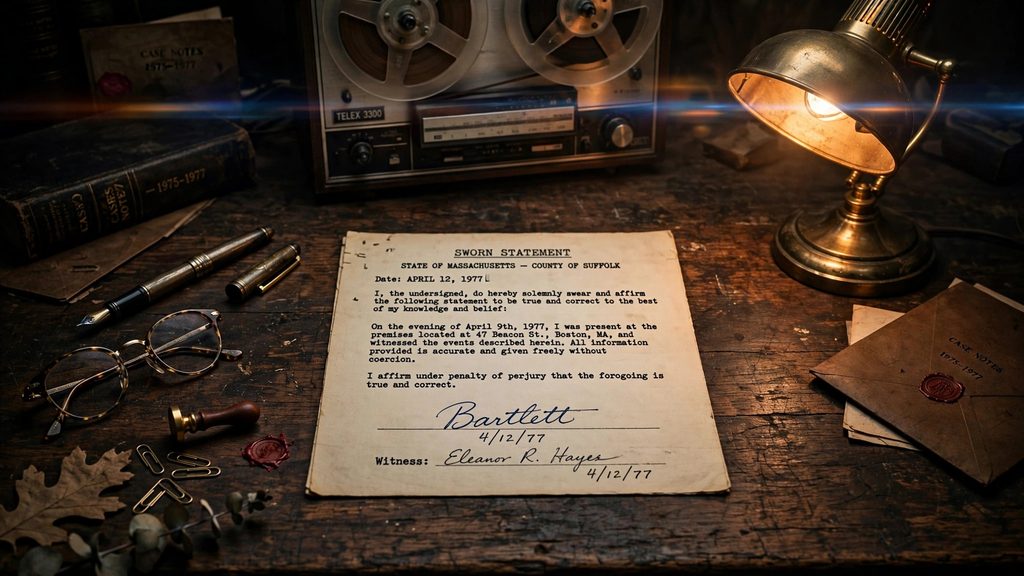
What he saw, by his own account, was not an animal he recognized. It was small, maybe three and a half feet tall, with an oversized head shaped like a watermelon, rough peach colored skin, and two glowing eyes that tracked the headlights like a pair of orange marbles. It had thin arms and long spindly fingers wrapped around the top of the wall. Bartlett did not stop the car. He kept driving, and that night, back home, he sat down and sketched what he had seen from memory. Along the bottom of the page he wrote a line that has followed the case for almost fifty years. “I, Bill Bartlett, swear on a stack of Bibles that I saw this creature.”
He was not the only one. Two hours later, another Dover teenager would describe something close to the same thing. A third report followed the next night, from two more witnesses on the far side of town. The popular version of what happened next is that four strangers each saw the same impossible creature with no way to have influenced one another. The real record is messier, and more interesting, than that.
Three Encounters, Not One Night
Just after midnight, fifteen year old John Baxter was walking home along Miller Hill Road when he came across something crouched in a wooded clearing. He described a bulbous, oversized head on thin shoulders, long spindly arms and fingers, and eyes that stayed fixed on him the entire time he backed away. The third report did not come that same night. It came the next evening, April 22, when eighteen year old Will Taintor was driving fifteen year old Abby Brabham home along Springdale Avenue and their headlights caught something similar crouched at the roadside. Brabham gave the account that differs most from the other two. She described the eyes as glowing green rather than orange, and said the build looked more apelike than Bartlett’s version.
So the case is not one encounter witnessed three times in a single night. It is three separate encounters, involving four people, spread across roughly a day. When Bartlett later mapped the three locations, he said they lined up in something close to a straight line across town, a detail that has nothing to do with whether the witnesses knew each other and everything to do with how small Dover actually is.
The Witnesses Were Not Four Strangers
That last point matters, because the usual version of this story leans hard on the idea that the witnesses barely knew each other. The real picture is less clean. Bartlett and Baxter knew each other, at least casually, from the same small town. Bartlett and Taintor were close friends, and by most later accounts Taintor already knew about Bartlett’s sighting before he and Brabham had their own encounter the following night. Brabham, by most accounts, did not know about any of it beforehand.
None of that proves anyone invented anything. Dover in 1977 was small enough that it would have been unusual for four teenagers that age not to know each other at all. What it does mean is that the four of them cannot be treated as sealed off from one another, each independently reporting the same impossible thing with no way to have shaped each other’s memory of it.
A Case File Built Almost Immediately, and Complicated Decades Later
The person most responsible for the Dover Demon surviving as more than a local rumor is Loren Coleman, a cryptozoologist who was living nearby in Needham at the time. Coleman began looking into the reports on April 28, about a week after the first sighting, and interviewed all four primary witnesses between May 3 and May 5. He brought in Walter Webb, Joseph Nyman, and Ed Fogg, researchers with backgrounds in UFO investigation who were used to interviewing witnesses methodically rather than collecting a good story, and together they talked to the teenagers, their families, their teachers, and the police. Coleman eventually gave the case the name it is known by today and wrote it up at length in his book Mysterious America.
Coleman’s own account from that investigation held that the four of them did not realize more than one of them had seen anything until the week before he sat down with them, and that the drawings Bartlett and Baxter produced, compared side by side, matched closely despite the two of them not having discussed the sighting beforehand. For decades that was treated as close to the last word on the case.
A 2022 reconstruction of the case in Skeptical Inquirer complicates it. Taintor’s established friendship with Bartlett, and his apparent prior knowledge of the first sighting, sit awkwardly next to a clean story about four strangers and one impossible coincidence. The same reconstruction found that recollections of exactly when Baxter first learned about Bartlett’s drawing conflict with each other, which weakens, without resolving, the claim that his sketch was produced in total isolation. Neither Coleman’s original account nor the newer reconstruction settles the question outright. They just disagree about how clean the evidence actually is.
A Reliable Witness Is Not the Same as a Correct One
Dover’s police chief at the time, Carl Sheridan, who led the town’s small department for more than two decades, was reportedly direct about Bartlett specifically, calling him an outstanding artist and a reliable witness. None of the four had a documented history of pranks serious enough to raise suspicion going in, and none of them sought money or publicity from what happened.
That matters, but it settles less than it sounds like it does. A witness can be entirely honest and still misidentify what he saw, especially at night, at a distance, for a few seconds, under headlights. Sincerity is not the same thing as accuracy. The real question was never only whether Bartlett, Baxter, Taintor, and Brabham were lying. It is whether four honest witnesses saw the same unfamiliar thing, saw different ordinary things and described them in similar terms, or gradually shaped each other’s memories once the story began circulating around a small town. The story reached the Boston Globe within a month, by mid-May 1977, and the paper has returned to it more than once since, each time treating the case with the same open skepticism the original report did.
The Owl, the Moose, and a Hoax Nobody Ever Confessed To
Four serious explanations have been proposed over the decades, and each runs into the same basic problem. The first is a baby moose or horse foal, caught at an awkward angle in headlights. Moose are rare but not unheard of in Massachusetts, and a young, wet, gangly limbed animal could, in theory, look strange enough to startle a teenager. The trouble is that none of the three descriptions mention fur, a muzzle, or four legs, and no one ever reported a missing or injured foal or calf in the area that spring.
The second is Joe Nickell’s theory that the witnesses saw a snowy owl, whose pale plumage can reflect headlights at night in a way that might account for an oversized pale head and two glowing eyes. It is the same basic type of explanation Nickell later offered for the Mothman sightings in West Virginia, a large owl misidentified for something stranger in the dark. Nickell himself frames it carefully. The claim is not that an owl has been positively identified, only that a misperceived animal is a more economical starting point than an unknown humanoid. The problem with applying it to Dover is scale. An owl does not have long, thin fingers wrapped around a stone wall, and three witnesses in three locations would each have had to make a similar misidentification within about a day of each other.
The third is the one Dover’s own police leaned toward at the time, a school vacation prank that got out of hand. Teenagers with a mask or a costume piece could produce a convincing fright in a dark backyard, and a small town full of teenagers on school vacation could supply both witnesses and an audience. No mask, costume, or prop was ever recovered, though, and nobody who knew Bartlett, Baxter, Taintor, or Brabham ever came forward in almost fifty years to say they had helped build one.
The fourth, argued by researcher Benjamin Radford, is that popular culture is part of the explanation. He points to 1977 as the year of Star Wars and Close Encounters of the Third Kind, two films full of exactly the kind of big eyed, oversized headed creature the Dover teenagers described. The dates are the weak point. Star Wars opened on May 25, about five weeks after the sightings, and Close Encounters not until November. Radford is careful not to claim the teenagers copied a movie outright, and millions of people saw the same films that year without reporting a creature in their own backyard.
Skeptic Brian Dunning takes the position furthest on his Skeptoid podcast, arguing there is no evidence that anything happened at all and that the honest default is to assume nothing unusual occurred until proven otherwise.
Nobody Else Has Ever Reported One
If pop culture alone explained the sightings, the Dover Demon should not have stayed so strictly local. Star Wars and Close Encounters played in theaters across the entire country that year, yet nothing resembling the Dover Demon’s specific combination of features, the watermelon head, the missing nose and mouth, the long thin fingers, has turned up as a recurring regional cryptid anywhere else. Folklorist Jeff Belanger, who has studied New England’s legends for years, has pointed out that copycat reports are exactly what you would expect from a story this well known, and nearly fifty years on, they have simply never arrived.
What the Record Actually Supports
None of this adds up to proof that something unclassified crouched at the edge of Dover for parts of two days in April 1977. It adds up to something messier than the popular legend, and in its own way more interesting. The witnesses were not four isolated strangers. Some of them knew each other, one of them already knew about the first sighting before his own, and the famous matching drawings rest on an independence that later reporting cannot fully confirm. None of that proves a hoax. It also does not explain away four specific, consistent descriptions of the same unfamiliar thing, documented and investigated within days rather than assembled decades later from faded memory.
Bartlett kept his sworn statement. Coleman kept his case file. Researchers who went back decades later to complicate the story still could not close it either way. Whatever was or wasn’t at the edge of those three encounters, it never came back, and nobody has ever confessed to putting it there.