





In 1980, a Soviet theoretical physicist and a Soviet ornithologist published a paper almost nobody read outside a narrow circle of specialists, calculating how many human bodies the Earth’s biosphere could sustain without losing its own capacity to regulate itself. Their number was 250 million people, a fraction of a percent of the eight billion currently alive.
That figure was never a political decree, and it was never a blueprint for engineered population reduction. It was an attempt to answer a much narrower, much stranger question: what happens when a single species starts spending the energy budget the rest of life on Earth depends on to keep the planet stable?
The Physicist, the Ornithologist, and an Inconvenient Equation
The paper is real, and its authors were serious scientists working well outside the fringe. Viktor Gorshkov was a theoretical physicist whose doctoral work had been reviewed by future Nobel laureates Alexei Abrikosov and Vitaly Ginzburg, with an early career spent on nuclear and atomic physics before he turned his attention to the biosphere as a thermodynamic system. Viktor Dolnik was a Soviet ornithologist and ethologist, author of nearly two hundred scientific works and, for a general audience, the popular science book Disobedient Child of the Biosphere, which laid out the biological realities of human existence in terms Soviet readers weren’t used to hearing. In 1980, the two published “Energetics of the Biosphere” in Soviet Physics Uspekhi, a respected physics journal, applying the mathematics of energy flow and thermodynamic budgets, the same kind of accounting used in solid-state physics, to the entire living world.
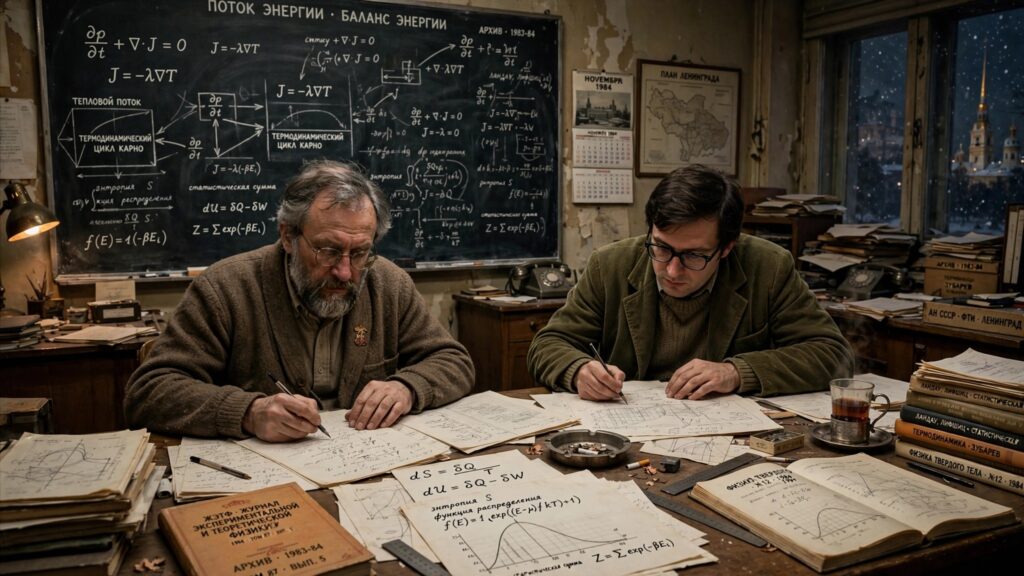
Their question was deceptively simple: how much energy can Earth’s biosphere allocate to large animals, and where does humanity actually fit inside that budget? For roughly 3.5 to 3.8 billion years, life on this planet has cycled carbon, water, and nutrients through repeated catastrophic resets, oxygen crises, snowball-Earth glaciations, and mass extinctions, always recovering because the core work of stabilizing the system was carried out by the smallest organisms: microbes, fungi, and small invertebrates processing matter at enormous scale. Larger animals, everything with a spine, from frogs to whales, sit at the very top of that energetic pyramid, and in Gorshkov and Dolnik’s accounting, all wild vertebrates on Earth combined consume roughly one percent of the biosphere’s total net primary production. One percent, shared among every bird, mammal, reptile, amphibian, and fish alive.
The Ecological Body | Humanity’s Biological Shadow
Humans are large mammals, and by that same energetic accounting, we belong inside that same one-percent bracket alongside every other vertebrate. Dolnik’s original calculation found that even in the early 1980s, humanity, once livestock, pets, and the knock-on effects of deforestation were factored in, was already appropriating roughly seven percent of the biosphere’s total production, seven times the share any other large-animal population would occupy on its own. Measured today through the internationally recognized HANPP framework, Human Appropriation of Net Primary Production, that global figure sits closer to twenty-five percent.
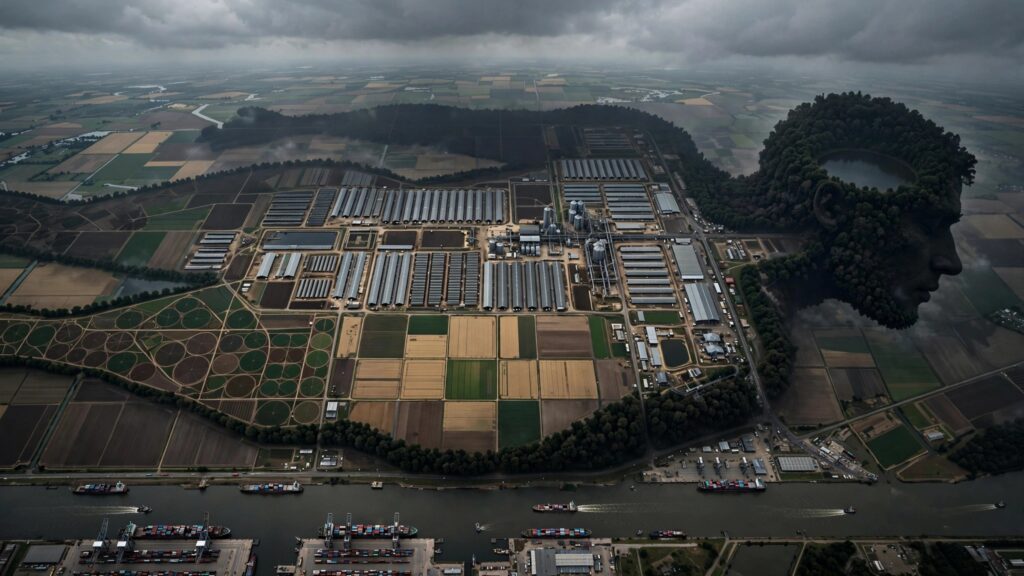
This is the detail most retellings of the 250-million figure get wrong. It was never a calculation of how many people the planet can feed through industrial fertilizer and modern agriculture. Humanity has repeatedly proven capable of feeding far more than 250 million people by that narrow metric. It’s an estimate of what population, at a given level of energy consumption, would leave the biosphere’s self-regulating capacity intact. Billions of broiler chickens, hundreds of millions of cattle, pigs, and sheep aren’t separate from that calculation, they’re the expanded biological body of industrial humanity, and the biosphere has to support all of them, not just the eight billion humans directly. A field of monoculture wheat, a clear-cut forest, an open-pit mine, and a transatlantic flight are all, in this framework, different conduits for pulling solar energy out of the wild biological economy and redirecting it into the human one. Ecologically speaking, modern humans aren’t just a large primate. We’re a primate bundled together with a cow, a tractor, and a global logistics network, and the whole bundle draws on the same one percent of the planet’s energy budget every other vertebrate has to share.
Megacities as Demographic Traps
Dolnik made an observation in the final years of the Soviet Union that read as an eccentric aside at the time and reads very differently now: he described megacities as “demographic traps,” places where human reproduction reliably falls below simple replacement, not because of any single ideology or policy, but as a structural response to density, cost of living, delayed pairing, and the economics of raising children in dense, expensive environments.

The current numbers make his observation difficult to dismiss as speculation. South Korea’s total fertility rate sits at roughly 0.68 to 0.73 children per woman as of the most recent 2026 data, the lowest peacetime fertility rate ever recorded by any nation in history. China sits at approximately 1.0, its population having peaked in 2023 and now in decline, with UN projections showing it could fall from today’s 1.4 billion to as low as 633 million by 2100, roughly where it stood in the late 1950s. Japan sits near 1.2. Italy and Spain sit near 1.2 as well. France recorded more deaths than births in 2025 for the first time since the Second World War. The replacement threshold required simply to hold a population steady, accounting for early mortality, is 2.1 children per woman. As of the most recent United Nations World Population Prospects data, 99 of 194 countries, more than half the world, already sit below that threshold, and 63 countries representing 28 percent of the global population have already passed their peak population and begun to shrink. This isn’t a scattered set of national policy failures. It’s a pattern repeating with striking consistency across nearly every advanced industrial society on Earth, largely independent of the specific pronatalist policies individual governments have tried.
The Myth of the “Golden Billion”
The phrase “golden billion” has circulated for decades in geopolitical rhetoric, particularly in Russian political discourse, as shorthand for an alleged secret plan by Western elites to deliberately cull the global population down to a privileged remainder. That specific narrative, a coordinated, intentional depopulation plot, has no documentary or institutional evidence behind it anywhere. No leaked plan, no named architects, no verifiable program. What the real ecological accounting actually points toward is both more mundane and, in its own way, more difficult to argue with: simple thermodynamics rather than conspiracy. The Global Footprint Network’s accounting finds that if all eight billion people currently alive adopted the consumption profile of an average American, the planet would need the resource yield of roughly five Earths to keep pace, a level of overshoot with no need for any hidden committee to explain it. The distribution of that consumption is itself stark: the wealthiest ten percent of the world’s population generates roughly half of all planetary carbon emissions, while the poorest fifty percent account for only about a tenth.

The Earth doesn’t impose a fixed, immutable ceiling on human headcount in isolation from how those humans actually live. It imposes limits on the flow of energy, water, and matter, and those limits shift dramatically depending on lifestyle. A planet where everyone lived at the consumption level of a subsistence farmer could comfortably support billions more people than currently exist without destabilizing global climate or hydrological systems. A planet where everyone lived at the consumption level of a wealthy technocrat might struggle to sustainably support even a few hundred million. Technology can shift that ceiling considerably, nuclear fusion, synthetic protein production, closed-loop industrial recycling, and advanced automation could each meaningfully change the equation, but no technology yet available or plausibly near-term can manufacture unlimited fresh water, unlimited topsoil, or unlimited functioning ecosystems from nothing.
The Real Question, and Why It’s Harder Than It Sounds
The question that dominates most public debate on this subject, some version of “how many people should be left on Earth,” is worth naming directly as a dangerous framing, one that invites authoritarian answers dressed up as environmental concern, and it isn’t the question the actual science supports asking. The real, considerably harder question Gorshkov and Dolnik’s work points toward is whether eight billion people, along with the vast industrial and agricultural apparatus supporting them, can be integrated into the biosphere’s energy budget without permanently breaking its climate regulation and hydrological cycling, the same self-stabilizing functions that have kept the planet habitable through billions of years of prior disruption.

That question remains genuinely open. Gorshkov’s later work, continued after his death in 2019 by physicist Anastassia Makarieva and collaborators, has extended the biotic regulation framework considerably, including research into how large, intact forests actively drive atmospheric circulation and rainfall patterns, a mechanism now called the biotic pump. None of that later work amounts to a settled prediction of collapse, and none of it licenses treating any specific population, nation, or group of people as the identified problem to be solved. What it does is strip away the comfortable assumption that humanity’s role as an intelligent, technological species exempts it from the same thermodynamic accounting every other large animal on the planet has always been subject to. We remain, in the terms this research actually uses, a large primate with an extraordinary toolkit, a catastrophic appetite, and a genuinely open question about whether the toolkit is sophisticated enough to outmaneuver the energy budget that built us in the first place.