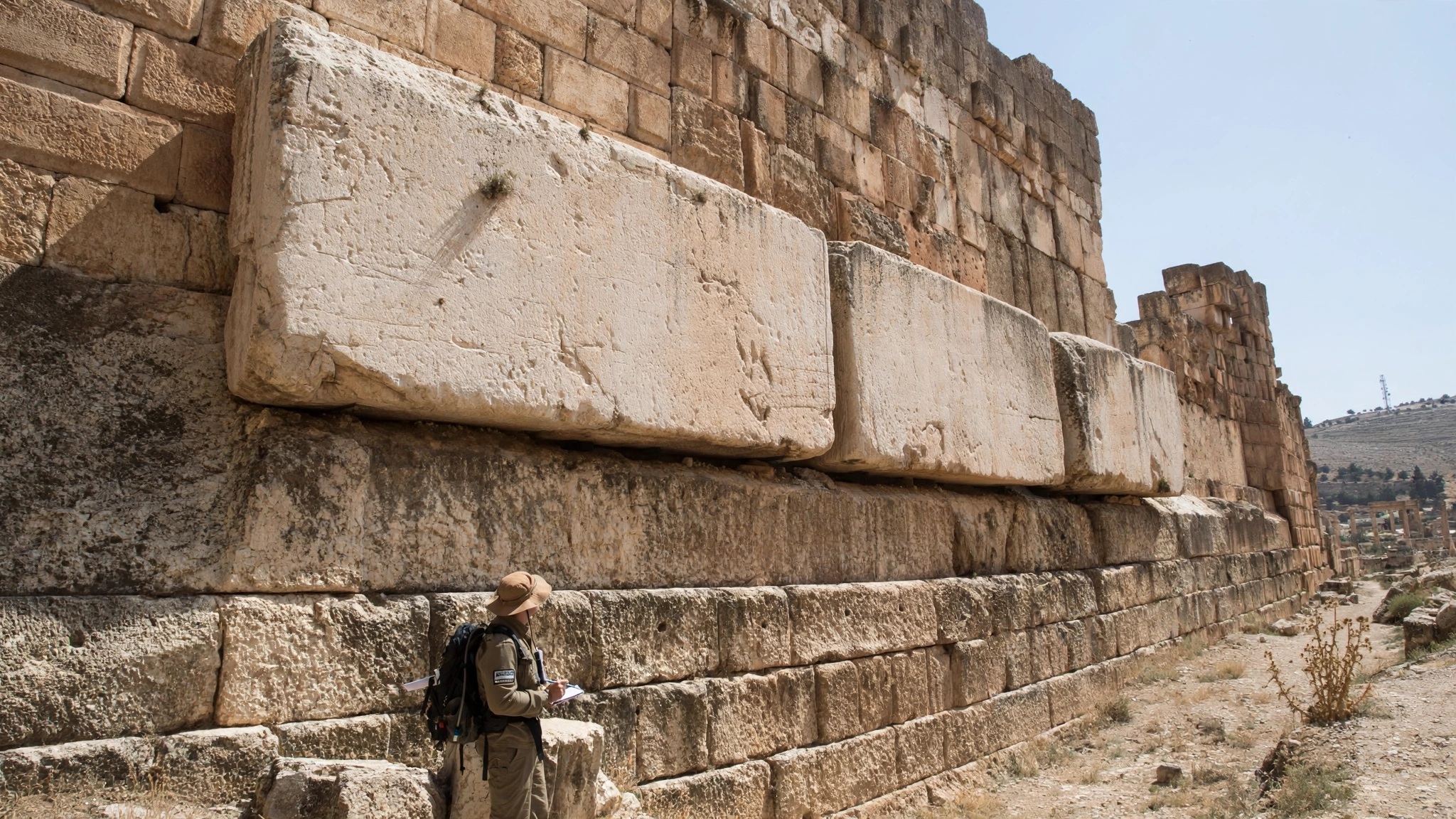
In the Bekaa Valley of eastern Lebanon, three blocks of stone sit wedged into the podium wall of a Roman temple, each one nineteen meters long, four meters high, weighing somewhere between 750 and 800 tonnes. They are fitted together so precisely that visitors have spent two centuries trying, and failing, to slide a knife blade into the seam between them. The claim that no crane alive today could lift them is, on its own terms, false: the world’s largest land crane could hoist one with capacity to spare, and the record for a single lift belongs to a machine that moved twenty-five times the weight of a single Trilithon stone.
That correction doesn’t make Baalbek less extraordinary. It clarifies what’s actually extraordinary about it, and the actual question turns out to be considerably more interesting than the one the crane comparison was trying to ask.
What’s Actually Sitting in the Bekaa Valley
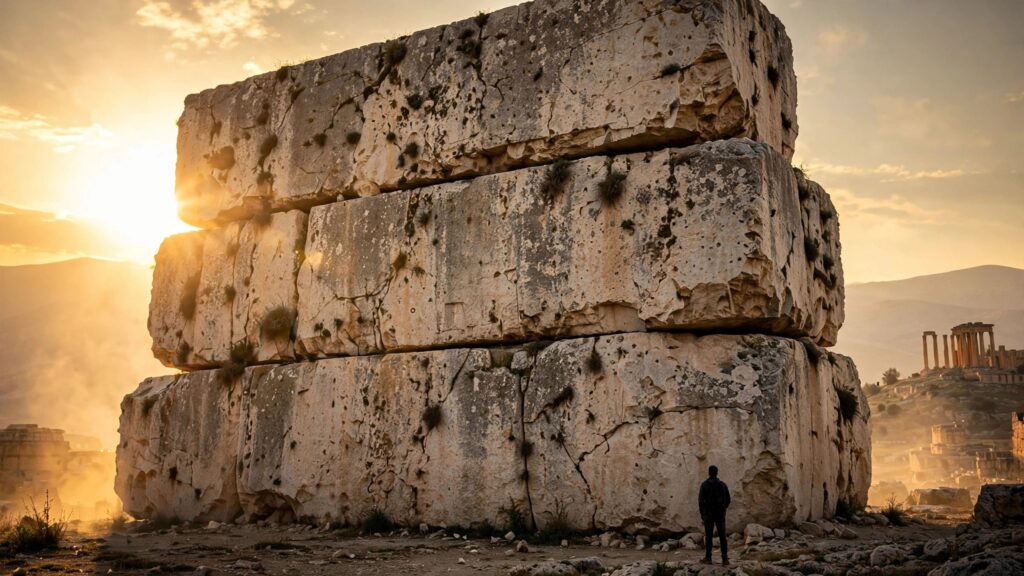
Baalbek was Heliopolis to the Greeks and Romans, City of the Sun, and it sits roughly 85 kilometers northeast of Beirut at an altitude of 1,170 meters, close enough to the source of the Litani River that ancient builders never lacked for water or labor. What draws people to it today isn’t primarily the temple itself, though the Temple of Jupiter is the largest religious structure the Romans ever attempted to build, its Corinthian columns rising to nearly 20 meters and its total footprint dwarfing anything comparable in Rome. What draws people is the foundation beneath it. The western retaining wall of the podium incorporates three stones known collectively as the Trilithon, a name attached to them by at least the early Byzantine period even though, in the strict archaeological sense, they don’t form a true trilithon at all. Each stone measures close to 19.6, 19.3, and 19.1 meters respectively, roughly 4.3 meters high and 3.6 meters thick, and each weighs an estimated 750 to 800 tonnes, figures calculated from their measured volume and the known density of the local limestone. They sit not at ground level but roughly seven meters up the podium wall, resting atop a lower course of stones that are themselves no small undertaking, eleven meters wide and estimated at 350 tonnes apiece.
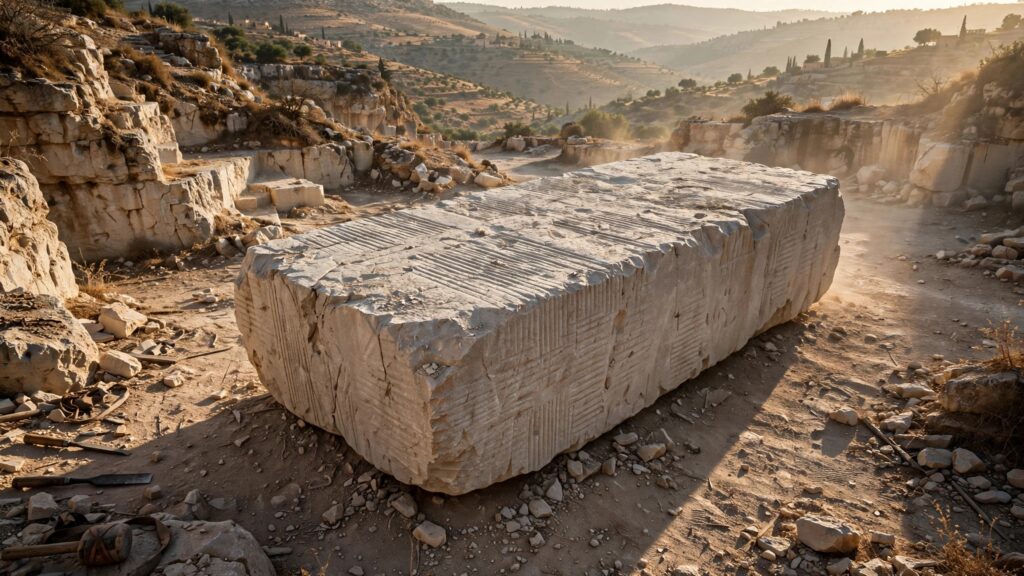
Eight hundred meters from the temple, at the ancient quarry, the story gets stranger and better documented at the same time. Six colossal stones remain visible there today, cut but never moved, and three of them, smaller than the ones already in the wall, are themselves estimated at 800 to 1,000 tonnes. In 2014, a German Archaeological Institute excavation team led by Jeanine Abdul Massih uncovered a seventh: a monolith completely freed from the bedrock on all sides, fully cut, entirely ready for transport, and abandoned exactly where it lay. It remains, as far as anyone has found, the largest precisely cut stone block anywhere in the world, larger even than the three already installed in the Trilithon. Whoever quarried it walked away before moving it an inch.
Correcting the Crane, and Why It Matters
The claim that anchors most viral retellings of Baalbek, that no crane in the world today could lift these stones, needs to be addressed directly because it’s checkable and it doesn’t hold up. The current holder of the title “world’s largest land-based crane” is the Sarens SGC-250, nicknamed Big Carl, a ring crane currently at work on the Hinkley Point C nuclear power station in the United Kingdom. Its rated lifting capacity is 5,000 tonnes at a working radius of 40 meters, meaning it could lift a single 800-tonne Trilithon stone with more than four times the load to spare. Big Carl isn’t even the outright record holder for a single lift. That belongs to Taisun, a fixed gantry crane in a Chinese shipyard used for installing modules on semi-submersible vessels, which holds the documented world record for hoisting 20,133 tonnes in a single lift, more than twenty-five times the weight of one Trilithon stone. Modern cranes don’t strain against these stones. They could stack several of them and still have margin left.
This correction isn’t a small technicality. It changes what the actual mystery is. The interesting question was never “could a modern crane lift this,” because obviously one can, several times over, with room to spare. The interesting question is how a civilization with no cranes at all, no steel cable, no diesel engines, no hydraulics, managed to quarry, transport, raise to a height of seven meters, and fit with knife-blade precision, stones that modern engineers would still approach with real caution even with five-thousand-tonne machines at their disposal. That’s not a lesser mystery than the crane framing implied. It’s a better one, because it’s actually true, and because the answer, as far as anyone currently has it, remains incomplete.
What the Quarrying Actually Tells Us
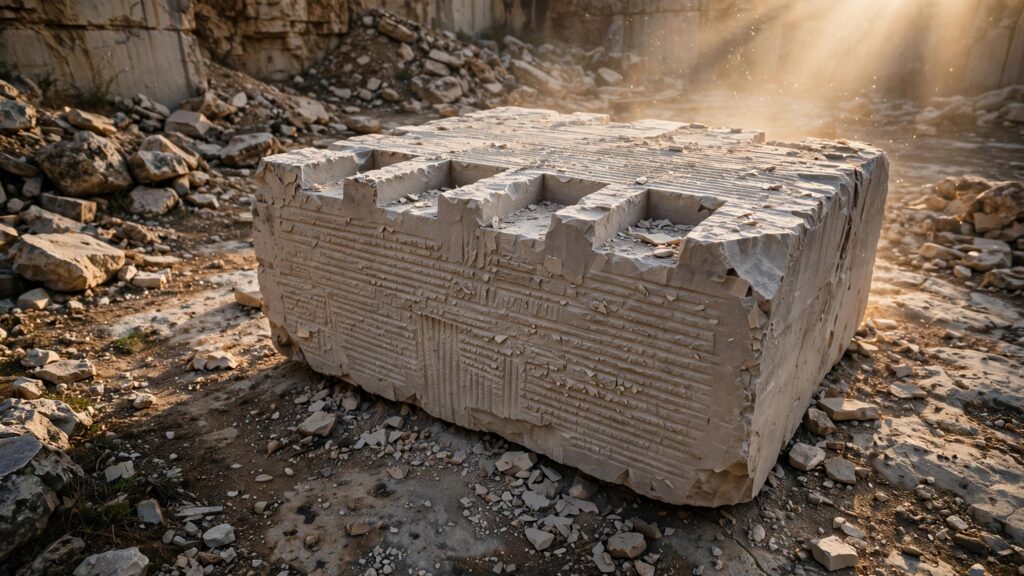
The quarrying itself is the part of this story that’s actually well understood, and it’s worth being clear about that before getting to the parts that aren’t. Archaeologists reading the tool marks preserved on the quarry floor and on the unfinished faces of the abandoned stones have reconstructed the method with reasonable confidence: workers cut narrow channels around the intended block using iron picks and chisels, drove wooden wedges into those channels, and soaked the wedges with water. As the wood absorbed water and expanded, it exerted enough force along the channel to fracture the limestone in a controlled line, freeing the block from the surrounding bedrock. This was standard Roman quarrying practice, documented at smaller scale at quarry sites across the empire, and at Baalbek it required nothing qualitatively different from ordinary Roman stoneworking, only more of it: more channels, more wedges, more patience, more workers standing in the same place for longer. The 2014 discovery of the fully-cut, still-abandoned monolith actually reinforces this reading rather than undermining it. Its surfaces show exactly the tool marks this technique would leave, at exactly the scale the site’s other quarried stones show, cut free and simply never moved, for reasons no one has recovered: a change in imperial priorities, a recognition partway through that the block was too large even for Roman ambition, or something the historical record simply didn’t preserve.
What Actually Remains Unresolved
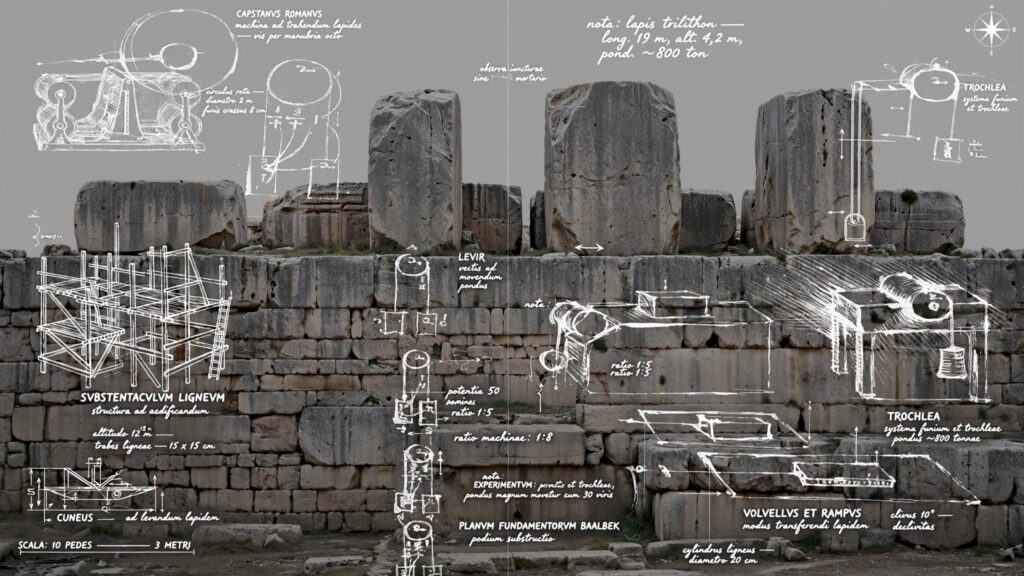
Getting the stone out of the ground is documented. Getting it from the quarry to the temple, and then seven meters up a wall, into a millimeter-precise fit alongside its neighbors, is where the confident explanations thin out considerably. Several methods have been proposed, and none has been experimentally validated at the actual scale Baalbek required. Massive earthen or timber ramps, built up gradually as the stone was hauled and levered upward, are structurally plausible and have real precedent in ancient construction, but no physical trace of such a ramp survives at Baalbek to confirm it was actually used there. Capstan and windlass systems, essentially large geared winches operated by dozens or hundreds of men walking in circles to generate mechanical advantage, are known Roman technology and appear in Roman engineering texts, but scaling that approach to an 800-tonne load pushes the documented examples considerably further than anything else Roman engineers are known to have attempted. Sledges running on lubricated timber tracks, sometimes proposed alongside log rollers, could plausibly have handled the horizontal transport from quarry to temple site, a distance of roughly 800 meters, but the final vertical lift of seven meters and the precision of the final placement remain the parts no single proposed method fully accounts for. Contemporary Roman-era engineering writers, including Vitruvius, describe cranes and lifting devices used in ordinary Roman construction, but nothing in the surviving literature describes machinery built for a load anywhere near this scale. The honest state of the evidence is that Roman engineers plainly succeeded, since the stones are sitting exactly where they intended them, fitted with a precision that still impresses modern masons. What’s missing isn’t proof it happened. It’s a specific, physically verified account of exactly how.

The dating itself carries its own layer of real complexity, separate from the lifting question. The visible Roman temple complex is confidently dated to the early Imperial period, construction beginning under Augustus around 27 BCE and continuing for roughly two centuries into the Antonine dynasty, based on architectural style, construction technique, and stratigraphic context that archaeologists consider solid. But research led by Daniel Lohmann of the German Archaeological Institute has proposed that the massive platform itself, including the section incorporating the Trilithon, may represent an unfinished pre-Roman sanctuary from the Hellenistic period or earlier, later absorbed and built upon once Roman construction began. This isn’t a claim that non-human or vastly more ancient builders were involved. It’s a legitimate, actively studied archaeological question about whether the platform’s earliest phase predates the Romans who get conventional credit for the whole complex, and it remains an active, evolving area of research rather than a settled footnote.
Twain, and the Long History of Being Impressed
Baalbek has been stopping travelers in their tracks for a very long time. Mark Twain visited in the 1860s and wrote about the ruins with the kind of reverence he rarely extended to tourist sites, describing his party’s eyes falling upon “the walls and columns of Baalbec, a noble ruin whose history is a sealed book.” That’s worth sitting with: even in Twain’s era, decades before anyone had systematically excavated the quarry or measured the stones with modern precision instruments, the site already read as something whose full story hadn’t been recovered. That impression has held up remarkably well against a century and a half of subsequent archaeology. The quarrying is now understood. The transport and lifting, in specific physical detail, still isn’t.
The Serapeum, and Why This Isn’t an Isolated Puzzle
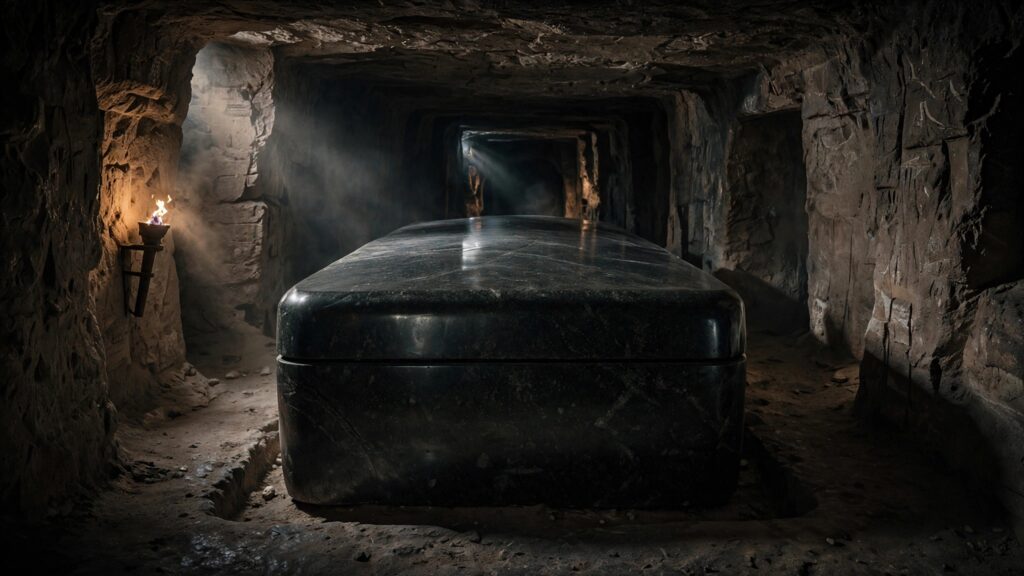
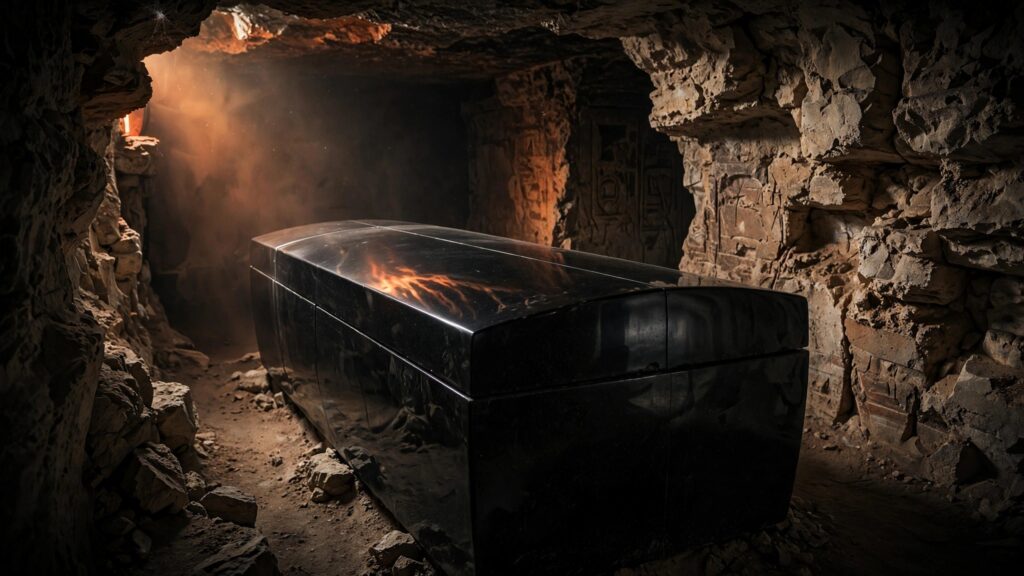
Baalbek isn’t alone in posing this particular kind of question, and it’s worth knowing its nearest true cousin. In the underground galleries of the Serapeum at Saqqara in Egypt, discovered by French Egyptologist Auguste Mariette in 1850, sit twenty-four granite and diorite boxes, each weighing between 70 and 100 tonnes, their lids alone running to 30 tonnes. The stone was quarried at Aswan, roughly 800 kilometers from Saqqara, meaning it traveled the length of a small country, likely by Nile barge, before being maneuvered through narrow limestone tunnels and set into place with a precision engineers who’ve measured the boxes directly describe as comparable to modern granite surface plates, flat and square to tolerances measured in thousandths of an inch. Conventional Egyptology holds the boxes were built as sarcophagi for the sacred Apis bulls, though no bull remains were ever recovered from any of them, a real gap in the standard explanation that Egyptologists and independent researchers continue to debate. What Baalbek and the Serapeum share isn’t a common builder or a shared secret. It’s the same underlying, legitimate engineering puzzle: pre-industrial societies, using tools archaeologists can identify and technique archaeologists can partially reconstruct, achieving scale and precision that still requires genuine caution to explain fully, even now, even with the benefit of everything modern engineering knows that they didn’t.
What’s Actually Remarkable Here
Baalbek doesn’t need an inflated claim about modern cranes to be worth taking seriously. It needs the opposite: an honest accounting of what’s actually settled and what isn’t. The quarrying method is documented down to the tool marks. The 800-tonne weight is measured, not estimated from myth. The Roman attribution for the visible temple is solid, even as active, ongoing research keeps the platform’s deeper history open. And the specific mechanics of how those three stones traveled 800 meters, climbed seven meters, and settled into a fit too precise for a knife blade, using nothing but Roman-era tools and Roman-era engineering, remains the one piece nobody has fully recovered. That’s not a gap conspiracy needs to fill. It’s a gap actual archaeology is still working on, stone by stone, tool mark by tool mark, at a quarry where the evidence is still sitting exactly where the builders left it two thousand years ago.