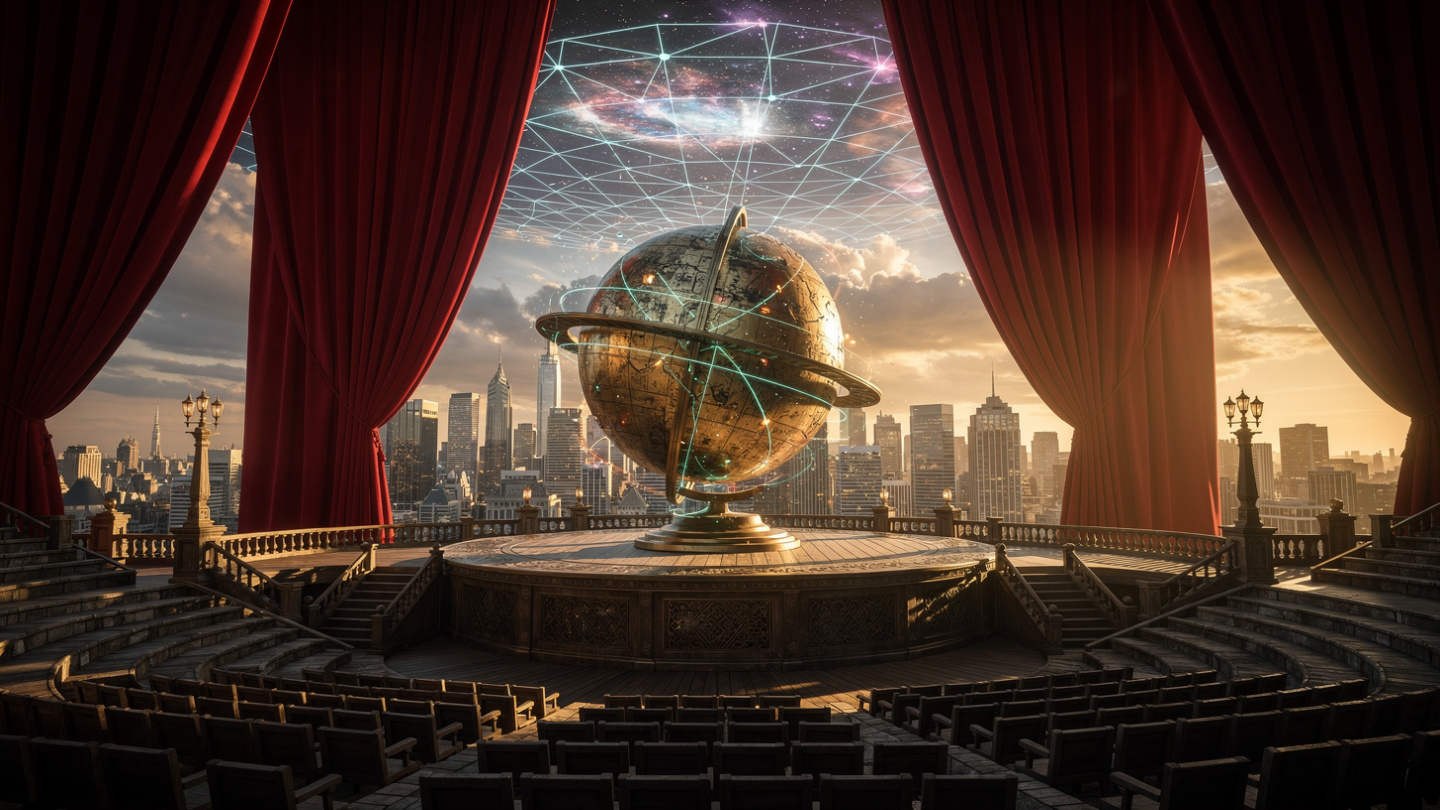
William Shakespeare really did compare the world to a stage in As You Like It, and London’s Globe Theatre really did open in 1599. Renaissance Europe also embraced elaborate court ritual, symbolic theater, and political pageantry. What the historical record doesn’t support is the claim that these events formed part of a coordinated planetary control program.
The genuine history of Renaissance theater, royal ceremony, and political symbolism is fascinating enough on its own, and considerably more complex than the conspiracy built around it.

“All the World’s a Stage” Was Always a Metaphor
The line appears in As You Like It, spoken by the character Jaques, part of a well-known monologue describing the seven ages of man, infancy through old age, each compared to a role an actor moves through. Shakespeare was drawing on a genuinely old literary tradition, the theatrum mundi, “theater of the world,” a metaphor for human life used by writers going back to classical antiquity, well before Shakespeare picked it up. It was a poetic device for discussing mortality and the stages of a life, not a coded confession about a hidden control system. Renaissance audiences understood it exactly that way, as a striking, memorable image about the human condition.

What Actually Happened to the Globe Theatre
The documented timeline deserves precision, since the actual cause of each event is mundane and well recorded. The Globe opened in 1599, built by Shakespeare’s own company, the Lord Chamberlain’s Men. On June 29, 1613, during a performance of Henry VIII, a theatrical cannon fired to announce the king’s arrival misfired, igniting the thatched roof. The building burned to the ground within an hour, with only one recorded injury, a man whose burning trousers were extinguished with a bottle of ale. The company rebuilt it within a year with a tiled roof, and it operated until Puritan authorities closed all London theaters in 1642, with the structure demolished by 1645 to make way for housing. Its foundations were rediscovered in 1989, leading actor Sam Wanamaker’s decades-long campaign to reconstruct it, finally opening in 1997. No historian studying this well-documented sequence has connected it to Romanov political timing. The dates are coincidental, and the actual cause of the 1613 fire, a misfired prop cannon, is one of the better-documented accidents in theater history.

The Romanov Timeline, Without the Numerology
Russia’s early seventeenth century has its own, entirely separate documented history. The country endured the Time of Troubles, a genuine period of famine, civil war, and foreign intervention following the end of the Rurik dynasty. Mikhail Romanov was elected tsar in 1613 by a national assembly seeking to end that instability, founding a dynasty that would rule Russia for three centuries. That election and London’s theater fire happened in the same calendar year for the same reason any two unrelated historical events sometimes share a year, coincidence, not a documented “energetic contract” between them. Russian and English history in this period are extensively studied separately, by different historians, working from entirely different archives, and neither field has found a connection.
Martin Behaim’s Actual Globe
The Erdapfel deserves accurate description on its own terms. Martin Behaim, a German merchant and navigator, created the object in Nuremberg around 1492, the oldest surviving terrestrial globe in the world. It reflects the geographic knowledge available in Europe at that exact moment, notably completed before news of Columbus’s voyage had reached Nuremberg, meaning it depicts a world without the Americas at all. That’s a documented historical snapshot of pre-Columbian European geography, valuable to historians of cartography precisely because of what it doesn’t yet show, not a symbol of psychological enclosure.

Renaissance Rulers Genuinely Staged Power
This is where the genuine history becomes worth exploring on its own terms. Renaissance and early modern monarchs genuinely did use elaborate, deliberate theatrical staging: royal entries into cities, coronations, military triumphs, and court masques were meticulously choreographed to project authority, documented political tools historians of the period study directly. That’s not evidence of a hidden species managing humanity. It’s documented statecraft, rulers across many cultures and centuries understanding that visible ceremony reinforces legitimacy, a continuously studied feature of political history.
Where “Blue Blood” Actually Comes From
The etymology deserves direct, documented correction. The phrase traces to the Spanish sangre azul, referencing the pale skin of certain Castilian noble families, through which blue veins were visibly prominent, distinguishing them, in their own era’s terms, from those with darker complexions. It’s a documented, if socially loaded, historical idiom about visible skin and veins, not a description of copper-based physiology. No documented biology, ancient or modern, supports blue or copper-based blood in any human population. Human blood’s red color comes from iron-based hemoglobin, well-established chemistry with no exceptions found in any studied human lineage.
Why Humans Are Built to Find These Patterns
The psychology behind the numerology deserves its own honest explanation. Apophenia, the tendency to perceive meaningful connections between unrelated events, is a well-documented cognitive trait, closely related to the pattern-recognition instincts discussed elsewhere on this site. Carl Jung’s concept of synchronicity proposed that meaningful coincidences might reflect something beyond pure chance, an influential idea in twentieth-century psychology, though one mainstream science treats as a description of a human meaning-making tendency rather than a physical force linking events. Dates like 1599, 1613, 1642, and 1645 feel connected because human minds are specifically built to notice and weight patterns, a documented feature of cognition, not because the dates themselves carry hidden intent.

Why “Life as Theater” Still Resonates Today
This is where the underlying observation becomes genuinely rich intellectual territory rather than conspiracy. Sociologist Erving Goffman’s 1956 book The Presentation of Self in Everyday Life argued directly that everyday social life functions through performance, people managing impressions the way actors manage a role, foundational sociology still taught today. Philosopher Guy Debord’s 1967 The Society of the Spectacle argued that modern life increasingly replaces authentic experience with mediated image and performance, an influential critique of media culture. Media theorists Neil Postman and Marshall McLuhan separately examined how television and mass communication reshape public discourse into something closer to entertainment than substantive debate. That’s a genuine, rich body of scholarship explaining why politics increasingly feels like performance, without requiring a hidden species directing the script.
Where Metaphor Ends and Speculation Begins
Life as theater is genuine philosophy, genuine literature, and genuine sociology, a metaphor with genuine explanatory power stretching from Shakespeare through Goffman and Debord to contemporary media criticism. The leap from that metaphor to a literal planetary prison simulation, run by a hidden non-human hierarchy, is speculation, a different kind of claim entirely, unsupported by the documented history it’s built on top of. Readers can weigh that leap for themselves, but it’s worth naming clearly as a leap rather than a conclusion the historical record itself supports. The Globe Theatre, the Erdapfel, and the Romanov election are each fascinating on their own accurate, documented terms. None of them needed a hidden script to already be worth knowing precisely.
The 1613 Globe fire is the only verified event in this entire chain, not a coded signal in a hidden script.