



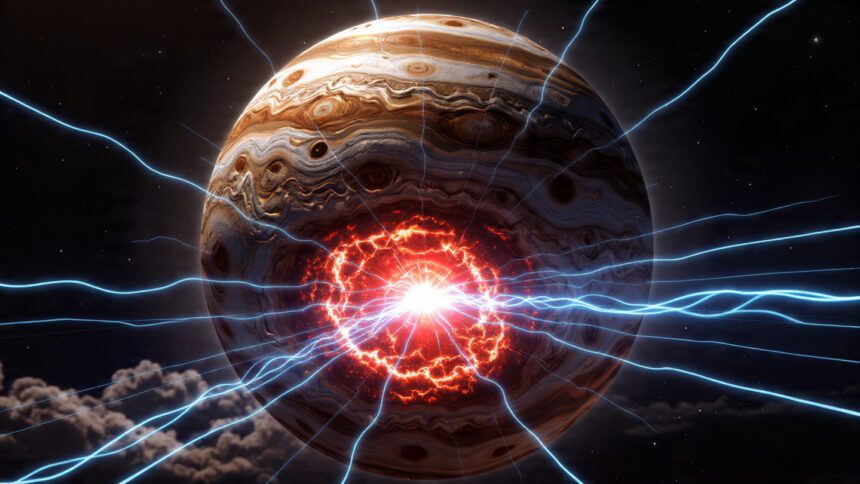
Jupiter becoming a second sun is not a new scientific proposal. It is one of Arthur C. Clarke’s most famous pieces of speculative fiction. In 2010: Odyssey Two, published in 1982, proliferating alien monoliths transform Jupiter into a small star that humanity names Lucifer. The physics vocabulary sometimes attached to modern versions of that idea is real — fusion, magnetic confinement, magnetohydrodynamics, plasma instability — but none of it solves the central problem. Jupiter simply does not contain enough mass to sustain the hydrogen fusion that defines a star. To cross that threshold, it would need roughly 75–80 times its present mass. That is not a software problem, a control problem, or a governance problem. It is a mass problem.
And that distinction is what makes the story interesting. Clarke was not writing nonsense because he imagined Jupiter becoming a star. He was writing science fiction, and the fictional technology was allowed to do something known physics does not provide an engineering pathway to do. Modern retellings can borrow every impressive term in the fusion lexicon and still never cross the one number that matters. Once that number is put back into the story, the boundary between serious physics and stellar fantasy becomes remarkably clear.

The “Lucifer” Idea Belongs to Clarke
The literary trail is unusually easy to follow. Clarke’s 2010: Odyssey Two appeared in 1982, and its climax turns Jupiter into a new star called Lucifer. The monoliths multiply inside the Jovian system and alter the planet until stellar ignition occurs, creating a second sun whose light changes the environment of the moons and becomes a defining event in the later Odyssey books. The mechanism is deliberately beyond contemporary engineering: Clarke does not offer a laboratory design that humanity could reproduce with magnets, computers, or a sufficiently clever reactor. The monoliths are artifacts of an extraterrestrial intelligence capable of manipulating matter on a scale far outside anything human technology can presently approach. That is precisely where the fiction is doing its job. Clarke gives the reader the consequence — Jupiter becomes a sun — without pretending that terrestrial engineering has solved the underlying astrophysics.
Clarke himself deserves a little more precision than the usual shorthand gives him. He studied mathematics and physics at King’s College London and worked during the Second World War in the Royal Air Force, including radar-related work, before becoming a full-time author. In 1945 he famously published the technical concept of using geostationary satellites for global communications, decades before such systems became commonplace. He was therefore no stranger to real engineering constraints. But he was a science-fiction writer, not a physicist running an experimental stellar-engineering program, and 2010 should be read in that spirit: as a technically informed imaginative construction, not as a suppressed engineering blueprint.

The Number That Changes Everything
For a normal hydrogen-burning star, gravity has to compress the core until temperatures and pressures become sufficient for sustained nuclear fusion. The relevant threshold is not infinitely precise because it depends somewhat on composition and the physical model, but the familiar figure is about 75–80 Jupiter masses for the onset of sustained hydrogen burning. Jupiter contains exactly one Jupiter mass. In other words, the planet is not a little below the stellar threshold. It is short by roughly two orders of magnitude in mass. Astronomy references commonly describe Jupiter as requiring about 80 times its current mass to become a hydrogen-burning star.
There is an even more revealing lower threshold. Objects with roughly 13 Jupiter masses can begin burning deuterium under suitable conditions, which is why that figure is commonly used around the lower boundary of the brown-dwarf regime. But deuterium burning is not what powers an ordinary main-sequence star like the Sun. Jupiter would need roughly thirteen times its mass merely to enter that very different regime, and something closer to eighty times its mass to sustain ordinary hydrogen fusion. NASA describes brown dwarfs as objects generally between about 13 and 80 Jupiter masses, with enough mass for deuterium fusion but not enough to ignite sustained hydrogen fusion.
That is why the phrase “just squeeze Jupiter harder” fails. Compression can raise density and temperature, but compression does not create additional material. You can change the arrangement of Jupiter’s existing mass, you cannot make one Jupiter mass gravitationally behave as though it were eighty without introducing an additional source of mass or invoking physics beyond the ordinary stellar model. The central obstacle is therefore not whether the plasma can be controlled elegantly enough. It is whether there is enough matter there in the first place.
The Fusion Terms Are Real
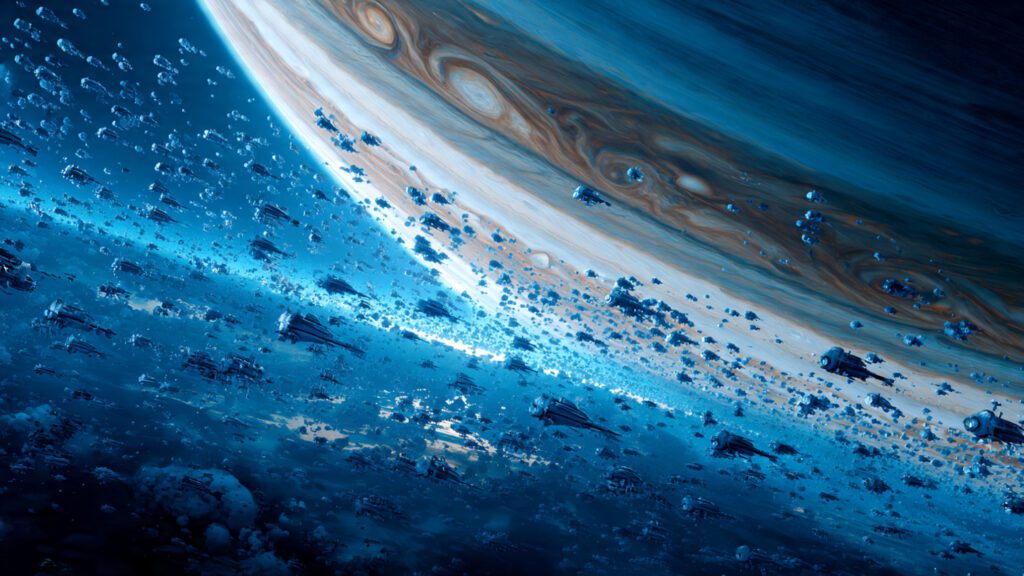
This is where the modern version of the story becomes rhetorically convincing, because the terminology is genuine. The Lawson criterion is a foundational concept in fusion research, relating the plasma temperature, particle density, and confinement time needed for fusion conditions. Modern fusion experiments still use the related fusion triple product as a central measure of progress. ITER describes those three quantities — temperature, density, and confinement time — as fundamental conditions for achieving useful fusion in the laboratory.
The Coulomb barrier is real too: positively charged atomic nuclei electrically repel one another, so fusion requires them to approach closely enough for the strong nuclear interaction to dominate. Magnetohydrodynamics is real physics concerned with the behavior of electrically conducting fluids and plasmas in magnetic fields. Rayleigh-Taylor instabilities are real fluid-dynamic instabilities that appear in astrophysical and laboratory environments, including fusion research. None of these terms is pseudoscience. The problem comes when legitimate concepts are assembled into a sentence that quietly assumes they solve a completely different problem. A fusion reactor can manipulate temperature, density, and confinement. It does not thereby acquire the mass of a star.

Why a Fusion Reactor Is Not a Miniature Star
The comparison between terrestrial fusion and stellar fusion is useful only up to a point. A laboratory reactor attempts to create a controlled plasma in an engineered chamber and confine it long enough for fusion reactions to release useful energy. A star does almost the opposite: its enormous mass generates the gravitational pressure that confines its core. The star does not need a magnetic bottle wrapped around its interior because its own gravity provides the confinement. That difference is fundamental. When a proposed “Jupiter star” scenario invokes magnetic fields, plasma control, distributed computation, or sophisticated feedback systems, it is borrowing solutions from laboratory fusion and applying them to an object whose defining constraint is gravitational mass.
ITER’s own description of fusion makes the distinction clear: laboratory fusion requires extremely high temperature, sufficient particle density, and sufficient confinement time. These are engineering variables. The stellar threshold is an astrophysical consequence of whether an object contains enough mass for gravitational compression to create the necessary core conditions. A spectacular control system could make a plasma easier to manipulate. It cannot turn one Jupiter mass into eighty Jupiter masses.
Jupiter Is Not Really a “Failed Star”
The phrase “failed star” sounds scientific because brown dwarfs really are often described that way. But applying it casually to Jupiter obscures an important distinction. Brown dwarfs occupy a mass regime above planets and below hydrogen-burning stars, and some can form through processes resembling stellar formation. Jupiter, by contrast, is generally understood as a planet formed within the disk surrounding the young Sun. Alan Boss has emphasized that calling Jupiter a failed star is misleading because planets and stars follow different formation histories, even though the boundary between planets and brown dwarfs becomes complicated at the extremes.

That distinction matters because Jupiter did not begin life as a star that simply ran out of fuel or stopped growing at the last moment. It formed in the Solar System’s protoplanetary environment. Stars form through gravitational collapse of gas clouds, giant planets can form through core accretion and other processes operating inside a young planetary disk. There are legitimate debates about the relative importance of different planet-formation mechanisms in different systems, but none of them turns Jupiter into an aborted star. Jupiter is a gas giant because that is what its formation history produced.
But Someone Really Did Propose “Stellifying” Jupiter

This is where the story gets more interesting rather than less. Clarke was not the only person to explore the idea. In 1989, Martyn J. Fogg published Stellifying Jupiter: A First Step to Terraforming the Galilean Satellites in the Journal of the British Interplanetary Society. Fogg proposed an extraordinarily speculative mechanism involving a primordial black hole placed inside Jupiter. The black hole would accrete material and release energy, potentially warming the Galilean moons over astronomical timescales. The paper itself made the assumptions explicit: the scenario depended on the existence of primordial black holes and on sufficiently efficient conversion of accreted mass into usable energy.
That proposal is important precisely because it demonstrates the difference between saying “this has never been imagined by serious scientists” and saying “this is not an established engineering capability.” The first statement would be false. The second is the scientifically relevant one. Speculative astrophysics has explored ways of making Jupiter behave more like a stellar energy source, that does not mean humanity possesses the technology, materials, objects, or energy infrastructure required to carry them out.
The Mass Problem Does Not Disappear Inside a Better Model
This is the point at which elaborate proposals can become misleading without containing a single obviously false physics term. A model can correctly discuss plasma instability, magnetic fields, density gradients, feedback loops, confinement, energy transport, and even stellar ignition while quietly leaving its most important input unspecified: where the additional mass comes from. That omission is decisive. If the mechanism merely compresses Jupiter’s existing material, it has not supplied the missing mass required for sustained hydrogen burning. If it adds material from elsewhere, then the problem has changed into a gigantic Solar System-scale mass-transport problem, and that additional process has to be physically specified and energetically accounted for.
There is no known engineering method that allows an existing Jupiter-mass planet to cross the hydrogen-burning threshold simply by optimizing its internal control architecture. The threshold is not a bureaucratic rule imposed by astrophysicists. It emerges from the physics of self-gravitating objects. NASA’s descriptions of brown dwarfs place the transition into sustained hydrogen fusion at roughly the upper end of the brown-dwarf mass range, around 75–80 Jupiter masses.

The Real Boundary Between Physics and Fiction
The mistake is not imagining Jupiter as a star. The mistake is confusing the language used to describe a physical system with a demonstration that the system can actually be built. Lawson criteria are real. Coulomb repulsion is real. Magnetohydrodynamics is real. Plasma instabilities are real. Stellar structure is real. Jupiter is real. Clarke’s Lucifer is real as a piece of science-fiction history. And a speculative paper on stellifying Jupiter is real as a piece of scientific literature. What does not follow from any of those facts is that a sufficiently advanced control system can make Jupiter sustain hydrogen fusion today.
In fact, the genuine science is more satisfying once the boundary is made explicit. Fusion researchers have spent decades improving temperature, density, confinement, plasma stability, and energy gain, the same real engineering discipline behind serious proposals like the engine designed to move the Solar System, another idea that borrows genuine physics vocabulary while staying honest about the engineering gap still separating concept from capability. ITER describes the enormous progress made in fusion performance over the last half-century, while emphasizing that the remaining engineering challenges are substantial. Those achievements are extraordinary precisely because they work within the laws of physics rather than quietly moving the goalposts.
Clarke understood something science fiction has always understood better than bad futurism: sometimes the most important part of an impossible machine is the thing the machine cannot manufacture. His fictional monoliths could transform Jupiter into Lucifer because they belonged to a civilization operating at a scale beyond the story’s human technology. Real engineers do not have that privilege. They have to account for every kilogram, every joule, every instability, every source of energy and every physical constraint. And when the calculation finally comes down to the most basic question — how much mass is actually there — Jupiter gives the same answer it has given for 4.5 billion years.
One Jupiter is not a star waiting for the right software. It is a planet. To make it a star, you need something Jupiter does not have. And no amount of impressive vocabulary can hide the missing mass.
Jupiter cannot become a star, no matter how the physics is dressed up in impressive vocabulary.