


The Michelson-Morley experiment is the standard account of how the ether died.
Albert Michelson and Edward Morley conducted their famous interferometry experiment in Cleveland, Ohio, in July 1887, attempting to detect the motion of the Earth through the luminiferous ether, the medium through which electromagnetic waves were assumed to propagate in the same way that sound waves propagate through air. If the ether was real, the Earth’s orbital motion through it should produce a measurable difference in the speed of light measured in different directions. The experiment found no such difference. The ether, as nineteenth-century physics conceived it, was not there.
The standard account ends here: the Michelson-Morley null result was explained by Einstein’s special relativity in 1905, which dispensed with the ether entirely by making the speed of light constant in all reference frames without requiring a medium. The ether was refuted and abandoned, a Victorian scientific hypothesis that the twentieth century’s cleaner framework made unnecessary.
The standard account is incomplete in a way that the history of physics since 1905 makes increasingly apparent.
This needs a precise technical correction rather than a soft caveat, because the specific reason the ether was rejected is exactly the property that separates it from the quantum vacuum, not a superficial difference of vocabulary. The luminiferous ether was proposed as a medium at rest relative to some absolute, preferred frame of reference, and the entire point of the Michelson-Morley experiment was to detect Earth’s motion through that preferred frame. It found none, and special relativity resolved this by establishing that no such preferred frame exists anywhere in physics: every inertial observer, moving at any constant velocity, measures the same laws of physics and the same speed of light. The quantum vacuum of quantum field theory inherits this property directly. It is Lorentz invariant, meaning it looks identical to every inertial observer regardless of their motion, which is the specific opposite of what a medium with a preferred rest frame would do. This is not a minor technical footnote. It is the exact property whose absence in special relativity, and whose absence in the quantum vacuum, is what makes both compatible with more than a century of subsequent experimental physics in a way the classical ether never was. The quantum vacuum genuinely does have real, measurable energy and real, measurable effects, the Casimir effect and vacuum fluctuations are genuine physics, but calling it “the ether under a different name” overstates the connection by erasing the one property that mattered most in why the ether was rejected in the first place.
What Mendeleev Actually Proposed
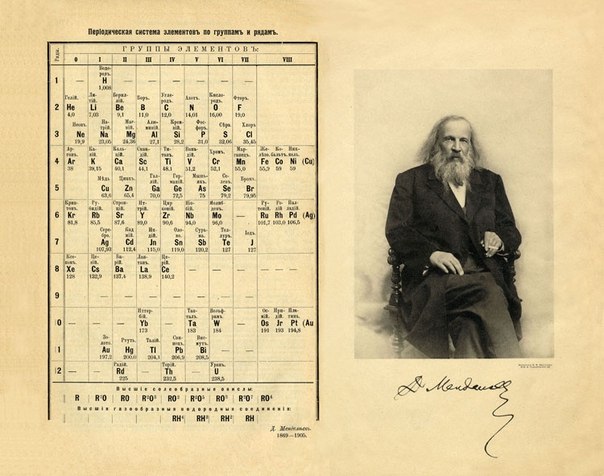
Dmitri Mendeleev’s 1904 paper An Attempt at a Chemical Conception of the Ether, published in Russian and recorded in the history of chemistry literature, proposed a hypothesis about the ether’s chemical nature that distinguished it from the simple mechanical ether of Newtonian physics.
Mendeleev’s proposal was that ether was a genuine chemical element, the lightest possible element, occupying a position before hydrogen in the periodic table in a hypothetical zero group. His reasoning was systematic: the periodic table he had constructed from the known elements in 1869 showed a clear pattern of atomic masses and chemical properties that he extended beyond the known elements. If the pattern was genuine, there should be an element lighter than hydrogen whose chemical inertness placed it in a zero group, analogous to the noble gases that occupied the zero group of heavier elements.
The element he proposed, which he discussed under the designations coronium and later with reference to the spectroscopic observations of the solar corona that suggested an unidentified light element, was not hydrogen. It was hypothetically much lighter, with an atomic mass that Mendeleev estimated at approximately 0.17 atomic mass units, placing it in a completely different mass range from any known element.
Whether this proposed element is the same as what the quantum field theory calls the vacuum or the zero-point energy field is not a question that can be answered by simple assertion. But the property Mendeleev attributed to his ether element, chemical inertness combined with ubiquitous presence, is the combination that the quantum vacuum field exhibits in the modern framework.

The claim that Mendeleev’s original periodic table was deliberately suppressed after his death is the element of the source that requires the most careful handling. What is established: the 1906 eighth edition of Fundamentals of Chemistry was the last edition Mendeleev supervised before his death in February 1907. His ether paper’s hypothetical zero-group element was not incorporated into the subsequent development of the periodic table. Whether this reflects deliberate suppression or the normal process of scientific revision, in which speculative proposals that do not generate experimental confirmation are set aside rather than institutionalized, is a question the available historical record does not clearly resolve.
What is established without controversy is that Mendeleev was nominated for the St. Petersburg Academy of Sciences in 1880 and was rejected by one vote, a result that was considered a national humiliation and was widely attributed to political rather than scientific factors. He was subsequently elected to scientific academies across Europe and received the Davy Medal from the Royal Society in 1882. The rejection by his own country’s premier scientific institution despite universal international recognition is the recorded institutional anomaly in his biography that the suppression narrative builds on without fully establishing.
Tesla and the Radiant Energy Framework
The Tesla piece in this library covers Tesla’s conviction that a universal energy medium, which he called radiant energy and which he identified with the ether of the nineteenth-century physics tradition, was the fundamental substrate through which electromagnetic phenomena propagated and through which wireless energy transmission was possible.
Tesla’s research program, whose most ambitious expression was the Wardenclyffe Tower project, was built on the assumption that the Earth itself was a resonant node in an ether medium and that energy could be transmitted wirelessly through this medium by driving the Earth’s resonant modes. Whether this program was physically viable depends on whether the quantum vacuum, which modern physics acknowledges as a real medium with measurable effects, can be driven in the way Tesla proposed.
The convergence of Mendeleev’s chemical ether element and Tesla’s radiant energy medium in the same period, 1890 to 1910, is the historical pattern that the suppression narrative treats as evidence of coordinated institutional resistance. Whether the two researchers were proposing the same underlying physical reality under different disciplinary vocabularies, or whether their proposals were genuinely different and both happened to be set aside by the twentieth century’s theoretical revolution, is the question that the quantum vacuum’s established properties can now help address.
The Quantum Vacuum and What It Actually Is
The quantum vacuum is not empty space. This is not a mystical or alternative claim. It is the established content of quantum field theory, whose predictions have been confirmed to greater precision than any other theory in the history of physics.
In quantum field theory, every point in space is permeated by quantum fields whose lowest energy state, the vacuum state, is not zero energy but a non-zero energy called the zero-point energy. This zero-point energy is not theoretical speculation: it produces the Casimir effect, a measurable attractive force between closely spaced conducting plates that has been experimentally confirmed to the precision of the theoretical prediction.
The Casimir effect was first predicted by Hendrik Casimir in 1948 and experimentally confirmed with high precision by Steven Lamoreaux at the University of Washington in 1997. The mechanism is well established: the quantum vacuum’s energy density is reduced in the space between closely spaced conducting plates because certain modes of the vacuum field cannot exist in the gap, producing a net inward pressure from the unreduced vacuum outside. The force is measurable, it agrees with the theoretical prediction, and it cannot exist if the quantum vacuum is simply empty space.
The cosmological constant problem, described in the peer-reviewed physics literature as the largest discrepancy between theory and observation in all of physics, involves the quantum vacuum’s energy density directly. Quantum field theory’s calculation of the vacuum energy density produces a value approximately 120 orders of magnitude larger than the observed cosmological constant, which is constrained by cosmological observations to a small but non-zero value. Whether this discrepancy reflects a fundamental error in the theoretical framework, a cancellation mechanism that quantum field theory has not yet identified, or something about the relationship between the quantum vacuum and the geometry of spacetime that neither quantum mechanics nor general relativity has yet captured, is the most profound open problem in theoretical physics.

The nineteenth-century ether was proposed as a ubiquitous medium permeating all of space and transmitting electromagnetic energy. The quantum vacuum is also ubiquitous and does have real, measurable energy. But given the Lorentz invariance distinction established above, these are best understood as genuinely different physical proposals that happen to share some surface-level descriptive language, rather than the same reality under two names. Mendeleev and Tesla were reasoning toward something real in sensing that empty space is not truly empty, and quantum field theory later vindicated that instinct in its own way, without vindicating the specific mechanical, preferred-frame ether they were describing.
The Suppression Question
The source’s claim that Mendeleev’s periodic table was deliberately falsified after his death requires the most careful handling in this library’s framework, where the distinction between well established institutional resistance to inconvenient research and undocumented conspiracy claims is consistently maintained.
What is established: the development of the periodic table from Mendeleev’s 1869 original through to the modern form reflects the incorporation of the noble gases as a new group, the discovery of isotopes that complicated the mass-based ordering, and the quantum mechanical explanation that resolved the table’s theoretical basis. These changes were driven by well documented experimental discoveries and theoretical developments rather than by ideological opposition to elements.

What is also well established: the early twentieth century’s adoption of the special relativistic framework explicitly dispensed with the ether, and this dispensal was not simply a theoretical revision but a rhetorical one that positioned ether theory as a definitively refuted Victorian hypothesis rather than as a first approximation to the correct theory. Whether this rhetorical positioning was accurate, or whether it was partly driven by the institutional desire to establish a clean narrative of theoretical progress rather than acknowledge the continuity between the ether tradition and the quantum vacuum, is a question that the history of physics literature has examined in several academic treatments.
The institutional treatment of Tesla’s free energy and wireless transmission work, recorded in the Tesla piece in this library, shows a pattern of research termination and patent resistance that goes beyond the normal scientific process of setting aside unconfirmed proposals. Whether this pattern reflects deliberate suppression of genuinely viable technology or simply the investment decisions of financiers who correctly identified that wireless electricity transmission was less commercially viable than wired transmission, is a question whose answer determines whether the suppression narrative is accurate or is itself a narrative error.
What the Convergence Implies
The convergence of Mendeleev’s chemical ether element, Tesla’s radiant energy medium, the zero-point energy field of quantum field theory, and the cosmological constant problem’s unresolved vacuum energy discrepancy, all pointing at the same physical reality from different theoretical directions and different historical periods, is the pattern that this piece has been building toward.
The Victorian ether, specifically the mechanical medium with a preferred rest frame that Michelson-Morley tested for, was genuinely refuted, and this piece should say so plainly rather than soften it. What survived and was later vindicated in a different form is the broader intuition that empty space is not truly empty and has real physical structure, which quantum field theory confirms through the zero-point energy field, the Casimir effect, and the unresolved cosmological constant problem, all without requiring or restoring a preferred reference frame.
Mendeleev proposed that ether was the first element, the lightest substance from which all heavier elements were derived through processes he encoded in his periodic table’s structure. Quantum field theory’s description of the vacuum as the ground state from which all particles emerge as excitations of the underlying fields is a strikingly similar intuition, arrived at through an entirely different mathematical language and without the preferred-frame baggage Mendeleev’s proposal carried.
Tesla proposed that the ether could be driven to transmit energy wirelessly through the Earth’s resonant modes. The Schumann resonances, recorded in the Tesla piece, confirm that the Earth’s electromagnetic cavity has exactly the resonant properties Tesla proposed, whether or not his wireless transmission scheme was practically viable.
Whether the institutional resistance that both Mendeleev and Teslan experienced reflected coordinated suppression of ether-based technology whose development threatened commercial interests, the pattern recorded in the Tesla piece’s treatment of J.P. Morgan’s withdrawal of Wardenclyffe Tower funding, or reflected the normal scientific process of setting aside proposals whose experimental confirmation was not forthcoming, is a question whose answer depends on evidence that the available record partially provides and partially withholds.
The mechanical ether was refuted. The intuition that space itself has real physical structure was not, and the quantum vacuum is where that intuition found its actual, technically rigorous form. The Casimir effect proves the vacuum energy is real. The cosmological constant problem proves physics does not yet fully understand what the vacuum is.
Mendeleev put it before hydrogen in his table. Tesla drove it at Colorado Springs. The modern framework measures its effects without fully explaining its nature.
Mendeleev’s specific zero-group element was not correct as he described it. What he and Tesla were both reaching for, real physical structure in what looks like empty space, turned out to be real after all, just not in the mechanical, preferred-frame form either of them imagined.