



There is a peculiar fact about being human that is easy to overlook because it happens so continuously that we rarely notice it happening at all: almost nothing remains, for long, merely an event. A tree falls in a forest. A storm arrives. A child is born. A stranger appears at exactly the moment we were thinking about them. Someone dies. We dream of a person we have not seen for twenty years and wake with the conviction that the dream mattered. A particular song begins playing on the radio after a relationship ends. An ancient story describes a journey, a flood, a descent into darkness or a return from death, and centuries later someone recognizes their own life inside it. The external event may be simple. What consciousness does with it is not.
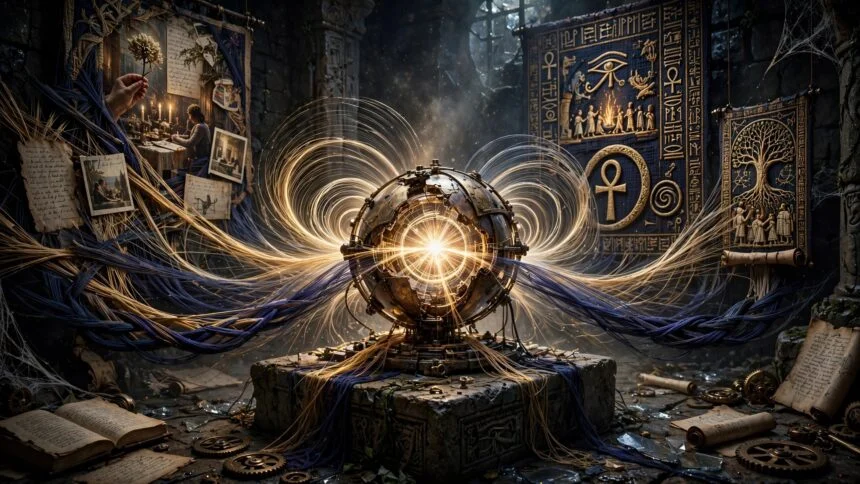
We remember some events and forget others. We connect things that occurred years apart. We assign causes where the evidence is incomplete. We turn accidents into lessons, suffering into narratives, coincidences into signs, landscapes into sacred places and private experiences into myths that can survive long after the person who experienced them is gone. We do not merely inhabit a sequence of events. We construct relationships between them. This is the beginning of meaning, and it creates a problem that sits at the boundary between psychology and philosophy: if consciousness is capable of transforming events into meaning, where does that meaning come from? Is meaning something we create, or something we discover? Does the distinction even make sense?
The question becomes particularly difficult when the experience is powerful enough to feel as though the meaning came from outside us. A dream can feel like a message. A coincidence can feel arranged. A religious experience can feel like contact with something greater than the self. A ritual can transform an ordinary object into something sacred without changing its physical composition. None of this means that the interpretation is objectively true. But neither does it mean that the experience is meaningless. That distinction is the territory of the Meaning Engine.
The Event Is Not the Meaning
Consider two people standing in the same hospital corridor. A doctor walks toward them and says that the operation was successful. The physical event is identical for both. For one person, it is the end of months of terror. For another, it is the beginning of a new obligation to care for someone who will never fully recover. The words are the same, but their significance is radically different because significance does not reside only in the event itself. It arises from the relationship between the event and the person experiencing it. An event can be described from the outside. Meaning describes what that event becomes within a mind, a life, a relationship or a culture.

Psychological research on meaning-making has increasingly distinguished between the meaning people already possess as part of their broader worldview and the meaning they construct in response to particular events. Crystal Park’s influential integrative framework, published in a 2010 Psychological Bulletin review, distinguishes between global meaning and situational meaning, as well as between the effort to make meaning and the meaning that eventually emerges. The distinction matters because humans do not approach experience as blank observers. We bring expectations, values, memories, identities and assumptions with us, which is one reason two people can survive apparently similar events and emerge with completely different understandings of what happened. One sees punishment. Another sees initiation. A third sees random chance. A fourth sees an opportunity. The event has not necessarily changed. The interpretation has.
That does not make the interpretation trivial. Interpretation can determine what a person does next, what they remember, whom they forgive, what they fear, what they worship and what they become. Meaning is therefore not simply decoration placed on top of reality. It can become part of the machinery through which a human being lives.
The Mind Does Not Receive a Finished World
This connects directly to the earlier Foundations. The Reality Filter asked how much of what we call reality is already shaped by perception. The Observer Trap asked whether an observer can ever completely step outside the conditions that shape observation. The Meaning Engine takes the next step: even after perception has delivered an experience, consciousness still has to decide what that experience means. This is one reason perception and meaning should not be collapsed into the same problem. Seeing a dark shape in the distance is perception. Deciding that it is a person, a threat, an omen, a memory trigger or nothing important at all involves interpretation.

The brain is not simply recording the world and storing the recording. It is continuously organizing experience. Modern cognitive science contains several different theories of how this occurs, and they should not be reduced to a single grand explanation, but a common theme is difficult to avoid: perception is deeply dependent upon prior expectations, internal models and the organism’s ongoing attempt to make sense of incoming information. That means the human relationship with the world is never merely passive reception. Something is always being done with what is received, and meaning is one of the things being done.
This helps explain why ambiguity is so psychologically fertile. When information is incomplete, the mind does not necessarily stop. It begins searching for relationships, comparing the present with memory, looking for patterns, asking what happened before, what might happen next and what this event says about the self. The unanswered question becomes an invitation. Sometimes that invitation produces genuine insight. Sometimes it produces mythology. Sometimes it produces both.
Why Humans Tell Stories About Themselves
A human life is not experienced as a database. Nobody normally remembers themselves as a collection of disconnected timestamps. What gets remembered is a childhood, a departure, a betrayal, a relationship, a failure, a discovery, a turning point. Some events become central while others disappear. Certain memories acquire symbolic importance because they appear to explain something about the person a self believes itself to be. Psychologists studying narrative identity describe the self partly in terms of an internalized and evolving life story that integrates reconstructed memories with an imagined future, giving life some degree of unity and purpose. Research on autobiographical memory similarly examines how particular memories become connected to enduring concerns and eventually form broader narrative structures.
This is remarkable when considered carefully. The person called “I” is partly maintained through a story about what has happened to “me,” and that story is continuously revised. A childhood humiliation can become evidence that the world is cruel. Years later, the same event can become the moment that taught someone compassion. A failed career can remain a wound, or become the event that made another life possible. A chance meeting can become an insignificant memory, or the moment at which an entire future appears, in retrospect, to have begun. The past has not changed. Its meaning has.

This does not mean memory is infinitely malleable or that people can simply choose whatever interpretation makes them feel good. Narrative identity is constrained by memory, social context, personality, culture and the actual sequence of events. But within those constraints, human beings continually reorganize experience into patterns that make a life intelligible. The question is never only “What happened?” It is also “What kind of story is this?” That question is extraordinarily powerful. It is also dangerous.
The Difference Between Meaning and Truth
This is where Monkey & Elf needs to be unusually disciplined. Suppose someone experiences a remarkable coincidence. They have been thinking about a deceased parent for several days. They suddenly find an old photograph they had forgotten existed. At the exact moment they discover it, a song associated with that parent begins playing somewhere nearby. The experience may be profound, and the person may reasonably say, “That meant something to me.” But that statement is not equivalent to “My parent caused this event from beyond death.” The first is a statement about experienced meaning. The second is a claim about external causation. Those are different propositions, and the distinction, deceptively simple as it looks, protects an enormous amount of intellectual territory.

A religious experience can be transformative without constituting laboratory evidence for a particular theology. A dream can reveal something psychologically important without proving that the dream originated from another realm. A ritual can produce genuine emotional and social effects without demonstrating that supernatural forces caused those effects. A coincidence can feel uncannily meaningful without establishing that the universe arranged it. And a myth can express profound truths about human existence without being a literal historical report. The mistake is not taking meaning seriously. The mistake is assuming that because something is meaningful, its preferred explanation has therefore been established. Meaning is not proof. That sentence belongs near the center of Monkey & Elf’s intellectual architecture.
Myth Is Meaning That Survived Its Author
Long before humans possessed laboratories, satellites or statistical software, they possessed stories. Those stories were not merely primitive attempts at scientific explanation. Some were explanations of the physical world, certainly, but myths also carried moral structures, social rules, models of human behavior, accounts of suffering, theories of death, explanations of identity and symbolic representations of forces that were otherwise difficult to describe. A flood could be a story about destruction, renewal, divine judgment, collective memory or the fragility of civilization. A descent into the underworld could be a cosmological account, a ritual narrative, a metaphor for psychological transformation or all of these simultaneously. A dying and returning god can be interpreted theologically, historically, psychologically or symbolically without requiring every interpretation to be true at once.
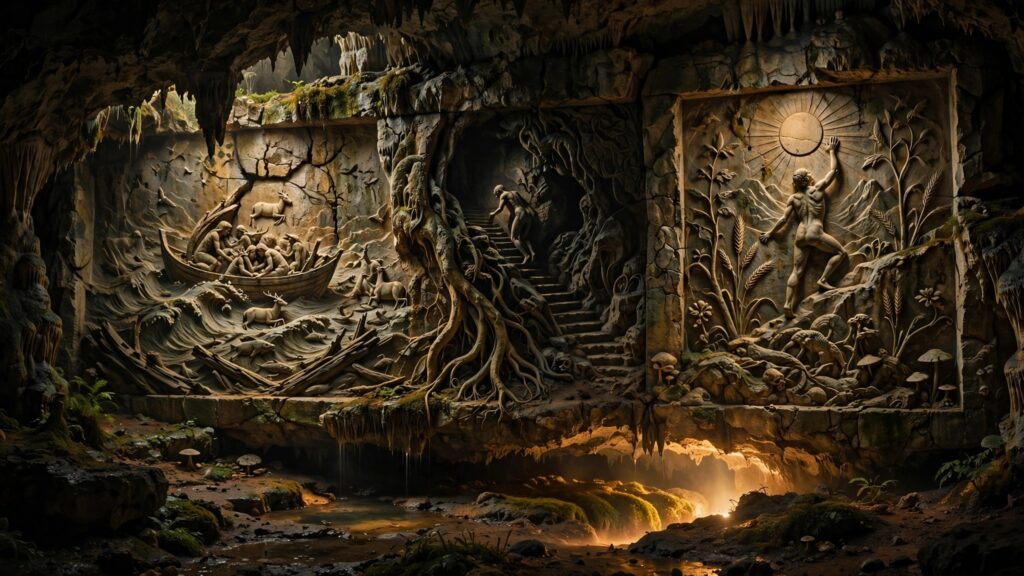
This is one reason mythology remains intellectually interesting even when its literal claims cannot be demonstrated. A myth is not necessarily a failed scientific paper. It can be a technology for carrying meaning across generations. The cognitive science of religion has taken seriously the question of why religious concepts and practices recur so widely, examining how ordinary cognitive processes interact with cultural transmission, religious identity, concepts of supernatural agents and social learning. Importantly, this field does not require the conclusion that religion is either divinely revealed or reducible to a single psychological mechanism, its strength lies partly in allowing several explanatory levels to coexist. That is a useful model for Monkey & Elf. We do not have to choose between “the myth is literally true” and “the myth means nothing.” There is an enormous territory between those positions.
Why Symbols Can Become More Powerful Than Words
A symbol is strange because it can contain more meaning than its physical form would suggest. A circle of light, a serpent, a tree, an eye, a mountain, a labyrinth, a doorway, a particular number, the object itself may be ordinary, but what it represents can be enormous. Symbols allow consciousness to compress complicated structures into forms that can be remembered, shared and emotionally activated, carrying meanings that would require pages of abstract explanation if expressed propositionally. This is why the same symbol can appear in radically different contexts while acquiring different meanings. The serpent can represent danger, sexuality, healing, rebirth, wisdom or evil. Water can represent destruction, cleansing, birth, chaos or transcendence. A mountain can be geographical terrain and simultaneously a meeting place between earth and heaven.

The symbol does not contain a single universal message waiting to be decoded. Its meaning emerges from relationships among culture, memory, emotion, narrative and context, which is precisely why symbolic interpretation can be illuminating and unreliable at the same time. The symbol can genuinely reveal something about the person interpreting it. It does not automatically reveal something about the universe.
The Strange Case of Synchronicity
Few subjects expose the boundary between meaning and proof more clearly than synchronicity. Carl Jung used the term to describe what he regarded as meaningful coincidences that could not simply be understood through ordinary causal explanation. His mature formulation was explicitly concerned with the relationship between coincidence and meaning, developed in dialogue with physicist Wolfgang Pauli, whose collaboration shifted Jung’s own framing of the idea from a mainly phenomenological and empirical description toward a more ontological, archetypal one. The appeal is obvious: sometimes events line up with such psychological precision that calling them “just coincidence” feels inadequate to the person experiencing them.
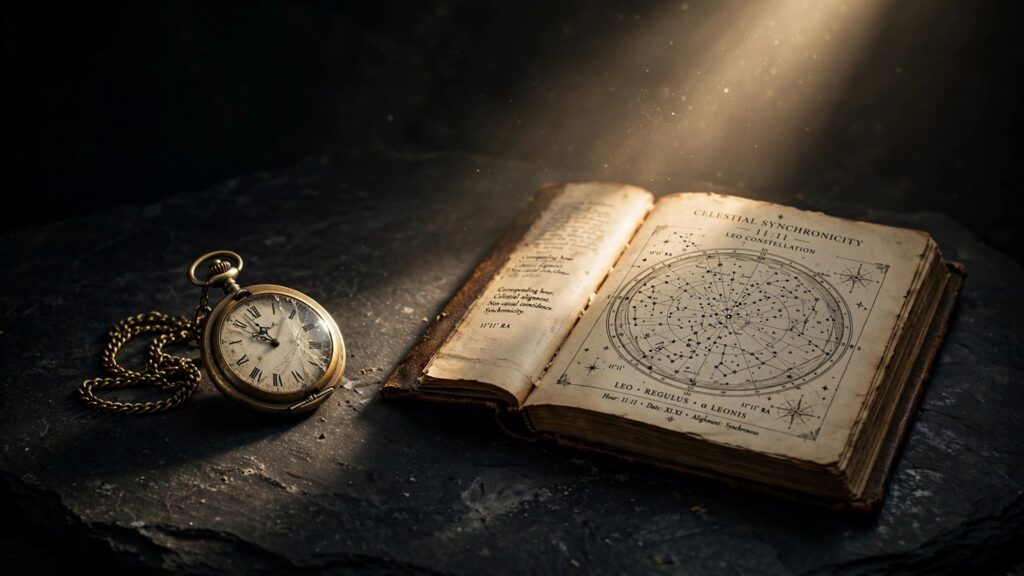
But there are actually two different questions hiding inside that experience. The first is psychological: why does this coincidence feel so meaningful? That question is entirely legitimate and can be investigated scientifically. The second is metaphysical: did something outside ordinary causation arrange the coincidence? That is a much stronger claim, and the first does not establish the second. This distinction is particularly important because human cognition is exceptionally sensitive to patterns, similarities and personally relevant coincidences. We do not encounter all possible events with equal psychological weight. We notice the ones that connect with what we are already thinking about, fearing, hoping for or remembering. That does not prove that every meaningful coincidence is psychologically generated. It establishes something more modest and more useful: the experience of meaning is real even when the external explanation remains unresolved. That is enough to make synchronicity worth studying without prematurely turning it into physics.
Dreams | The Private Mythology of the Mind
Dreams provide another doorway into the Meaning Engine because they demonstrate how readily consciousness transforms fragments into narratives. During sleep, memories, emotions, images and associations can combine into experiences that feel structured even when their construction is anything but deliberate. A person dreams about a house they have never seen. Inside the house is a room they somehow recognize. A dead relative appears. Something is being searched for but never found. The dream ends. What happened? At one level, there was a physiological event involving a sleeping brain. At another, there was an experience. And at a third, there may be meaning.

The temptation is to leap from the third level to a metaphysical conclusion, that the dream must have been a message, a visitation, a glimpse of another reality. But the opposite leap is equally crude: because dreams can be explained in terms of brain activity, they therefore have no significance. A dream can be generated by the brain and still reveal something about the dreamer’s emotional life. The physical mechanism and the subjective meaning are not competing explanations of exactly the same thing. They are explanations at different levels, a recurring principle throughout the Meaning Engine: explaining how an experience occurs does not necessarily exhaust what the experience means to the person who has it.
Ritual Turns Meaning Into Action
Meaning becomes even more powerful when it leaves the mind and enters behavior. A ritual is not simply an idea repeated. It is meaning enacted. Lighting a candle for the dead does not alter the chemical composition of the candle. A wedding ceremony does not physically transform two people into a different species of human being. A funeral does not reverse death. Yet these actions matter. They mark transitions, organize emotion, communicate identity, establish belonging, and tell a community what has happened and what should happen next. Psychological research on ritual identifies several functions, including regulation of emotion, performance states and social connection, while other work emphasizes the role of ritual in identifying group members, coordinating commitment and maintaining cohesion.

This helps explain why rituals survive even when their original cosmological explanations change. The physical action can remain while the interpretation evolves. A person may participate in a ritual because they believe God commanded it. Another may participate because it connects them to their ancestors. Another because it preserves family identity. Another because it creates psychological closure. The same ritual can therefore operate simultaneously at theological, psychological, social and symbolic levels. Again, meaning refuses to fit into a single category.
Religion Does Not Begin With Certainty
Religious traditions are among humanity’s most elaborate meaning systems. They answer questions that empirical science is not designed to answer in the same way: why are we here, what makes a life good, what is sacred, what happens when we die, what obligations do we have to strangers, what does suffering mean, is consciousness reducible to the physical. But religion also demonstrates the danger of confusing the existence of a meaning system with proof of every proposition contained within it. Religious cognition develops within culture, family, language and social transmission, and religious concepts are learned, interpreted and transformed across generations. Yet the fact that a belief has a psychological and cultural history does not settle whether the belief is metaphysically true.

That distinction matters in both directions. A materialist explanation of why humans develop religious concepts does not, by itself, prove that no transcendent reality exists. A person’s transcendent religious experience does not, by itself, prove the complete theological system they use to interpret it. Both conclusions exceed the evidence. The proper question is therefore not “Is religion psychological or supernatural?” It is “Which parts of the phenomenon are we trying to explain, and what kind of evidence would distinguish the possible explanations?” That is a much harder question. It is also a much more interesting one.
Meaning Can Save a Life, and Mislead One
Meaning is not harmless. It can orient a person toward courage, compassion and responsibility. It can also turn coincidence into conspiracy, uncertainty into certainty and ordinary strangers into enemies. The same machinery that allows a person to transform suffering into purpose can transform ambiguity into persecution. The same pattern-recognition that helps a scientist notice a new relationship can help a frightened mind construct a pattern that is not there. The same narrative ability that allows a survivor to make sense of trauma can become rigid enough to make every future event fit the original story.
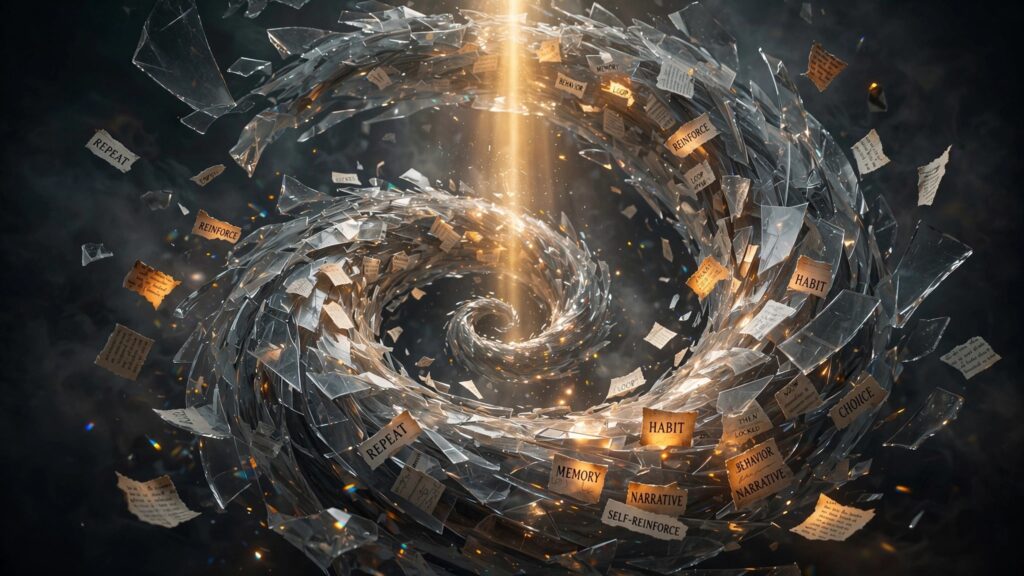
This is where the Meaning Engine connects back to the earlier Foundations. The Whirlpool Principle described self-reinforcing systems, and meaning can feed those systems directly: an interpretation changes behavior, behavior produces consequences, the consequences appear to confirm the interpretation, and the interpretation becomes more entrenched. The person is no longer merely experiencing events. They are experiencing events through a story that determines which events matter. This can happen to individuals, religions, political movements, scientific communities and entire civilizations. Once meaning becomes institutionalized, it can become difficult to distinguish the original observation from the interpretation built around it. That is how a question becomes a doctrine, and eventually, a doctrine can become a reality that people behave as though they have already proven.
The Most Dangerous Word Is “Sign”
Few words carry more seductive power than sign. A strange light becomes a sign. A coincidence becomes a sign. A dream becomes a sign. An ancient inscription becomes a sign. A personal tragedy becomes a sign. Sometimes this interpretation is psychologically useful. But the word can quietly smuggle a conclusion into an observation: something happened, then we say it was a sign, but a sign of what, and how do we know?

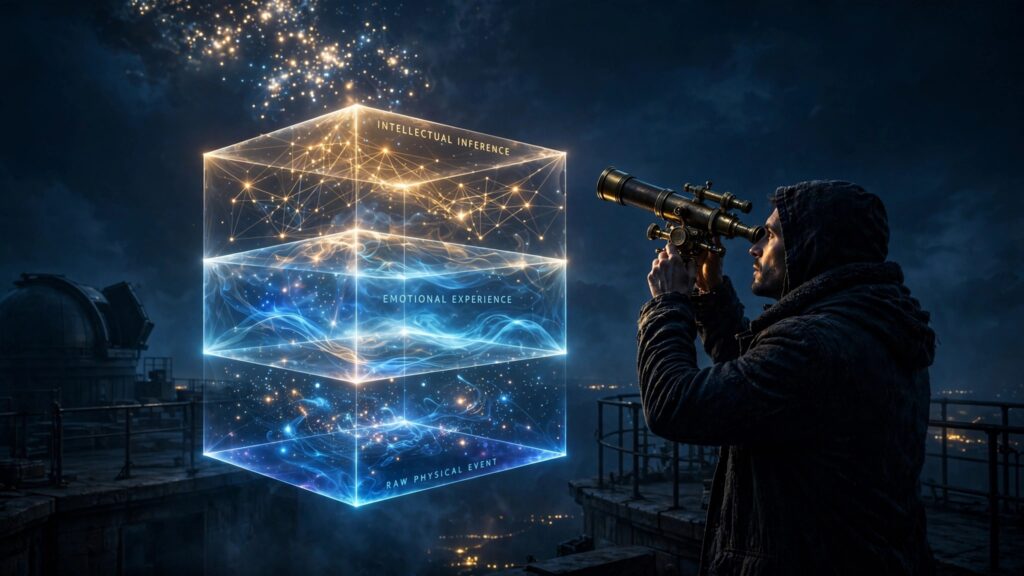
A disciplined investigation must separate three levels, the event, what actually happened, the experience, how it was perceived and felt, and the interpretation, what someone believes the event means. These three can all be real without being equivalent. A person genuinely experienced something extraordinary. That does not mean their explanation is established. Their explanation may eventually prove correct, it may prove partially correct, or it may be completely wrong. The experience itself does not decide the question. This is not skepticism for its own sake. It is respect for the difference between experience and inference.
The Meaning Engine Is Not a Machine for Finding Answers
Perhaps the deepest mistake is to imagine that the purpose of meaning is to eliminate uncertainty. It isn’t. Meaning can coexist with uncertainty. A person can say, “I don’t know why this happened, but it changed me,” and that statement is intellectually stronger than pretending to know. A person can say, “I experienced this as a spiritual event, but I cannot demonstrate its metaphysical cause,” and that is not a weaker spiritual position, it is a more honest one. A person can say, “This coincidence changed the direction of my life, but I don’t know whether it was chance,” and again nothing has been lost. Something has been preserved: the mystery.

This is where Monkey & Elf should resist the temptation that infects both conventional skepticism and alternative speculation, the temptation to convert uncertainty into a conclusion simply because conclusions feel more satisfying. The world does not owe us closure. Consciousness nevertheless keeps searching for it. That tension may be one of the defining characteristics of the human condition.
When Meaning Becomes Knowledge

There is, however, a more difficult possibility. Sometimes an interpretation begins as speculation and eventually becomes knowledge. A scientist sees an unexplained pattern, a hypothesis is proposed, others test it, predictions are generated, evidence accumulates, and the original meaning attached to the observation is gradually transformed into a demonstrable explanation. This is important because the distinction between meaning and proof should not become an excuse for permanent agnosticism. “Meaningful” does not mean “forever unknowable.” It means that the experience of significance and the question of external truth must be evaluated separately. If evidence accumulates, interpretation can become knowledge. If evidence fails to accumulate, the interpretation remains interpretation. That boundary is one of the most important intellectual boundaries on the entire site, and it allows Monkey & Elf to take unusual experiences seriously without surrendering the distinction between a compelling story and a demonstrated fact.

What Meaning Reveals
There is another possibility that is subtler still. Perhaps meaning does not primarily tell us what the universe is. Perhaps it tells us something about the relationship between the universe and the consciousness experiencing it. A mountain does not have to contain a message for a human being to experience standing before it as sacred. A coincidence does not have to be orchestrated for it to change a life. A myth does not have to be literally historical for it to express something profound about fear, death, love or transformation. A dream does not have to originate outside the brain for it to expose a conflict within the person dreaming it. The experience can matter without the metaphysical interpretation being settled.

This is not a retreat from mystery. It is an expansion of what mystery is allowed to mean. The question is no longer simply “Did the universe send me a message?” It becomes “Why is consciousness capable of experiencing an event as a message at all?” That question is stranger and deeper, because it brings us back to consciousness itself.
The Engine Inside the Observer
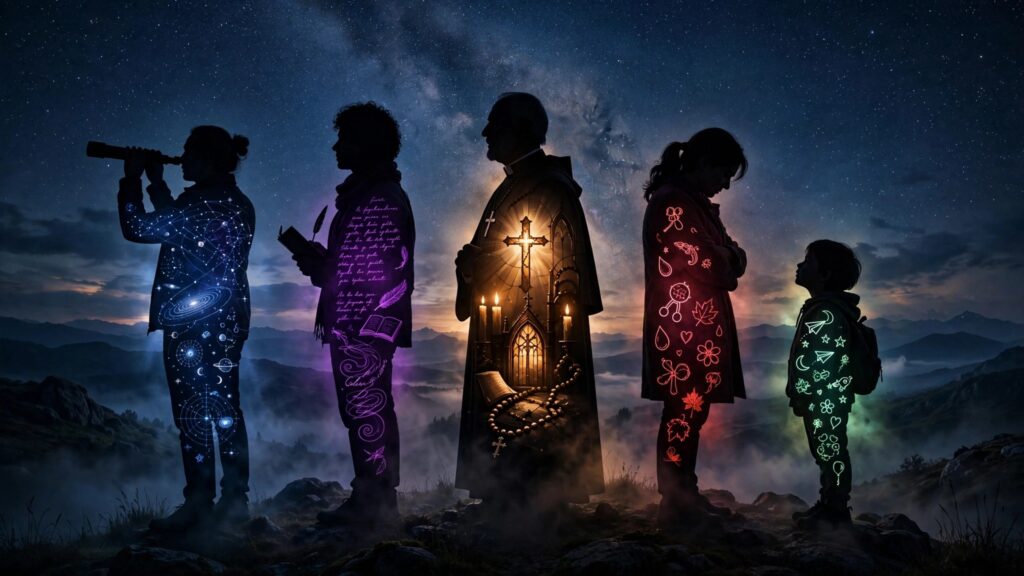
The earlier Foundations asked why the observer cannot simply step outside the conditions through which it observes. The Meaning Engine reveals another limitation: the observer does not merely observe. It interprets, remembers, compares, predicts, narrates, symbolizes, assigns value, and creates relationships between things that would otherwise remain separate moments in time. A human being can look at the same night sky as an astronomer, a priest, a poet, a grieving parent and a child and encounter five radically different worlds without any of them necessarily seeing a physically different sky. The photons may be the same. The meanings are not. This does not mean there are five objective universes. It means that human consciousness inhabits a world in which physical reality and interpreted reality are continuously entangled in experience.
That is why meaning cannot simply be dismissed as an illusion. Meaning changes behavior. Behavior changes relationships. Relationships change societies. Societies build institutions. Institutions reshape the world. A symbol can start inside a mind and eventually alter history. An idea can become a religion. A narrative can become a nation. A myth can become a civilization. A meaning can become a physical force through the actions of the beings who believe it. The Meaning Engine is therefore not merely an internal psychological mechanism. It is one of the ways consciousness becomes consequential.
The Boundary We Must Keep
There is a temptation, when confronted with the extraordinary power of meaning, to make one final leap: if consciousness can create meaning, perhaps consciousness creates reality itself. That possibility deserves philosophical examination. It does not deserve to be smuggled in as a conclusion. The fact that our experienced world is interpreted does not establish that the external world is produced by consciousness. The fact that symbols can change behavior does not establish that thoughts can directly rewrite physical law. The fact that synchronicities feel meaningful does not establish an acausal cosmic mechanism. The fact that religious experience can transform a person does not establish the metaphysics of the religion. The fact that myths recur does not establish a single hidden civilization, extraterrestrial intervention or universal historical event behind them. These possibilities can be explored. They cannot simply be promoted from possibility to fact because the human appetite for meaning is powerful. This is the discipline that separates an investigation from a belief system.

What We Are Actually Allowed to Say
We can say that humans construct meaning, that meaning shapes memory, identity and behavior, and that narrative identity provides people with ways of organizing their lives into stories of continuity and purpose. We can say that rituals regulate emotion, coordinate behavior and strengthen social connection, and that religious concepts and practices emerge through complex interactions between ordinary cognition, culture and social transmission. We can say that humans are unusually sensitive to patterns and coincidences that become personally significant, and that Jung’s concept of synchronicity provides one historically important attempt to describe meaningful coincidence, while its stronger metaphysical implications remain contested. We can say that an experience may be psychologically or spiritually profound without constituting independent evidence for its preferred metaphysical explanation. And we can say something even more important: not knowing what something means does not make the experience meaningless. Sometimes uncertainty is the most honest meaning we can give it.

The Engine Does Not Tell Us What the World Means
It tells us something stranger: that there is a creature capable of asking the question. Something happens. Consciousness notices. It remembers something else. It draws a connection. The connection acquires emotional weight. The event enters a story. The story becomes part of an identity. The identity changes behavior. The behavior changes the world. And then the altered world produces new events from which new meanings are constructed. The process does not have an obvious beginning. It does not have an obvious end. It is an engine.

Perhaps that is why humans have spent so much of their history looking for messages in the sky, patterns in numbers, gods behind storms, ancestors in dreams, destiny inside coincidence and stories inside suffering. The impulse is not an accidental feature of civilization. It is part of what consciousness does when confronted with an existence that does not arrive with its meaning already printed upon it. But here is the boundary that must remain intact: a meaningful event is not automatically a message, a powerful interpretation is not automatically a fact, a recurring symbol is not automatically a universal code, a coincidence is not automatically causation, a myth is not automatically history, and an experience of transcendence is not automatically proof of the metaphysics attached to it.

Yet none of those cautions require us to flatten the experience into nothing. The mystery can remain. The meaning can remain. The question can remain open. That is not intellectual failure. It may be the beginning of intellectual honesty, because perhaps the deepest function of the Meaning Engine is not to manufacture certainty, but to allow a conscious being to live inside uncertainty without becoming indifferent to it. To look at an event and ask what happened. To ask what it meant. To ask why it mattered. And then, before turning that meaning into a claim about reality, to ask one final question: how do we know? That question is the safeguard. It is also the doorway to the next Foundation, because once consciousness has constructed a meaning, and once that meaning has become part of the self, another problem appears. What happens when we discover that even the meanings we believe are ours were shaped by forces we never chose? That is the problem of freedom, and beyond it lies the question of what, if anything, it could mean to become genuinely free.
The Foundations