



The pyramids become power plants. Stonehenge becomes a computer. Nazca becomes an airport. Baalbek becomes a landing platform. An ancient Chinese tomb becomes a transmitter. The monuments never changed. We did. Every generation looks backward at something built by people with radically different tools and asks the same question: How could they possibly have done this?
The answer is usually less exotic and more difficult to accept. They were extremely good at being human. The recurring mystery isn’t why ancient civilizations had technology we have forgotten. It is why civilizations that possess their own astonishing technologies keep assuming that anything impressive from the distant past must have been built with something even more impressive.
And the machine we imagine changes remarkably well with the century.
Every Generation Projects Its Highest Technology Backward
The pattern can be followed almost perfectly through the last century. Engineer Christopher Dunn became convinced, after encountering Peter Tompkins’s 1971 book Secrets of the Great Pyramid, that the monument was not primarily a tomb but a sophisticated machine. His 1998 book The Giza Power Plant proposed that the Great Pyramid had functioned as an acoustic and energy-generating device.
Stonehenge received a different technological upgrade. In 1965, astronomer Gerald Hawkins used a computer to investigate possible astronomical relationships among Stonehenge’s stones and published the results in Stonehenge Decoded. His work helped establish that the monument had genuine astronomical significance, although later scholarship has challenged some of his specific computational interpretations.
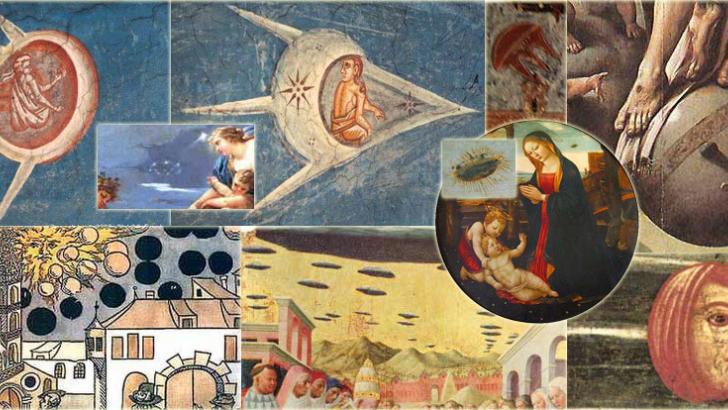
And then there was Erich von Däniken. In Chariots of the Gods?, published in 1968, ancient monuments became something else entirely: evidence of extraterrestrial visitors. Nazca’s enormous ground drawings became possible landing strips. Baalbek’s enormous stones became a platform for spacecraft. The stones had not acquired new properties. The vocabulary around them had.
Radio-age thinkers found transmitters. Computer-age thinkers found processors. Atomic-age thinkers found power plants. The space age found landing platforms. The pyramid simply remained a pyramid.

Baalbek Is the Perfect Test Case
Baalbek is particularly useful because the scale of the ancient engineering is genuinely extraordinary. The Roman sanctuary in Lebanon’s Beqaa Valley contains some of the largest masonry blocks ever incorporated into a monumental structure. Three enormous blocks, collectively known as the Trilithon, form part of the podium of the Temple of Jupiter. Estimates of their individual weights commonly run into the hundreds of tons.
And the quarry nearby contains something even more spectacular. The stones known as the Stone of the Pregnant Woman, the Stone of the South and the enormous block sometimes called the Forgotten Stone demonstrate that Roman quarrymen were working on a scale that makes even modern observers stop and look twice. That is where the extraterrestrial explanation becomes psychologically tempting.
The stones are enormous. The joints are remarkable. The quarry is real. The engineering achievement is genuinely difficult to comprehend. But none of those observations establishes a non-human builder. In fact, archaeology gives us something more interesting: evidence that humans were already capable of extraordinary stoneworking long before anyone needed to invoke another civilization.
Quarry surfaces preserve working traces. Ancient stonecutters used channels, wedges and other mechanical techniques to separate blocks from the bedrock. The Romans possessed sophisticated systems of labor organization, roads, lifting equipment, hauling technology and military logistics. What we do not possess is a surviving Roman construction manual explaining exactly how every individual Trilithon block was transported and raised.
That distinction matters. We don’t need to pretend the operation is completely solved. We also don’t need to pretend that an unsolved engineering detail is evidence of extraterrestrial engineering. The honest answer can simply be: the Romans did something spectacular, and we don’t know every step of how they did it. That is a much smaller mystery than a spacecraft. And it has the considerable advantage of being supported by archaeology.
The Real Mystery Is the Scale of Human Organization
The most important thing about a thousand-ton stone may not be the stone itself. It may be the number of people required to make the stone useful. Ancient monumental construction demanded quarrymen, engineers, haulers, carpenters, masons, surveyors, overseers, food suppliers, administrators and political authorities capable of keeping all of them working toward one objective.
That is easy to overlook because the finished monument hides the labor that produced it. We see the stone. We don’t see the supply chain. We see the wall. We don’t see the thousands of decisions that made the wall possible. And that creates a peculiar psychological distortion. A machine looks like a single object. Human civilization does not. A spacecraft can be pointed to and called a technology. A labor force of thousands coordinating transport, food, tools, roads, measurements and construction over years looks like something much less glamorous.
But it is technology too. Perhaps the most sophisticated technology of all is the ability of large numbers of ordinary people to coordinate themselves around an extraordinary objective.
Why a Jade Burial Suit Can Feel Like a Disappointment
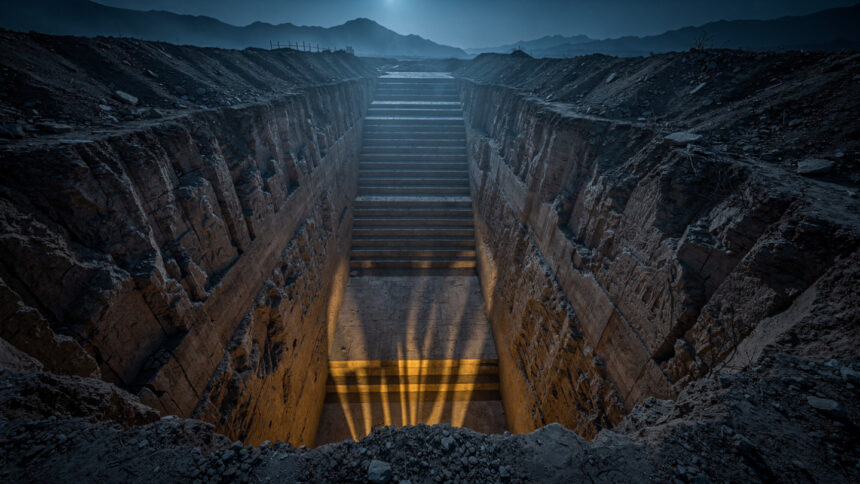
The same psychological problem appears in ancient China. Consider the elaborate jade burial suits associated with elite Han-period burials. The objects are real. The craftsmanship is real. The materials are real. The archaeological record is extensive. And yet the explanation can feel strangely anticlimactic. A jade suit was made by human beings. Piece by piece. Over time. With tools.
That answer is completely compatible with the evidence. But psychologically, it can feel too small. A civilization capable of producing a monumental tomb seems, to the modern imagination, as though it ought to possess a correspondingly monumental secret. The structure is enormous. Therefore the explanation should be enormous. And that is precisely where alternative theories become attractive.
If ordinary people built it, the achievement is remarkable. If an unknown civilization built it, the achievement becomes mysterious. Those are not the same thing. In fact, the first explanation may be the more astonishing one.
Technology Is Mythology’s Favorite Costume
Every civilization has a mental picture of what advanced power looks like. For the Romans, it was monumental engineering, aqueducts, roads, concrete and mechanical devices. For the Victorians, it was steam, electricity and industrial machinery. For the early twentieth century, it became radio, aviation and wireless communication. For the Cold War generation, it became atomic energy, rocketry and nuclear technology. For ours, it is artificial intelligence, quantum computing, biotechnology and systems whose internal workings are opaque even to most educated observers.
And so the ancient world gets upgraded accordingly. The gods acquire the technology of the people imagining them. So do the ancestors. So do the lost civilizations. A Victorian encountering an unexplained ancient structure could imagine steam power. A radio enthusiast could imagine a transmitter. A computer scientist could imagine an ancient computer. Someone raised in the space age can look at a perfectly ordinary geometric arrangement of stones and see a launch facility.
The object hasn’t changed. The observer’s definition of power has.
Stonehenge Didn’t Become a Computer
This is why the Stonehenge story is particularly revealing. Gerald Hawkins’s 1965 work was important because it used computational methods to test astronomical relationships that had previously been discussed much more impressionistically. But there is a crucial distinction between saying Stonehenge encodes astronomical knowledge and saying Stonehenge was an ancient computer.
The first is a defensible description of a monument with demonstrable astronomical alignments. The second is a modern metaphor that can easily become a literal claim. That difference illustrates the larger problem. Ancient people really did observe the sky. They tracked celestial cycles. They constructed monuments aligned with astronomical events. They developed calendars. They encoded measurements into architecture.
None of this requires them to possess silicon. The astonishing part is that human beings were doing sophisticated quantitative reasoning without silicon in the first place.
Nazca Does Not Need an Airport
The Nazca Lines produce the same reaction for a different reason. Seen from the ground, many of the enormous figures and geometric forms are difficult to comprehend. Seen from above, they suddenly become legible. That fact encouraged generations of speculation because modern civilization had just developed the ability to routinely experience landscapes from the air.
So the modern question became: who were they meant for? But that question smuggles modern assumptions into an ancient context. The Nazca people did not need airplanes to understand large-scale geometry. They needed planning. They needed surveying techniques. They needed labor. They needed a reason to create the lines. Archaeology continues to debate the precise functions and meanings of different geoglyphs, including their relationship to ritual, movement, water and landscape.
That uncertainty is legitimate. It is also sufficient. We don’t need to turn an unanswered question about why something was built into an invented answer about who flew here.
The Difference Between “We Don’t Know” and “Someone Else Must Have Done It”
This is the crucial epistemic move that gets lost in ancient-technology speculation. There are three completely different statements. We know how it was made. We have plausible explanations but some details remain uncertain. We don’t yet know how it was made. None of these means: therefore someone else made it. That final step feels natural because uncertainty creates a vacuum and human beings hate empty spaces in explanations.
So we fill them. And because the unknown is invisible, we tend to fill it with whatever our own civilization considers most powerful. The mystery becomes a mirror.
The Actual Miracle Was Never the Signal
Strip away the transmitters. Remove the ancient power plants. Take the extraterrestrial landing platforms off the stones. The monuments remain. And what remains is arguably more impressive. Human beings with no satellites, no cranes capable of lifting hundreds of tons, no combustion engines, no computers and no modern surveying equipment nevertheless learned how to quarry enormous blocks, transport them, measure landscapes, orient buildings, organize labor and construct monuments that survived for thousands of years.
That is not evidence of a lesser civilization. It is evidence of a civilization whose technological environment was radically different from ours. We tend to underestimate technologies that no longer resemble our own. A modern engineer sees a crane and immediately recognizes technology. An ancient engineer sees a coordinated labor force, a prepared track, a lever, a sledge, a wedge and a carefully calculated gradient.
We see primitive tools. They saw a system. And systems can be astonishingly powerful.
The Ring Never Existed. The Wanting Did.
There is a recurring object hidden beneath the oldest monuments. Not in the soil. In the imagination. Every age seems to bury its own impossible machine beneath ancient stone. The Victorian age could have hidden a steam engine there. The radio age found transmitters. The nuclear age found power plants. The space age found spacecraft. Our own age has begun finding artificial intelligence, quantum systems and technologies whose complexity is almost indistinguishable from magic to anyone standing outside the field.
The object changes because the fantasy changes. The monument doesn’t. That is why the ancient-technology question is ultimately more interesting as psychology than as archaeology. It tells us something about the person asking the question. We look at an ancient monument and say: they couldn’t have done this. Then we quietly add: unless they had what we have.
A computer. A power plant. A transmitter. A spacecraft. Something sufficiently advanced that the ancient builders stop looking like us. But perhaps that is precisely the mistake. Perhaps the most unsettling possibility is not that someone else built the monuments. It is that people did. People with fewer machines. Fewer resources. Less energy. Less information.
And yet enough ingenuity, coordination and time to build something that still makes a technological civilization stare at the stones thousands of years later. The monument does not need a hidden machine inside it to be extraordinary. The machine was the civilization itself. And unlike the imaginary transmitters, power plants and landing platforms we keep placing inside ancient ruins, that technology is actually there.
It was called human cooperation. The stones never changed. The story around them did. The stone was never the mystery. We were.