



The Demiurge was not originally an alien, a programmer, a globalist, or a metaphor for digital surveillance. He was something stranger: a creator who did not know the true God existed. In some ancient texts, he is arrogant and hostile, the architect of a defective material cosmos who mistakes his own limited power for absolute divinity. In others, he is not evil at all, but ignorant, just, and ultimately capable of participating in humanity’s redemption. The modern internet has turned this figure into the administrator of a cosmic prison. The surviving ancient texts give us something far more interesting: competing visions of creation, ignorance, salvation and the possibility that the god who made our world was himself only seeing part of the picture.
And there is an important complication before we go any further. “Gnosticism” was never a single ancient religion with one official doctrine, one founder or one universally accepted Demiurge. It is a modern scholarly umbrella applied to a collection of movements and texts that differed substantially from one another, and some scholars have argued that the category itself can obscure more than it reveals. What we call Gnostic literature today includes Sethian, Valentinian and other traditions whose cosmologies overlap in places and sharply diverge in others. That diversity is not a footnote to the story. It is the story.
The Demiurge Was a Creator Who Didn’t Know He Wasn’t God
The most famous version appears in texts such as the Apocryphon of John, the Hypostasis of the Archons and On the Origin of the World, works preserved in the remarkable collection of manuscripts discovered near Nag Hammadi in Egypt in 1945. The thirteen codices contained dozens of works, most preserved in Coptic copies produced centuries after many of the underlying compositions were written. Among these texts is a cosmology in which the highest divine reality lies beyond the material universe, while the creator of the visible world is a secondary being who does not understand the higher reality from which existence ultimately derives.
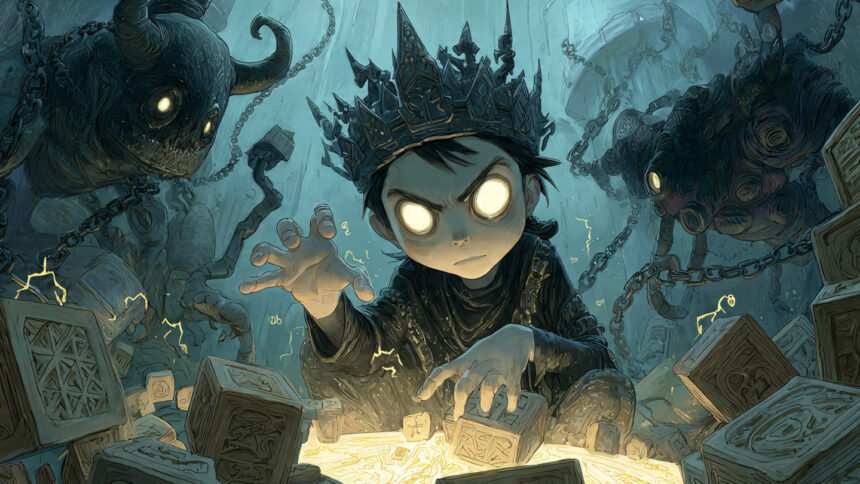
In the Apocryphon of John, the being is called Yaldabaoth and is associated with names including Saklas and Samael. He emerges from Sophia, or Wisdom, in a cosmic crisis involving an act of creation outside the proper divine order. He is described as ignorant of what lies above him. He looks at his own creation and declares, in effect, that he alone is God. The irony is the heart of the myth: the creator is not merely evil. He is mistaken. He believes his limited perspective is the whole of reality.
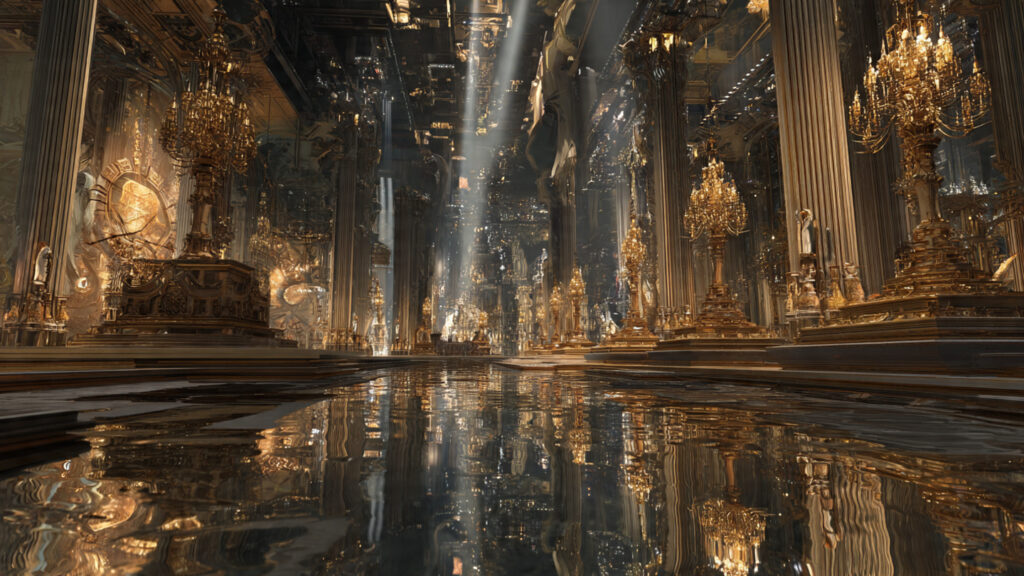
That is the part modern retellings often lose. The Demiurge is not simply a devil with a construction contract. His defining characteristic in the most hostile versions is ignorance. He does not know the higher divine realm. He does not understand his own origins. He mistakes the world he can perceive for the entirety of existence. The cosmic catastrophe therefore begins not merely with malice but with a failure of knowledge.
But “Gnosticism” Was Never One System
This is where the popular version of the story begins to break apart. Modern scholars have long used “Gnosticism” as a convenient label, but there is no evidence for a single ancient organization that called itself the Gnostic Church and taught one standardized theology. The term has been applied retrospectively to a range of religious movements and texts. Modern scholarship increasingly emphasizes their diversity, and some historians have argued that the category should be dismantled or used much more cautiously.
That matters enormously when discussing the Demiurge. In some Sethian texts, the creator is a genuinely hostile cosmic power. But Valentinian Christianity offers a substantially different interpretation. The Valentinian teacher Ptolemy explicitly objected to people who called the creator evil, arguing that they failed to understand divine providence. For Ptolemy, the Demiurge occupies a middle position: he is not the supreme God, but neither is he the Devil. He is a just creator whose limited understanding does not make him intrinsically evil.
The difference is profound. One tradition gives us a cosmic tyrant who imprisons spiritual beings inside matter. Another gives us a subordinate creator who is ignorant but ultimately participates in a larger providential order. Both are routinely placed under the word “Gnosticism.” They should not therefore be flattened into one doctrine simply because both distinguish the ultimate God from the creator of the material cosmos.
The Valentinian position is particularly revealing because it turns the familiar story inside out. The Demiurge can learn. He can recognize the existence of a higher God. He can become aligned with Christ. In some Valentinian interpretations, the creator eventually becomes part of the process through which creation itself is redeemed. The ancient debate was therefore not simply “Is the creator evil?” It could also be “What kind of ignorance does the creator suffer from, and what happens when that ignorance is overcome?”
Was the Demiurge Supposed to Be Yahweh?
Sometimes, yes. But the answer requires more care than the modern version usually allows. Several texts and ancient reports connect the Demiurge to the God of the Hebrew scriptures, especially through the creator’s boast that he alone is God. In these interpretations, passages from Jewish scripture that appear to describe the supreme creator are reread as statements made by a lower cosmic being who does not know the higher God.
But there was no universal “Gnostic” position on this. Marcion, for example, developed a radically dualistic Christian theology in which the creator and lawgiver associated with the Hebrew scriptures was distinct from the loving God revealed by Jesus. Yet Marcion is not simply interchangeable with the Sethian or Valentinian traditions preserved at Nag Hammadi. His system lacks much of the elaborate mythology involving Sophia, Barbelo and the Aeons that modern readers associate with Gnostic cosmology. He belongs in the history of competing second-century Christian interpretations, but labeling him without qualification as a Gnostic can create as many problems as it solves.
Valentinianism again complicates the picture. Valentinian sources could identify the Demiurge with the god of Israel while simultaneously refusing to portray him as pure evil. The Old Testament was not simply discarded. Some of its passages could be interpreted as inspired through different levels of the divine hierarchy, and the Demiurge himself could eventually recognize the higher reality.
That is why the claim “the Gnostics discovered that Yahweh was the evil Demiurge” is historically inadequate. It takes one strand of an extraordinarily diverse second-century argument and turns it into a universal doctrine. The actual evidence shows something more interesting: early Christians were arguing fiercely over what their scriptures meant, who the creator was, whether the material world was fundamentally good or defective, and how Jesus fit into a hierarchy of divine realities.
The Strange Jesus of the Nag Hammadi Library
The surviving texts also reveal how radically varied early Christian ideas about Jesus could be. The Gospel of Thomas, preserved in Coptic in the Nag Hammadi codices, contains 114 sayings attributed to Jesus rather than a continuous narrative of his ministry. There is no conventional Passion narrative, no resurrection story and no biography resembling the canonical Gospels. Its opening presents the sayings as hidden or secret words of the living Jesus, and several of its teachings place unusual emphasis on interpretation, self-knowledge and discovering what is already present.
That does not make Thomas a secret fifth Gospel that the Church simply “banned.” The history is more complicated. Greek fragments of Thomas were already known from Oxyrhynchus before the complete Coptic manuscript was identified at Nag Hammadi, and scholars continue to debate when the collection reached its final form and how its sayings relate to earlier Christian traditions. Some sayings closely resemble material in Matthew and Luke; others are radically different. What makes Thomas historically valuable is precisely that it gives us another window into the diversity of early Christian literary culture.
The Gospel of Truth, associated with Valentinian Christianity and traditionally linked to Valentinus, offers another tone entirely. Its central problem is ignorance: humanity does not recognize the Father, and revelation awakens the knowledge necessary for restoration. Here the emphasis is not on an evil cosmic jailer ruling through brute force but on ignorance, recognition and return.
Then there is the Gospel of Judas. The surviving Coptic manuscript belongs to a codex physically dated by radiocarbon analysis, conducted by scientist A.J. Timothy Jull at the University of Arizona’s AMS laboratory, the same facility that dated the Dead Sea Scrolls, to roughly 220 to 340 CE, while the underlying composition is generally placed earlier. Its Jesus is presented through a dramatically different theological lens, and Judas is recast not simply as the betrayer of Jesus but as the disciple entrusted with a peculiar and privileged role. The manuscript was rediscovered in modern times after decades of neglect, authenticated through radiocarbon, paleographic, imaging and other analyses, and published in the twenty-first century.
These texts do not prove that the early Church possessed one suppressed alternative Christianity. They demonstrate something both less cinematic and more important: Christianity was internally diverse from an extremely early period, and different communities produced radically different interpretations of Jesus, creation, salvation and the relationship between the visible world and the divine.
The Buddha Was Not Secretly Teaching Gnostic Cosmology
The supposed Buddhist-Gnostic connection belongs to a much later history. There are genuine conceptual similarities that modern readers can find compelling: ignorance as a source of suffering, liberation through transformation of consciousness, detachment from ordinary assumptions about reality, and the possibility that ordinary perception does not reveal the whole truth. But resemblance is not genealogy.
There is no surviving second- or third-century Gnostic text in which Buddha appears as a teacher inside the Demiurge cosmology. The familiar modern synthesis emerged much later through comparative religion, occultism and Theosophical thought, when Western writers began placing Buddhism, Hinduism, Gnosticism and other traditions into a common map of “ancient wisdom.” That comparison can be philosophically interesting. It is not evidence that the traditions were historically one system.
The Ancient Texts Never Mentioned the Great Reset
This is where the modern conspiracy layer becomes unmistakable. The ancient texts do not discuss digital surveillance, central-bank policy, Iran, the Great Reset, artificial intelligence, biometric identity systems or twenty-first-century geopolitical elites. None of those concepts existed in the historical world in which these texts were composed. When modern writers place them inside the Demiurge myth, they are creating a new interpretation of the ancient material rather than recovering a prediction hidden inside it.
That does not mean the comparison is automatically worthless. A modern person may look at algorithmic surveillance and think of Archons. Someone surrounded by bureaucratic systems may experience the world as an invisible hierarchy whose rules are difficult to understand. Someone worried about artificial intelligence may find the Demiurge story uncannily relevant: a powerful creator produces a world whose inhabitants do not fully understand the system governing them. Those are legitimate modern metaphors. They simply should not be presented as if the second century anticipated the twenty-first.
Why the Demiurge Came Back in the Modern Imagination
The ancient myth survived because its central problem is almost impossible to make obsolete: what if the reality we inhabit is not the whole of reality? Modern science fiction rediscovered that question without needing to copy ancient texts literally. Philip K. Dick became one of its most remarkable modern interpreters. After the extraordinary experiences he reported beginning in early 1974, Dick spent the rest of his life trying to understand what had happened to him, filling notebooks with theological, philosophical and metaphysical speculation that eventually became the enormous body of writing known as the Exegesis. His novel VALIS turned those concerns into fiction, transforming Gnostic and theological ideas into a story about hidden structures beneath apparently ordinary reality.
Carl Jung approached related material from a completely different direction. He was fascinated by Gnostic mythology, alchemy and the symbolic structures of religious experience, and he used ancient religious imagery in his psychological writing. But Jung was not simply declaring that the ancient Gnostics had discovered modern psychology. He was appropriating their symbols as material for understanding the human psyche. The distinction is crucial: the modern thinker is not necessarily revealing what the ancient author “really meant.” Sometimes the modern thinker is building something new from an ancient image.
Then came modern science fiction’s false-reality stories, most famously The Matrix. Its world of artificial construction, hidden control and awakening obviously resonates with the broad emotional structure of Gnostic mythology. But resonance is not proof of prophecy. The Wachowskis were working within a cultural environment already saturated with cyberpunk, artificial intelligence, Plato’s cave, religious symbolism and philosophical skepticism about perception. The ancient myth had not predicted the film. The film had rediscovered the myth’s central question.
The Real Gnostic Horror Was Ignorance
This may be the most important point in the entire tradition. In the most dramatic Gnostic myths, humanity’s problem is not simply that an evil ruler has placed us in a prison. It is that we do not know we are imprisoned. The Archons can rule because the inhabitants of the lower world mistake the lower world for the whole of reality. The Demiurge can call himself God because he does not know there is anything above him.
Read this way, the myth is not fundamentally about Satan. It is about epistemology: what can a limited being know about the system in which it exists? The creator himself suffers from the same problem. He is powerful enough to create a world but ignorant enough to mistake his creation for ultimate reality. Humanity inherits the same condition. We see a small part of existence and are tempted to call the visible part the whole.
That is why the mythology can feel uncannily modern without having predicted modern technology. We live inside systems whose complexity exceeds any individual’s ability to comprehend them. Financial networks, algorithms, bureaucracies, supply chains, artificial intelligence and global communications all create consequences no single participant fully understands. A person can therefore feel trapped inside an invisible architecture without there being a literal cosmic jailer behind it.
And That Is Where the Modern Conspiracy Goes Too Far
The leap from metaphor to literal conspiracy is seductive because it converts uncertainty into agency. If the world feels chaotic, there must be someone controlling it. If institutions are opaque, there must be an architect behind them. If technology changes rapidly, there must be a hidden group that already knows where everything is going. The Demiurge becomes a convenient template into which every modern fear can be inserted: surveillance becomes the Archons, governments become servants of the false god, digital identity becomes the mark of the system, and geopolitical conflict becomes evidence of an approaching cosmic reset.
But the ancient texts do not provide that map. They provide a cosmology of their own time, written by communities negotiating questions about Jewish scripture, Christianity, Greek philosophy, revelation, salvation and the nature of the material world. Modern political claims have to be demonstrated with modern evidence. Ancient mythology cannot substitute for that evidence simply because the metaphor feels perfect.
This distinction is especially important because the real historical material is already extraordinary. We have manuscripts buried for centuries. We have rival Christian cosmologies. We have a creator who sometimes appears as a cosmic tyrant and sometimes as a subordinate, redeemable craftsman. We have Jesus presented as revealer rather than simply sacrificial savior in some texts. We have ancient authors arguing over the meaning of their own scriptures. And we have modern scholars still debating whether the category “Gnosticism” itself is the right tool for describing these movements.
The Demiurge Survived Because the Question Never Died
The most tempting version of the story says the Gnostics discovered the truth, the Church buried it, and modern conspiracy culture finally recovered it. The historical record is much less tidy. There was no single Gnostic religion with one secret doctrine waiting intact beneath two thousand years of censorship. There were competing communities, competing texts and competing ideas about creation, Jesus, salvation and the God of Israel. Some viewed the creator with horror. Others considered him just. Some emphasized escape from the material world. Others imagined a more complicated process of cosmic restoration.
That makes the Demiurge more interesting than the internet version. He is not merely an ancient Satan. He is the embodiment of a question: What happens when a being with immense power mistakes its limited perspective for ultimate truth? The answer in the ancient myth was cosmic. The answer in the modern world can be technological, political, psychological or philosophical.
But the ancient texts never needed the Great Reset, artificial intelligence or digital surveillance to make that question disturbing. They had already imagined a creator who could build an entire world and still fail to understand the reality above it.
That is the part worth carrying forward. Not the claim that the Gnostics secretly predicted our century, but the older warning beneath the myth: the most dangerous prison may be the one whose walls are invisible precisely because the person inside it believes the room is the whole universe.