



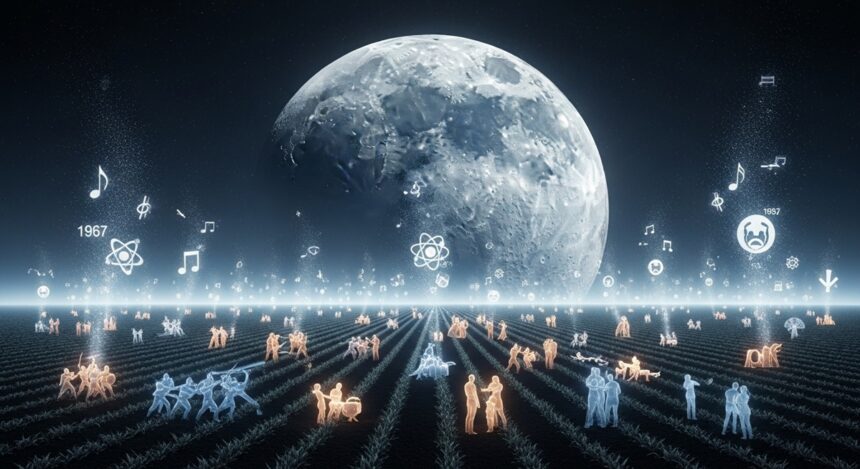
“The Moon is the great enemy of man. We serve the Moon. We are like sheep that she raises, feeds, shears, and saves for her own personal use. But when she is hungry, she kills as much as she wants. All organic life works for the Moon.” That’s not a metaphor George Ivanovich Gurdjieff was softening for effect. It was, according to his own students, the literal core of a cosmology he insisted on as fact, not allegory, one built decades before anyone had a working theory of how the Moon actually formed.
Gurdjieff was a 20th-century mystic whose ideas still unsettle people in philosophy, spirituality, and occasionally science. His full lunar cosmology is genuinely strange, humanity as livestock, suffering as fuel, the Moon as a hungry, half-formed god. What makes it worth a careful look isn’t whether it’s literally true. It’s that a handful of things he insisted on, most notably that the Moon was born violently rather than gently, sat outside the mainstream science of his own era and have since moved closer to it, for reasons that have nothing to do with mysticism.
Who Gurdjieff Actually Was
Even the basic facts of Gurdjieff’s life are contested, starting with his birth year. He claimed 1866. Other records, including one of his own passports, suggest as late as 1877. Historians generally leave it at “sometime between 1866 and 1877,” born in Alexandropol, in what’s now Gyumri, Armenia, then part of the Russian Empire. His father was Greek, a bardic reciter of ancient epics, and his mother was Armenian. Growing up fluent in Armenian, Pontic Greek, Russian, and Turkish, he was exposed early to competing religious and folk traditions in a region where they overlapped constantly.
By his own account, largely uncorroborated by outside sources, Gurdjieff spent much of his twenties and thirties traveling through Central Asia, Egypt, Iran, India, and Tibet, seeking esoteric knowledge from Sufi orders, yogic traditions, and secret societies he never named precisely. He surfaced in Moscow around 1912 with a formulated teaching and began gathering students, including the philosopher P.D. Ouspensky, whose own books did more than anything else to spread Gurdjieff’s ideas to a Western audience. Displaced by the Russian Revolution, he founded his first Institute for the Harmonious Development of Man in 1919 at Tiflis, now Tbilisi, Georgia, then re-established it in 1922 at the Château du Prieuré in Fontainebleau, France, where it operated until financial pressure closed it in the early 1930s.
At the Prieuré, Gurdjieff taught through lectures, original music composed with Thomas de Hartmann, structured group dances called Movements, and physically demanding labor, all aimed at jolting students out of what he called “waking sleep.” He wrote several dense, deliberately difficult books, most notably Beelzebub’s Tales to His Grandson, and died in Paris in October 1949. Critics called him a manipulator. Devoted students called him a genius who saw further than his contemporaries. Both readings can be true of the same man. What’s not in dispute is that his cosmology, especially the claims about the Moon, remains the most provocative part of his legacy.
The Cosmology, As He Actually Described It
Gurdjieff laid out his system in Beelzebub’s Tales, with Ouspensky’s In Search of the Miraculous providing the clearest secondary account. The universe unfolds through what Gurdjieff called the Ray of Creation, a descending scale running from the Absolute, an original unity, down through galaxies, stars, planets, and finally the Moon, with each level governed by a growing number of mechanical laws, three at the top, ninety-six by the time you reach the Moon. In this scheme the Moon is not a dead rock but an immature, still-forming body, born from what Gurdjieff described as a catastrophic collision and now dependent on Earth to keep growing.
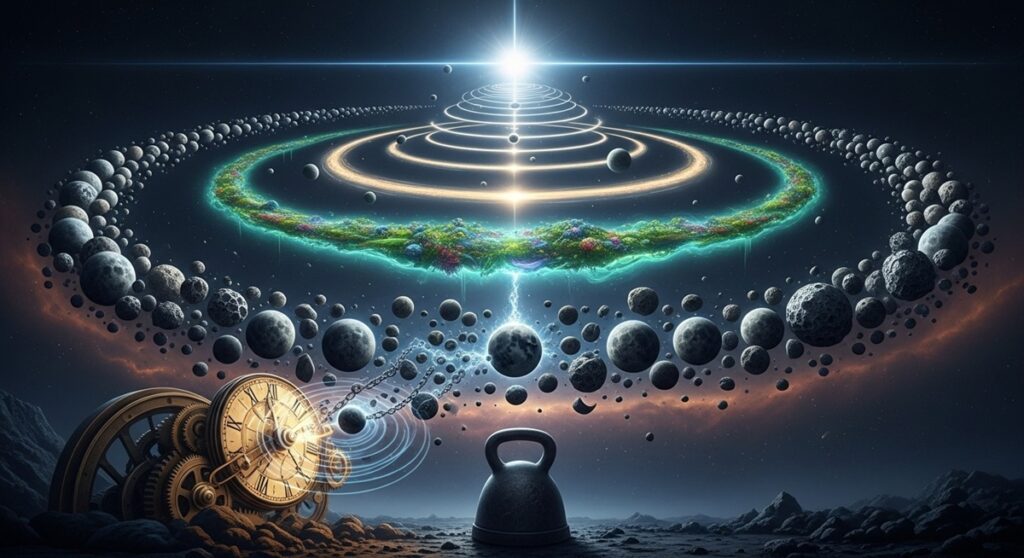
The dependency, in his telling, runs through organic life. Humans, animals, and plants absorb solar and terrestrial energy, then convert it through emotion, effort, and death into subtler “vibrations” that the Moon consumes as nourishment. War, in this framework, is simply a spike in production. Ouspensky summarized the mechanism bluntly: “Organic life is clockwork… If the kettlebell is removed, the movement will stop immediately.” Gurdjieff was explicit that none of this was meant as poetry. He wanted it taken as a literal description of how the cosmos is structured, and of why humanity, in his view, urgently needs to wake up from a mechanical existence it doesn’t recognize as mechanical.
The Catastrophic Birth, and What Science Actually Believed at the Time
This is the part of the story that gets overstated most often, so it’s worth being precise about what was and wasn’t the scientific consensus when Gurdjieff was writing. In Beelzebub’s Tales, composed mostly through the 1920s and 1930s, he described the young Earth colliding with a comet he called Kondoor, with the larger fragment becoming the Moon and a smaller one becoming a forgotten second satellite he named Anulios. By the early 20th century, the three dominant scientific hypotheses for the Moon’s origin were co-accretion, the idea that Earth and Moon formed together from the same disk of material, fission, the idea that a young, rapidly spinning Earth flung off part of itself, and capture, the idea that the Moon formed elsewhere and was later grabbed by Earth’s gravity. A violent, singular collision wasn’t the mainstream position in any of the standard textbooks of Gurdjieff’s era.
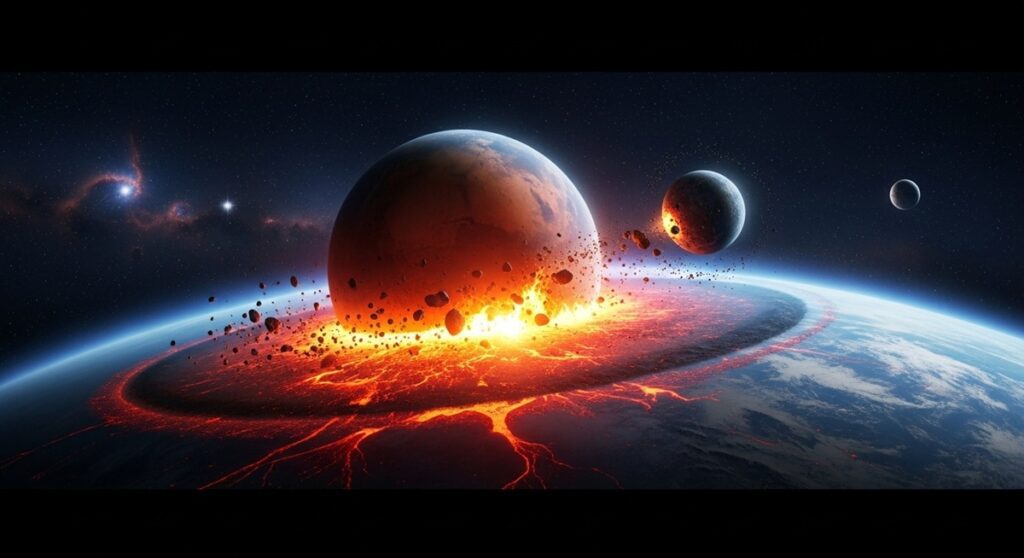
The scientific picture didn’t shift toward catastrophism until 1975, when Caltech astronomer William Hartmann and Donald Davis published the paper that became the foundation of what’s now called the Giant Impact Hypothesis, developed further the following year by Alastair Cameron and William Ward. In its now-standard form, a Mars-sized protoplanet named Theia struck the early Earth roughly 4.5 billion years ago, and debris from that collision coalesced into the Moon. It’s the best-supported model available today, though live debate continues over the exact size, speed, and angle of the impact. Gurdjieff’s account gets the broad shape right, a young Earth, a violent origin, debris becoming the Moon, decades before that shape became the mainstream scientific position. It also gets specific mechanics wrong: a comet is not a Mars-sized protoplanet, and no second satellite called Anulios has ever been found. Being early and being right aren’t the same claim, and this is early without being precisely right.
What Current Impact Research Has Actually Found
The Giant Impact Hypothesis itself keeps generating genuine, well-sourced findings, independent of anything Gurdjieff wrote. Seismologists have long known about two continent-sized, unusually dense structures at the base of Earth’s mantle, called large low-velocity provinces, first identified through their effect on seismic waves in the 1980s. In November 2023, a team led by Qian Yuan, then at Arizona State University, published research in Nature proposing that these structures are surviving fragments of Theia’s mantle, material dense enough to have sunk to the core-mantle boundary during the impact and remained largely intact for 4.5 billion years, rather than mixing evenly into Earth’s interior the way most models had assumed. It’s a genuinely striking, peer-reviewed result: pieces of the object that helped create the Moon may still be sitting a few thousand kilometers beneath your feet.
The Moon Is Also Rusting, and That’s Real Too
A separate, unrelated line of research adds its own strange footnote to the Earth-Moon relationship. In 2020, planetary scientist Shuai Li and colleagues at the University of Hawai’i reported detecting hematite, ordinary iron rust, concentrated at the Moon’s poles, using data from India’s Chandrayaan-1 orbiter. That’s a genuine puzzle, since rust requires oxygen and water, and the Moon has almost none of either freely available, while the constant hydrogen bombardment from solar wind should actively prevent oxidation rather than cause it. The proposed explanation is what researchers call Earth wind: for roughly five days each lunar month, when Earth sits directly between the Moon and the Sun, our planet’s magnetotail shields the Moon from solar wind while simultaneously leaking oxygen ions from Earth’s own upper atmosphere onto the lunar surface. A follow-up study published in September 2025 by a team including researchers at Macau University of Science and Technology confirmed the mechanism experimentally, firing oxygen ions at iron-rich lunar minerals in lab conditions and successfully producing hematite. It’s a real and well-documented finding. It has nothing to do with Gurdjieff’s vibrations, but it’s a genuine reminder that Earth and Moon remain physically entangled in ways that keep surprising planetary scientists.
What the Lunar Biology Research Actually Shows
This is the part of Gurdjieff’s cosmology, the Moon exerting a subtle biological pull on organic life, where the honest answer is genuinely mixed rather than a clean yes or no. A 2013 study by chronobiologist Christian Cajochen found that participants sleeping in fully darkened, controlled rooms with no visual cues about the lunar phase still showed reduced melatonin and lighter sleep around the full moon, a result the researchers couldn’t explain through moonlight exposure alone. A larger 2021 study led by Horacio de la Iglesia and Leandro Casiraghi, examining both indigenous Toba/Qom communities in Argentina and urban university students in the United States, found that people across very different lighting environments fell asleep later and slept less in the days leading up to a full moon. Some smaller studies have also reported intermittent synchronization between menstrual cycle onset and lunar phase in a subset of women, particularly those with longer cycles.
Set against that, large-scale data tells a more boring story. Studies pooling hundreds of thousands of hospital births have found no significant lunar effect on conception rates or birth timing, and the long-standing folk claim that full moons increase psychiatric crises, violence, or emergency room visits has been repeatedly tested and repeatedly fails to hold up. The most defensible summary is narrow: moonlight itself, as an ordinary light source, appears to have a small, measurable effect on human sleep architecture across cultures, even when people aren’t consciously aware of the lunar phase. That’s a real and interesting finding about light and circadian biology. It is not evidence of a Moon that requires human suffering as sustenance.
Where the Metaphor Outruns the Mechanism
It’s worth being direct about one more thing, since it’s the kind of citation that circulates as if it settles the question. A 2025 paper occasionally cited as reframing Gurdjieff’s Moon cosmology in terms of “recursive emergence” and quantum physics is not a peer-reviewed scientific publication. It’s a self-published, AI-assisted speculative essay hosted on ResearchGate, explicitly credited as “a collaboration with GPT-4o,” and it carries no more scientific weight than any other individually authored blog post. Citing it alongside the Yuan et al. Nature paper or the Cajochen sleep study, as though they belong to the same category of evidence, is exactly the kind of conflation that turns a genuinely interesting historical coincidence into something that reads like a settled scientific vindication. It isn’t one. Gurdjieff’s vibrations, subtle bodies, and cosmic food chain remain a metaphysical framework he asked his students to accept on his authority, not a physical mechanism anyone has measured.
The Fourth Way
The grim cosmology was never the point for Gurdjieff so much as the setup for an argument about how to live inside it. He taught that ordinary human consciousness is a kind of waking sleep, mechanical, reactive, and largely unaware of itself, and that most people go through entire lives without ever really choosing anything. His proposed way out, which he called the Fourth Way, distinguished itself from the traditional paths of the fakir, the monk, and the yogi by insisting on working simultaneously on body, emotion, and intellect, rather than mastering one at the expense of the others.
In practice, that meant self-observation without immediately trying to change what you noticed, doing ordinary physical labor with full attention rather than on autopilot, deliberately tolerating certain kinds of discomfort as a training exercise, and working to unify what Gurdjieff described as the many competing, often contradictory “I”s that make up an ordinary personality. Movements, the structured group dances he choreographed, were built as a physical version of the same discipline, demanding enough coordination that students couldn’t perform them on autopilot.
What’s Actually Left Standing
None of this needs an invented vindication to be worth taking seriously as intellectual history. Gurdjieff insisted on a violent, catastrophic origin for the Moon at a time when serious astronomy leaned toward gentler explanations, and decades later, mainstream planetary science moved toward catastrophism too, for reasons of orbital mechanics and isotopic chemistry that owe nothing to his cosmology. Real, ongoing research keeps finding fragments of that ancient collision embedded in Earth’s mantle and its residue rusting the lunar poles. Separately, real chronobiology keeps finding a small but genuine lunar fingerprint on human sleep. None of that adds up to a hungry Moon feeding on suffering. It adds up to a stopped-clock coincidence about origins, sitting next to a genuinely rich, still-unfinished body of Earth-Moon science that would be worth knowing about whether Gurdjieff had ever written a word.