There is a real technology that can detect people through walls. It is not Kinect, it is not X-ray vision, and it does not require science fiction. Radar and other radio-frequency sensing systems can detect movement, breathing, position, and in some cases coarse human shape through concrete and other building materials. What makes the story interesting is not the internet myth that Microsoft once gave the living room a machine capable of seeing through clothes. It is that the real technology was already being developed for military and law-enforcement purposes long before most people had ever heard of Kinect.
That distinction matters because two very different technologies have been repeatedly collapsed into one story. Through-wall radar works by sending electromagnetic waves into a barrier and analyzing the tiny fraction of energy that penetrates, reflects from objects or people on the other side, and returns to the receiver. Kinect worked fundamentally differently: its depth sensor projected infrared structure into the scene in front of it and measured how that pattern changed to estimate distance. One technology was deliberately engineered to sense beyond an obstruction. The other was engineered to understand the three-dimensional geometry of whatever its sensors could directly see. The first is genuinely capable of looking through certain walls. The second never acquired the magical ability to see through somebody’s clothes.
Radar Was Old. Seeing Through Walls Was the Hard Part.
Radar itself has deep military roots. During the Second World War, MIT’s Radiation Laboratory and allied research programs transformed microwave radar from an emerging scientific technology into a practical military system, producing more than a hundred radar designs and helping establish the engineering foundation from which later sensing technologies developed. The Cold War then drove radar into increasingly sophisticated forms of surveillance, tracking, remote sensing, and battlefield detection. But there is an important distinction between radar and through-wall radar: detecting an aircraft in open air is comparatively straightforward because the signal travels through air, whereas trying to recover a useful signal after it has crossed a wall, reflected from a human, and crossed the wall again is an entirely different engineering problem.
The wall does not politely let the radar through. MIT Lincoln Laboratory’s later experiments illustrate the problem vividly: when researchers tested their system against four- and eight-inch concrete walls, more than 99 percent of the transmitted signal could be blocked on the first passage, and the reflected signal then suffered another enormous loss on the way back. The challenge was therefore not simply producing enough power. It was extracting a meaningful human signal from a vastly stronger reflection produced by the wall itself, while simultaneously dealing with multipath reflections, clutter, wall thickness, material properties, antenna geometry, and the fact that a person who appears motionless is still moving slightly as they breathe.

The Through-Wall Breakthrough Became Concrete in the 1990s and 2000s
By the late 1990s and early 2000s, the technology was no longer merely an intriguing laboratory concept. Researchers were publishing through-wall radar experiments capable of detecting moving people behind barriers, while U.S. government programs were explicitly evaluating sensors for military and law-enforcement use. A 1997 paper on through-wall differential radar described an ultra-wideband system that detected people moving behind walls, fences, trees, and other obstacles. By 2000, the U.S. National Institute of Justice was describing a system called MARS, the Motion and Ranging Sensor, capable of penetrating concrete and masonry and providing both two-dimensional movement detection and three-dimensional information about objects behind walls.
The U.S. Army subsequently formalized through-wall sensing as a technology objective for urban warfare. Research programs investigated radar, millimeter-wave, terahertz, acoustic, and other approaches, but radar emerged as the most mature technology for practical through-wall sensing. The engineering problem was no longer whether electromagnetic energy could interact with a structure. It was whether that interaction could be turned into useful information at a safe distance, with enough resolution and reliability to matter to someone standing outside the building.
From the Battlefield to a Briefcase
The result was a gradual transition from large experimental systems toward portable sensors. By the 2010s, the National Institute of Justice was testing commercially available through-wall devices including the Range-R, Xaver 100, Xaver 400, and an experimental standoff imaging radar. These systems were designed primarily around practical questions: Is somebody inside? Where are they? Are they moving? Can a responder determine the location of a person without exposing themselves by entering the room?
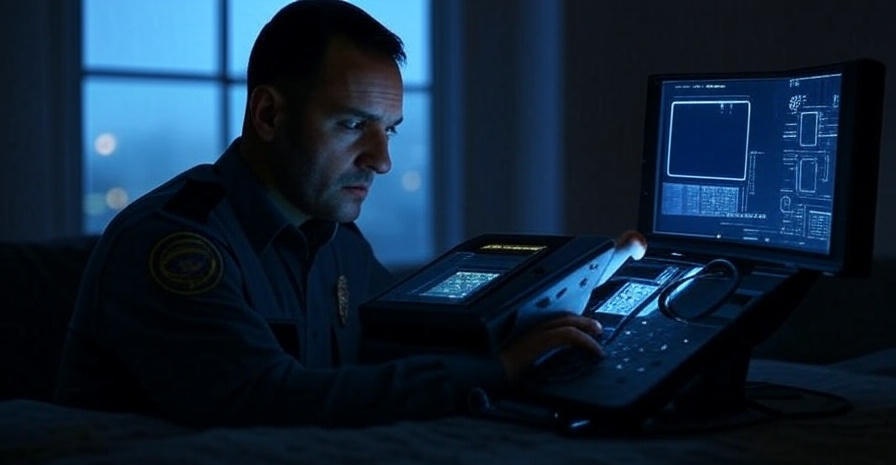
That last point is important because “see through walls” is itself a misleading phrase. These systems do not normally produce a television-quality picture of everything inside a house. A 2011 MIT Lincoln Laboratory system, for example, produced real-time radar imagery of moving humans behind concrete and cinder-block walls, but the people appeared as moving blobs rather than photographic human figures. The system could detect people who attempted to stand still because the minute movements associated with breathing were still detectable, but stationary furniture and other non-moving objects were much harder or impossible for that particular system to distinguish.
The Kinect Rumor Was a Different Kind of Technology
Then came Kinect.
Microsoft’s Kinect arrived with the Xbox 360 in 2010 and became famous because it could recognize human movement without a conventional controller. The original system combined an RGB camera, an infrared camera, an infrared projector, microphones, and software capable of constructing a three-dimensional representation of the user’s body. Its infrared projector cast a known pattern into the scene, the camera observed how that pattern was distorted, geometry and triangulation then allowed the system to estimate depth.

That distinction destroys the famous “X-ray Kinect” story almost by itself. Kinect was measuring reflected infrared light from the surfaces visible to its sensors. It was not transmitting penetrating radiation through a person and reconstructing whatever lay on the other side. Microsoft explicitly denied the clothing-penetration claim, while technical descriptions of the sensor show exactly what it was actually doing: projecting infrared structure, observing the reflected pattern, and calculating depth from the geometry of the visible scene.
Why People Thought Kinect Could See Through Clothes
The rumor was helped along by a genuine capability. Infrared sensing can make scenes look dramatically different from ordinary visible-light photography, especially in darkness. Demonstrations of Kinect’s infrared abilities were therefore easy to misunderstand once detached from the underlying engineering. Online retellings gradually transformed “Kinect can see people in ways a normal camera cannot” into the much more sensational “Kinect can see through clothing.” The first statement describes an actual sensing system. The second describes a capability the device did not possess.
The difference is not semantic. Clothing is an ordinary physical surface. Kinect’s depth system needs the infrared pattern to reach a surface and return to the sensor. It can estimate the geometry of a shirt, trousers, skin, furniture, walls, and other objects that are within its sensing range and optical path. It does not magically subtract the fabric and expose the anatomy beneath it. A device designed around reflected infrared structure is not secretly an X-ray machine simply because the resulting depth map looks uncanny.

Kinect Still Raised a Real Privacy Question
Debunking the clothing myth does not mean Kinect was harmless or irrelevant to privacy. The device contained cameras and microphones and could map body movement, recognize faces in certain configurations, and process voice information. Microsoft’s own privacy documentation describes Kinect as a combination of camera, microphone, and infrared sensor capable of using movement and voice to control gameplay, with optional facial-recognition functionality. Those are genuine forms of data collection. They simply aren’t the same thing as penetrating someone’s clothing.
There was also a genuine security story surrounding Kinect: researchers quickly began experimenting with the hardware, reverse-engineering its interfaces and finding ways to use the sensor for applications Microsoft had never intended. That was a legitimate demonstration of how a consumer sensing device could escape the narrow purpose imagined by its manufacturer. A camera intended for gaming became useful in robotics, art installations, mapping, research, and eventually stranger applications. The important lesson was not that Kinect secretly possessed X-ray vision. It was that once a capable sensor enters millions of homes, people will find uses for it that its designers never anticipated.

Then Wi-Fi Started Doing Something That Sounds Even Stranger
The more interesting technological development came from a completely different direction: ordinary radio signals. In 2013, MIT researchers demonstrated Wi-Vi, a system using low-power Wi-Fi-like radio signals to detect moving people through walls and closed doors. The idea was deceptively simple. Some of the transmitted radio energy penetrated the wall, reflected from a person, and returned to the receiver. Sophisticated signal cancellation then attempted to remove the overwhelming reflections from the wall and isolate the much weaker reflections produced by human movement.
MIT’s subsequent WiTrack system pushed the concept further, using radio reflections to reconstruct three-dimensional human movement even when the person was in another room or otherwise occluded from the sensor. The reported prototype could localize the center of a human body to within roughly 10 to 13 centimeters in two horizontal dimensions and about 21 centimeters vertically, while also providing coarse information about body-part direction. It was not a magic camera. It was something more interesting: a system extracting spatial information from radio waves that human beings cannot see.
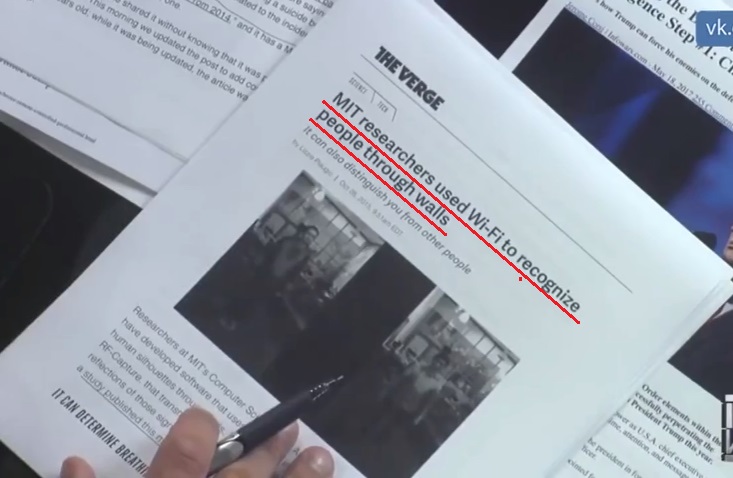
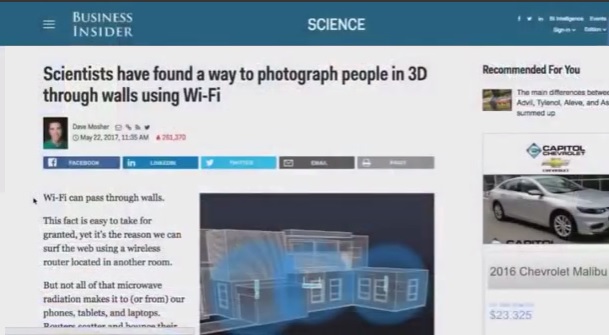
Research since then has continued to push radio-frequency sensing toward increasingly detailed human-pose estimation and activity recognition. But another distinction matters here: a laboratory demonstration that reconstructs human motion under controlled conditions is not equivalent to an ordinary household Wi-Fi router secretly producing a perfect three-dimensional surveillance model of an entire building. The physics is real. The capabilities are real. The dramatic extrapolation is where the story usually outruns the evidence.
A Wall Is Not Invisible to Every Frequency
The underlying physics is worth understanding because it explains both why the technology works and why its limits are so important. “Seeing” through a wall does not mean making the wall transparent. Different electromagnetic wavelengths interact with materials differently. A frequency that penetrates one kind of wall may be heavily attenuated by another. Moisture, concrete composition, thickness, reinforcement, furniture, reflections from interior surfaces, and the distance between the sensor and the building all affect the result.
Longer wavelengths can improve penetration but generally demand larger antennas or sacrifice spatial resolution. Higher frequencies can offer finer detail but are more strongly attenuated by many materials. That is why serious through-wall systems are engineering compromises rather than supernatural windows. The problem is always the same: extract a weak, meaningful signal from a hostile electromagnetic environment.
The Other Way to Hear What You Cannot See
Radio isn’t the only technology that can reveal information that appears inaccessible. In 2014, researchers at MIT, Microsoft, and Adobe demonstrated the “visual microphone,” showing that high-speed video could recover information about sound by measuring microscopic vibrations in objects. A potato-chip bag filmed from 15 feet away behind soundproof glass could carry enough vibration information for researchers to reconstruct intelligible speech. A glass of water, aluminum foil, leaves, and other ordinary objects could similarly act as indirect sensors for acoustic information.
Again, the lesson is not that cameras have become supernatural microphones. It is that information leaks through physical systems in ways human senses do not normally perceive. Walls vibrate. Bodies move. Radio waves scatter. Objects respond to sound. Modern computation can sometimes extract those traces and turn them into information. The astonishing part is not that machines have acquired human senses. It is that engineers have learned to exploit signals that were already there.

Then the Legal Question Becomes Unavoidable
Once technology can reveal something about the interior of a home without physically entering it, the technical question immediately becomes a constitutional one: does obtaining that information count as a search?
The U.S. Supreme Court confronted a closely related problem in Kyllo v. United States in 2001. Federal agents had used a thermal imager from outside a home to detect heat patterns associated with indoor marijuana cultivation. The Court held that when the government uses technology not in general public use to explore details of a home that otherwise could not be known without physical intrusion, that surveillance constitutes a Fourth Amendment search and is presumptively unreasonable without a warrant. Kyllo was a thermal-imaging case, not a through-wall-radar case, and that distinction should not be erased. But the principle is directly relevant to the broader technological problem: the Constitution cannot simply assume that a home’s privacy ends where the newest sensor begins.
What a Wall Can No Longer Hide
That is the part of this history that deserves more attention than the old Kinect rumor.
Through-wall radar is real. Government agencies have studied and tested it. Researchers have demonstrated systems capable of detecting human movement behind concrete and other barriers. Wi-Fi-based sensing can recover information about human motion without requiring a person to carry a transmitter. Video can recover acoustic information from microscopic object vibrations. None of those technologies gives an operator omniscient vision through a building, and none should be described as if it does.
Kinect, meanwhile, never needed to see through clothes to become an important privacy story. It demonstrated something subtler: a consumer device could continuously observe bodies, movement, faces, voices, and spatial relationships inside an ordinary home. The rumor made that capability more sensational than it was. The reality made it more consequential.
The future of surveillance will probably not look like Superman’s X-ray vision. It will look more mundane, and therefore more difficult to notice: a radio reflection here, a vibration there, a depth map assembled from infrared light, a machine-learning model extracting patterns from signals nobody realized they were producing. The wall was never truly invisible. What changed was our ability to listen to what passed through it.
And that is why the most important question is no longer whether machines can see through walls. They already can, within limits. The harder question is how much information we are willing to let machines extract from the spaces we once assumed were private, and whether the law will move quickly enough to answer that question before the technology makes the answer for us.