



Two enormous swords survive from the fifteenth and sixteenth centuries. One is more than two meters long and weighs 6.6 kilograms. The other stretches nearly 3.8 meters and weighs about 14.5 kilograms. Both look so oversized that the obvious question seems unavoidable: who were these things made for?
The answer is considerably more interesting than a lost race of giants. The sword associated with the Frisian folk hero Grutte Pier is a genuine, exceptionally large two-handed weapon that modern scientific examination found could have been used in combat. The famous Japanese Norimitsu Ōdachi is an entirely different kind of object: a gigantic sword made as a religious dedication, where its extraordinary size was part of the point. Neither requires a three-meter human being. Neither is evidence that such a population existed. What these swords actually reveal is something more tangible: medieval and early-modern craftsmen could deliberately build objects far outside ordinary proportions when warfare, ceremony, symbolism, or reputation gave them a reason to do so.
Grutte Pier’s Sword Really Was a Weapon
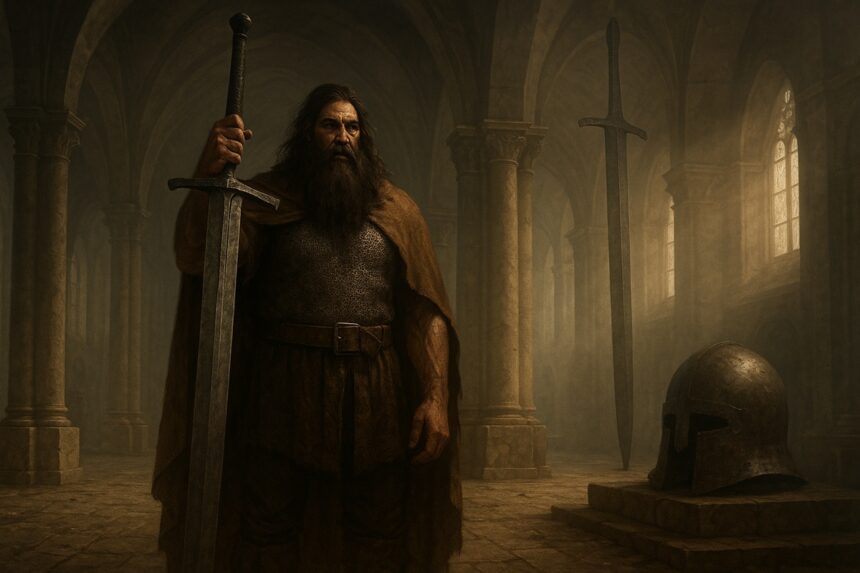
The blade preserved at the Fries Museum in Leeuwarden measures approximately 2.13 meters and weighs about 6.6 kilograms. It has long been associated with Pier Gerlofs Donia, the sixteenth-century Frisian rebel leader better known as Grutte Pier, whose name became inseparable from stories of extraordinary physical strength. The museum itself treats the sword as one of the great objects of Frisian history, while also acknowledging that Pier’s legend grew larger with every generation: stories made him roughly 2.15 meters tall, immensely strong, and capable of feats that belong as much to folklore as biography, a pattern of exaggerated stature echoed in unrelated traditions like why humanoid giants emerged in Florida and Antarctica’s hidden ark.
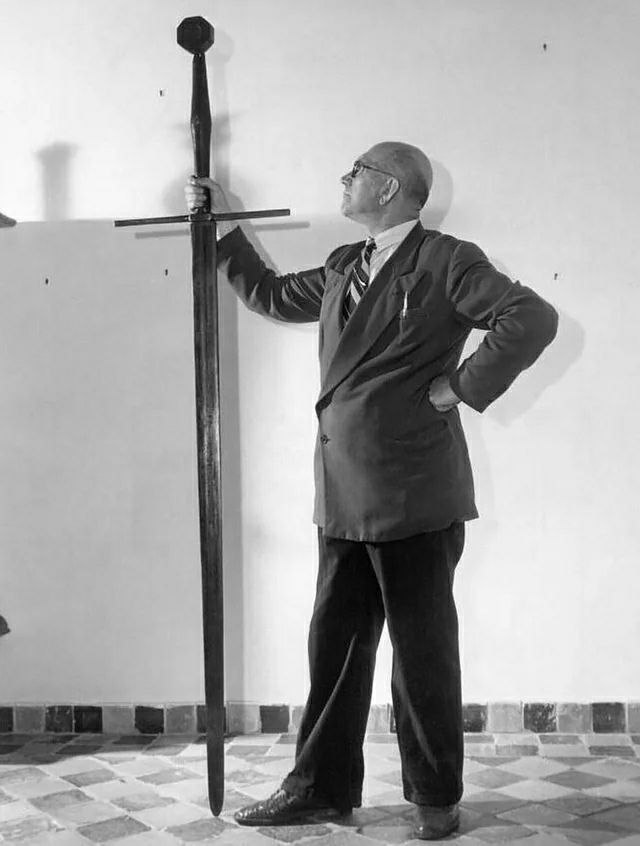
Then the sword was subjected to a much more serious test than legend. In 2022, the Dutch television program Historisch Bewijs investigated both its date and whether such a massive blade could actually have functioned as a weapon. Researchers used neutron imaging at the ISIS Neutron and Muon Source in the United Kingdom to examine the sword’s internal structure and manufacture. The resulting analysis found that its characteristics were compatible with the period in which Grutte Pier lived and, crucially, that the weapon could have been used in combat. The Fries Museum described the result as remarkable precisely because the sword’s immense dimensions had long encouraged doubts about whether it was anything more than a ceremonial or legendary object.
That does not prove that Grutte Pier personally carried this exact sword into every battle attributed to him. The surviving documentary chain connecting the individual man to the individual blade is much weaker than the popular story suggests. What the scientific investigation establishes is narrower and more useful: this was not merely an absurdly oversized prop. Its construction is consistent with a real historical weapon capable of being used by a human fighter.
A Sword This Long Does Not Require a Giant
The central mistake in the giant theory is surprisingly simple. It assumes that the length of a sword must be scaled to the height of its owner. Historical weapons do not work that way. A weapon is designed around reach, balance, leverage, fighting technique, battlefield requirements, and the role for which it is intended. A two-handed sword can be extremely long without requiring its user to stand nearly as tall as the blade itself, because the human body does not have to hold the entire weapon alongside itself like a measuring stick.
The weapon traditionally associated with Grutte Pier belongs broadly to the family of enormous European two-handed swords generally described as Zweihänder or related greatswords. Comparable weapons existed in the German-speaking lands and elsewhere during the same broad period. Some were associated with elite soldiers and the complicated battlefield tactics surrounding pike formations, although modern popular descriptions sometimes exaggerate the specific role of these swords as dedicated “pike breakers.” The important point is simpler: very large two-handed swords were a real historical weapon category, and their existence does not require an unusually tall population.
The Japanese Sword Tells a Completely Different Story
Now consider the famous Japanese blade commonly identified as the Norimitsu Ōdachi. Its dimensions are almost absurd by comparison: roughly 3.77 meters overall and about 14.5 kilograms, with a production date traditionally given as 1446. It is associated with Kibitsu Shrine in Okayama and belongs to the Japanese tradition of extraordinarily large ōdachi, swords whose dimensions could turn the object itself into a spectacle.
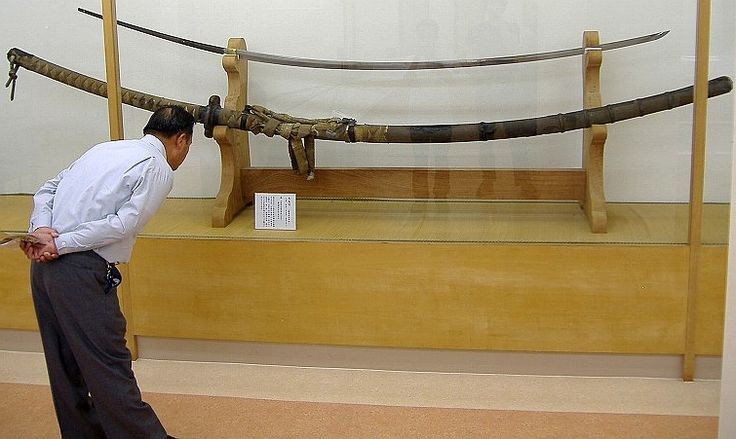
And this is where the viral comparison usually collapses. The Norimitsu Ōdachi is not simply a Japanese equivalent of Grutte Pier’s battlefield sword. Its enormous proportions belong to a different tradition in which oversized blades could be produced as religious offerings and demonstrations of craftsmanship. In such a context, the question “What giant could possibly swing this?” is answering the wrong question. The object was not necessarily designed to be swung by anyone. Its extraordinary dimensions were themselves a statement of devotion, technical ability, prestige, and spectacle, the same impulse toward the monumental found in stories like the last refuge of aliens, where the star guests of our planet found peace.
Japan contains other extraordinary examples of enormous dedication swords, including the Haja-no-Ontachi, which is even longer. The existence of such objects is therefore not evidence for a forgotten class of superhuman swordsmen. It is evidence that craftsmen and patrons sometimes deliberately made ceremonial objects at a scale far beyond practical requirements.
The Sword’s Size Is Not a Height Measurement
This distinction matters because giant-skeleton theories often begin with a deceptively persuasive piece of arithmetic: take the length of a sword, compare it with the height of an ordinary modern person, and scale the proportions upward until the weapon appears “normal.” The problem is that the premise is invented. There is no historical law saying a sword must occupy a fixed percentage of its owner’s height, and there is certainly no archaeological rule that allows a person’s height to be reconstructed from the length of a weapon alone.
Grutte Pier himself was apparently an unusually tall man. The Fries Museum preserves the tradition that he stood around 2.15 meters, and his enormous reputation was probably helped by the physical reality that he was much larger than many of his contemporaries. But unusually tall is not the same thing as three meters tall, and neither is the same thing as belonging to a separate human population. The museum’s own account is revealing here: the sword and the stories about Pier reinforced one another, each making the other seem larger over time.
Human Height Has Extreme Outliers, But They Are Still Human
The biological record provides another useful reality check. The tallest person in recorded medical history for whom there is irrefutable evidence was Robert Wadlow, who reached 2.72 meters. His height was associated with pathological overproduction of growth hormone, and his case is extraordinary precisely because it represents an extreme medical outlier rather than an ordinary human body plan. There is no comparable skeletal evidence for a lost population of humans routinely reaching three meters or more.
That does not mean no ancient human could ever have approached an extraordinary height. Human variation is real, historical measurements are incomplete, and archaeology is never entitled to absolute statements based on absence alone. It means something more defensible: a claim that an entire population regularly produced three-meter humans requires physical evidence proportionate to the claim. A gigantic sword is not that evidence.
The Missing “1492–1502 Cataclysm”
Some versions of the giant-sword story add another layer: the suggestion that an unknown catastrophe around the turn of the sixteenth century destroyed or erased a civilization of unusually large people, leaving only oversized artifacts behind. It is an attractive narrative because it supplies a convenient answer to the obvious question of where the giants went. But the explanation has no independent evidentiary foundation.
There is no established archaeological horizon corresponding to a worldwide 1492–1502 catastrophe that erased a population of giant humans, nor is there a recognized geological event from that interval that provides such an explanation, the same absence of evidence found in the lost giants of Patagonia, myth, mystery, and the truth behind ancient encounters. The period was certainly turbulent: wars, dynastic upheavals, epidemic disease, colonization, demographic collapse, and the beginning of sustained European expansion across the Atlantic all belong to this era. But historical turbulence is not evidence of a hidden biological extinction event. A catastrophe introduced only to explain why another unsupported claim lacks evidence is not independent evidence. It is a second layer of the same story.
Why Giants Keep Appearing in Human Stories
The persistence of giant stories is real. The explanation does not have to be. Across cultures, people have told stories about beings larger, stronger, older, or more primordial than ordinary humans. Sometimes those stories may preserve memories of unusually large individuals. Sometimes enormous animal bones found without a modern framework for paleontology were interpreted through the categories available to the people who discovered them. Sometimes the giant is simply a mythic device: a way of representing primordial power, wilderness, chaos, ancientness, or an enemy so formidable that ordinary human proportions no longer seem adequate.
There is another mechanism that matters here: exaggeration compounds. A genuinely tall historical figure becomes a legendary strongman. A strongman becomes someone who can lift impossible weights. His unusually large sword becomes proof of his extraordinary body. Eventually the sword is no longer evidence about a particular warrior, it becomes evidence for an entire vanished race. The chain looks persuasive only because each step inherits the emotional force of the previous one while quietly losing its evidentiary foundation.
Where Grutte Pier’s Sword Fits Among Other Giants
Grutte Pier’s sword becomes less mysterious, not more, when placed beside other large European swords. The sixteenth-century battlefield was full of specialized weapons whose dimensions were determined by tactical circumstances rather than the average height of their users. Two-handed swords appear in the context of pike formations, mercenary armies, bodyguards, ensigns, and elite fighting roles. Some were practical weapons, others had ceremonial or representational functions, and many occupied an uncertain space between battlefield utility and status display.
That historical variety is important because it destroys the false choice between “ordinary sword” and “giant sword.” Premodern societies routinely made objects at scales that would be excessive for everyday use because excess itself could communicate something: wealth, prestige, devotion, intimidation, technical mastery, or membership in a particular military tradition. The Norimitsu Ōdachi represents one version of that phenomenon. Grutte Pier’s sword represents another.
What the Scientific Test Actually Changed
The most interesting part of the Grutte Pier story is therefore not that modern science “proved the legend.” It didn’t. It did something much more valuable. It tested a physical object against the historical claim that had grown around it.
The result was striking: the enormous sword is not merely a modern prop, nor does its size automatically disqualify it from combat. Its construction and dating are compatible with the world in which Grutte Pier lived, and the investigation concluded that it could have been used as a weapon. That narrows the mystery considerably. The blade does not need a giant to explain it. It needs a skilled human being, a specialized weapon, and a historical culture capable of producing extraordinary steelwork.
What Survives the Debunking
There is a temptation in historical mystery stories to assume that debunking the spectacular explanation makes the object less interesting. Here, the opposite is true. A 2.13-meter sword weighing 6.6 kilograms really was made, survived centuries, and was recently examined with modern scientific equipment. A 3.77-meter Japanese sword really exists as a monument to craftsmanship and religious dedication. The people who made these objects did not need industrial machinery, modern alloys, or a hidden race of superhumans to accomplish something that still looks extraordinary centuries later.
That is the reversal worth keeping. The swords really are giants. The humans who made and used them did not have to be.
Grutte Pier’s blade does not reveal a forgotten species. The Norimitsu Ōdachi does not preserve the weapon of a three-meter samurai. The alleged cataclysm does not supply the missing population, because there is no independent population to explain away in the first place. What survives in the museums and shrines is something stranger in a quieter way: evidence that ordinary human beings, working within very different worlds of warfare, religion, prestige, and craftsmanship, were perfectly capable of making objects so extraordinary that centuries later we still feel compelled to invent extraordinary people to explain them.
Those giant swords now sit in museum cases with their metallurgy fully documented, which is a stranger fate than the myth ever gave them.