
In 1960, a Harvard psychology professor decided that the people studying psychedelics could not honestly understand the experience without experiencing it themselves. Timothy Leary took psilocybin with the people he was supposed to be studying, and within a few years the experiment that began with Harvard backing had become one of the most consequential, and controversial, episodes in the history of American psychology. Leary would claim that psychedelics could transform personality, reduce criminal behavior and open entirely new dimensions of human consciousness. Some of the early results looked astonishing. Then the numbers stopped cooperating. Harvard fired Leary and Richard Alpert for different reasons, the project collapsed, Leary became a counterculture icon, he was sentenced to ten years in prison over two marijuana cigarettes, escaped over a prison wall using a telephone wire, fled across three continents, and was eventually captured in Afghanistan. Then came the strangest question of all: whether the man who spent his life attacking authority eventually gave the FBI information about the people who had helped him escape. The surviving record proves the interviews happened. It does not completely settle what Leary told them.
That is the real Timothy Leary story. Not the cartoon version in which he was either a prophet persecuted by a frightened government or a reckless drug evangelist who deserved everything that happened to him. He was a serious psychologist who helped launch an unusually ambitious research program, a researcher whose methodological convictions repeatedly collided with conventional scientific standards, a charismatic advocate who transformed legitimate questions about consciousness into a mass cultural movement, and a man whose own early claims were later subjected to the kind of long-term scrutiny that his original experiments had never adequately received. The records are stranger than either legend because they contain both things at once: genuine intellectual daring and genuine methodological failure.
Harvard Did Not Begin With a Madman
Leary arrived at Harvard in 1959 with a PhD from the University of California, Berkeley and an established career in personality psychology. Richard Alpert was already at Harvard, a younger psychologist who would later become famous under the name Ram Dass. Together they became the central figures in what came to be known as the Harvard Psilocybin Project, acquiring psilocybin and LSD from Sandoz, the Swiss pharmaceutical company that had supplied researchers with psychedelic compounds. The project’s circle was not an underground cult operating in somebody’s basement. Its participants included psychologist David McClelland, novelist Aldous Huxley, researcher Frank Barron and graduate student Ralph Metzner, while religious scholar Huston Smith later became involved in the experimental sessions.
That history matters because the later mythology often starts the story too late. Leary did not begin as an outsider throwing drugs at unsuspecting subjects. He entered an established academic environment, obtained institutional support, worked with recognized scholars and initially framed psychedelics as a legitimate subject for psychological investigation. The questions themselves were not absurd. Could a controlled alteration of consciousness reveal something about personality? Could a psychedelic experience produce lasting changes in outlook? Could the effects be therapeutic? Could a carefully prepared subject undergo a profound religious experience under experimental conditions?
Those were serious questions.
The problem was what Leary increasingly believed the answers required him to do.
The Researcher Who Refused to Stand Outside the Experiment
Leary and his colleagues did something that conventional research methodology regarded with suspicion: they took the drugs themselves. The reasoning was not frivolous. Psychedelic experiences were radically subjective, and Leary believed that an investigator who had never undergone the state being described by a participant was at a fundamental disadvantage. How could someone who had never experienced a psychedelic state adequately interpret what another person was reporting?
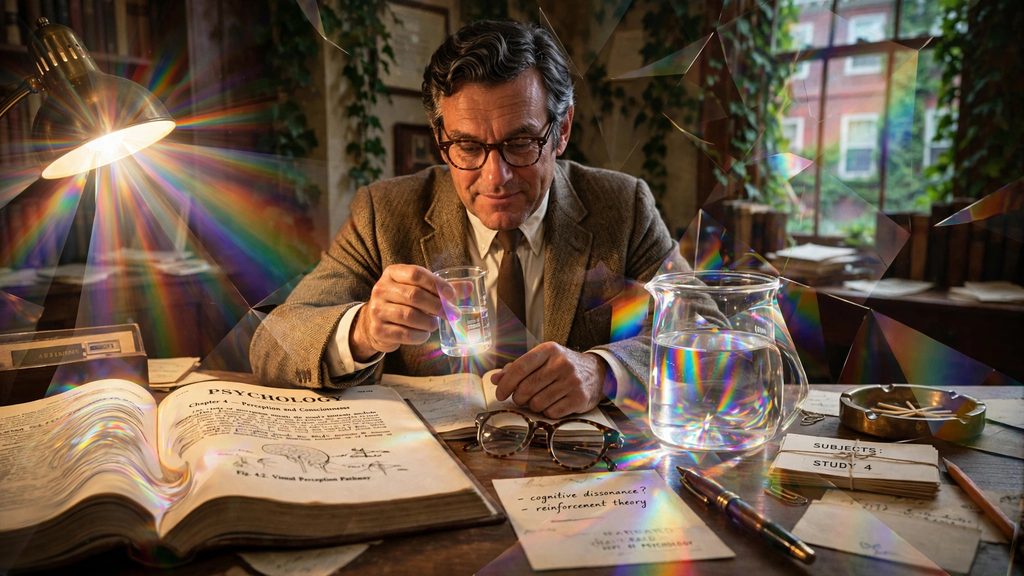
There is an intellectually serious argument buried inside that decision. It resembles the problem faced whenever researchers study experiences that cannot be fully translated into ordinary language: pain, grief, religious ecstasy, altered consciousness. First-person experience can provide information that detached observation cannot. But the same decision creates an obvious scientific problem. Once the researcher becomes a participant, expectation, enthusiasm and personal interpretation can begin influencing the experiment. The investigator is no longer merely measuring the phenomenon. He is inside it.
That tension would eventually define Leary’s career. He repeatedly treated conventional scientific distance as a limitation rather than a safeguard. Sometimes that produced genuinely original questions. Sometimes it produced exactly the kind of bias experimental controls were designed to prevent.
When the Psychedelic Project Was Still Trying to Be Science
The early Harvard work was not uniformly uncontrolled. One of its most famous experiments, the 1962 Good Friday Experiment, used a randomized double-blind design in which theological students received either psilocybin or a placebo during a Good Friday service. The researchers wanted to know whether the drug could produce what participants themselves regarded as an authentic religious or mystical experience. That is an unusually ambitious question, but the attempt to test it under controlled conditions was recognizably experimental psychology.
Other parts of the project were much less rigorous. Leary’s growing conviction that psychedelics could reveal profound truths about consciousness increasingly blurred the distinction between studying an experience and participating in a movement surrounding that experience. The project attracted writers, artists, religious thinkers and other people fascinated by psychedelics, and the laboratory began to sit uncomfortably close to a cultural experiment. The same institution could therefore contain a randomized clinical-style study and, only a short distance away, researchers convinced that the experience itself was too important to be reduced to conventional laboratory categories.
The contradiction was already there.
Leary simply became less interested in hiding it.
The Prison Experiment That Looked Like a Miracle
Between 1961 and 1963, the Harvard group conducted one of its most famous experiments at the Massachusetts Correctional Institution at Concord. With cooperation from state correctional authorities, prisoners were given repeated doses of psilocybin in a program combining psychedelic sessions with group therapy. The underlying idea was almost revolutionary for its time: if a psychedelic experience could interrupt habitual patterns of thought and give prisoners insight into their own behavior, perhaps it could reduce the probability that they would return to prison.
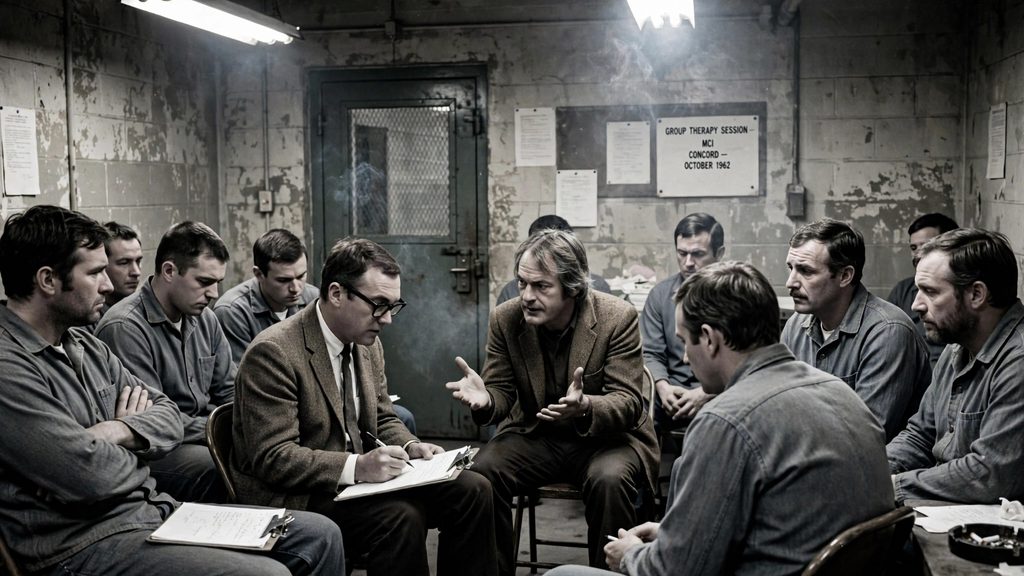
The first results appeared spectacular. Leary reported that roughly 23 percent of the participants had been reincarcerated at an eighteen-month follow-up, compared with an expected rate around 65 percent. He also emphasized the apparent safety of the sessions and argued that the benefits seemed strongest when participants remained connected to the researchers and to structured support groups after release. For a field accustomed to treating prison populations as difficult to rehabilitate, the numbers seemed to suggest that a few psychedelic experiences combined with sustained psychological support could accomplish something conventional punishment had failed to do.
It was an extraordinary claim.
And it did not survive long-term follow-up.
Thirty-Four Years Later, the Experiment Was Reopened
By the later follow-up, the picture looked dramatically different. A subsequent assessment found that the apparent reduction in recidivism had largely disappeared, with the observed rate approaching the comparison population. In 1998, Rick Doblin revisited the original Concord claims using criminal-justice records for surviving members of the study population and interviews with former participants and researchers. His conclusion was devastating to the strongest interpretation of Leary’s original findings: the published claim that the psychedelic treatment itself had produced a substantial reduction in recidivism was not supported by the long-term evidence.
This did not necessarily mean that every person who participated was harmed or that nothing useful happened. It meant something more specific and more important: the experiment did not establish what Leary had claimed it established. The early comparison had serious methodological weaknesses, and the support system that Leary himself believed was crucial to maintaining the effect did not survive. By 1963, the researchers were losing institutional support at precisely the moment when long-term follow-up would have mattered most.
The later record therefore turns the Concord Experiment into something more complicated than either a triumph or a fraud. It is a case study in how a promising result can become a celebrated result before the evidence has had time to mature, and how decades later, when somebody finally goes back to the records, the miracle can become an artifact of methodology.
Harvard Did Not Fire Them for the Same Thing
The popular version of the Harvard scandal reduces everything to one dramatic act of rebellion. The actual sequence is more interesting because Leary and Alpert were pushed out for different reasons.
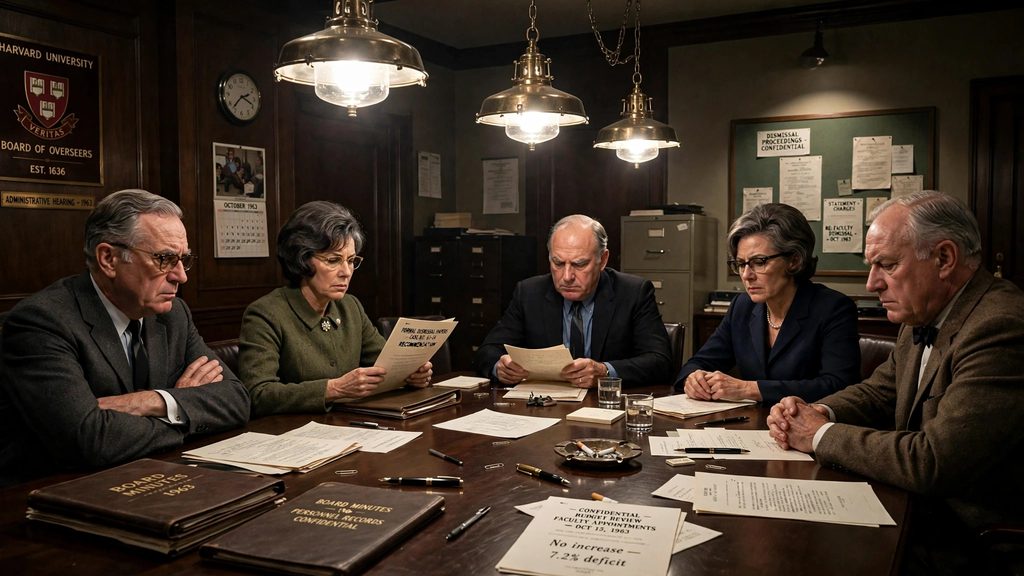
Leary’s relationship with Harvard deteriorated partly because he increasingly failed to fulfill his ordinary teaching responsibilities. He missed lectures and spent substantial amounts of time away from Cambridge, and the university ultimately declined to renew his appointment. Leary believed the teaching issue was being used as a convenient justification for a deeper institutional conflict over psychedelics and his increasingly unconventional behavior. Whether that interpretation captures the whole story is difficult to prove. The administrative record, however, makes one thing clear: Leary’s departure was not simply a single afternoon in which Harvard discovered that its professor had taken LSD.
Alpert’s dismissal was more directly tied to a specific violation. He gave psilocybin to an undergraduate off campus despite an agreement restricting the project’s drug use to approved categories of participants. The episode became a major scandal, and the fact that the recipient was an undergraduate made the institutional problem considerably more serious than merely another researcher experimenting on himself. Andrew Weil, then a Harvard student, became involved in bringing the incident to attention.
The distinction matters because it punctures two myths simultaneously. Harvard did not simply purge two innocent scientists because their ideas were too radical. But neither did it simply discover two irresponsible drug dealers and throw them out. The institution had genuine reasons to question their conduct, while Leary and Alpert were also operating at the edge of a scientific culture that had very little conceptual framework for the phenomenon they were studying.
The Project Left Harvard. The Movement Became Something Else.
After Harvard, the psychedelic project moved first to Mexico and eventually to Millbrook, New York, where Leary and his associates established a sprawling communal environment that attracted artists, intellectuals, seekers and celebrities. At that point the distinction between research institution and countercultural movement became almost impossible to maintain. Leary was no longer simply asking what psilocybin did to personality. He was arguing that psychedelic consciousness could change civilization itself.

His famous phrase, “turn on, tune in, drop out,” became a cultural instruction rather than a scientific hypothesis. Leary transformed himself from psychologist into public intellectual, then into counterculture celebrity, then into a political target. The government increasingly treated him not as an eccentric academic but as a symbol of a generation whose relationship with drugs, authority and social institutions was changing rapidly.
Then Leary Became a Political Problem
In 1969, Leary entered electoral politics and ran for governor of California against Ronald Reagan. His campaign was deliberately theatrical, but it was also a genuine political campaign in a state already becoming a battlefield over drugs and youth culture. The same year, Leary was arrested after police found two marijuana cigarettes in his car. He maintained that the drugs had been planted, an allegation that was never established as fact.
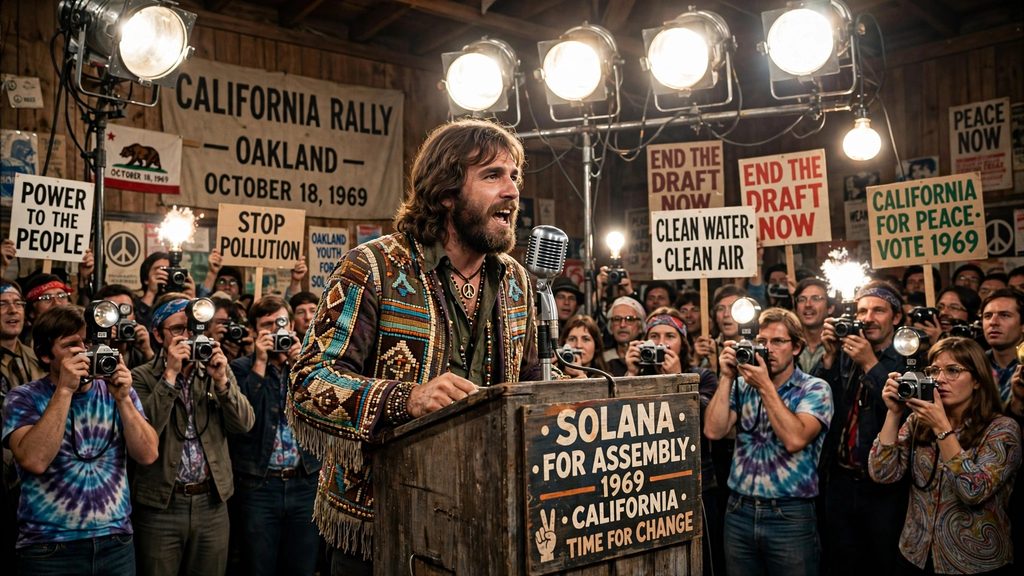
He was ultimately sentenced to ten years in prison. The phrase “ten years for two marijuana cigarettes” became one of the defining pieces of the Leary mythology, but the legal context is important: the sentence was not simply an arbitrary punishment for the quantity found in the ashtray. California’s drug laws and Leary’s prior criminal history contributed to the severity of the sentence. The case nevertheless became a powerful symbol of the disproportion between the small quantity involved and the enormous punishment imposed.
Leary had moved from the university laboratory into the center of the American drug war.
The Escape Over the Telephone Wire
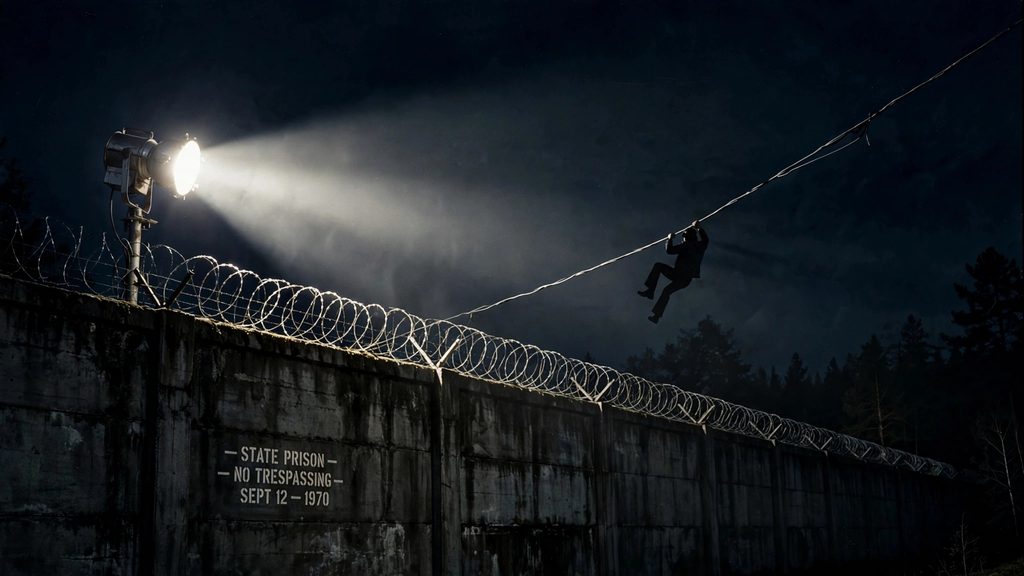
On September 12, 1970, only months into his sentence, Leary escaped from a minimum-security California prison. He climbed over a wall using a telephone wire, an improvised method that sounds almost fictional until the records are consulted. It was also extremely dangerous: the wire was not designed to carry a human being, and contact with electrical equipment could have killed him.
The escape was not a solitary act of eccentric improvisation. Members of the Weather Underground helped arrange it. Leary subsequently fled the United States, first reaching Algeria, where he spent time with Black Panther leader Eldridge Cleaver, and then moving through Europe before eventually arriving in Afghanistan. In 1973, Afghan authorities arrested him in Kabul and he was returned to the United States.
By then the former Harvard psychologist had become something almost unrecognizable from the man who had entered Cambridge in 1959. He was an international fugitive, an enemy of the drug laws, a celebrity of the counterculture and a political symbol whose name carried enormous weight on both sides of America’s cultural divide.
And Then the FBI Asked About the People Who Freed Him
This is where the story becomes genuinely uncomfortable because the evidence is simultaneously substantial and incomplete.
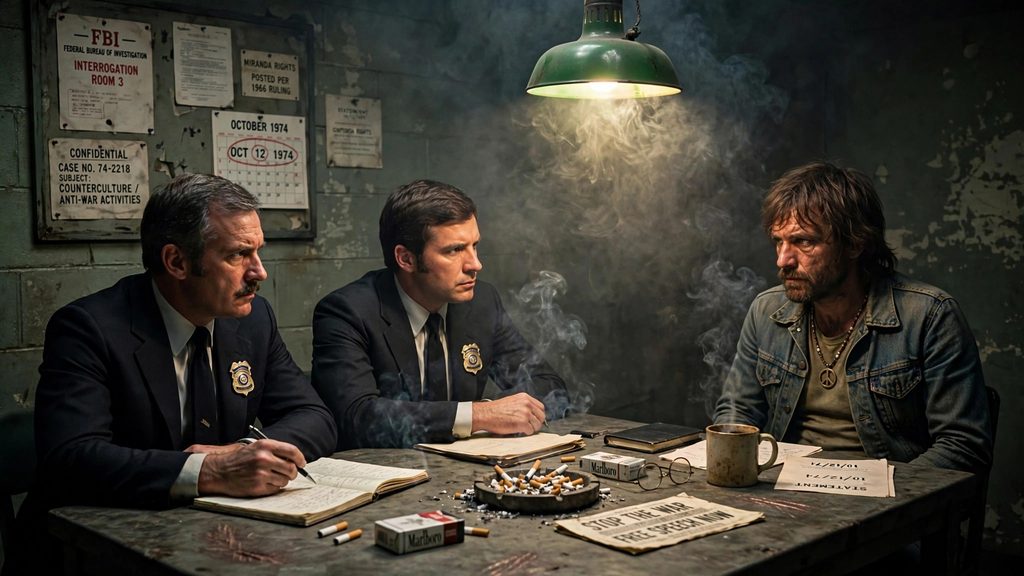
In 1974, FBI agents interviewed Leary after his return to federal custody. The surviving files show that investigators were interested in the people who had helped him escape and specifically pressed him for information about members of the Weather Underground. The Bureau’s questions were not hypothetical. They wanted names, connections and information about the network that had helped one of America’s most famous fugitives disappear.
Rumors that Leary had cooperated with the government circulated among his former allies. Some people who had helped him escape believed he had betrayed them. Leary himself denied being a snitch and later addressed the accusation directly in his autobiography. The accusation therefore has a real historical basis: people really did suspect him, the FBI really did interrogate him, and Leary really did have reason to cooperate if he wanted to reduce the consequences of his own situation.
But suspicion is not proof.
The surviving FBI material does not provide a clean confession establishing that Leary supplied the names of the people who helped him escape. Nor does the existence of an interview prove that he refused every request. The historical record allows the possibility of cooperation without conclusively demonstrating its extent. That is precisely why the question has survived for decades. The archive proves the interrogation. It does not give us the satisfying final sentence the mythology demands.
And that uncertainty should remain uncertainty.
The Paper Trail Outlived the Myth
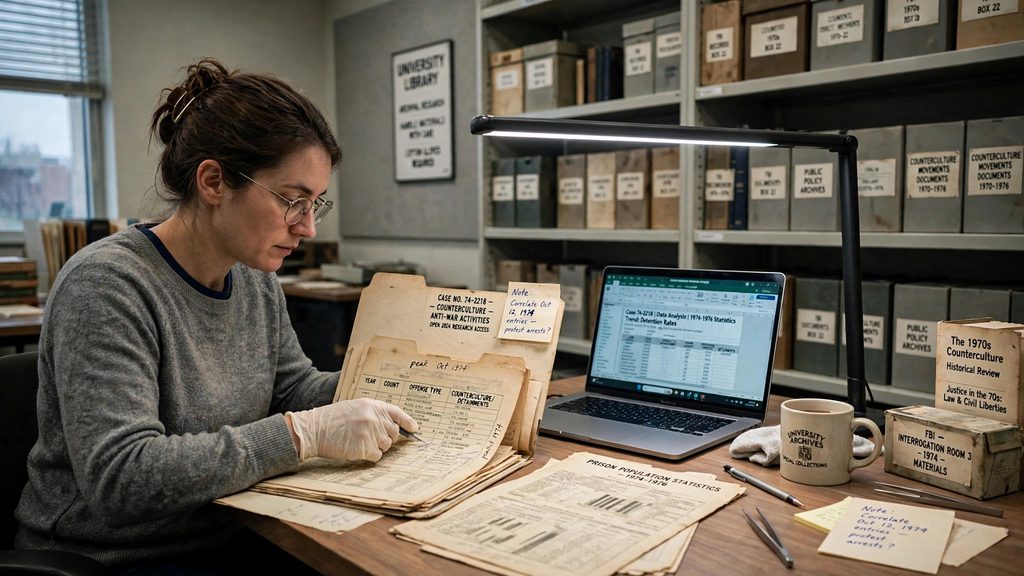
One reason Leary’s story remains unusually recoverable is that so much of it generated paperwork. The Harvard project produced research reports, correspondence, meeting records and administrative documents. Material associated with the project and Leary’s papers survives in archival collections, including the Purdue University Archives and the New York Public Library. Government agencies generated another documentary trail through his arrests, imprisonment, escape and FBI investigations.
This changes how the story should be told. We are not reconstructing Leary from counterculture folklore alone. We can compare what he said with what his colleagues recorded, what the university documented, what correctional authorities recorded, what the criminal justice system preserved and what later researchers found when they returned to the original study population.
And when those sources disagree, the disagreement itself becomes evidence about the man.
The Most Damaging Criticism Came After Leary Was Already Famous
The ultimate irony is that Leary did not have to be destroyed by Harvard, the FBI or the Nixon administration for his most famous scientific claim to weaken. The most consequential challenge came from something much less dramatic: time.
Long-term follow-up showed that the spectacular early recidivism figures from Concord did not hold. Later researchers went back to the original subjects and the original records. The effect Leary had promoted as evidence of a transformative treatment could not be sustained in the way the early publications had suggested. The experiment became an example of why follow-up matters, why comparison groups matter, why enthusiasm can contaminate interpretation, and why extraordinary early results are not the same thing as established effects.
Leary himself eventually acknowledged the limitation. The psychedelic sessions alone had not accomplished what the early claims implied. The continuing social and therapeutic support that he had believed was essential had collapsed before its importance could be properly tested.
The Strange Thing Is That Leary Wasn’t Completely Wrong
This is where the story becomes harder than a simple debunking. Leary’s most dramatic claims were often overstated, but his central intuition, that altered states of consciousness could produce profound psychological effects, was not nonsense. Modern psychedelic research eventually returned to questions that the Harvard project had raised decades earlier, this time with stricter screening, standardized doses, controlled environments, carefully defined outcomes and much more sophisticated statistical methods.
That does not vindicate the original Harvard claims. It makes the history more interesting. Leary was sometimes asking questions before the scientific infrastructure existed to answer them properly. His mistake was repeatedly treating an intriguing possibility as though it had already become an established conclusion. The later revival of psychedelic research does not erase the methodological problems of the Harvard project any more than the existence of modern rocket science would make every claim made by an early rocket enthusiast correct.
Ram Dass Took a Different Exit
The contrast with Richard Alpert is revealing. Alpert emerged from the Harvard scandal as Ram Dass and eventually built a long career as a spiritual teacher, writer and advocate of contemplative practice. Leary moved in almost the opposite direction: toward politics, fugitivity, prison, exile, technological experimentation, public provocation and eventually an embrace of his own mythology.
Two men began inside the same Harvard project. Both believed consciousness deserved to be studied differently. Both were pushed out. Their lives afterward demonstrate that there was never only one inevitable consequence of the psychedelic revolution. Alpert turned inward. Leary turned outward, becoming increasingly convinced that his role was not merely to study the transformation of consciousness but to accelerate it.
What the Records Actually Leave Us With
Timothy Leary’s life is often told as though one side must eventually defeat the other. Either he was the brave scientist who saw the future before everyone else, or he was a reckless propagandist whose career collapsed because he abandoned science. The surviving evidence supports neither caricature.
He helped create a legitimate Harvard research program into an almost unexplored psychological phenomenon. He participated in controlled experiments. He also blurred the distinction between researcher and subject. He produced early results that looked extraordinary and later turned out to be much weaker than advertised. He lost his Harvard position, while Alpert was dismissed over a separate conduct violation. He became one of the most recognizable figures of the psychedelic counterculture. He ran for governor. He was imprisoned. He escaped using a telephone wire. Radical allies helped him flee. The FBI later questioned him about them.
And then there is the final irony.
The man who spent his life arguing that consciousness could not be understood from the outside eventually had his most famous scientific claims judged by people who were willing to stand outside his story.
They went back to the prisoners.
They went back to the records.
They went back to the numbers.
And the numbers did not say what Leary once said they did.
That does not make Timothy Leary a fraud. It makes him something considerably more difficult to dismiss: a brilliant, reckless, charismatic researcher whose greatest weakness was inseparable from his greatest strength. He believed experience mattered so much that he was willing to cross the boundaries designed to keep experience from becoming evidence before it had earned the right to be called evidence.
His life ended with many questions still open. What exactly did psychedelics accomplish? How much of his original research was sound? How much was wishful interpretation? And when the FBI asked about the people who had helped him escape, how much did he actually tell them?
The archive answers some of those questions.
It refuses to answer others.
And for a man who spent his entire life telling people to question authority, that may be the most appropriate ending of all: not another legend, but a record that is finally allowed to remain incomplete.