At Eglin Air Force Base, the plan imagined an American airliner that would cease to be an airliner without anyone watching it happen. A duplicate aircraft would be painted and numbered to match a civilian-registered plane already operating out of Miami. Passengers would board the real aircraft under prepared identities, fly south, then quietly disembark at a private airfield while the original plane was replaced by an unmanned drone continuing along the filed route toward Cuba. Over the island, the drone would transmit a Mayday call reporting an attack by Cuban MiGs. Then it would be destroyed on command. To anyone listening from the ground, it would look like Cuba had just shot down an American passenger aircraft. The passengers would already be alive and safely out of the country.
The wreckage would tell a different story. This was not a screenplay, a rumor, or a later conspiracy theory. It was one of the scenarios written into a March 1962 memorandum submitted by the Chairman of the Joint Chiefs of Staff to the Secretary of Defense.
The Document Exists
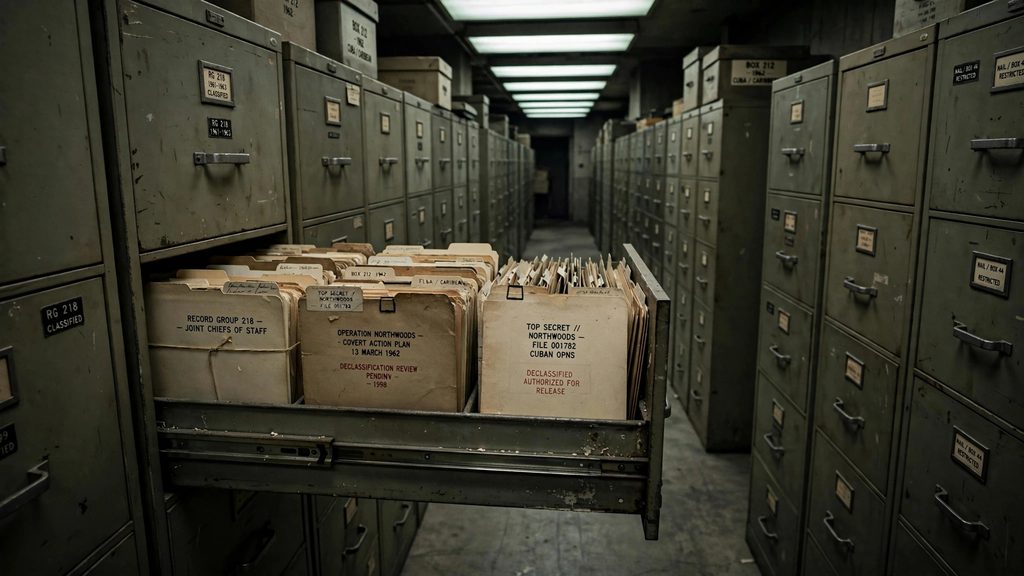
On March 13, 1962, General Lyman L. Lemnitzer, Chairman of the Joint Chiefs of Staff, sent Secretary of Defense Robert McNamara a memorandum titled Justification for U.S. Military Intervention in Cuba. It was classified Top Secret, Special Handling, and marked for restricted distribution. The document was submitted as a preliminary planning paper in response to a request from the Cuba Project for possible pretexts that could justify direct American military intervention. Its internal code word was NORTHWOODS. The Joint Chiefs were not merely discussing whether an incident might occur. They were asking what incidents could be manufactured, staged, or simulated so that Cuba could be made to appear responsible for American grievances serious enough to support an invasion. The National Security Archive’s published copy preserves the memorandum and its supporting material, including the proposed civilian-airliner scenario and several other schemes for manufacturing evidence of Cuban aggression.
The surrounding history makes the document easier to understand without making it any less disturbing. The Bay of Pigs invasion had failed less than a year earlier, and the Kennedy administration had subsequently intensified its covert campaign against Fidel Castro under Operation Mongoose. The Joint Chiefs were operating inside a Cold War environment in which overthrowing the Cuban government was not an abstract ambition but an active American objective. Northwoods emerged from that machinery. What makes it historically remarkable is not that military planners were thinking about Cuba, nor even that they were considering deception. It is the extraordinary specificity of the proposed deception: the document contemplated incidents in which Americans could be placed in apparent danger, evidence could be manufactured, and the resulting outrage could be directed toward a predetermined military objective.
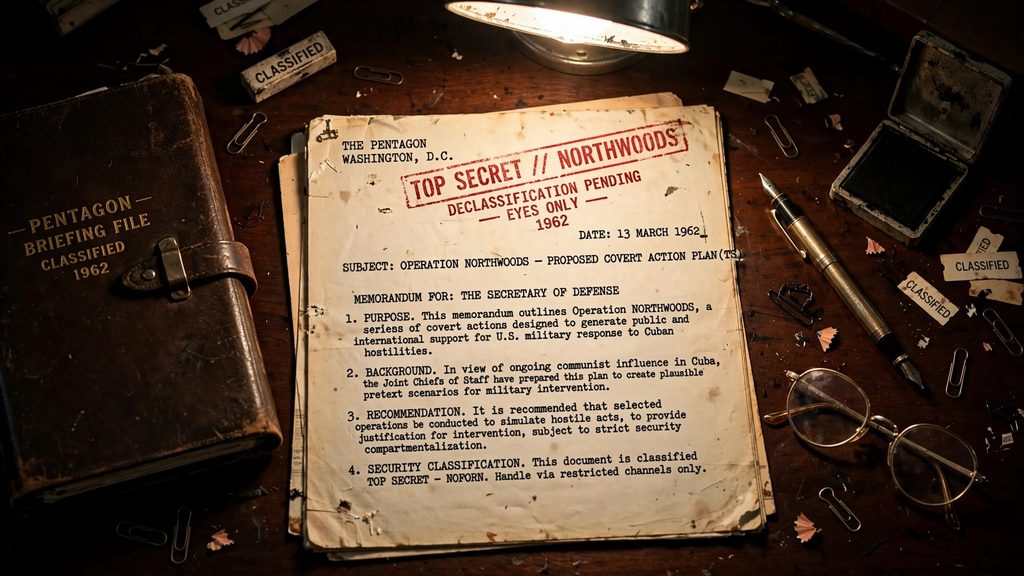
The memorandum eventually became public not because somebody smuggled out a photocopy in the 1960s, but because the U.S. government’s own declassification process opened the file decades later. The President John F. Kennedy Assassination Records Review Board, created by Congress in 1992, reviewed enormous quantities of previously classified material and transmitted declassified records to the National Archives. Northwoods emerged from that process in the 1990s, and journalist James Bamford later brought the document to a much wider audience through his 2001 book Body of Secrets. The National Security Archive subsequently published the surviving memorandum and related material in full. The document therefore occupies an unusually solid evidentiary category: it is not an allegation about what officials might have wanted to do. It is a surviving government record showing what senior military officials actually put forward on paper.
What the Joint Chiefs Actually Proposed
The airliner deception was only one item in a catalogue of possible pretexts. The paper discussed creating a series of incidents that could be attributed to Castro’s government: a fabricated attack around Guantanamo Bay, a staged refugee disaster, simulated violence in American cities, attacks on civilian aircraft or shipping, and a deliberately constructed version of the USS Maine precedent in which an American ship could be destroyed and Cuba blamed for it. One proposal contemplated using aircraft made to resemble Soviet-supplied Cuban MiGs to create the appearance of Cuban aggression. Another envisioned a manufactured campaign of terrorism in Miami, other Florida cities, and even Washington. The purpose was not hidden behind euphemism. These incidents were intended to generate the political conditions under which American military intervention could be presented as justified.
The language becomes particularly revealing when the proposals are read together rather than as isolated curiosities. The planners were not simply imagining spectacular events. They were thinking about how those events would be perceived. Evidence would need to appear authentic. American casualties would matter because casualties create public emotion. The press would need something concrete to report. Cuban responsibility would have to be made believable. And the incidents would need to accumulate into a larger narrative in which the United States appeared to be responding to aggression rather than manufacturing it. The most chilling aspect of Northwoods is therefore not any single proposal. It is the bureaucratic understanding of how reality could be constructed for an audience that had no way of seeing the machinery behind it.
The civilian-airliner proposal makes that logic almost impossible to miss. The real passengers could be removed before the deception reached its most dangerous stage. A substitute aircraft would continue toward Cuba. A distress transmission would create the impression of an attack. And the destruction of the unmanned aircraft would provide physical evidence for the story. The public would not need to know that the passengers had survived because the entire point of the operation was to create an event that looked different from what had actually happened. In an age before satellite television and social media, the distance between an event and the public’s understanding of it was even easier for a government to exploit.
A Proposal Is Not an Operation
This is where the history has to become more precise, not less dramatic. Northwoods was never carried out. There was no American passenger aircraft secretly replaced by a drone under this plan, no staged Cuban attack generated from the proposal, no refugee boat deliberately sunk as part of Northwoods, and no campaign of fabricated terrorism executed under its authority. The document itself describes the material as a preliminary submission for planning purposes, and the Kennedy administration did not authorize the proposed operation. The National Security Archive likewise identifies Northwoods as a set of proposed pretexts rather than an operation that was implemented.
That distinction matters because Northwoods is often transformed in popular retellings from what the document actually establishes into something much larger. It does not prove that every later false-flag allegation is true. It does not establish that the United States subsequently used the plan against its own citizens. It does not provide a documentary bridge to September 11, 2001, or to any other later event. The document’s evidentiary value is narrower and stronger than that. It demonstrates that, at the highest level of American military planning during the Cold War, senior officers formally considered manufacturing incidents that could be blamed on Cuba in order to create a justification for war.
What Happened to Lemnitzer
Lemnitzer’s subsequent career adds another layer to the story, although it should not be turned into a certainty the surviving record cannot support. Later in 1962 he left the chairmanship of the Joint Chiefs and went on to serve as Supreme Allied Commander Europe beginning in 1963, one of the most senior military positions in the American alliance. He eventually retired and died in 1988. It is tempting to treat his reassignment as punishment for Northwoods, but the documentary record does not establish that connection. Nor does it show a formal disciplinary action against the other senior officers associated with the proposal. The more defensible conclusion is also the more interesting one: the man who signed the memorandum went on to have a long and prestigious military career, while the document itself disappeared into the classified record for decades.
The Strange Afterlife of a Rejected Plan
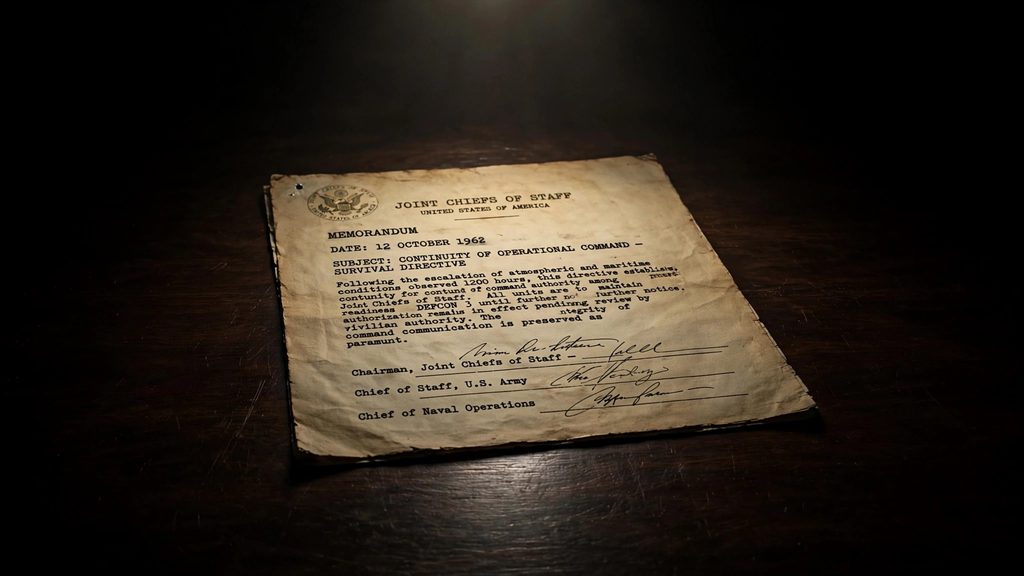
That long silence is part of what made Northwoods so powerful when it finally emerged. For decades, the public had no opportunity to read the document because the document was classified. When it eventually became accessible, it contained something that normally exists only at the edge of political imagination: a government paper, on official letterhead, signed by the Chairman of the Joint Chiefs of Staff, describing concrete ways to manufacture the appearance of foreign aggression. The proposals were not discovered in a novel or reconstructed from an anonymous source years later. They were sitting in the historical record waiting to be released.
And yet the most important fact about Northwoods is not that the plan was monstrous. It is that the plan was rejected. That second half of the story is sometimes treated as an inconvenient footnote because it makes the narrative less absolute. It shouldn’t. A government that produces an extraordinary proposal and a government that actually implements it are historically different things. Northwoods gives us evidence of the first. It does not give us evidence of the second.
The Paper Is the Story
There is no need to inflate Operation Northwoods into something it was not. The surviving record is already extraordinary enough. In March 1962, while the United States was pursuing the overthrow of Castro, the Joint Chiefs of Staff submitted a formal proposal for creating incidents that could make Cuba appear to be the aggressor and thereby generate support for American military intervention. Among the possibilities was a scheme involving a civilian airliner, substitute passengers, an unmanned aircraft, a fabricated Mayday call, and its deliberate destruction. The proposal was not executed. It was not a secret operation that later came to light. It was a plan that reached the desk of the Secretary of Defense and stopped there.
That is the line worth preserving. Not that Northwoods proves every conspiracy, and not that a rejected memorandum somehow becomes evidence of an event decades later. The remarkable fact is simpler: senior American military leaders once put a false-flag war strategy into writing, complete with proposed casualties, fabricated evidence, and mechanisms for deceiving the public, and the paperwork survived long enough for the public to read it. The conspiracy theory is unnecessary. The document is strange enough on its own.