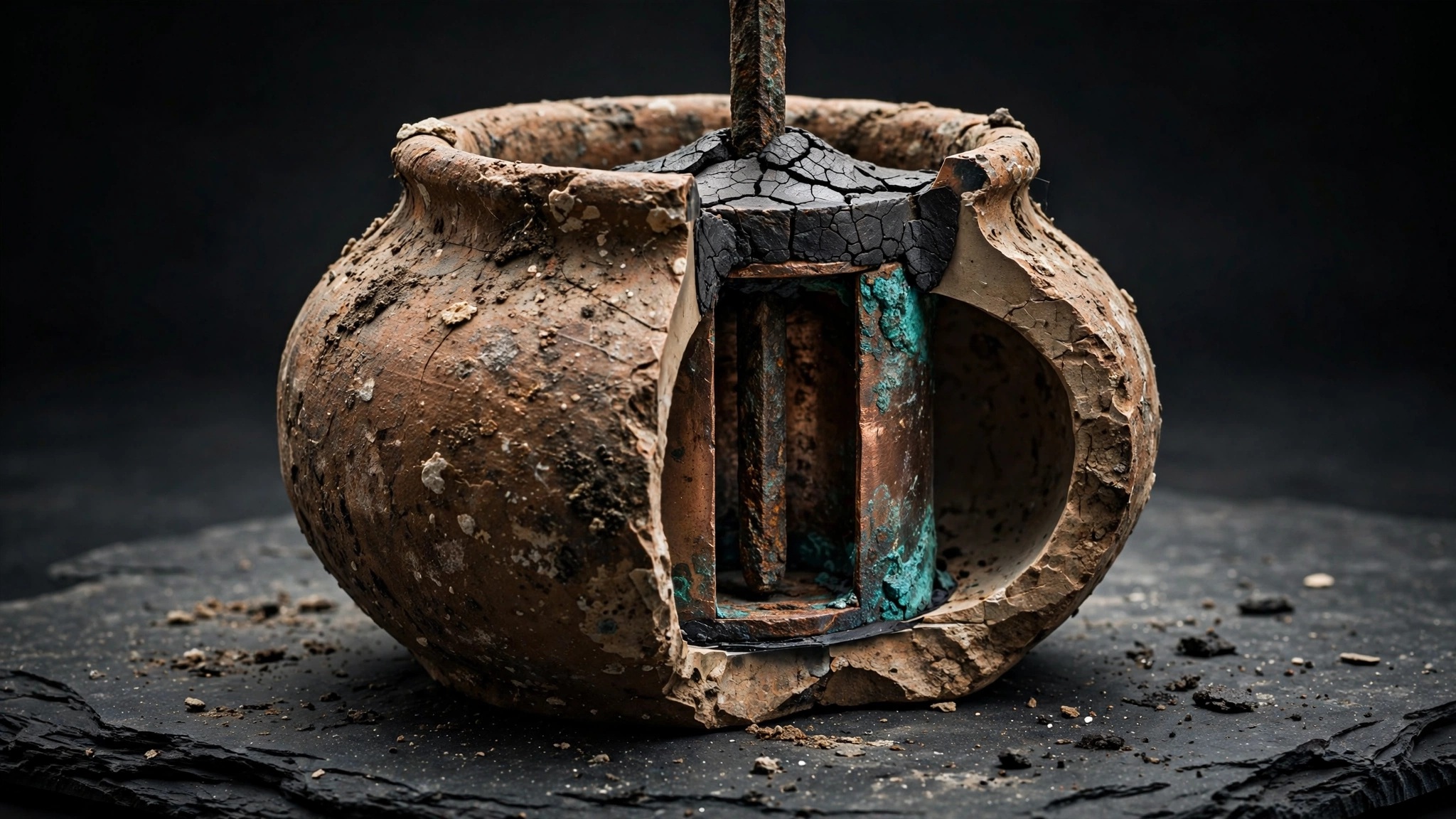
A clay jar the size of a large mug, dug up outside Baghdad and dated to somewhere between 150 BC and 650 AD, has spent eighty years posing a question archaeology still hasn’t fully closed: not whether it can generate electricity, which modern replicas have repeatedly confirmed it can, but whether the people who sealed it that way meant it to.
In 1938, an Austrian painter turned archaeologist named Wilhelm König was working through the storerooms of the National Museum of Iraq when he stopped at an unremarkable object: a squat ceramic jar, roughly 13 centimeters tall, that had been pulled from the ground at Khujut Rabu, a village just outside Baghdad, a couple of years earlier. Inside it, sealed with bitumen, sat a rolled copper cylinder. Inside the cylinder, suspended by another plug of bitumen, sat an iron rod, corroded in a way that suggested it had once sat in an acidic liquid.
König recognized the shape of something he’d never expected to find in a Parthian-era grave assemblage. Two dissimilar metals, kept apart by an insulating seal, with room between them for a liquid. That is, structurally, a description of a galvanic cell, the same basic architecture Alessandro Volta would use in 1800 to build what histories of science call the first electric battery. König published his hypothesis in 1938 and expanded it in a 1940 book. If he was right, someone in ancient Mesopotamia had built a battery roughly two thousand years before anyone Western science credits with inventing one.
What Was Actually Found
The object usually called the Baghdad Battery, or the Parthian Battery, is not a single unique find. König’s jar was one of a group of similar vessels recovered from the Khujut Rabu area, and comparable sealed jars containing metal cylinders and rods have been excavated at other sites in the region, including Seleucia-on-the-Tigris and near ancient Ctesiphon, the great imperial capital that stood a short distance from where König’s jar surfaced. König initially dated his jar to the Parthian period, roughly 150 BC to 224 AD. Later archaeological reassessment has generally placed it in the following Sassanid period instead, 224 to 650 AD, based on comparison with better-documented pottery and metalwork from the region. Either dating puts the object more than a thousand years before Volta.
The construction is simple and specific. A cylindrical sheet of copper, roughly 9 centimeters long, is rolled and its seam soldered shut, then capped at the bottom with a copper disk. An iron rod is suspended from an asphalt stopper at the top, positioned so it hangs inside the copper cylinder without touching it. The whole assembly sits inside the outer clay jar, and the jar’s own opening is sealed with more bitumen. There is no lid you could remove and replace, no visible terminal, nothing that announces itself as a container meant to be opened and closed repeatedly. Whatever went inside, it appears to have gone in once.

König had no ancient text to point to. No Parthian or Sassanid document describes a device like this, names it, or explains what it was for. His conclusion rested entirely on the physical geometry of the object: two dissimilar metals, an insulating barrier, and enough internal space to hold a liquid, which is exactly what a wet-cell battery needs and almost nothing else does.
The First Replications
König’s hypothesis reached the United States by way of Willy Ley, a science writer who had fled Germany in the 1930s. Working from Ley’s description of König’s drawings, engineer Willard F. M. Gray built a replica at General Electric’s High Voltage Laboratory in Pittsfield, Massachusetts, in 1940. Gray filled it with copper sulfate solution and measured approximately half a volt, small, but a real, measurable current running through a real circuit. It was the first independent confirmation that the geometry worked as König said it could.
For decades afterward, the number most commonly repeated in connection with the jar wasn’t Gray’s half a volt. It was a claim from 1978, when Egyptologist Arne Eggebrecht, then director of the Roemer-Pelizaeus Museum in Hildesheim, Germany, announced he had wired together a series of replica jars, filled them with grape juice, and used the resulting current to electroplate a thin layer of silver onto another object. The demonstration was filmed and widely rebroadcast through the 1980s, and for a generation of documentaries and popular articles, it became the accepted proof that the ancient battery hypothesis wasn’t just physically possible but had been reenacted successfully.

There is a problem with that claim that rarely makes it into the retellings: no photographic or written record of Eggebrecht’s experiment has ever surfaced. Bettina Schmitz, a researcher who later worked at the same Hildesheim museum, has stated plainly that no documentation of the 1978 procedure exists. The claim survives only as secondhand recollection. Whatever Eggebrecht did or didn’t demonstrate in 1978, it isn’t verifiable evidence, and a growing number of researchers writing about the jar in recent years have specifically flagged the Eggebrecht story as a citation that should stop circulating as established fact.
MythBusters and the Weak Result That Stuck
The most widely seen test of the hypothesis came in 2005, when the Discovery Channel series MythBusters built ten replica jars, filled them with lemon juice, and wired them in series. Individually, each jar produced about 0.4 volts, a weak result consistent with earlier replications. Connected together, the ten jars produced roughly 4.3 volts, enough to deposit a barely perceptible plating on a small coin and to deliver a mild, perceptible current through a moistened acupuncture needle.
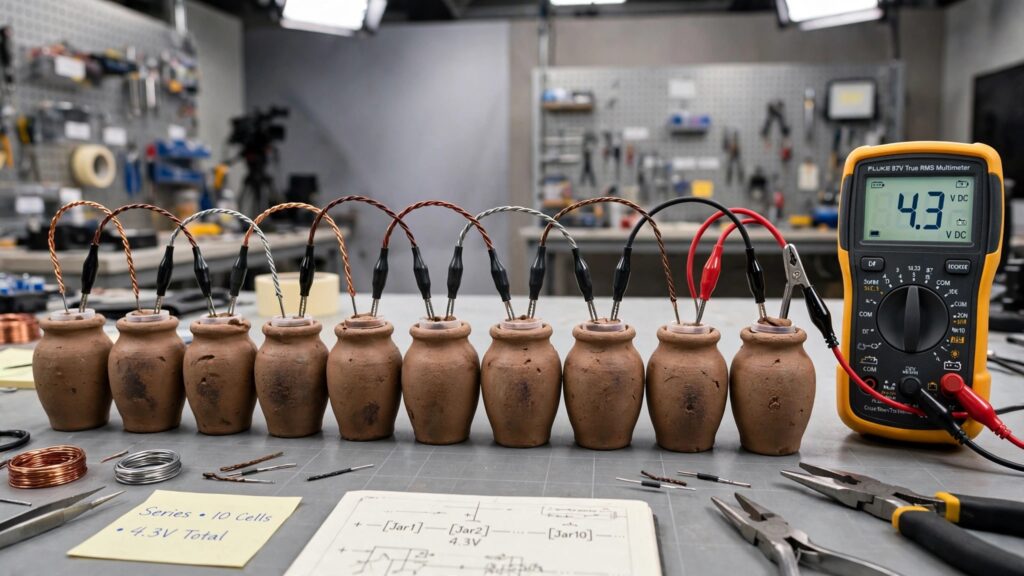
It was an entertaining demonstration, and it settled the most basic question in the hypothesis’s favor: the shape does work as a battery, in the sense that it generates measurable voltage. But 0.4 volts per cell is not an impressive number, and for two decades it quietly reinforced the skeptical case. A device this weak, many archaeologists argued, would have been a strange amount of engineering effort for a return that couldn’t reliably shock a person, let alone plate anything with a usable thickness of metal.
What Every Version Missed for Sixty-Seven Years
This is where the story picks up an entry that most existing accounts of the Baghdad Battery, including the ones still being republished today, don’t yet include. In January 2026, Sino-Platonic Papers, an academic series published through the University of Pennsylvania’s Department of East Asian Languages and Civilizations under editor-in-chief Victor H. Mair, released a paper by independent researcher Alexander Bazes titled “The Baghdad Battery: Experimental Verification of a 2,000-Year-Old Device Capable of Driving Visible and Useful Electrochemical Reactions at over 1.4 Volts.”
Bazes’s argument starts from a detail every prior replication, König’s own description included, treated as incidental: the seam where the rolled copper sheet is soldered shut. That solder, based on the metallurgical composition described in the archaeological record, would have been a lead-tin alloy. Bazes proposed that this solder joint, exposed to moisture and air through the porous ceramic wall of the outer jar, forms its own separate electrochemical cell, a tin-air battery, operating in series with the copper-iron cell inside. Nobody had modeled the object as two batteries stacked together. Everybody, including König, had modeled it as one.
When Bazes built a replica incorporating this second cell and filled it with electrolytes consistent with what would have been available in the ancient Near East, he measured a combined output exceeding 1.4 volts, roughly the output of a single modern AA battery, and more than three times what earlier single-cell replications had produced. The design also solved a separate, longstanding objection: in earlier reconstructions, the copper cylinder’s terminal was sealed inside bitumen, making it awkward or impossible to connect to an external circuit, while the two-cell design Bazes describes puts a usable positive terminal on the outside of the assembly. At that voltage, the reconstructed jar could reliably drive visible electrochemical reactions, including etching, electrolysis, and thin electroplating, applications that a 0.4-volt cell could only gesture at.
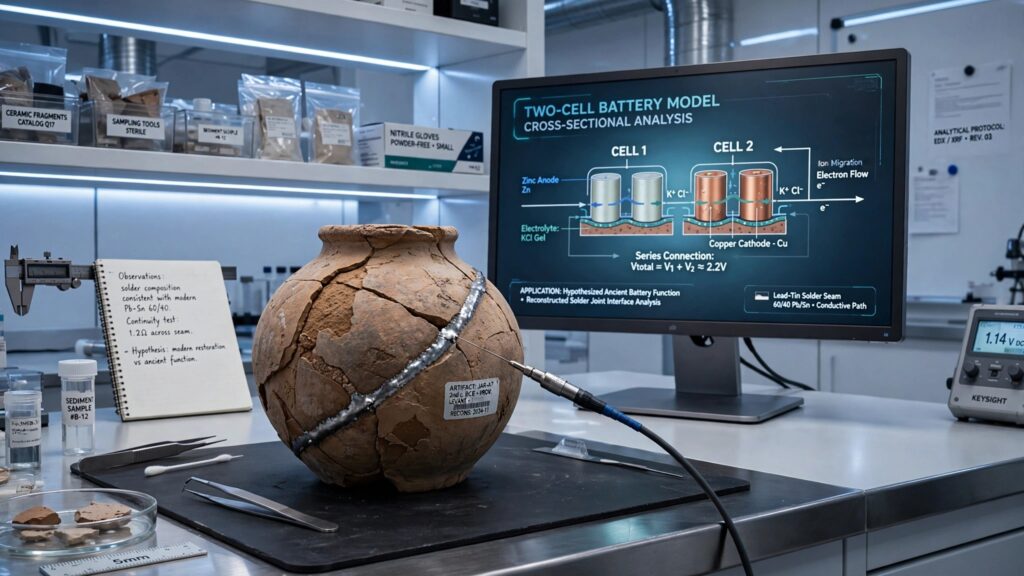
The paper has been covered by Chemistry World, the magazine of the Royal Society of Chemistry, and by Language Log, the linguistics blog run out of the University of Pennsylvania by Mair himself, who edited the original paper. As of the most recent reporting, it has not yet been independently replicated by an outside laboratory, and it has not yet been formally evaluated by archaeologists specializing in Parthian or Sassanid metalwork. Bazes has been careful about the limits of his own claim. Asked by Chemistry World whether the object was definitely a battery, he answered: “if this artefact were truly a battery, and I could be wrong of course, then my experiment shows the most effective and convenient way it could have been used as one.”
A Stronger Battery That Still Isn’t Evidence of Electroplating
Here is the detail that makes the 2026 result more interesting than a simple vindication of König: Bazes’s own reading of what the stronger voltage was probably for does not point toward electroplating. In discussing the result, he has leaned toward the idea that the device’s practical ancient use, if it had one, was more likely something like controlled ritual corrosion or etching than the gold-plating application König originally proposed and that popular retellings have repeated ever since.
That puts the strongest pro-battery voice in this story on the same side as the field’s most established skeptics on one specific point. Paul Craddock, longtime head of the British Museum’s Department of Scientific Research, has said plainly: “The examples we see from this region and era are conventional gold plating and mercury gilding. There’s never been any irrefutable evidence to support the electroplating theory.” David A. Scott, senior scientist at the Getty Conservation Institute, has gone further: “There is absolutely no evidence for electroplating in this region at the time.” No gilded object recovered from the Parthian or Sassanid Near East shows the chemical signature electroplating would leave. Every one tested shows fire gilding or mercury gilding instead, established, well-documented ancient techniques that have nothing to do with a wet-cell battery.
There’s a specific reason König reached for electroplating in the first place, and it’s worth knowing, because it complicates his hypothesis further. Researcher Gerhard Eggert, writing in the Skeptical Inquirer in 1996, pointed out that König had seen local Baghdad jewelers in 1938 using a ceramic-pot gilding technique and had assumed it represented an unbroken tradition stretching back to antiquity. Eggert traced that specific 1938 technique to a patent filed in Birmingham, England, in 1839, less than a century before König watched it performed. The method König cited as evidence of ancient knowledge passed down through millennia was, as far as the documented record shows, itself a nineteenth-century import.
The Scroll Jar Hypothesis
The leading alternative explanation predates Bazes’s paper by decades and has never gone away, because it fits the archaeological context more comfortably than the battery hypothesis does. Comparable sealed jars containing a metal rod inside a metal sleeve have been recovered at Seleucia-on-the-Tigris and near Ctesiphon in contexts archaeologists associate with the storage of sacred or valuable papyrus and parchment scrolls. In this reading, the iron rod served as a spindle the scroll was wound around, the copper cylinder was a protective sleeve keeping insects and moisture away from the fragile material inside, and the bitumen seal, at both the cylinder and the outer jar, was standard practice for protecting something you wanted intact decades or centuries later, not evidence of a liquid electrolyte.

Under this reading, the acidic corrosion König and later researchers observed on the iron rod isn’t residue from a deliberately introduced electrolyte. It’s the decomposition byproduct of organic material, the scroll itself, breaking down over roughly two thousand years inside a sealed container. Elizabeth Stone, an archaeologist at Stony Brook University who has led excavation work in Iraq, put the field’s position bluntly in 2012: “I don’t know anybody who thinks it’s a real battery in the field.” William B. Hafford, an archaeologist and curator at the University of Pennsylvania’s Penn Museum, has made a similar point more recently, noting that the jars lack several features you’d expect from an object deliberately engineered to generate and deliver current, chief among them any obvious, reusable way to connect it to something external.
Where This Actually Leaves Things
Two claims about this object are well established and not in serious dispute. First: the jar, filled with an acidic or alkaline liquid, functions as a working electrochemical cell, and the 2026 Bazes reconstruction shows it can do so at a considerably higher voltage than anyone had previously demonstrated, once the solder joint is correctly modeled as part of the circuit rather than incidental plumbing. Second: no ancient text, no comparable gilded artifact, and no independent line of archaeological evidence currently supports the specific claim that Parthian or Sassanid craftsmen used it, or anything like it, for electroplating.
What remains genuinely open is the question sitting between those two established facts: intent. A copper pipe and an iron nail left standing in lemon juice will also generate a small voltage, and nobody concludes from that fact alone that ancient plumbers were secretly electricians. The Bazes paper raises the ceiling on what the object was physically capable of. It does not, on its own, tell us what the person who sealed that bitumen stopper two thousand years ago believed they were sealing inside.

There’s an additional complication that makes the debate harder to close, not easier: the original artifact König examined is very likely gone. It was held at the National Museum of Iraq in Baghdad until April 2003, when the museum was looted during the fall of the city, an event documented in detail by U.S. Marine Colonel Matthew Bogdanos, who led the subsequent investigation and published his findings in the American Journal of Archaeology in 2005. Bogdanos’s count put the losses at roughly 15,000 items. Around 7,000 to 8,000 have been recovered in the years since through international efforts. König’s jar has not been among them. Its current location, and whether it survived the looting intact at all, is unknown. Any future analysis, whatever technique might eventually settle the electrolyte question definitively, will most likely have to work from the comparable jars recovered at other Mesopotamian sites, not from the specific object that started the debate.
What isn’t in doubt is the shape of the thing, and what that shape is capable of when you fill it correctly. Two dissimilar metals, an insulating seal, room for a liquid, and now, eighty-eight years after König first noticed the geometry, a documented method for coaxing a genuinely useful voltage out of it. Whether that was ever the point, or whether a Sassanid craftsman two thousand years ago sealed a scroll into a jar using the same basic materials science that happens, incidentally, to also make a battery, is a question the physical evidence alone may never fully answer. The chemistry works. What people actually did with it is still, honestly, missing.
That gap is why this file is stamped Unresolved. A quarter of the archive ends at an edge like this one, and the Verdict Index shows which files they are.